




Listening Article
Table of Contents
Hard Water vs Soft Water: Differences, Examples, Uses, Drinking Safety & Treatment Guide
July 8, 2026
AI Summary
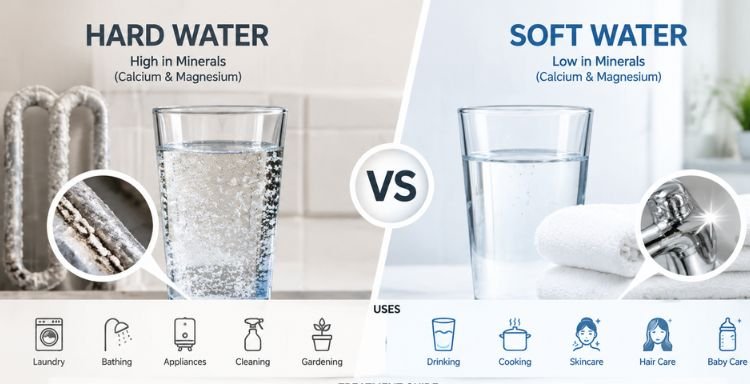
Hard water contains higher concentrations of dissolved minerals, primarily calcium and magnesium, while soft water contains very low levels of these minerals. Both types of water can be suitable for different applications, but their performance varies depending on how the water is used. Hard water often causes scale formation in pipes, boilers, and industrial equipment, whereas soft water improves cleaning efficiency and protects water systems from mineral deposits.
Choosing between hard water and soft water depends on the intended application. Industries generally prefer soft water to improve equipment life and production efficiency, while hard water may still be suitable for drinking if it meets the required water quality standards. Understanding the difference helps homeowners, businesses, and industries select the right water treatment solution.
Introduction
Water plays an essential role in homes, industries, healthcare, food processing, hospitality, manufacturing, and countless daily activities. However, not all water has the same chemical composition. One of the most important characteristics that determines how water behaves is its hardness.
You may have noticed white deposits on taps, reduced soap lather while washing clothes, scaling inside kettles, or frequent maintenance issues in boilers and pipelines. These are often signs of hard water. On the other hand, water that produces rich soap lather and leaves fewer mineral deposits is commonly referred to as soft water.
Understanding the difference between hard water and soft water is important not only for households but also for commercial establishments and industries where water quality directly affects operational efficiency, equipment lifespan, maintenance costs, and product quality.
This comprehensive guide explains what hard water and soft water are, how they differ, where each type is commonly found, whether hard water is safe to drink, how water softening systems work, and how industries select the right water treatment solution based on their specific requirements.
What is hard water and soft water?
The difference between hard water and soft water is primarily determined by the amount of dissolved minerals present in the water.
What Is Hard Water?
Hard water is water that contains relatively high concentrations of dissolved calcium and magnesium minerals. As groundwater passes through rocks such as limestone, chalk, and dolomite, it naturally dissolves these minerals, increasing the hardness of the water.
Hard water occurs naturally in many regions and is commonly supplied through borewells, groundwater sources, and some municipal water systems.
What Is Soft Water?
Soft water contains very low concentrations of calcium and magnesium. It may occur naturally in certain regions or be produced through water softening systems, reverse osmosis plants, or demineralization processes.
Because it contains fewer hardness-causing minerals, soft water performs better in cleaning applications and helps reduce scale formation in water systems.
 Email Us
Why Does Water Become Hard?
Water does not become hard because of pollution or contamination. In most cases, hardness is a natural result of the geological formations through which water travels.
As rainwater seeps into the ground, it passes through layers of soil and mineral-rich rocks. During this journey, the water dissolves naturally occurring minerals, especially calcium and magnesium. These dissolved minerals remain in the water until they are removed through appropriate treatment processes.
The amount of hardness varies depending on:
- Geological formations
- Water source
- Seasonal changes
- Groundwater depth
- Local mineral composition
This explains why two nearby locations may have noticeably different water hardness levels.
Common Sources of Hard Water
Hard water is commonly obtained from:
- Borewell water
- Groundwater
- Deep wells
- Limestone regions
- Underground aquifers
- Some municipal water supplies
Groundwater generally contains higher hardness than surface water because it remains in contact with mineral-rich rocks for longer periods.
Permanent Hard Water
Permanent hardness is caused by dissolved sulphates, chlorides, and nitrates of calcium and magnesium.
Unlike temporary hardness, it cannot be removed simply by boiling.
Treatment usually requires technologies such as:
- Water softeners
- Reverse osmosis
- Demineralization
- Ion exchange systems
Characteristics of Permanent Hardness
- Caused by sulphates and chlorides
- Cannot be removed by boiling
- Requires water treatment
- More challenging for industrial applications
Why Does Water Hardness Matter?
Water hardness affects much more than household cleaning.
For industries, excessive hardness may result in:
- Scale formation inside pipelines
- Reduced heat transfer efficiency
- Boiler scaling
- Cooling tower deposits
- Increased energy consumption
- Reduced membrane life in RO systems
- Higher maintenance costs
- Increased chemical consumption
For households, hard water may lead to:
- Soap scum
- White deposits on taps
- Stiff laundry
- Reduced appliance efficiency
- Scale inside water heaters and kettles
Understanding water hardness helps users select appropriate treatment methods based on the intended application.
Quick Facts About Hard Water and Soft Water
| Parameter | Hard Water | Soft Water |
| Calcium Content | High | Low |
| Magnesium Content | High | Low |
| Soap Lather | Less | More |
| Scale Formation | High | Very Low |
| Pipe Deposits | Common | Minimal |
| Industrial Suitability | Depends on application | Preferred for many processes |
Key Takeaways
✔ Hard water contains higher concentrations of calcium and magnesium.
✔ Soft water contains very low levels of hardness-causing minerals.
✔ Water hardness is a natural characteristic influenced by geology and water source.
✔ Temporary and permanent hardness require different treatment approaches.
✔ Understanding hardness is essential before selecting any water treatment solution.
Hard Water vs Soft Water Comparison
The table below provides a comprehensive comparison between hard water and soft water.
| Parameter | Hard Water | Soft Water |
| Mineral Content | High calcium and magnesium | Very low calcium and magnesium |
| Water Hardness | High | Low |
| Soap Performance | Produces less lather | Produces rich lather |
| Detergent Requirement | Higher | Lower |
| Scale Formation | High | Minimal |
| Appliance Life | May reduce lifespan due to scaling | Helps improve equipment life |
| Boiler Performance | Scale formation reduces efficiency | Better heat transfer efficiency |
| Laundry | Clothes may feel stiff | Clothes remain softer |
| Pipe Deposits | Common | Minimal |
| Maintenance Requirement | Higher | Lower |
| Industrial Suitability | Depends on application | Preferred for many industrial processes |
| Drinking | Generally safe when within acceptable limits | Also suitable for drinking |
Although soft water offers several operational advantages, it is not automatically better for every application. The right choice depends on the intended use of the water.
OUR OTHER PRODUCT
Hard Water and Soft Water Difference Explained
Many users search using phrases such as hard water soft water difference, soft and hard water difference, or hard water versus soft water. Regardless of the wording, the underlying concept remains the same.
The most significant difference is that hard water contains dissolved calcium and magnesium ions, while soft water has these minerals removed or significantly reduced.
This simple difference influences several practical aspects:
Cleaning Performance
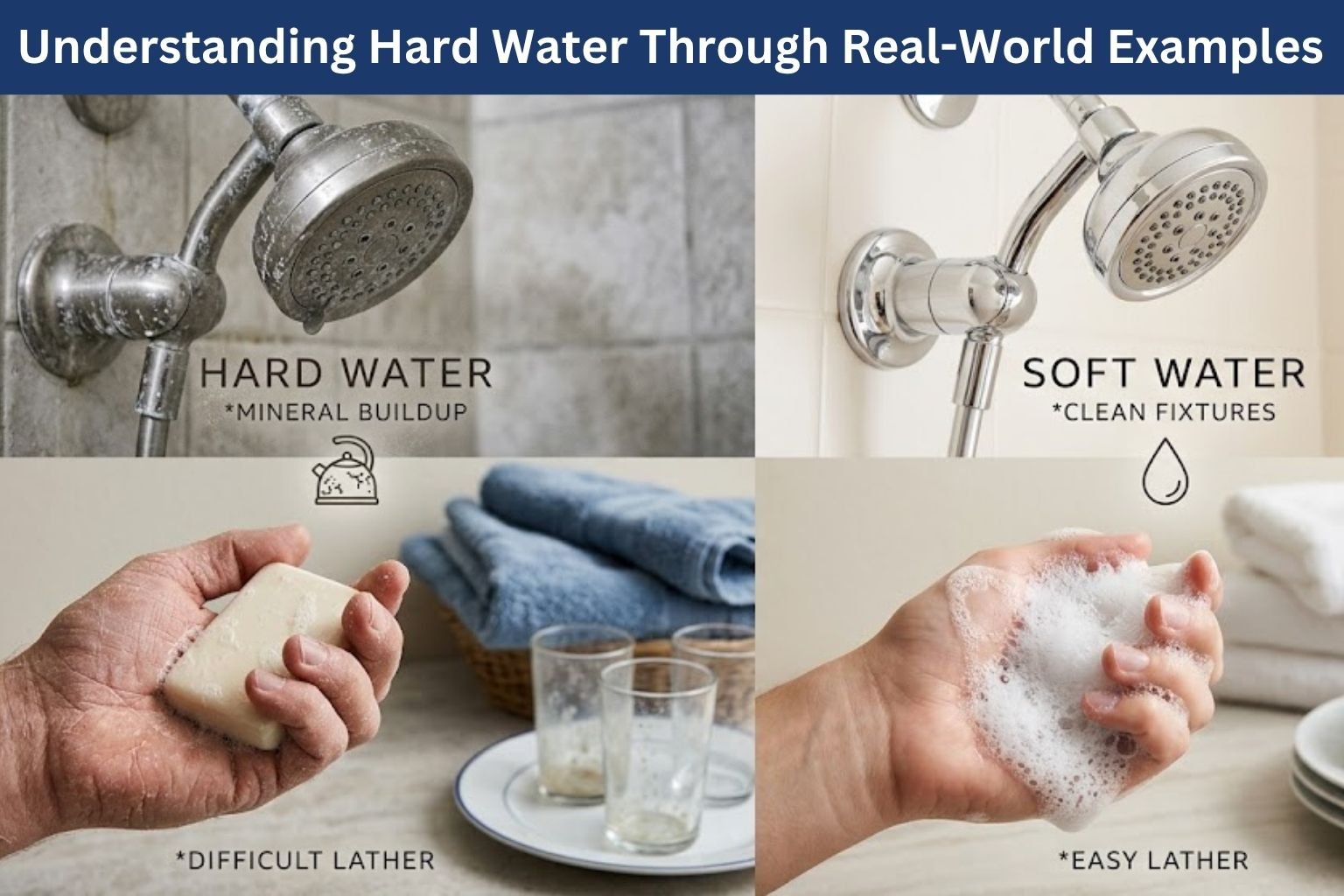
Soap reacts with calcium and magnesium in hard water, forming insoluble deposits commonly known as soap scum. As a result, more soap or detergent is required to achieve effective cleaning.
Soft water allows soap to dissolve more efficiently, producing better lather and improved cleaning performance.
Scale Formation
Hard water gradually forms mineral deposits inside:
- Water heaters
- Boilers
- Heat exchangers
- Pipelines
- Cooling towers
- Coffee machines
- Industrial equipment
These deposits reduce efficiency and increase maintenance requirements.
Soft water significantly reduces this problem.
Client Review
“We installed a Water Softening Plant from DTPPL, and the results have exceeded our expectations. The system consistently delivers soft water, operates efficiently, and requires minimal maintenance. The installation process was smooth, and their technical team provided excellent guidance and after-sales support. DTPPL is a trusted manufacturer for high-quality water treatment solutions, and we would confidently recommend them to businesses worldwide.”
– Nicola Moosa
Energy Efficiency
Scale acts as an insulating layer on heating surfaces.
Even a thin layer of scale can reduce heat transfer efficiency, forcing equipment to consume more energy.
Using softened water helps maintain efficient heat transfer and lowers operating costs.
Equipment Reliability
Industrial systems operating with untreated hard water often experience:
- Frequent maintenance
- Reduced membrane life
- Pump wear
- Blocked pipelines
- Increased downtime
Soft water improves equipment reliability by minimizing mineral deposits.
Hard Water vs Soft Water Examples
Understanding real-world examples makes the concept much easier.
Examples of Hard Water
Hard water is commonly found in:
- Borewell water
- Groundwater from limestone regions
- Deep well water
- Certain municipal water supplies
- Underground aquifers
These water sources usually contain higher levels of calcium and magnesium.
Examples of Soft Water
Common examples of soft water include:
- Rainwater
- Reverse osmosis treated water
- Water treated through ion exchange softeners
- Distilled water
- Demineralized water
- Naturally soft surface water in some regions
These examples illustrate why soft water behaves differently during washing and industrial use.
OUR OTHER PRODUCT
Hard Water or Soft Water: Which Is Better?
There is no single answer because the best type of water depends entirely on its intended application.
The table below provides a practical comparison.
| Application | Recommended Water Type | Reason |
| Drinking | Either, if water meets quality standards | Both can be suitable |
| Household Cleaning | Soft Water | Better soap performance |
| Laundry | Soft Water | Softer clothes and lower detergent use |
| Water Heaters | Soft Water | Reduces scale formation |
| Boilers | Soft Water | Prevents scaling and improves efficiency |
| Cooling Towers | Soft Water | Reduces maintenance |
| Textile Industry | Soft Water | Improves process consistency |
| Pharmaceutical Industry | Soft Water | Required for controlled production |
| Food and Beverage Industry | Soft Water or Process-specific Treated Water | Maintains product quality |
| Hotels and Hospitals | Soft Water | Protects plumbing and equipment |
This comparison demonstrates that soft water is generally preferred for commercial and industrial operations, while hard water may still be suitable for drinking after meeting applicable quality standards.
Is Hard Water Safe to Drink?
In many cases, yes.
Hard water naturally contains calcium and magnesium, which are essential minerals for the human body. When hardness levels fall within recommended drinking water standards, hard water is generally considered safe for consumption.
However, extremely hard water may:
- Affect taste
- Cause scale buildup in household appliances
- Reduce soap efficiency
- Increase maintenance requirements
If the water also contains excessive levels of iron, fluoride, arsenic, nitrate, or microbial contamination, additional treatment may be necessary regardless of hardness.
For this reason, drinking water decisions should always be based on a comprehensive laboratory water analysis rather than hardness alone.
Hard Water for Drinking
Many people believe that hard water should never be consumed, but this is a common misconception.
Hardness itself does not necessarily make water unsafe.
Before deciding whether water is suitable for drinking, consider:
- Water hardness
- Total Dissolved Solids (TDS)
- pH
- Microbiological quality
- Heavy metals
- Fluoride
- Nitrate
- Iron
- Other dissolved contaminants
A complete water quality assessment provides a far more accurate picture than hardness alone.
Water Hardness Classification
Water hardness is commonly classified according to the concentration of calcium carbonate (CaCO₃).
| Water Type | Hardness (mg/L as CaCO₃) |
| Soft Water | 0 to 60 |
| Moderately Hard Water | 61 to 120 |
| Hard Water | 121 to 180 |
| Very Hard Water | Above 180 |
This classification helps homeowners and industries determine whether water softening or additional treatment may be beneficial.
Does Hard Water Always Need Treatment?
Not necessarily.
Whether treatment is required depends on:
- Intended application
- Hardness level
- Type of industry
- Equipment sensitivity
- Operational requirements
- Overall water quality
For example:
- A household may continue using moderately hard water without major issues.
- A steam boiler operating with the same water may experience severe scale formation and reduced efficiency.
- A pharmaceutical plant would require much higher water quality standards than a residential property.
This is why water treatment decisions should be based on technical requirements rather than hardness alone.
Key Takeaways
✔ The primary difference between hard water and soft water is the concentration of calcium and magnesium minerals.
✔ Hard water can cause scaling, while soft water helps protect plumbing and industrial equipment.
✔ Both hard water and soft water can be suitable for drinking if they meet applicable water quality standards.
✔ Soft water is generally preferred for industrial processes, commercial facilities, and applications where equipment efficiency is important.
✔ Water hardness should always be evaluated together with other quality parameters before selecting a treatment solution.
Signs You Have Hard Water: How to Identify Water Hardness in Your Home or Industry
Many people use hard water every day without realizing it. Unlike muddy or contaminated water, hard water is usually clear, colourless, and odourless. The only noticeable difference is how it behaves during everyday use.
Whether you are a homeowner, facility manager, or industrial operator, recognizing the early signs of hard water can help you prevent equipment damage, reduce maintenance costs, and choose the right water treatment solution.
Common Signs of Hard Water
White or Chalky Deposits on Taps and Fixtures
One of the most visible signs of hard water is the formation of white mineral deposits around taps, showerheads, wash basins, and kitchen sinks.
These deposits, commonly known as limescale, are formed when calcium and magnesium remain behind after water evaporates.
Soap Does Not Produce Enough Lather
If you notice that soap or shampoo takes longer to form foam, hard water may be the reason.
The dissolved calcium and magnesium react with soap before it can create lather, resulting in:
- Higher soap consumption
- Poor cleaning efficiency
- Soap residue on surfaces
 WhatsApp
 White Scale Inside Kettles and Water Heaters
Heating hard water accelerates mineral deposition.
If you frequently observe white deposits inside:
- Electric kettles
- Geysers
- Water heaters
- Coffee machines
your water likely contains significant hardness.
Dry Skin and Dull Hair
Although hard water is generally safe to use, the mineral content may leave soap residue on the skin and hair.
Some users experience:
- Dry skin
- Rough hair texture
- Difficulty rinsing shampoo completely
The severity depends on water hardness and individual sensitivity.
Stiff Laundry After Washing
Hard water can reduce detergent performance and leave mineral residues on fabrics.
As a result:
- Clothes may feel stiff.
- Colours may appear dull over time.
- More detergent is often required.
Frequent Plumbing Maintenance
Scale gradually accumulates inside pipelines, reducing internal diameter and restricting water flow.
Signs include:
- Reduced water pressure
- Blocked showerheads
- Slow-flowing taps
- Increased plumbing maintenance
Higher Energy Consumption
Mineral deposits act as an insulating layer on heating surfaces.
Even a thin layer of scale forces heating equipment to consume more energy to achieve the same temperature.
Industrial Equipment Requires Frequent Cleaning
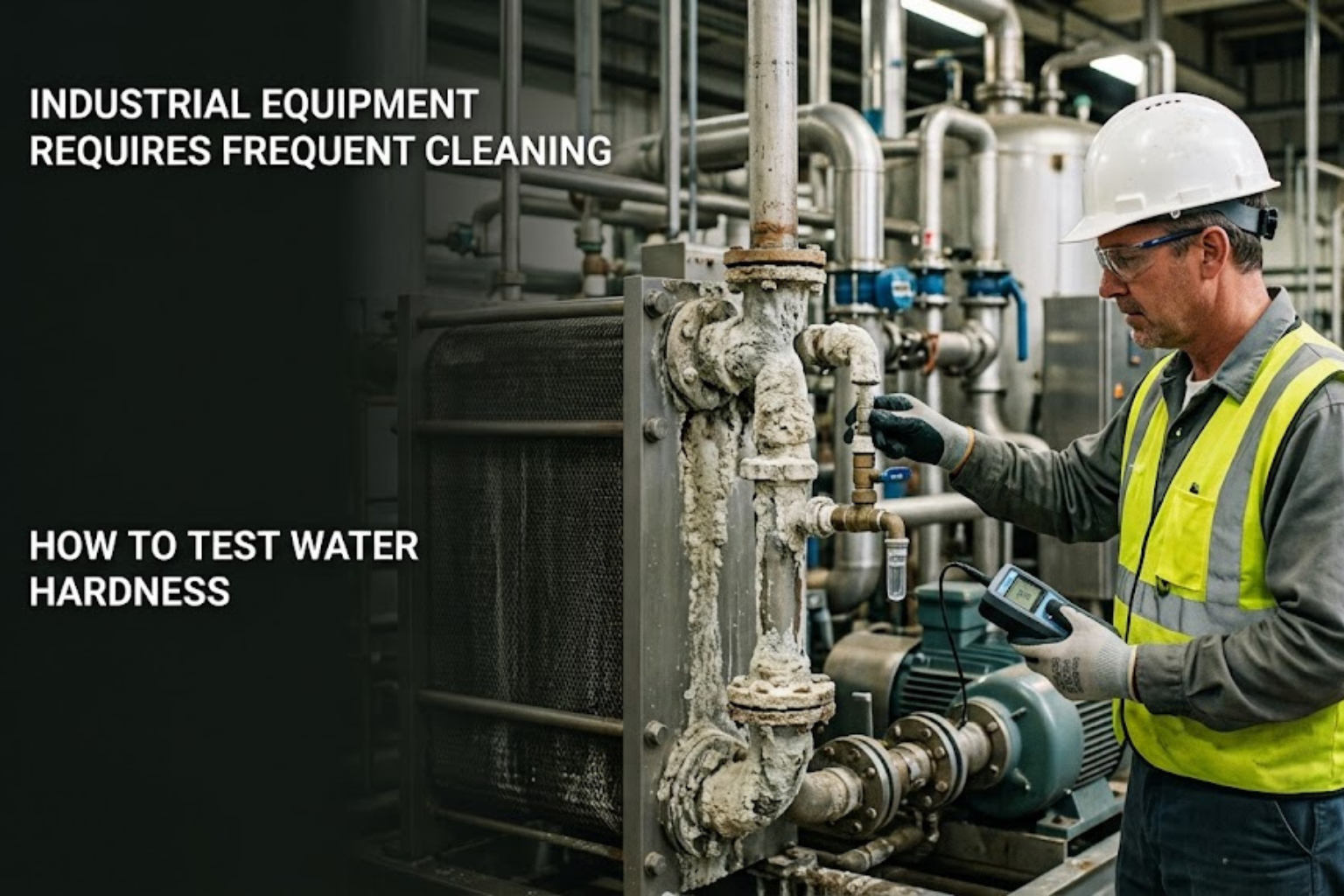
In industrial facilities, untreated hard water often causes:
- Boiler scaling
- Heat exchanger fouling
- Cooling tower deposits
- Reduced RO membrane performance
- Increased maintenance shutdowns
These issues directly affect production efficiency and operating costs.
How to Test Water Hardness
Before investing in any water treatment system, it is important to determine the actual hardness of the water. Testing provides accurate information that helps in selecting the most suitable treatment technology.
Method 1: Soap Lather Test
A simple home test involves adding a small amount of liquid soap to a bottle filled with water and shaking it.
Observation
Rich foam with clear water
The water is likely soft.
Limited foam with cloudy appearance
The water may contain higher levels of hardness.
Although this method provides only a basic indication, it is useful for preliminary assessment.
Method 2: Water Hardness Test Strips
Test strips are widely available and offer a quick way to estimate hardness.
Simply:
- Dip the strip into the water.
- Wait for the recommended time.
- Compare the colour with the provided chart.
These strips are suitable for routine household monitoring.
Method 3: Laboratory Water Analysis
For commercial and industrial applications, laboratory testing is the most reliable option.
A professional water analysis typically measures:
- Total Hardness
- Calcium Hardness
- Magnesium Hardness
- Total Dissolved Solids
- pH
- Iron
- Chloride
- Sulphate
- Fluoride
- Nitrate
- Microbiological parameters
A complete analysis allows engineers to design an efficient and cost-effective treatment system.
TDS vs Hardness: Understanding the Difference
Many people assume that Total Dissolved Solids (TDS) and hardness are the same. In reality, they measure different characteristics of water.
Understanding this distinction is essential when selecting a water purification or water softening system.
What Is TDS?
TDS refers to the total concentration of dissolved substances in water.
These substances may include:
- Calcium
- Magnesium
- Sodium
- Potassium
- Chlorides
- Sulphates
- Bicarbonates
- Silica
- Other dissolved minerals
TDS represents the overall mineral content of the water.
What Is Water Hardness?
Water hardness specifically refers to the concentration of calcium and magnesium ions.
Hardness is therefore only one component of Total Dissolved Solids.
TDS vs Hardness Comparison
| Parameter | TDS | Water Hardness |
| Measures | Total dissolved substances | Calcium and magnesium concentration |
| Unit | mg/L | mg/L as CaCO₃ |
| Includes Sodium | Yes | No |
| Includes Chlorides | Yes | No |
| Indicates Scaling Potential | Partially | Directly |
| Determines Soap Performance | No | Yes |
| Used for RO Design | Yes | Yes |
A water sample can have:
- High TDS with low hardness.
- Low TDS with high hardness.
- High values for both.
- Low values for both.
Therefore, treatment decisions should always be based on a complete water analysis rather than a single parameter.
Does Boiling Remove Hard Water?
One of the most common misconceptions is that boiling completely removes water hardness.
The answer depends on the type of hardness.
Temporary Hardness
Boiling can reduce temporary hardness because heating converts bicarbonates of calcium and magnesium into insoluble compounds that settle at the bottom of the container.
Permanent Hardness
Permanent hardness is caused by dissolved sulphates and chlorides.
Boiling does not remove these minerals.
In such cases, technologies such as water softeners, reverse osmosis, or ion exchange systems are required.
How to Remove Hardness from Water
There are several methods available for reducing water hardness. The most suitable option depends on water quality, daily consumption, and the intended application.
| Method | Temporary Hardness | Permanent Hardness | Typical Applications |
| Boiling | ✔ | ✖ | Household use |
| Lime Softening | ✔ | Partial | Municipal treatment |
| Ion Exchange Softener | ✔ | ✔ | Homes and industries |
| Reverse Osmosis | ✔ | ✔ | Drinking water and industrial processes |
| Nanofiltration | Partial | ✔ | Specialized applications |
| Demineralization | ✔ | ✔ | High purity industrial water |
Each method offers unique advantages, and in many industrial installations, multiple technologies are combined to achieve the desired water quality.
Water Softener vs Reverse Osmosis
Many buyers believe that a water softener and a reverse osmosis system perform the same function. They do not.
Although both improve water quality, they address different treatment objectives.
| Feature | Water Softener | Reverse Osmosis |
| Primary Purpose | Removes hardness | Removes dissolved contaminants |
| Removes Calcium and Magnesium | ✔ | ✔ |
| Reduces TDS | ✖ | ✔ |
| Prevents Scale | ✔ | ✔ |
| Improves Drinking Water Quality | Limited | Yes |
| Suitable for Boilers | Excellent | Usually used after pretreatment |
| Suitable for Drinking Water Plants | Used as pretreatment | Main purification technology |
In many commercial and industrial facilities, a water softener is installed before the reverse osmosis system to protect RO membranes from scaling and extend their operational life.
Decision Guide: Which Water Treatment Solution Do You Need?
Selecting the right treatment depends on both water quality and application.
This simplified approach helps users understand that no single technology is suitable for every situation.
Key Takeaways
✔ Hard water often reveals itself through scale formation, reduced soap performance, appliance deposits, and increased maintenance.
✔ Laboratory water analysis is the most reliable method for evaluating hardness and selecting the right treatment system.
✔ Water hardness and Total Dissolved Solids are different parameters and should not be confused.
✔ Boiling can reduce temporary hardness but is ineffective against permanent hardness.
✔ Water softeners and reverse osmosis systems serve different purposes and are often used together in commercial and industrial water treatment.
Industry Wise Challenges of Hard Water and the Right Treatment Solutions
While hard water may cause minor inconveniences in homes, its impact on commercial and industrial operations can be far more significant. Mineral deposits, scaling, and reduced equipment efficiency can increase operating costs, affect production quality, and shorten the lifespan of valuable assets.
Different industries have different water quality requirements, making it essential to choose the right treatment solution for each application.
Hotels and Hospitality
Hotels consume large volumes of water for guest rooms, kitchens, laundries, spas, and HVAC systems.
Common Challenges
- Scale formation in water heaters and boilers
- Reduced efficiency of hot water systems
- White deposits on bathroom fittings
- Increased detergent consumption in laundry operations
Recommended Solution
- Water Softener
- Reverse Osmosis for drinking water applications
Hospitals and Healthcare Facilities
Hospitals require high-quality water for patient care, sterilization, laboratories, and medical equipment.
Common Challenges
- Scaling in sterilization equipment
- Reduced efficiency of hot water systems
- Mineral deposits in plumbing
Recommended Solution
- Water Softener
- Reverse Osmosis
- UV or other suitable disinfection systems, depending on the application
Food and Beverage Industry
Water directly influences product quality, taste, hygiene, and production consistency.
Common Challenges
- Mineral deposits in processing equipment
- Reduced cleaning efficiency
- Product quality variations
Recommended Solution
Customized water treatment based on raw water quality, often combining water softening and reverse osmosis.
 Call Now
Pharmaceutical Industry
Pharmaceutical manufacturing requires water that meets strict quality standards.
Common Challenges
- Scaling in process equipment
- Inconsistent process water quality
- Reduced equipment efficiency
Recommended Solution
Engineered purification systems incorporating appropriate pretreatment, reverse osmosis, and high-purity polishing technologies based on process requirements.
Textile Industry
Textile manufacturing depends on consistent water quality for dyeing, washing, and finishing operations.
Common Challenges
- Uneven dye absorption
- Increased chemical consumption
- Fabric quality inconsistencies
Recommended Solution
Water softening and appropriate purification technologies selected according to process water specifications.
Boilers and Steam Generation
Boilers are among the systems most affected by hard water.
Common Challenges
- Scale formation
- Poor heat transfer
- Higher fuel consumption
- Frequent maintenance
- Tube failures
Recommended Solution
Proper feed water treatment using water softening, reverse osmosis, or demineralization depending on boiler operating pressure and water quality.
Cooling Towers
Cooling towers continuously circulate water, making them highly susceptible to scale formation.
Common Challenges
- Reduced heat exchange efficiency
- Increased chemical consumption
- Fouling
- Higher maintenance costs
Recommended Solution
A combination of water softening, chemical treatment, and appropriate water quality monitoring.
Commercial Buildings and Offices
Commercial facilities require reliable water quality for drinking, restrooms, cafeterias, and HVAC systems.
Common Challenges
- Plumbing scale
- Appliance maintenance
- Reduced water heater efficiency
Recommended Solution
Water softeners for utility water and reverse osmosis systems for drinking water where required.
Choosing the Right Water Treatment Solution
Selecting a treatment system should never be based solely on hardness or price.
The right solution depends on several factors:
- Source water quality
- Total hardness
- TDS
- Daily water consumption
- Intended application
- Industry standards
- Available installation space
- Future expansion plans
- Operating and maintenance costs
A detailed water analysis provides the foundation for selecting the most suitable treatment process.
Common Myths About Hard Water and Soft Water
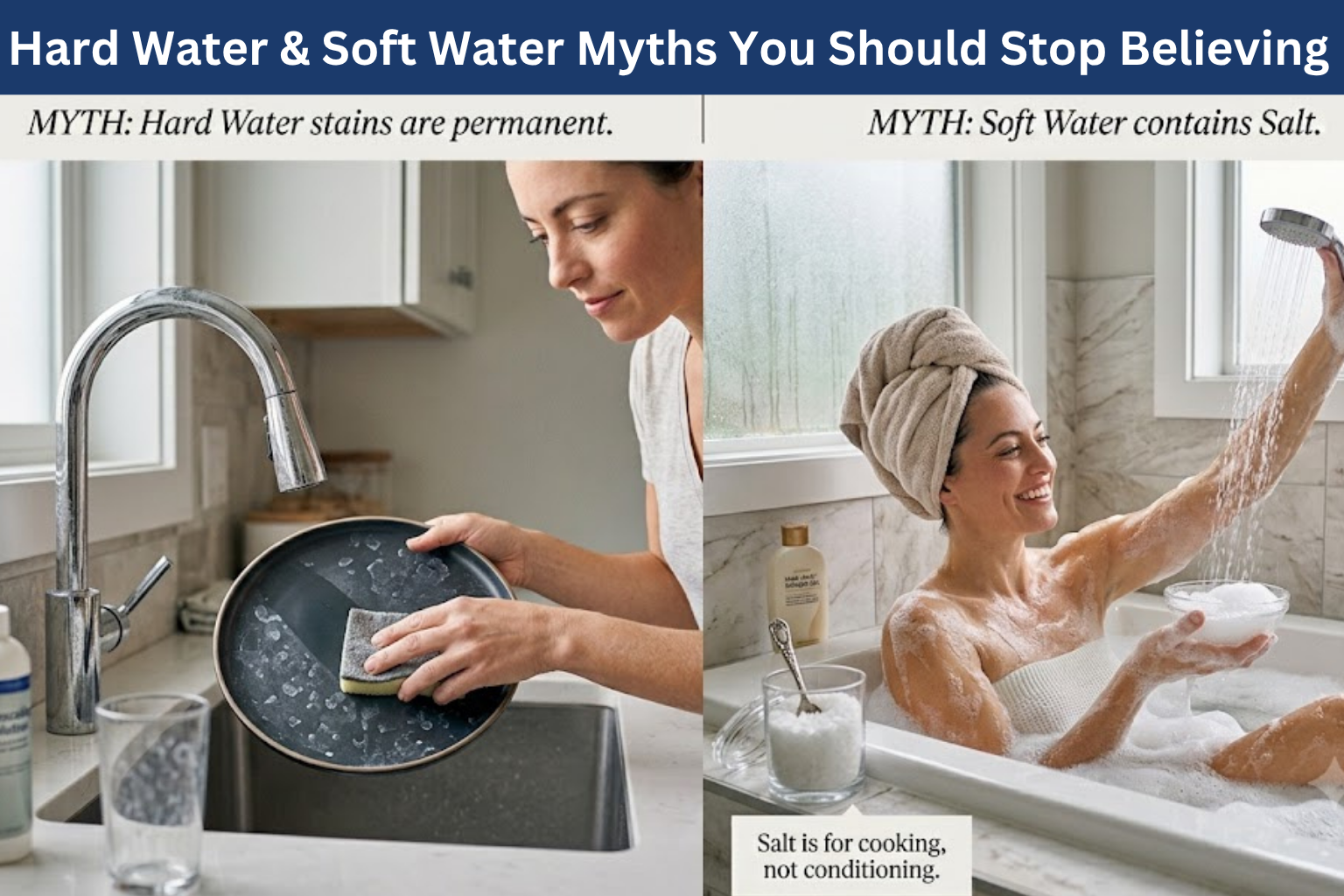
Several misconceptions often lead to incorrect treatment decisions. Understanding the facts helps users make informed choices.
Myth 1: Hard Water Is Unsafe to Drink
Fact: Hard water is generally safe to drink when it meets applicable drinking water quality standards. Hardness alone does not determine whether water is safe for consumption.
Myth 2: Soft Water Is Always Better
Fact: Soft water is beneficial for many domestic and industrial applications, but the ideal water quality depends on how the water will be used.
Myth 3: Boiling Removes All Hardness
Fact: Boiling can reduce temporary hardness but does not remove permanent hardness caused by sulphates and chlorides.
Myth 4: High TDS Means High Hardness
Fact: TDS and hardness are different parameters. Water may have high TDS with relatively low hardness or vice versa.
Myth 5: Reverse Osmosis and Water Softeners Do the Same Job
Fact: A water softener removes hardness-causing calcium and magnesium, whereas reverse osmosis removes a much wider range of dissolved impurities.
Why Industries Prefer Soft Water
Many industrial processes depend on water with controlled hardness to improve efficiency and product quality.
Soft water offers several operational advantages:
- Reduces scale formation
- Improves heat transfer efficiency
- Protects pipelines and equipment
- Extends the life of boilers and heat exchangers
- Improves detergent performance
- Reduces maintenance downtime
- Lowers operating costs
- Supports consistent manufacturing processes
Although soft water is preferred in many industries, the required water quality should always be determined by process requirements rather than assumptions.
How DTPPL Helps Businesses Manage Water Quality
At Dharmanandan Technologies Pvt. Ltd. (DTPPL), every project begins with understanding the customer’s water source, production process, and quality objectives.
Instead of recommending a standard solution, DTPPL follows an engineering-based approach:
- Analyse the source water.
- Identify hardness and other critical water quality parameters.
- Understand the intended application.
- Select suitable treatment technologies.
- Design a customized water treatment process.
- Support installation, commissioning, and long-term performance.
This approach enables businesses to improve operational efficiency while reducing maintenance costs and protecting valuable equipment.
Conclusion
Understanding the difference between hard water and soft water is essential for making informed decisions about water treatment in homes, commercial facilities, and industries.
Hard water and soft water each have distinct characteristics. While hard water naturally contains higher levels of calcium and magnesium, soft water has lower concentrations of these minerals, making it suitable for applications where scaling and equipment protection are important.
Rather than asking whether hard water or soft water is better, the more practical question is which type of water is most suitable for your intended application.
A proper water quality analysis, combined with the right treatment technology, helps ensure reliable performance, lower operating costs, and long-term system efficiency.
Whether you are managing a residential property, hotel, manufacturing facility, or large industrial operation, selecting the right water treatment solution begins with understanding your water—not making assumptions about it.
Water Softening Plant (Water Softener)
Capacity: 500 LPH to 10,000 LPH
(USD 4,200 to USD 49,500)
Frequently Asked Questions About Hard Water & Soft Water
What is the difference between hard water and soft water?
Hard water contains higher concentrations of calcium and magnesium, whereas soft water contains lower levels of these minerals. This difference affects scaling, soap performance, equipment efficiency, and maintenance requirements.
What is hard water?
Hard water is water that naturally contains elevated levels of dissolved calcium and magnesium minerals.
What is soft water?
Soft water contains very low concentrations of calcium and magnesium, either naturally or after treatment through technologies such as ion exchange or reverse osmosis.
Is hard water safe to drink?
In most cases, yes. Hard water is generally safe when it complies with applicable drinking water quality standards. However, overall water quality should always be evaluated through laboratory testing.
Which is better for drinking: hard water or soft water?
Both can be suitable for drinking if they meet quality standards. The choice depends on the complete water quality profile rather than hardness alone.
What causes hard water?
Hard water forms when groundwater dissolves calcium and magnesium from rocks such as limestone, chalk, and dolomite.
Can boiling remove hard water?
Boiling can reduce temporary hardness but does not remove permanent hardness.
What is the best method for removing water hardness?
The most suitable method depends on the application. Common solutions include water softeners, reverse osmosis systems, and demineralization technologies.
Is TDS the same as hardness?
No. TDS measures all dissolved solids, while hardness specifically measures calcium and magnesium.
How can I identify hard water at home?
Common signs include white deposits on taps, poor soap lather, scale inside kettles, stiff laundry, and blocked showerheads.
Why do industries use soft water?
Industries use soft water to reduce scaling, improve equipment efficiency, lower maintenance costs, and maintain consistent production quality.
Does reverse osmosis remove hardness?
Yes. Reverse osmosis removes hardness along with many other dissolved impurities, although water softeners are often used before RO systems to protect the membranes.
Can hard water damage household appliances?
Over time, hard water can lead to scale buildup inside appliances such as water heaters, washing machines, dishwashers, and coffee machines, reducing their efficiency and lifespan.
How often should water hardness be tested?
It is advisable to test water whenever there is a change in the water source, before installing a treatment system, or periodically as part of routine water quality monitoring.
Does every home or business need a water softener?
Not necessarily. The need for a water softener depends on water hardness levels, the intended use of the water, and the sensitivity of plumbing systems and equipment.
Our associates





































Director – Global Marketing and Sales
Mr. Bhavesh from Dharmanandan Techno Projects Pvt. Ltd. has played a pivotal role in elevating the DTPPL brand to the global stage, leveraging his exceptional expertise in marketing and communications. He is committed to helping clients achieve significant growth while strengthening their own brands. Dharmanandan Techno Projects Pvt. Ltd. is a leading manufacturer and supplier of water purification systems and turnkey solutions for mineral water plants. With years of experience in designing and delivering high-quality water treatment solutions, the company provides end-to-end services, including system design, installation, maintenance, and ongoing support. Specializing in scalable and customizable water plants, DTPPL has successfully served industries worldwide, ensuring clean and safe drinking water across diverse applications.