




Listening Article
Table of Contents
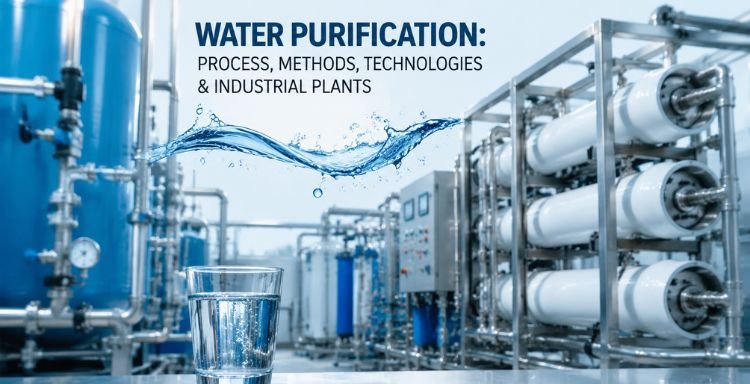
Water Purification: Process, Methods, Technologies & Industrial Plants
July 6, 2026
AI Summary
Water purification is the process of removing physical, chemical, and biological contaminants from water to make it suitable for drinking, industrial applications, food processing, pharmaceuticals, manufacturing, and commercial use. Modern water purification combines technologies such as filtration, activated carbon, reverse osmosis, ultraviolet disinfection, ozone treatment, and remineralization to produce high quality water.
The right purification method depends on the source water, contaminant levels, daily water demand, and end application. While small systems are suitable for homes and commercial establishments, industries and municipalities require large scale water purification plants designed for continuous operation. Selecting the appropriate water purification technology improves water quality, protects equipment, reduces maintenance costs, and ensures long term operational efficiency.
Introduction
Clean water is one of the most valuable resources for human health, industrial production, agriculture, food processing, healthcare, pharmaceuticals, hospitality, and countless other applications. However, water obtained from rivers, lakes, borewells, reservoirs, or municipal supplies often contains suspended particles, dissolved salts, microorganisms, organic matter, heavy metals, and other impurities that make treatment necessary before use.
This is where water purification plays an essential role.
From a simple household filter to a fully automated industrial water purification plant capable of producing thousands of litres every hour, purification systems help convert raw water into water that is suitable for its intended application.
Today, industries are increasingly adopting advanced water purification technologies to improve product quality, reduce operational costs, comply with environmental regulations, and enhance production efficiency. Whether the requirement is a compact commercial unit or a water purification system for bulk supply, selecting the right purification process is the first step toward reliable and sustainable water management.
This comprehensive guide explains everything you need to know about water purification, including its importance, purification methods, treatment technologies, industrial applications, plant selection, and factors affecting the cost of a water purification plant.
 Drop Us an Email!
What Is Water Purification?
One of the most common questions people ask is:
What is water purification?
Water purification is the process of removing unwanted impurities, contaminants, microorganisms, dissolved minerals, chemicals, suspended solids, and harmful substances from water so that it becomes suitable for a specific purpose.
Depending on the application, purified water may be used for:
- Drinking water
- Packaged drinking water manufacturing
- Mineral water production
- Pharmaceutical manufacturing
- Food and beverage processing
- Hotels and hospitals
- Chemical industries
- Textile processing
- Boiler feed water
- Cooling towers
- Commercial establishments
- Agricultural applications
Rather than relying on a single treatment method, modern purification systems often combine several technologies to achieve the desired water quality.
The purification objective differs depending on the application.
For example:
| Application | Purification Objective |
| Drinking Water | Safe consumption |
| Industrial Use | Protect machinery and maintain process quality |
| Pharmaceutical Manufacturing | Ultra high purity water |
| Food Processing | Hygienic production |
| Mineral Water Plants | Controlled mineral composition |
| Commercial Buildings | Reliable water supply |
This is why there is no single purification method suitable for every situation.
Why Is Water Purification Important?
Water quality directly influences health, productivity, equipment life, manufacturing efficiency, and operating costs.
Effective water purification provides benefits far beyond producing clean water.
Improves Water Quality
Purification removes suspended particles, unpleasant odours, colour, microorganisms, dissolved contaminants, and unwanted minerals.
Protects Industrial Equipment
Industries depend on high quality water to reduce scaling, corrosion, membrane fouling, and equipment damage.
Proper purification extends the lifespan of:
- Reverse osmosis membranes
- Pumps
- Boilers
- Heat exchangers
- Cooling towers
- Pipelines
Supports Manufacturing Processes
Many industries require water with specific quality parameters to maintain product consistency.
Examples include:
- Pharmaceutical manufacturing
- Food processing
- Dairy
- Beverage production
- Cosmetics
- Electronics
Reduces Maintenance Costs
Removing impurities before water enters industrial systems helps minimise:
- Scale formation
- Membrane replacement
- Chemical consumption
- Downtime
- Equipment repairs
Promotes Sustainable Water Management
Modern purification systems enable industries to:
- Reduce water wastage
- Recycle treated water
- Improve process efficiency
- Lower environmental impact
- Optimise resource utilisation
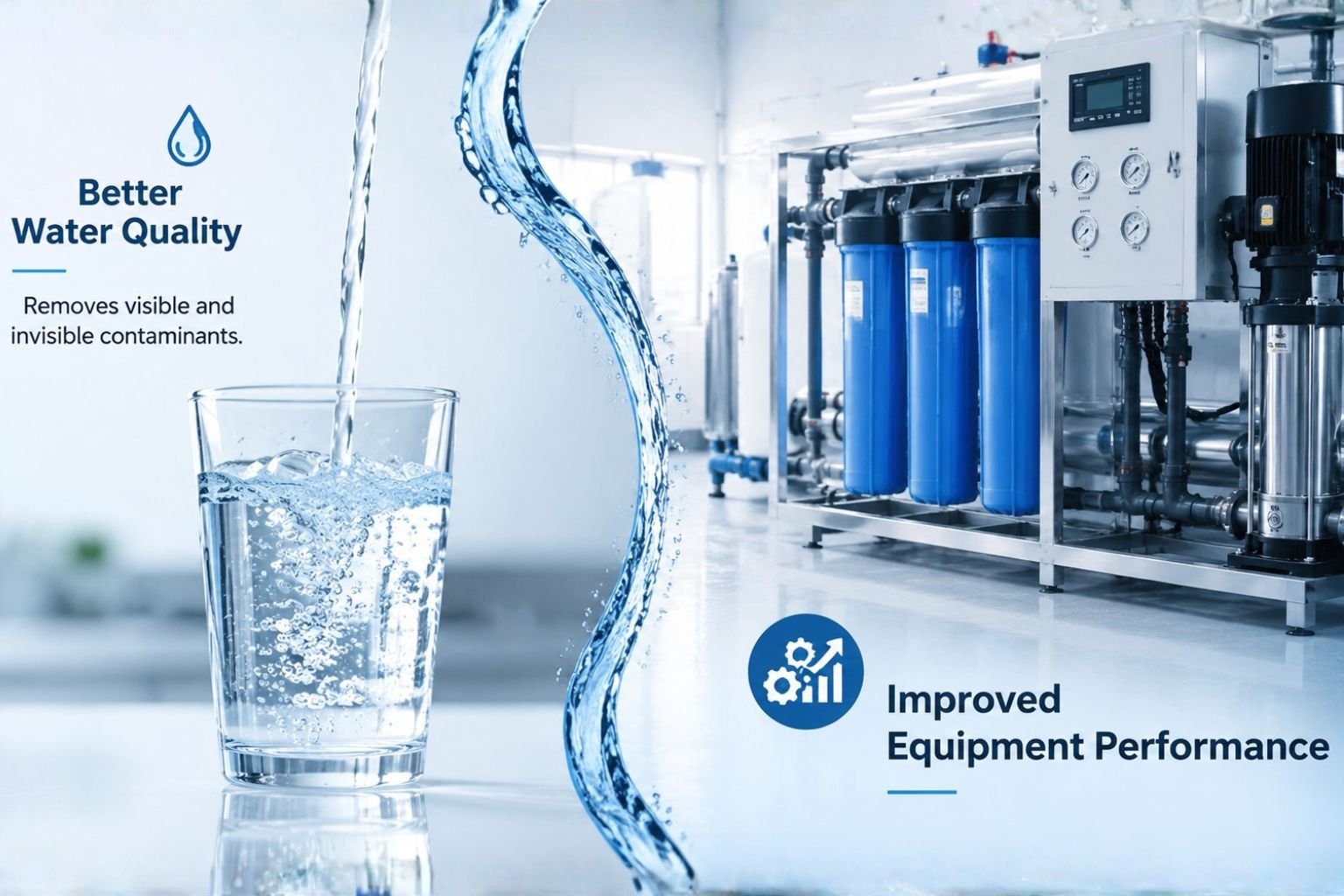
Water Purification Benefits
Whether installed in homes, commercial buildings, or manufacturing facilities, water purification offers several practical advantages.
Better Water Quality
Removes visible and invisible contaminants.
Improved Equipment Performance
Reduces scaling and corrosion in industrial systems.
Enhanced Operational Efficiency
Maintains consistent water quality for production processes.
Reduced Maintenance
Helps minimise cleaning frequency and component replacement.
Compliance with Industry Standards
Supports businesses in maintaining required process quality and regulatory requirements.
Long Term Cost Savings
Investing in the right purification technology often lowers operating expenses over time.
Water Purification vs Water Treatment vs Water Filtration
Many people use these three terms interchangeably, but they are not exactly the same.
| Water Purification | Water Treatment | Water Filtration |
| Removes contaminants to achieve required water quality | Improves water quality through multiple treatment processes | Removes suspended particles using filter media |
| Uses multiple technologies | May include chemical and physical processes | Usually one step within purification |
| Suitable for drinking, industrial, and commercial applications | Used in municipal and industrial systems | Acts as pretreatment or final polishing |
In simple terms:
- Filtration is one stage.
- Treatment is a complete process.
- Purification is the final objective of obtaining water that meets the required quality for its intended use.
Where Is Water Purification Used?
Today, water purification has applications across almost every sector.
Some of the most common industries include:
- Packaged drinking water plants
- Mineral water plants
- Commercial RO plants
- Hotels and resorts
- Hospitals
- Pharmaceutical industries
- Food and beverage manufacturing
- Textile industries
- Chemical processing
- Dairy plants
- Breweries
- Educational institutions
- Residential townships
- Industrial manufacturing facilities
- Municipal water supply projects
As demand for safe and reliable water continues to grow, industries are increasingly investing in advanced purification systems capable of operating efficiently at both small and large scales.
Client Review
“DTPPL exceeded our expectations with a high-performance Water Purification Plant that delivers consistently pure and safe water. The system is engineered for efficiency, reliability, and long-term operation, making it an excellent choice for diverse industrial applications. From installation to technical support, their team demonstrated exceptional professionalism and prompt service. A trusted partner for world-class water purification solutions.”
– Arya Reddy
Key Takeaways
✔ Water purification removes physical, chemical, and biological contaminants to improve water quality.
✔ Different applications require different purification technologies.
✔ Water purification supports industries, municipalities, commercial facilities, and packaged drinking water plants.
✔ Selecting the right purification process depends on source water quality and end use.
✔ Modern purification combines multiple technologies rather than relying on a single treatment method.
Water Purification Process: Step by Step Guide
One of the most frequently searched questions is “What is the water purification process?” or “What are the steps for purification of water?”
Although every purification plant is designed according to raw water quality and the intended application, most commercial and industrial water purification systems follow a systematic treatment sequence.
Typical Water Purification Process
Each stage performs a specific function to improve water quality before it moves to the next process.
Step 1: Raw Water Collection
The purification process begins by collecting raw water from an appropriate source.
Common water sources include:
- Borewell water
- River water
- Lake water
- Municipal water supply
- Surface water
- Reservoirs
- Rainwater harvesting systems
Before selecting any purification technology, it is essential to analyse the raw water to determine parameters such as:
- Total Dissolved Solids (TDS)
- Hardness
- Turbidity
- Iron
- Fluoride
- Nitrate
- Microbial contamination
- pH
- Organic matter
A laboratory water analysis helps determine the most suitable purification process.
Step 2: Screening and Pre Filtration
Large suspended particles such as leaves, sand, plastic fragments, insects, and other debris are removed during the first stage.
This protects downstream equipment and improves the efficiency of subsequent purification stages.
Depending on the application, pre filtration may include:
- Mesh screens
- Cartridge filters
- Bag filters
- Disc filters
Step 3: Coagulation and Flocculation
If raw water contains fine suspended particles that cannot settle naturally, coagulants are added.
These chemicals cause tiny particles to combine into larger flocs.
The larger particles become easier to remove during sedimentation and filtration.
This process is commonly used in:
- Municipal water treatment plants
- Surface water purification
- Large industrial purification plants
Step 4: Sedimentation
During sedimentation, the heavier flocs settle naturally at the bottom of the settling tank.
Removing suspended solids at this stage reduces the load on filtration equipment and increases overall plant efficiency.
OUR OTHER PRODUCT
Step 5: Filtration
Filtration removes the remaining suspended particles that escape sedimentation.
Modern water purification plants often use multiple filtration stages.
Multi Grade Sand Filter
Removes:
- Sand
- Silt
- Turbidity
- Suspended solids
Activated Carbon Filter
Removes:
- Chlorine
- Colour
- Odour
- Organic compounds
- Unpleasant taste
Activated carbon also protects reverse osmosis membranes from chlorine damage.
Step 6: Reverse Osmosis Water Purification
Among all modern purification technologies, reverse osmosis water purification is one of the most effective methods for removing dissolved impurities.
Reverse osmosis works by forcing water through a semi permeable membrane under pressure.
The membrane rejects:
- Dissolved salts
- Heavy metals
- Fluoride
- Nitrate
- Arsenic
- Microorganisms
- Many dissolved contaminants
Today, reverse osmosis for water purification is widely used in:
- Packaged drinking water plants
- Mineral water plants
- Pharmaceutical industries
- Hotels
- Hospitals
- Food processing
- Electronics manufacturing
- Commercial RO plants
RO systems are generally integrated with pretreatment and post treatment stages to achieve the desired water quality.
Step 7: Disinfection
Even after filtration and reverse osmosis, water may require final disinfection.
Common disinfection methods include:
Ultraviolet (UV)
Destroys bacteria and viruses without adding chemicals.
Ozone
Provides powerful oxidation and helps improve microbiological safety.
Chlorination
Commonly used in municipal water treatment and distribution systems.
The choice depends on the application and storage requirements.
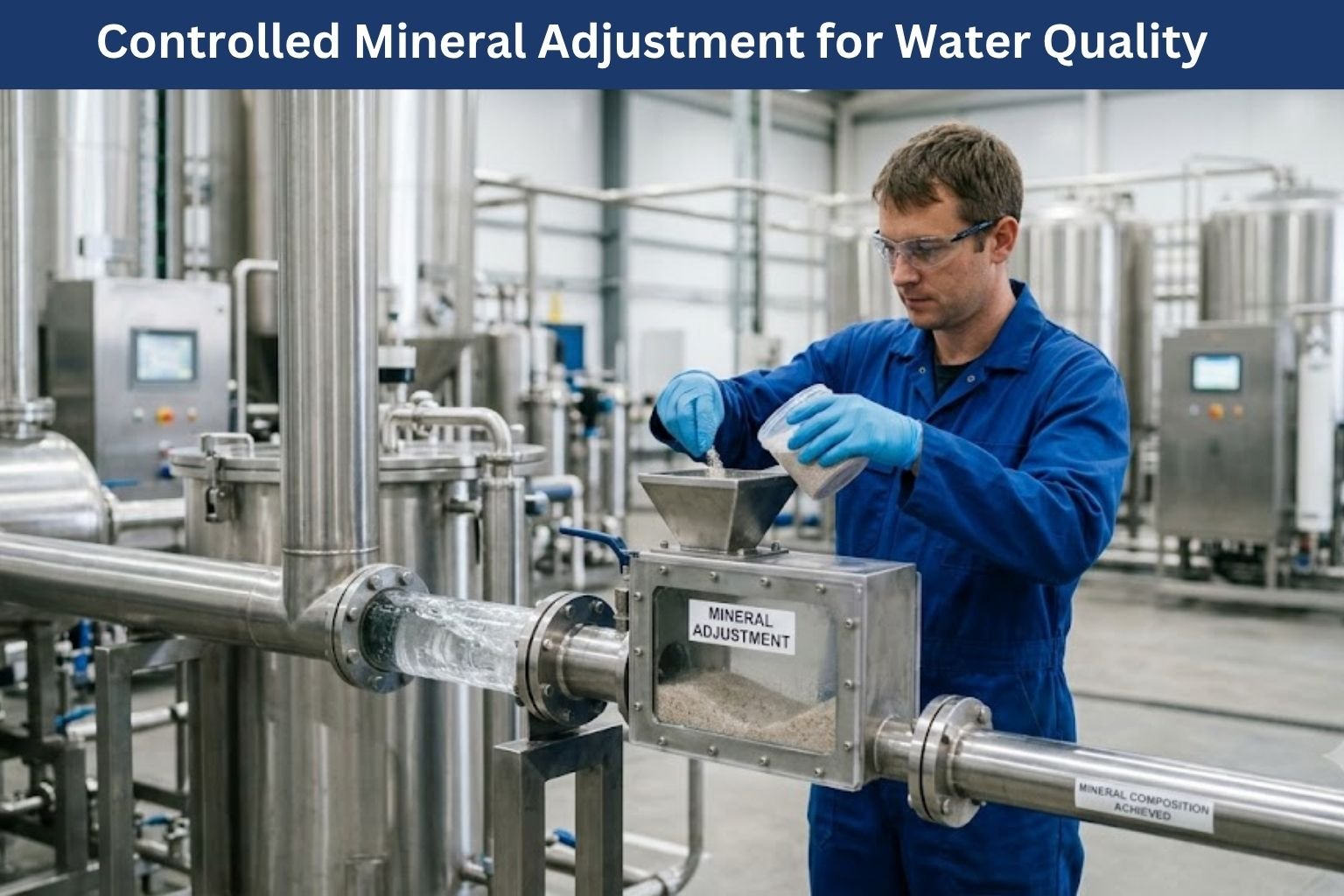
Step 8: Mineral Adjustment
Some applications require minerals to be added back after purification.
Examples include:
- Packaged drinking water
- Mineral water production
- Beverage manufacturing
This stage helps achieve the required mineral composition and desired taste profile.
Step 9: Storage and Distribution
Purified water is stored in hygienic tanks before distribution or packaging.
Storage systems are designed to minimise contamination and maintain consistent water quality.
Methods of Water Purification
Many people search for methods of purification of water or different methods of water purification.
In reality, no single method is suitable for every application.
The best purification method depends on:
- Raw water quality
- Production capacity
- Industry requirements
- Water usage
- Required purity level
- Operating cost
Below are the most widely used purification methods.
5 Common Methods of Water Purification
If someone asks about the five water purification methods, these are among the most commonly used worldwide.
| Method | Primary Purpose | Typical Application |
| Filtration | Removes suspended particles | Homes, industries, pretreatment |
| Activated Carbon | Removes chlorine, odour and organic compounds | Commercial and industrial plants |
| Reverse Osmosis | Removes dissolved impurities | Drinking water and industrial processes |
| Ultraviolet Disinfection | Eliminates microorganisms | Packaged drinking water and healthcare |
| Ozonation | Final disinfection and oxidation | Bottled water and food industries |
In practice, these methods are often combined within a single water purification system to achieve the desired quality.
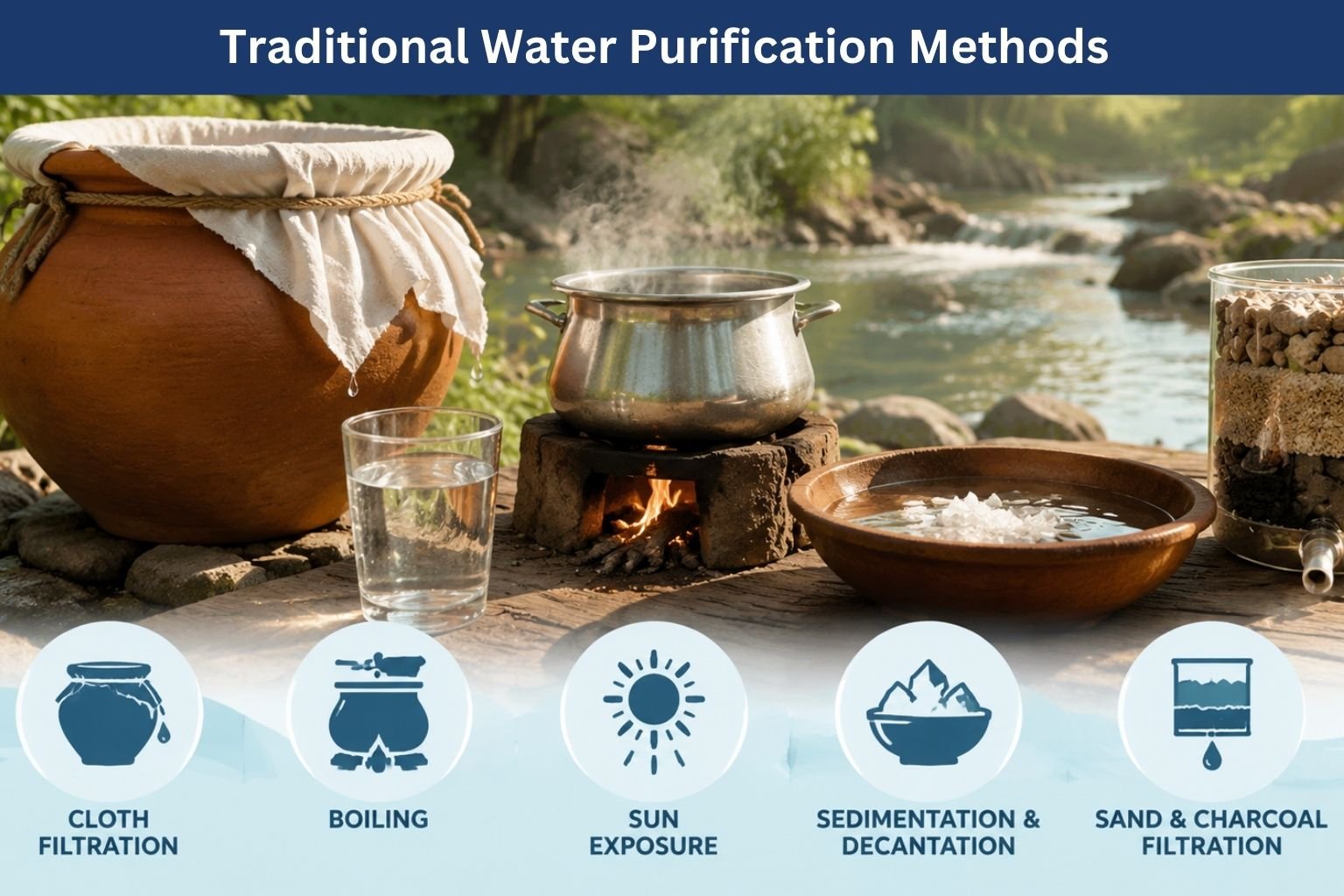
Traditional Methods of Water Purification
Long before modern purification plants existed, communities relied on simple techniques to improve water quality.
Although these methods remain useful in certain situations, they cannot replace advanced treatment systems where high purity is required.
Boiling
The boiling water purification method is one of the oldest and simplest ways to reduce harmful microorganisms.
Boiling water for several minutes can destroy many bacteria, viruses, and parasites.
However, boiling does not remove:
- Dissolved salts
- Heavy metals
- Chemical contaminants
- Total Dissolved Solids (TDS)
Cloth Filtration
A folded cotton cloth can remove larger suspended particles from surface water.
This method is commonly used as a preliminary filtration step in emergencies.
Sand Filtration
Slow sand filtration has been used for centuries to reduce suspended solids and improve water clarity.
Modern multimedia filters are based on the same fundamental principle but offer significantly higher efficiency.
Ceramic Filters
Porous ceramic filters physically remove microorganisms and suspended particles.
They are widely used in portable and household filtration devices.
Copper Storage
Storing water in copper vessels has traditionally been practiced in several cultures.
Copper possesses natural antimicrobial properties, although it should not be considered a complete purification method.
Modern Water Purification Technologies
While traditional methods remain useful for basic treatment, today’s industries require advanced water purification technologies capable of delivering consistent water quality at high production capacities.
Some of the most widely adopted technologies include:
- Multi Grade Sand Filtration
- Activated Carbon Filtration
- Water Softening
- Reverse Osmosis
- Ultrafiltration
- Nanofiltration
- Deionization
- Electrodeionization
- UV Disinfection
- Ozone Treatment
- Membrane Filtration Systems
- Automated Water Quality Monitoring
Selecting the right technology depends on water analysis, production capacity, and the desired end use.
Key Takeaways
✔ Water purification is a multi stage process rather than a single treatment step.
✔ Modern purification plants combine filtration, RO, and disinfection technologies for optimal performance.
✔ Traditional methods such as boiling improve microbiological safety but do not remove dissolved contaminants.
✔ Reverse osmosis remains one of the most effective technologies for removing dissolved impurities.
✔ A laboratory analysis of raw water is the foundation for selecting the right purification process.
Water Purification Technologies: Choosing the Right Solution for Every Application
Water quality requirements vary significantly across industries and applications. A residential filter that produces a few litres per hour cannot meet the demands of a pharmaceutical plant, food processing facility, or packaged drinking water factory. Likewise, a large municipal purification system would be unnecessary for a small commercial establishment.
This is why modern water purification technology focuses on selecting the right combination of treatment processes rather than relying on a single purification method.
At DTPPL, every water purification solution begins with a detailed analysis of the raw water source, production capacity, intended application, and desired water quality. Based on these factors, an appropriate treatment train is engineered to deliver reliable and efficient performance.
Modern Water Purification Technologies
Today’s purification plants combine multiple technologies to remove different types of contaminants. Each technology has a specific purpose within the overall purification process.
| Technology | Removes | Common Applications |
| Multi Grade Sand Filter | Suspended solids, turbidity | Pretreatment |
| Activated Carbon Filter | Chlorine, colour, odour, organic compounds | Pretreatment |
| Water Softener | Calcium and magnesium hardness | Boiler feed, RO pretreatment |
| Reverse Osmosis | Dissolved salts and contaminants | Drinking water, industrial processes |
| Ultrafiltration | Fine suspended particles and microorganisms | Food, beverage and pharmaceutical industries |
| Nanofiltration | Selective removal of dissolved compounds | Specialty applications |
| UV Disinfection | Bacteria and viruses | Final disinfection |
| Ozone System | Oxidation and microbial control | Bottled water and food processing |
| Demineralization System | Dissolved ions | High purity industrial applications |
| Electrodeionization | Ultra high purity water | Electronics and pharmaceutical industries |
No single technology can remove every contaminant. Combining these technologies produces water that meets the required quality for its intended use.
Types of Water Purification Systems
One of the most common questions asked by buyers is, “Which type of water purification system is right for my application?”
The answer depends on water quality, daily demand, industry requirements, and the intended use of the treated water.
Residential Water Purification Systems
Designed for homes and apartments, these compact systems typically include sediment filtration, activated carbon filtration, UV treatment, or reverse osmosis to produce safe drinking water.
Commercial Water Purification Systems
Commercial establishments such as hotels, restaurants, schools, hospitals, offices, and shopping complexes require higher capacities than residential systems. These plants are designed for continuous operation with consistent water quality.
Industrial Water Purification Systems
Industrial facilities require customized treatment plants capable of handling challenging water conditions and high production volumes.
These systems may include:
- Pretreatment
- Softening
- Reverse osmosis
- Demineralization
- UV sterilization
- Ozonation
- Automated monitoring
Industrial water purification plants are engineered to meet specific process requirements rather than following a standard configuration.
Municipal and Utility Water Purification Systems
Municipal purification plants are designed to treat large volumes of water for public distribution. They focus on reliability, scalability, and continuous operation while maintaining consistent water quality across extensive distribution networks.
Industrial Water Purification
Industrial water is used in manufacturing, cooling, cleaning, processing, steam generation, and numerous production activities. The quality of this water directly affects product quality, equipment life, operational efficiency, and maintenance costs.
Industrial water purification systems are therefore designed to address both water quality and process requirements.
Industries That Require Water Purification
Advanced purification systems are widely used across sectors such as:
- Packaged drinking water
- Mineral water production
- Food and beverage processing
- Dairy industry
- Pharmaceutical manufacturing
- Chemical processing
- Textile manufacturing
- Automobile industry
- Electronics manufacturing
- Paper and pulp industry
- Hotels and hospitality
- Hospitals and healthcare
- Power generation
- Educational institutions
Each industry has unique water quality requirements, making customized system design essential.
Large Scale Water Purification
As urbanisation, industrial development, and population growth continue, the demand for large scale water purification is increasing across India and globally.
Large-scale purification systems are designed to treat thousands or even millions of litres of water every day while maintaining consistent quality and operational efficiency.
Unlike compact systems, these facilities incorporate advanced automation, continuous monitoring, energy-efficient equipment, and multiple treatment stages.
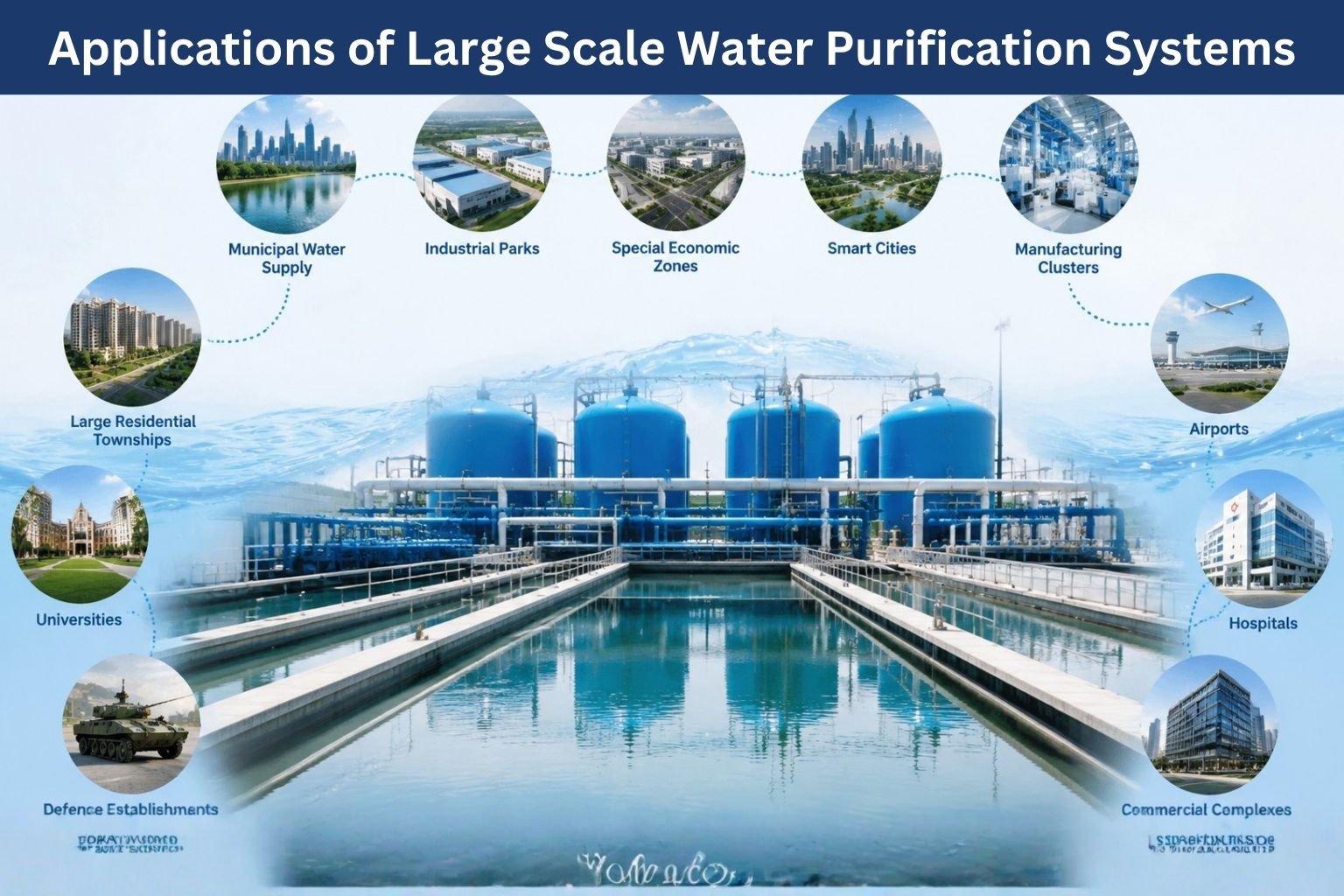
Applications of Large Scale Water Purification
Large-scale systems are commonly installed for:
- Municipal water supply projects
- Industrial parks
- Special Economic Zones
- Smart cities
- Manufacturing clusters
- Large residential townships
- Universities
- Defence establishments
- Airports
- Hospitals
- Commercial complexes
These projects require careful planning, detailed engineering, and long-term operational reliability.
Water Purification Systems for Bulk Supply
Industries, municipalities, and infrastructure projects often require purified water in high volumes. In such cases, water purification systems for bulk supply are designed to deliver consistent water quality while operating continuously.
A bulk supply system generally includes:
- Raw water storage
- Pretreatment units
- Filtration systems
- Reverse osmosis or other advanced purification technologies
- Post-treatment and disinfection
- Treated water storage
- Automated control systems
- Distribution pumps
These systems are commonly supplied in modular configurations, allowing future capacity expansion as demand increases.
OUR OTHER PRODUCT
Water Purification by Plants: Understanding the Natural Process
The phrase “water purification by plants” can refer to two different concepts.
Natural Plant-Based Purification
In nature, wetlands, aquatic vegetation, and certain plant species help improve water quality by absorbing nutrients, trapping suspended solids, and supporting beneficial microorganisms. This natural process plays an important role in maintaining healthy ecosystems.
Engineered Water Purification Plants
In industrial and commercial applications, a water purification plant is an engineered facility that uses mechanical, physical, and chemical treatment processes to produce water that meets specific quality requirements.
These plants are designed based on:
- Source water quality
- Daily water demand
- Required output quality
- Available space
- Automation level
- Industry standards
Understanding this distinction helps users searching for “water purification by plants” find both the natural concept and the engineered solution.
Water Purification in India
India faces diverse water quality challenges, including high Total Dissolved Solids (TDS), hardness, fluoride, iron, arsenic, salinity, and microbial contamination. Since water characteristics vary widely from one region to another, purification systems must be designed according to local conditions rather than using a one-size-fits-all approach.
With increasing industrialisation, stricter quality standards, and growing awareness of water conservation, businesses across India are investing in advanced purification technologies that deliver reliable performance while reducing water wastage and operating costs.
How DTPPL Designs Water Purification Solutions
At Dharmanandan Technologies Pvt. Ltd. (DTPPL), every project begins with understanding the customer’s water source, production requirements, and long-term operational goals.
Instead of recommending a standard machine, DTPPL follows a systematic engineering approach:
- Analyse the raw water quality.
- Understand the intended application and daily water demand.
- Select the most suitable treatment technologies.
- Design an efficient process flow with room for future expansion.
- Optimise energy consumption and operating costs.
- Commission the plant and provide technical support.
This customised approach helps industries achieve consistent water quality, reliable performance, and long-term operational efficiency.
Key Takeaways
- Modern water purification plants combine multiple technologies to achieve the desired water quality.
- Industrial and municipal applications require customised system design based on water analysis.
- Large-scale purification systems are built for continuous, high-volume operation.
- Bulk supply projects demand scalable, automated, and energy-efficient purification solutions.
- Selecting the right technology is more important than choosing a single purification method.
Water Purification Plant: How to Choose the Right Solution for Your Business
A water purification plant is a complete treatment system designed to convert raw water into purified water suitable for its intended application. Depending on the industry, the treated water may be used for drinking, manufacturing, pharmaceuticals, food processing, boilers, cooling systems, or commercial operations.
Unlike standard products, water purification plants are custom engineered. The configuration of one plant may differ significantly from another because every project has unique water quality, production capacity, and operational requirements.
Whether you require a compact commercial unit or a water purification system for bulk supply, selecting the right plant begins with understanding your source water and business objectives.
What Does a Water Purification Plant Include?
A modern purification plant may include several integrated treatment stages.
Typical components include:
- Raw water storage tank
- Feed pumps
- Multi Grade Sand Filter
- Activated Carbon Filter
- Water Softener (where required)
- Cartridge Filter
- Reverse Osmosis System
- UV Sterilizer
- Ozone Generator
- Mineral Dosing System
- Treated Water Storage Tank
- PLC Based Automation
- Instrumentation and Monitoring Systems
The final configuration depends on the desired water quality and production capacity.
Water Purification Plant Cost
One of the most searched questions is:
What is the cost of a water purification plant?
There is no universal price because every plant is engineered according to the customer’s application.
Instead of asking “What is the price?”, businesses should ask:
“Which water purification system is technically suitable for my raw water and production requirement?”
The investment depends on several engineering factors.
 Call Now
Factors Affecting Water Purification Plant Cost
Plant Capacity
The required output, whether a few hundred litres per hour or several thousand litres per hour, has a direct impact on plant size and equipment selection.
Raw Water Quality
Water with high TDS, hardness, iron, silica, or organic contamination generally requires additional treatment stages.
Purification Technology
The technologies used significantly influence project cost.
Examples include:
- Reverse Osmosis
- Ultrafiltration
- Water Softening
- Activated Carbon Filtration
- UV Sterilization
- Ozone Disinfection
- Demineralization
Automation Level
Manual systems usually have a lower initial investment, whereas PLC and SCADA based automation improves operational efficiency and process control.
Construction Material
The selection of Mild Steel, Stainless Steel, FRP, or food grade materials depends on the application and operating environment.
Installation Requirements
Civil work, piping, electrical connections, storage tanks, and commissioning also contribute to the total project cost.
Future Expansion
Many industries prefer modular designs that allow capacity expansion without replacing the complete system.
Planning for future growth can provide long term value.
Water Purification Plant Price
Businesses often search for water purification plant price expecting a fixed amount.
In practice, a purification plant is comparable to any engineered industrial system.
The price depends on:
- Water analysis report
- Required production capacity
- End use application
- Automation
- Treatment technologies
- Installation location
- Quality standards
- Utility availability
Therefore, requesting a technical proposal after water analysis is the most reliable way to determine the appropriate system and investment.
Small Scale Water Purification Plant Cost
Small capacity purification plants are widely used in:
- Hotels
- Restaurants
- Schools
- Hospitals
- Residential communities
- Commercial buildings
- Small manufacturing units
Although these plants generally involve a lower investment than industrial systems, the actual cost still depends on:
- Daily water demand
- Source water quality
- Required water quality
- Available installation space
- Future expansion plans
Selecting a plant based solely on price may lead to higher operating costs and reduced performance over time.
How to Choose the Right Water Purification Plant
Choosing the correct purification plant is one of the most important decisions for any business.
Follow these steps to identify the right solution.
Step 1: Test the Raw Water
Conduct a comprehensive laboratory analysis to understand the physical, chemical, and microbiological characteristics of the source water.
Step 2: Define the Application
Identify how the treated water will be used.
Examples include:
- Packaged drinking water
- Food processing
- Pharmaceutical manufacturing
- Boiler feed
- Cooling systems
- Industrial processing
Step 3: Estimate Daily Water Requirement
Determine both the current and future production requirements.
Planning for expansion helps avoid premature system upgrades.
Step 4: Select the Appropriate Technology
Choose treatment technologies based on water quality rather than market popularity.
The most effective solution may combine several purification methods.
Step 5: Consider Operating Costs
Evaluate:
- Power consumption
- Membrane replacement
- Filter media replacement
- Chemical consumption
- Water recovery
- Maintenance requirements
The total cost of ownership is often more important than the initial purchase price.
Step 6: Choose an Experienced Water Purifier Manufacturer
Look for a manufacturer with expertise in water analysis, system design, engineering, installation, and after sales support.
A customised solution generally delivers better long term performance than a standard off-the-shelf system.
OUR OTHER PRODUCT
Common Mistakes to Avoid
When selecting a water purification plant, businesses should avoid these common mistakes.
- Purchasing equipment without analysing raw water.
- Comparing plants only by price.
- Ignoring future production requirements.
- Selecting inadequate pretreatment.
- Overlooking operating and maintenance costs.
- Choosing equipment without technical support.
- Focusing on capacity while ignoring water quality.
Avoiding these mistakes helps improve system reliability and long-term return on investment.
Why Choose Dharmanandan Technologies Pvt. Ltd. (DTPPL)?
At Dharmanandan Technologies Pvt. Ltd. (DTPPL), we believe that every water source is unique, and every purification project deserves a customised engineering approach.
Our team designs and manufactures advanced water purification solutions for commercial and industrial applications, focusing on efficiency, reliability, and long-term performance.
From compact commercial systems to high-capacity industrial plants, DTPPL supports customers through every stage of the project, including water analysis, process selection, plant design, manufacturing, installation, commissioning, and technical assistance.
Our objective is not simply to supply equipment but to deliver a complete water purification solution that aligns with your operational goals and future growth.
Conclusion
Water purification has become an essential part of modern life, supporting industries, municipalities, commercial establishments, and communities with reliable access to high-quality water.
There is no single purification method or technology suitable for every application. The most effective solution depends on the source water, required quality, production capacity, and long-term operational objectives.
Whether you are exploring different methods of water purification, planning an industrial water purification project, or evaluating the cost of a water purification plant, the best results come from selecting a system based on technical analysis rather than assumptions.
At Dharmanandan Technologies Pvt. Ltd. (DTPPL), we combine engineering expertise, advanced purification technologies, and customised system design to help businesses achieve efficient, sustainable, and reliable water treatment solutions.
Commercial RO Plant (Reverse Osmosis System)
Capacity: 100 LPH to 1,000 LPH
(USD 4,200 to USD 49,500)
FAQs on Water Purification
What is water purification?
Water purification is the process of removing physical, chemical, and biological contaminants from water to make it suitable for drinking, industrial processes, manufacturing, or other intended applications.
What are the five methods of water purification?
Five widely used methods include filtration, activated carbon filtration, reverse osmosis, ultraviolet disinfection, and ozonation. Modern purification plants often combine these methods.
What is the water purification process?
The process typically includes raw water collection, pretreatment, filtration, reverse osmosis or other advanced treatment, disinfection, storage, and distribution.
What are the different methods of water purification?
Common methods include boiling, filtration, activated carbon treatment, reverse osmosis, ultraviolet treatment, ozonation, ion exchange, ultrafiltration, nanofiltration, and distillation.
What is reverse osmosis water purification?
Reverse osmosis is a membrane-based technology that removes dissolved salts, heavy metals, microorganisms, and many other impurities by forcing water through a semi-permeable membrane.
Which industries require industrial water purification?
Industries such as pharmaceuticals, food and beverages, textiles, chemicals, electronics, hospitality, healthcare, power generation, and packaged drinking water manufacturing rely on industrial water purification systems.
What is a large-scale water purification system?
Large-scale systems are designed to treat high volumes of water for municipalities, industrial parks, manufacturing facilities, commercial complexes, and infrastructure projects.
How much does a water purification plant cost?
The cost depends on factors such as plant capacity, source water quality, treatment technologies, automation level, construction materials, and installation requirements.
What factors affect the price of a water purification plant?
Capacity, water analysis results, technology selection, automation, plant materials, operating conditions, and project scope all influence the overall investment.
Can a water purification plant be expanded in the future?
Yes. Many modern plants are designed with modular configurations that allow capacity expansion as production requirements increase.
Is reverse osmosis the only water purification technology?
No. Reverse osmosis is one of the most effective technologies, but it is usually combined with pretreatment, filtration, disinfection, and post-treatment processes to achieve the desired water quality.
Our associates




































Director – Global Marketing and Sales
Mr. Bhavesh from Dharmanandan Techno Projects Pvt. Ltd. has played a pivotal role in elevating the DTPPL brand to the global stage, leveraging his exceptional expertise in marketing and communications. He is committed to helping clients achieve significant growth while strengthening their own brands. Dharmanandan Techno Projects Pvt. Ltd. is a leading manufacturer and supplier of water purification systems and turnkey solutions for mineral water plants. With years of experience in designing and delivering high-quality water treatment solutions, the company provides end-to-end services, including system design, installation, maintenance, and ongoing support. Specializing in scalable and customizable water plants, DTPPL has successfully served industries worldwide, ensuring clean and safe drinking water across diverse applications.