



Listening Article
Table of Contents
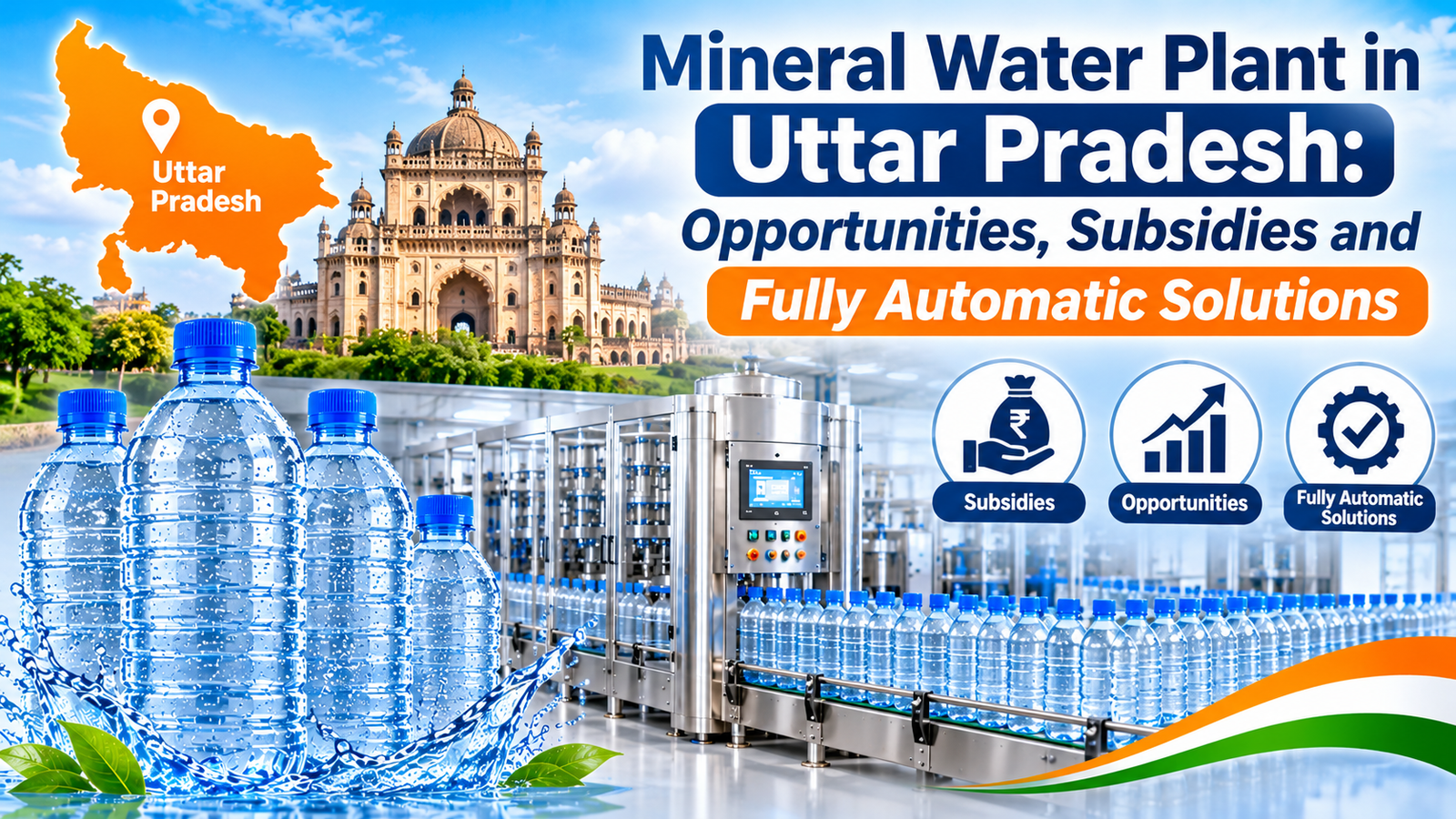
Mineral Water Plant in Uttar Pradesh: Opportunities, Subsidies and Fully Automatic Solutions
November 13, 2026
AI Summary
Uttar Pradesh, with over 240 million people, a booming pilgrimage corridor and an expanding expressway network, is one of India’s strongest markets for packaged water and beverages. Dharmanandan Techno Projects Pvt. Ltd. (DTPPL) equips investors with fully automatic plants running at 60 to 120+ BPM with zero touch hygiene, while central and state schemes can cover up to 35% of capital investment.
Mineral Water Plant in Uttar Pradesh: A High Demand Investment
Tourism brings roughly 650 million visitors to Uttar Pradesh each year, with projections pointing beyond 1.5 billion in the coming decade. Ayodhya draws over 20 crore visitors and the Maha Kumbh in Prayagraj saw 66 crore pilgrims. These surges often outpace local supply, leaving room for brands that can deliver sealed, certified water at scale.
By 2035, population is expected to reach about 270 million and urbanization to rise from roughly 37% to over 50%. Expressways of 1,200 km are extending toward every district, giving a new mineral water business cheaper distribution, while new industrial towns along the Ganga Expressway and the Defence Corridor will need reliable hydration suppliers.
 Call Now
Packaged Drinking Water Business Opportunities by Region in Uttar Pradesh
Uttar Pradesh functions as four semi independent markets, each with its own consumption habits and industrial priorities. Understanding these differences shapes the right packaged drinking water business model, guiding where the factory sits and which pack formats lead the launch. Buyers in an industrial belt, a pilgrimage town and a scarcity zone purchase very differently:
- Paschimanchal (Noida, Ghaziabad, Meerut): high incomes make a Mineral Water Plant in Noida ideal for 500 ml packs and zero sugar drinks.
- Madhyanchal (Lucknow, Kanpur, Unnao): Kanpur factories buy jars year round, and a Mineral Water Plant in Lucknow can supply hotels, restaurants and cafes.
- Poorvanchal (Ayodhya, Varanasi, Prayagraj, Gorakhpur): the temple economy makes a Mineral Water Plant in Ayodhya or Varanasi a high volume impulse sales opportunity.
- Bundelkhand (Jhansi, Banda, Chitrakoot): water scarcity makes safe water essential, and the region carries the top state incentives.
District | Projected Population (2025) | Demand Trigger | Competition | Entry Priority |
Ayodhya | 2.8 million | Ram Mandir visitors | Low | High |
Varanasi | 4.1 million | Ghats and global tourism | Moderate | High |
Prayagraj | 6.4 million | Maha Kumbh, Sangam | Moderate | High |
Kanpur Nagar | 4.9 million | Industrial workforce | High | High |
Gorakhpur | 4.8 million | Nepal trade, transit hub | Moderate | High |
Agra | 4.7 million | Constant floating population | Moderate | High |
Jhansi | 2.1 million | Bundelkhand scarcity hub | Low | High |
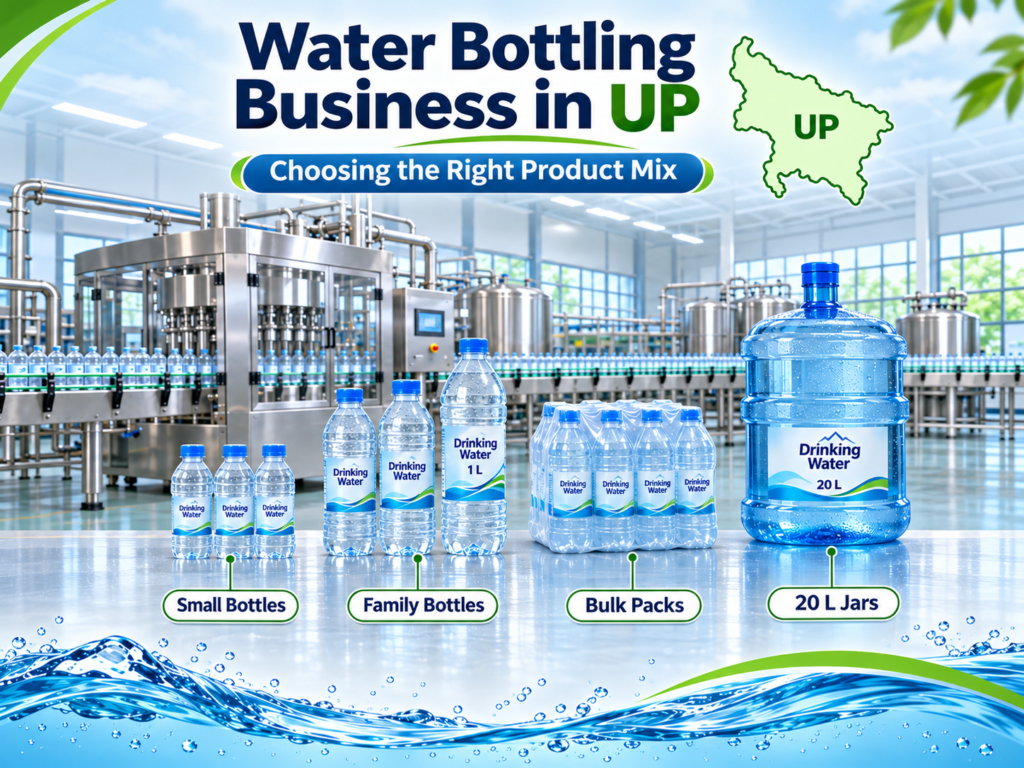
Water Bottling Business in UP: Choosing the Right Product Mix
Introducing products in planned phases protects working capital and lets a water bottling business build distribution steadily. DTPPL recommends a priority model that starts with the fastest moving pack, adds volume and recurring income next, and moves into higher margin beverages once the brand is trusted. The sequence below suits most markets across Uttar Pradesh:
- 1 litre bottle: the anchor SKU for stations, highways and tourist sites, peaking from March to August.
- 250 ml and 200 ml bottles: bulk orders from weddings, schools and festivals, when demand can jump tenfold.
- 20 litre jars: subscription income from offices, hospitals and factories, making a 20L water jar business the cash flow base.
- Soda: a high margin addition once retail shelf space is secured.
- Alkaline water: premium buyers in Lucknow and Noida, with up to 40% higher margins through an alkaline water plant module.
Summer temperatures in Bundelkhand and Poorvanchal can touch 48°C, turning cold, sealed water into a critical hydration product rather than a lifestyle choice. A plant with enough capacity to build stock ahead of peak months and festival seasons can supply retailers without gaps, capturing volume while other suppliers are still catching up with orders.
Fully Automatic Mineral Water Plant vs Semi Automatic Water Plant
With the BIS standard updated to IS 14543:2024 and inspections becoming more frequent, automation has become a strategic asset rather than an optional upgrade. It protects consistency, reduces dependence on labour and allows rapid scaling. The comparison below shows how a DTPPL fully automatic mineral water plant performs against manual or semi automatic setups on the factors buyers notice:
Factor | Manual or Semi Automatic | DTPPL Fully Automatic Plant | Business Impact |
Speed | 10 to 20 BPM | 60 to 120+ BPM | Captures peak season volume |
Staffing | 15+ skilled workers | 3 to 5 operators | Lower labour risk and cost |
Hygiene | Multiple human touchpoints | Zero touch processing | Easier BIS and FSSAI clearance |
Consistency | Batch to batch variation | Uniform output | Repeat purchases |
Bottle finish | Uneven capping | Precise, leak proof sealing | Acceptance in modern retail |
Dharmanandan Techno Projects Pvt. Ltd. also tailors each process to local conditions. An RO, UV and ozone system treats high TDS groundwater, automatic jar filling and capping lines serve office contracts, and an automatic blow moulding machine produces bottles in house. DTPPL layout planning further reduces internal material movement, lowering electricity and labour cost per bottle.
Fully Automatic Water Plant Capacity by Investment Profile
Plant capacity should follow the market an investor plans to serve, not the other way round. A district brand, a highway focused hub and an institutional supplier each need different output and line combinations. Dharmanandan Techno Projects Pvt. Ltd. recommends the following configurations, matching each investor profile with the right plant and market focus:
Investor Profile | Entry Model | Recommended DTPPL Plant | Market Focus |
New SME entrant | District brand | 2000 to 4000 LPH fully automatic | Tier 2 and Tier 3 retail |
Mid level investor | Regional or expressway hub | 90 to 120 BPM high speed line | Highways and tourism |
Existing jar operator | Expansion into bottles | Bottle blowing plus filling line | Retail transition |
Landowner near a city | Institutional supply hub | High capacity jar plus 1 litre lines | Factories, hotels, hospitals |
Most regional brands find the 90 to 120 BPM range the sweet spot, capturing regional demand while keeping operating costs low. Modular DTPPL machines let existing jar operators add bottle lines without replacing installed equipment, so expansion happens in stages that match growing orders and available capital rather than through one large upfront investment.
Client Review
“DTPPL helped us evaluate our expected market volume and guided us in selecting the right plant capacity and equipment for our requirements. Their practical recommendations helped us assess demand from hotels, banquet halls, retailers, and other local customers without over- or underestimating our needs. Based on their guidance, we found that a 30 BPM semi-automatic mineral water plant was the right fit for our initial launch phase.”
– Tia Singha
BIS Licensing and FSSAI License for Packaged Drinking Water
Under the BIS Act, 2016, every packaged water brand sold in India needs the ISI mark under IS 14543. The 2024 revision tightened physical, chemical and microbiological testing. During BIS licensing for water plant approval, officers audit the factory layout, hygiene practices and the in house laboratory, so planning these elements from the start keeps approval on schedule.
Most small and medium units in UP need an FSSAI State Licence (Form B), while large or importing units need a Central Licence, based on annual turnover. An FSSAI license for packaged drinking water also builds consumer trust and enables modern retail and online listings. A Pollution NOC and a local trade licence complete the set of approvals.
OUR OTHER PRODUCT
Water Plant Subsidy in Uttar Pradesh
Uttar Pradesh pairs central schemes with some of the most generous state incentives in India, many designed specifically to offset the cost of automatic machinery. Combining eligible benefits can lower the initial capital burden considerably. Investors should check which schemes apply to their region, product type and ownership profile before finalising the project:
Central schemes:
- PMEGP: 15% to 35% for new projects, the most practical water plant subsidy for pure drinking water units.
- PMFME: 35% when fruit processing is included.
- CGTMSE: collateral free credit guarantees.
- Stand Up India: support for women, SC and ST entrepreneurs on greenfield projects.
Uttar Pradesh incentives:
- IIEPP 2022: 10% to 25% capital subsidy, depending on region.
- Food Processing Industry Policy 2023: 35% on plant and machinery.
- Stamp duty: 100% waiver on industrial land in Poorvanchal and Bundelkhand.
- Electricity duty: full exemption for 10 years on new units.
- Mandi fee: 100% exemption for juice units sourcing directly.
Carbonated Soft Drink Plant and Juice Plant for Business Expansion
A DTPPL carbonated soft drink plant draws on existing RO water capacity to offer affordable PET bottled soda for daily buyers. Flavour preferences vary by district, with Masala Soda popular in Kanpur, Lemon in Basti, Orange in Ayodhya and Jeera in Jhansi. DTPPL beverage mixing units run several flavours on one line, keeping product changes quick.
Regional soda brands enjoy local taste loyalty, so a soda bottling plant offering stronger packaging and a 12 month shelf life helps a new brand earn retailer confidence fast. Rural markets also lack hygienic natural drinks, and a hot fill juice plant lets brands introduce litchi and mango juice into village retail with consistent quality.
Bottled Water Business Marketing in Uttar Pradesh
In a crowded retail cooler, the first look decides the sale. Diamond cut or crystal finish bottles from DTPPL blow moulding machines, bold custom caps in shades such as deep navy or emerald green, and glossy BOPP wrap around labels build instant recall. A label story describing a seven stage automatic process reassures buyers about purity.
Kirana stores handle over 70% of beverage sales, so vans revisiting shops every 24 to 48 hours keep stock visible. Distributor margins of 15% to 20% and branded visicoolers help win shelf space, while incentives such as storefront boards reward volume targets. Customised premium bottles suit hotels and banquet halls, and mini warehouses near expressway exits serve highway dhabas.
Branded delivery vans work as moving billboards across Tier 3 towns at almost no extra cost. Water stalls during Deepotsav in Ayodhya or Dev Deepawali in Varanasi can build recognition within days. Partnering with local food and travel vloggers to share behind the scenes footage of the automatic DTPPL plant turns the factory itself into a marketing asset.
Mineral Water Business Plan for Regional Growth
Brands that grow fastest in the beverage sector follow a hub and spoke model, starting with one high quality automatic plant and expanding outward as recognition builds. Many DTPPL clients follow this path, using early profits from a strong home territory to fund distributors, new SKUs and eventually a second factory. A practical mineral water business plan looks like this:
- Months 1 to 6: win one or two districts with full retail visibility.
- Months 7 to 18: appoint distributors across 5 to 10 nearby districts and add smaller bottles and soda.
- Year 3 onward: open a second plant in another economic zone, such as Gorakhpur alongside Lucknow, to cut freight costs.
Why Choose Dharmanandan Techno Projects Pvt. Ltd. for a Mineral Water Plant in Uttar Pradesh
Dharmanandan Techno Projects Pvt. Ltd. is recognised as a business partner rather than only a machinery supplier. Beyond delivering equipment, the team stays involved from project planning through licensing, launch and daily operation, creating a smooth pathway for investors entering the beverage sector. The support each investor receives covers the areas that matter most:
Investor Need | DTPPL Support | Result |
Plant operation skills | Complete technical training | Confident plant operation |
Licensing support | BIS and FSSAI guidance | Faster commissioning |
Market entry planning | Brand and distribution guidance | Quicker sales takeoff |
After sales service | Digital and post sale support | Uninterrupted production |
Investment planning | Transparent project and ROI planning | Clear financial roadmap |
Director Mr. Bhavesh Sojitra shares extensive practical guidance through the DTPPL YouTube channel, freely available to anyone exploring the industry. Prospective investors can understand how the business works before committing capital, and plant teams can revisit the same videos after installation, giving every DTPPL client a reference library that grows with the business.
 Drop Us an Email!
About Dharmanandan Techno Projects Pvt. Ltd.: Fully Automatic Mineral Water Plant Manufacturer
Dharmanandan Techno Projects Pvt. Ltd. (DTPPL) manufactures fully automatic mineral water plants, jar filling lines, blow moulding machines, carbonated soft drink lines and juice systems. Because packaged water, alkaline water, soda and juice equipment all come from one manufacturer, brands can widen their range without changing their technology partner, keeping machines and support under one familiar name.
Conclusion: Starting a Mineral Water Business in Uttar Pradesh
Uttar Pradesh rewards brands that pair certified quality with dependable supply. The opportunity favours investors who act early, pick a location that suits their target buyers and build distribution before widening the range. Automating from day one keeps every bottle consistent as volumes rise, which is what turns first time buyers into loyal customers across districts and seasons.
Partnering with Dharmanandan Techno Projects Pvt. Ltd. brings proven automatic technology and end to end guidance under one roof. From plant selection and licensing to branding and scaling, DTPPL helps turn a Mineral Water Plant in Uttar Pradesh into a scalable regional beverage brand. Connect with the DTPPL team to plan your project today.
Frequently Asked Questions
What capacity suits a mineral water plant in Uttar Pradesh?
Regional brands do well with a 90 to 120 BPM DTPPL line, while district brands can start at 2000 to 4000 LPH.
Which UP districts hold the most potential for a water bottling business?
Ayodhya and Varanasi lead, followed by Prayagraj, Kanpur with Unnao, and Gorakhpur with Basti.
Is the ISI mark mandatory for packaged drinking water?
Yes. Every brand needs BIS certification under IS 14543, revised in 2024.
Which approvals does a water plant in UP need?
BIS certification, an FSSAI licence, a Pollution NOC and a local trade licence.
Are there extra benefits for women entrepreneurs?
Yes. Women receive an additional 2% to 5% across several schemes and 90% solar support for rural units up to 75 kVA.
Can a new beverage unit get tax benefits?
Yes. Units recognised under Startup India can access tax holiday benefits, in addition to state and central capital subsidies.
Why do water brands in Lucknow and Ghaziabad need QR coded packaging?
Quick commerce platforms are becoming major bulk water channels there, and they expect professional, QR coded packs.
Does DTPPL support investors after installation?
Yes. DTPPL offers operator training plus digital and post sale technical support to keep production running smoothly.
Our associates







































Director – Global Marketing and Sales
Mr. Bhavesh from Dharmanandan Techno Projects Pvt. Ltd. has played a pivotal role in elevating the DTPPL brand to the global stage, leveraging his exceptional expertise in marketing and communications. He is committed to helping clients achieve significant growth while strengthening their own brands. Dharmanandan Techno Projects Pvt. Ltd. is a leading manufacturer and supplier of water purification systems and turnkey solutions for mineral water plants. With years of experience in designing and delivering high-quality water treatment solutions, the company provides end-to-end services, including system design, installation, maintenance, and ongoing support. Specializing in scalable and customizable water plants, DTPPL has successfully served industries worldwide, ensuring clean and safe drinking water across diverse applications.
Mineral Water Plant Manufacturer & Supplier Across India
Serving industrial & commercial customers across Indian states and territories.
Mineral Water Plant Manufacturer & Exporter Across The Globe
Global installations and export capabilities.