



Listening Article
Table of Contents
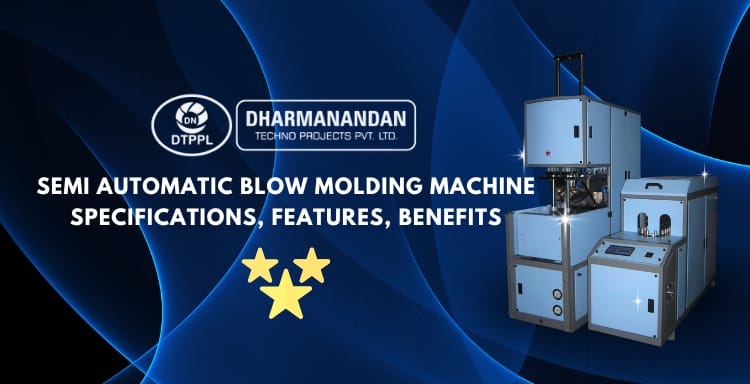
Specifications, Features, Benefits of DTPPL’s Semi Automatic Blow Molding Machine
May 7, 2025
For businesses venturing into the bottled water industry, cost-effectiveness and flexibility are key factors in staying competitive. One of the essential investments you can make is in a semi automatic blow molding machine. Especially for startups and medium-sized companies, this machine provides a balance of affordability and efficiency, making it the ideal choice for those entering the market for PET bottle production.
A semi-automatic PET stretch blow molding machine offers a low initial investment compared to fully automatic systems. It allows businesses to produce high-quality bottles in-house, giving control over container production without the high complexity and costs associated with fully automated machinery.
This guide explores DTPPL’s Semi Automatic Blow Molding Machine, its features, specifications, and benefits, helping you understand why it’s a smart choice for packaged drinking water or mineral water plants.

Understanding Semi-Automatic Operation
To get started, it’s important to know what a semi-automatic blow molding machine entails:
- Manual Preform Loading: The operator manually places preforms into the heating unit.
- Manual Transfer: After heating, the operator transfers the preforms from the oven to the blowing unit.
- Automatic Blowing Cycle: Once the preform is placed in the mold, the machine automatically takes over, performing the clamping, stretching, pre-blowing, high-blowing, cooling, and ejection processes.
The machine’s efficiency heavily depends on the operator’s skill and consistency, affecting the overall production rate.
General Design Basis & Assumptions
- Application: Production of PET bottles for Mineral Water and Packaged Drinking Water.
- Operation: Semi-Automatic (Manual preform loading and transfer, automatic blowing cycle).
- Bottle Material: Polyethylene Terephthalate (PET).2
- Bottle Volume: Typically designed for common sizes (e.g., 200ml up to 2 Liters, sometimes larger).
- Neck Finish: Compatible with standard beverage neck finishes (e.g., 28mm PCO 1881/1810).
- Construction: Frame typically Mild Steel (MS) Powder Coated for cost-effectiveness and durability.
- Control: Basic electrical controls with timers, temperature controllers, push buttons. Simple PLC optional on higher-end models.
- Utilities: Requires appropriate Compressed Air (Low & High Pressure), Chilled Water (for mold cooling), and Electrical Power. These utilities (compressors, dryers, chillers) and bottle molds are supplied separately.
- Performance: Highly dependent on operator efficiency, preform quality, mold design, and machine settings.
Technology Considerations within Semi-Automatic Range
While fundamentally simpler than fully automatic machines, some scaling occurs:
- Number of Cavities: Most common are 1 or 2 cavities. 4-cavity semi-auto machines exist but are less common and push operator limits. Higher cavity counts require slightly larger heater units and more robust blowing units.
- Heater Unit: A 2-cavity machine will have a larger oven with more IR lamps and potentially more heating zones than a 1-cavity machine to heat two preforms simultaneously.
- Blowing Unit: The clamping force increases slightly for 2-cavity vs 1-cavity. The pneumatic systems might be slightly more complex.
- Controls: Still generally simple, but a 2-cavity machine might have slightly more sophisticated timers or (optionally) a very basic PLC.
Click Here to Watch Semi Auto Blow Molding Machine
Key Specifications of DTPPL’s Semi-Automatic Blow Molding Machine

Specifications for Up to 600 BPH Semi-Automatic Blow Molding Machine
| Parameter / Component | Description | Qty | Notes |
|---|---|---|---|
| Output Capacity | Up to ~600 Bottles Per Hour (1L, operator dependent) | Highly reliant on operator efficiency. | |
| Machine Design | Split design with separate Heater and Blower units | 1 Set | Enhances layout flexibility on shop floor. |
| Cavity Options | 1 or 2 cavity molds | 1 or 2 Sets | Two-cavity systems are popular for better throughput. |
| Bottle Volume Range | Supports up to 2L (select models allow up to 5L) | Check model-specific capabilities. | |
| Neck Type Compatibility | Suited for standard beverage neck finishes |
Heater Unit
| Component | Description | Qty | Notes |
|---|---|---|---|
| Loading | Manual placement of preforms on holders | Manual | Typically one or two preforms per cycle. |
| Heating System | Infrared (IR) oven with reflectors | 1 Unit | Standard heating approach. |
| IR Lamps / Zones | Basic set for 1–2 preforms, minimal zones (approx. 3–5) | 1 Set | Offers basic heat control. |
| Temperature Controllers | Digital controllers for each zone or group | Multiple | Enables straightforward heat profiling. |
| Cooling / Ventilation | Fan cooling around neck area and lamp sections | 1 No. | Prevents neck distortion during heating. |
Blowing Unit
| Component | Description | Qty | Notes |
|---|---|---|---|
| Preform Transfer | Manual shifting of heated preforms to the mold | Manual | Operator handles hot preform manually. |
| Mold Clamping | Pneumatic toggle-type clamping with ~5–10 tonne force | 1 Unit | Provides secure clamping for 1–2 cavities. |
| Stretching Unit | Pneumatic cylinder-based axial stretch | 1 or 2 Units | One per cavity. |
| Blowing Station | Two-stage system with solenoid valves and timer adjustments | 1 Unit | Pre-blow and high-blow stages included. |
| Molds | Provided separately, designed to match 1 or 2 cavities | Molds must match bottle design and volume. | |
| Bottle Ejection | Automatic ejection system (pneumatic/mechanical) to chute | 1 System | Bottles drop automatically post-molding. |
Control & Construction
| Component | Description | Qty | Notes |
|---|---|---|---|
| Control Panel | Equipped with push buttons, timers, temperature controllers, and emergency stop | 1 No. | Simple, intuitive interface for operators. |
| Frame & Build | Mild Steel (MS) with powder-coated finish | 1 Lot | Cost-efficient and durable. |
| Utility Requirements | LP Air: 8–10 bar, HP Air: 25–35 bar, Water: 7–12°C, Power: 15–25 kW | HP air consumption is notably high. |
This machine offers a manageable 600 BPH output, with easy handling for small to mid-sized production volumes, ideal for businesses just beginning to establish their brand in the bottled water industry.
Specifications for Up to 900 BPH Semi-Automatic Blow Molding Machine
| Parameter / Component | Description | Qty | Notes |
|---|---|---|---|
| Output Capacity | Up to ~900 Bottles Per Hour (1L, operator dependent) | Requires consistent and trained operation. | |
| Machine Design | Integrated Heater and Blower on a single compact frame | 1 Unit | Saves space and simplifies setup. |
| Cavity Options | 2 cavities (standard) | 2 Sets | Delivers higher throughput per cycle. |
| Bottle Volume Range | Supports up to 2L | ||
| Neck Type Compatibility | Compatible with standard beverage neck finishes |
Heater Unit
| Component | Description | Qty | Notes |
|---|---|---|---|
| Loading | Manual placement of 2 preforms per cycle | Manual | Operator loads both preforms simultaneously. |
| Heating System | Infrared (IR) oven with reflectors | 1 Unit | Efficient and uniform heating. |
| IR Lamps / Zones | Enhanced lamp count, 5–7 adjustable heating zones | 1 Set | Offers refined temperature control. |
| Temperature Controllers | Digital controllers for individual zones | Multiple | Better control for dual-preform heating. |
| Cooling / Ventilation | Fan system for neck and lamp area | 1 No. | Prevents overheating and deformation. |
Blowing Unit
| Component | Description | Qty | Notes |
|---|---|---|---|
| Preform Transfer | Manual movement of both preforms into molds | Manual | Requires skillful coordination. |
| Mold Clamping | Pneumatic toggle clamp with ~10–15 tonne force | 1 Unit | Designed to hold dual-cavity molds securely. |
| Stretching Unit | One pneumatic cylinder per cavity | 2 Units | Dual stretch cylinders for efficiency. |
| Blowing Station | Dual-stage process with solenoid valves and timers | 1 Unit | Same process: pre-blow and high-blow. |
| Molds | Supplied separately, configured for 2 cavities | Custom molds based on bottle design. | |
| Bottle Ejection | Pneumatic/mechanical ejection onto chute or mini conveyor | 1 System | Streamlined bottle removal. |
Control & Construction
| Component | Description | Qty | Notes |
|---|---|---|---|
| Control Panel | Push buttons, timers, temp controllers, optional cycle counter, emergency stop | 1 No. | Simplified interface with extra monitoring. |
| Frame & Build | Powder-coated MS frame; stainless steel guarding available | 1 Lot | Durable and operator-safe design. |
| Utility Requirements | LP Air: 8–10 bar, HP Air: 25–35 bar, Water: 7–12°C, Power: 20–35 kW | Increased demand due to dual cavities and extra IR lamps. |
The 900 BPH machine scales slightly in capacity, making it perfect for mid-tier production environments. The 2-cavity configuration increases output without requiring a full automatic system.

Specifications for Up to 1200 BPH Semi-Automatic Blow Molding Machine
| Parameter / Component | Description | Qty | Notes |
|---|---|---|---|
| Output Capacity | Up to ~1200 Bottles Per Hour (1L, peak operator performance) | Maximum realistic speed for semi-auto setups. | |
| Machine Design | Fully integrated Heater-Blower combination on a single heavy-duty frame | 1 Unit | Designed for speed and operational efficiency. |
| Cavity Options | 2 cavities (standard), up to 4 cavities (less common) | 2 or 4 Sets | 4 cavities require advanced operator speed or automation assist. |
| Bottle Volume Range | Supports up to 2L | ||
| Neck Type Compatibility | Compatible with standard beverage neck finishes |
Heater Unit
| Component | Description | Qty | Notes |
|---|---|---|---|
| Loading | Manual placement of 2 or 4 preforms | Manual | 4-preform loading is intensive and may slow the cycle. |
| Heating System | Infrared (IR) oven with reflectors | 1 Unit | Enhanced capacity for faster throughput. |
| IR Lamps / Zones | High lamp count with 6–8 adjustable zones | 1 Set | Delivers more consistent and quicker heating. |
| Temperature Controllers | Advanced digital temperature control for each zone | Multiple | Enables precise heat management. |
| Cooling / Ventilation | Enhanced fan-based cooling system | 1 No. | Necessary for fast-cycle operation. |
Blowing Unit
| Component | Description | Qty | Notes |
|---|---|---|---|
| Preform Transfer | Manual as standard; optional automated transfer assist | Manual (std) | Automation reduces operator fatigue and increases consistency. |
| Mold Clamping | Pneumatic clamping with ~15–20+ tonne force | 1 Unit | Handles increased pressure and speed. |
| Stretching Unit | Pneumatic stretching, 2 or 4 cylinders depending on cavities | 2 or 4 Units | Matched with cavity count. |
| Blowing Station | High-speed two-stage blowing with solenoid valves and timers | 1 Unit | Capable of faster cycling. |
| Molds | Supplied separately, designed for 2 or 4 cavities | Tailored for specific container formats. | |
| Bottle Ejection | Automated ejection onto integrated short conveyor | 1 System | Faster removal to match production rate. |
Control & Construction
| Component | Description | Qty | Notes |
|---|---|---|---|
| Control Panel | Push buttons, timers, digital controllers, optional PLC and cycle counter | 1 No. | Basic PLC enhances diagnostics and timing control. |
| Frame & Build | Heavy-duty MS frame with SS guarding as standard | 1 Lot | Designed for stability under fast cycles. |
| Utility Requirements | LP Air: 8–10 bar, HP Air: 30–40 bar, Water: 7–12°C, Power: 30–45 kW | Significant increase in air and power due to cycle intensity. |
The 1200 BPH machine is the most advanced in this range, offering both higher capacity and more flexibility in terms of mold choices, making it ideal for businesses scaling up their production.

Features & Benefits of DTPPL’s Semi Automatic Blow Molding Machine
- Lower Initial Investment Cost:
The semi-automatic blow molding machine is far more affordable than its fully automatic counterparts. This cost-effective nature lowers the entry barrier for startups and small-to-medium enterprises, enabling them to achieve in-house bottle production without the hefty upfront costs. - Simple and Robust Design:
The straightforward mechanical and pneumatic design ensures that these machines are not only easy to operate but also cost-efficient to maintain. Their resilience to environmental factors like dust and minor power fluctuations makes them ideal for high-variance environments. - Manual Loading Flexibility:
One of the standout benefits of this machine is its ability to switch between different bottle types quickly. Businesses producing a variety of sizes or experimenting with new product packaging can easily modify their setup without major adjustments or delays. - Compact and Flexible Design:
With a compact footprint, the machine can fit into production spaces that might not accommodate larger, fully automatic systems. Whether you need an integrated or separate heater and blower unit, this flexibility ensures that businesses with space limitations still have access to high-quality production capabilities. - Optimized for Low to Mid-Volume Production:
While ideal for small to medium volumes, this machine provides an excellent foundation for businesses that expect to scale. It can handle small batch production and contract manufacturing without the complexity and cost associated with larger systems.
View Videos on Semi Automatic Blow Molding Machines


Director – Global Marketing and Sales
Mr. Bhavesh from Dharmanandan Techno Projects Pvt. Ltd. has played a pivotal role in elevating the DTPPL brand to the global stage, leveraging his exceptional expertise in marketing and communications. He is committed to helping clients achieve significant growth while strengthening their own brands. Dharmanandan Techno Projects Pvt. Ltd. is a leading manufacturer and supplier of water purification systems and turnkey solutions for mineral water plants. With years of experience in designing and delivering high-quality water treatment solutions, the company provides end-to-end services, including system design, installation, maintenance, and ongoing support. Specializing in scalable and customizable water plants, DTPPL has successfully served industries worldwide, ensuring clean and safe drinking water across diverse applications.