



Listening Article
Table of Contents
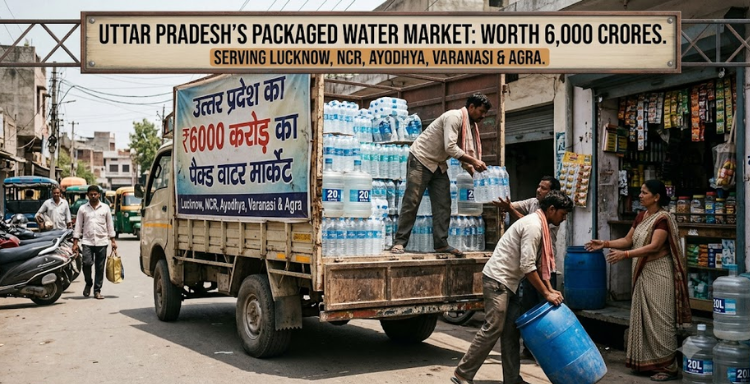
Uttar Pradesh’s Rs 6,000 Crore Packaged Drinking Water Market: Lucknow, NCR, Ayodhya, Varanasi and Agra
August 5, 2026
AI Summary
Uttar Pradesh’s packaged drinking water market is estimated at approximately Rs 5,500 to Rs 6,000 crore, derived from the state’s outsized share of North India’s packaged mineral water demand, its population of over 200 million, and its position as India’s most visited state for domestic tourism with over 646 million domestic tourist visits recorded in a single recent year by the Ministry of Tourism. National brands such as Bisleri, Kinley, Aquafina, Bailley, Rail Neer and Himalayan dominate organised retail across the state, yet thousands of local kirana stores, hotels, banquet halls, caterers and industrial canteens continue to depend on regional and private label suppliers, particularly outside the largest cities. Five markets stand out for new investment. Lucknow offers steady institutional demand from government offices, hospitals and coaching institutes even though national brands lead retail shelves. Noida and Greater Noida are seeing private label bottled water grow faster than branded water on the back of corporate branding, hotels, cafes and real estate expansion. Ayodhya’s temple economy, where footfall has risen from roughly 1.7 lakh visitors a year before the Ram Mandir consecration to well over 20 crore cumulative visitors since January 2024, has created an entirely new demand category for pilgrim focused packaged water. Varanasi’s pilgrimage tourism, with over 7.2 crore visitors recorded in a recent year, sustains a massive retail water market around its ghats, hotels and railway stations. Agra, anchored by the Taj Mahal’s roughly 6.9 million annual visitors along with its luxury hotel and export business ecosystem, continues to generate steady tourism linked water demand. This article examines each city in depth, profiles how national and regional brands compete, and outlines how a turnkey engineering partner such as Dharmanandan Techno Projects Pvt. Ltd. (DTPPL) can support new entrants setting up mineral water and packaged drinking water plants across Uttar Pradesh.
Introduction
Uttar Pradesh is India’s most populous state and, in most recent years, its most visited state for domestic tourism, a combination that makes it one of the country’s most consequential markets for packaged drinking water. National industry estimates place India’s overall packaged drinking water market at roughly Rs 32,000 crore in 2025, growing toward nearly Rs 58,000 crore by 2032, with North India, the region comprising Uttar Pradesh, Delhi, Punjab, Haryana, Rajasthan and Uttarakhand, accounting for close to a third of that national total. Given that Uttar Pradesh alone holds more than half of North India’s population, a reasonable working estimate places the state’s own packaged drinking water market in the range of Rs 5,500 to Rs 6,000 crore today, with strong further upside as tourism infrastructure and urban consumption continue to expand.
This is not a market that has stood still. Bisleri International has announced investment exceeding roughly USD 56 million (approximately Rs 470 crore) toward new bottling and packaging infrastructure in Uttar Pradesh, and new entrants such as Usha Shriram’s Aquaero brand have launched with planned investments exceeding USD 36 million. These moves reflect a broader recognition among national players that Uttar Pradesh’s demand curve, driven by population growth, religious tourism and rapid infrastructure expansion, has entered a new phase.
This article looks closely at five of the state’s most important packaged drinking water markets, Lucknow, the National Capital Region cities of Noida and Greater Noida, Ayodhya, Varanasi and Agra, examines how national and regional brands are competing for share, and explains where genuine opportunity remains for new entrepreneurs and investors, including how a project engineering partner such as DTPPL can help set up a compliant, efficient plant.
Read Our Article
How National Brands Built Consumer Trust Across Uttar Pradesh
Six brands in particular, Bisleri, Kinley, Aquafina, Bailley, Rail Neer and Himalayan, have shaped consumer expectations of packaged drinking water quality across Uttar Pradesh over the past two decades. Industry estimates suggest Bisleri alone holds close to a third of the organised national market, with Kinley and Aquafina following behind it, though India’s overall packaged water sector remains only partially organised, leaving considerable room for regional competition.
Case Study Themes Across the Six Brands
| Brand | Distribution Approach | Where It Wins Most |
| Bisleri | Deep multi tier dealer network reaching kirana stores across tier two and tier three UP towns | Retail shelf presence, highway stops, general trade |
| Kinley | Backed by Coca Cola’s beverage distribution network, often bundled with soft drink supply chains | Modern retail, quick service restaurants, events |
| Aquafina | Backed by PepsiCo’s snack and beverage distribution infrastructure | Retail chains, cinema halls, airports |
| Bailley | Parle Agro’s existing juice and beverage distribution reach | General trade, regional retail |
| Rail Neer | Manufactured specifically for Indian Railways under IRCTC oversight | Railway stations and onboard train pantries |
| Himalayan | Tata Consumer Products’ premium positioning and hospitality tie ups | Premium hotels, airlines, upscale retail |
Distribution Model
National brands typically operate through a layered distribution model: company owned or company controlled bottling plants supply regional super stockists, who in turn supply local distributors covering specific districts, who finally reach thousands of individual kirana stores, general stores and modern retail outlets. This structure allows a handful of national players to reach even smaller towns across Uttar Pradesh, though it also means margins get thinner the further a bottle travels from its bottling point.
Retail Strategy
National brands invest heavily in visible retail placement, chilled display units in shops, branded crates and coolers, and prominent shelf space in supermarkets and convenience stores. This visibility reinforces consumer trust and makes these brands the default choice for casual, walk in retail purchases.
Institutional Supply
Corporate offices, hospitals and educational institutions across Lucknow, Noida and other large UP cities frequently sign annual supply contracts with national brands for bulk 20 litre jars, valuing the consistency and compliance documentation that established players can provide.
Client Review
“In Dharmanandan Techno we have very good experience in Emergency service. They solve our issues with in 6 hr only. Really appreciate Service of this company and specially Hirenbhai supported us very much .”
– Nishant Dobariya
Hotel Supply
Star rated hotels in Agra, Varanasi, Lucknow and Noida generally prefer premium national or international brands such as Himalayan for in room and restaurant service, since brand perception directly affects guest experience in hospitality settings.
Highway Penetration
Along the Yamuna Expressway, the Purvanchal Expressway and National Highway corridors connecting Lucknow, Agra, Varanasi and Ayodhya, national brands maintain strong presence at fuel stations and branded highway food courts, though independent dhabas and smaller roadside stops frequently stock regional and local brands instead, given lower price points and better retailer margins on those products.
How Local Uttar Pradesh Brands Are Winning Their Regional Markets
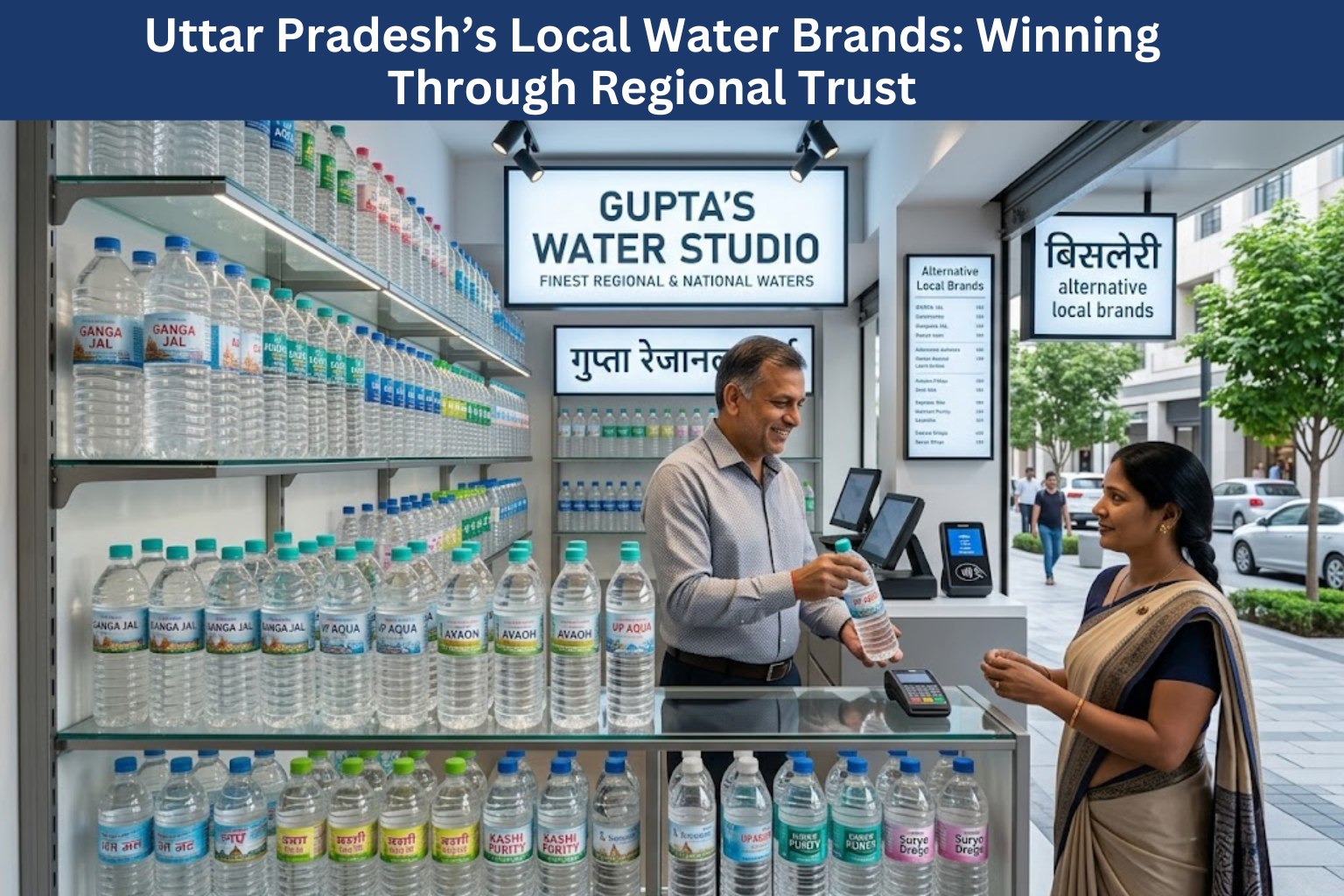
Alongside the national names, Uttar Pradesh supports a large number of regional packaged drinking water brands and private label manufacturers, the kind of local businesses that operate under names built around simple, memorable words such as King Aqua, Blue Gold, Wave Water or Fresh Up style branding, along with many more purely local, town specific labels that rarely appear outside their home districts. These local players collectively account for a meaningful share of everyday consumption across the state’s smaller cities and rural markets, even though they rarely challenge national brands in metro retail.
Why Regional Brands Survive and Grow
- Lower transportation costs: A plant located within or near a district town avoids the long haul freight costs that eat into a national brand’s regional margins, allowing local brands to price competitively while still protecting their own margin.
- Dealer relationships: Local manufacturers often work with the same handful of distributors and retailers for years, building trust based relationships that are harder for an outside national brand to replicate quickly.
- Better retailer margins: Because local brands do not need to fund large national advertising budgets, they can typically offer retailers a better per case margin than national competitors, which keeps small shopkeepers loyal even without heavy brand advertising.
- Local trust: In many tier two and tier three Uttar Pradesh towns, consumers trust a familiar local name, particularly one associated with a known local manufacturer or family business, as much as or more than a national brand they primarily know from television advertising.
- Faster replenishment: Local production means retailers rarely run out of stock during demand spikes, since replenishment does not depend on regional warehouses located hundreds of kilometres away.
OUR OTHER PRODUCT
Why Even Established Mineral Water Brands Leave Room for New Entrepreneurs
Despite the scale of national and regional competition already active in Uttar Pradesh, several structural gaps continue to create room for new entrants:
- Thousands of retailers still depend on local suppliers, particularly in smaller towns and rural markets where national brand distribution simply does not reach efficiently or consistently.
- Seasonal supply fluctuations during summer months and festival and pilgrim seasons regularly strain existing supply chains, creating temporary shortages that local, flexible producers are well placed to fill.
- Growth in housing societies across Lucknow, Noida, Greater Noida and other expanding urban areas is creating fresh institutional demand for bulk jar water supply contracts.
- Hotels, banquet halls and caterers, an industry segment that has expanded dramatically alongside Uttar Pradesh’s wedding and events economy, frequently prefer working with responsive local suppliers who can guarantee same day delivery for large events.
- Institutions and industrial canteens, including schools, colleges, hospitals and manufacturing units, represent a steady, contract based demand segment that rewards reliability over brand recognition.
 Call Now
Lucknow: Can a Local Mineral Water Brand Compete With Bisleri?
Lucknow, Uttar Pradesh’s capital, presents a genuinely interesting test case. National brands dominate retail shelf space across the city’s markets, but a closer look at where Lucknow’s packaged water is actually consumed reveals real opportunity for well run local and private label businesses.
Where Demand Concentrates in Lucknow
- Government offices and the state secretariat, which together represent one of the largest institutional buyers of bulk water in the city
- The city’s large medical sector, including King George’s Medical University and several major private hospitals, each of which requires certified purified water around the clock
- Lucknow’s extensive coaching institute ecosystem, which draws students from across eastern Uttar Pradesh and creates dense, price sensitive retail demand near campuses
- Corporate offices in Gomti Nagar and the Vibhuti Khand business district
Where Opportunities Still Exist for Local Mineral Water or Packaged Drinking Water Brands
A local Lucknow brand is unlikely to out market Bisleri on brand recall alone, but it can compete effectively on institutional contracts with government departments and hospitals, on bulk jar supply to coaching institutes and student hostels, and on private label supply to the city’s rapidly growing banquet hall and events industry, none of which depend primarily on national television advertising to win business.
For entrepreneurs researching this market, common questions include how to start a mineral water plant in Lucknow with relatively low upfront investment, what the typical setup costs look like for a packaged drinking water facility in the city, which industrial zones in Lucknow are best suited to a beverage production unit, and where to find manufacturers of bottling equipment for purified water in India, questions this article and the DTPPL section below address directly.
NCR (Noida and Greater Noida): Why Private Label Bottled Water Is Growing Faster Than Branded Water
Noida and Greater Noida represent one of Delhi NCR’s fastest growing commercial corridors. Noida recorded roughly 4.7 million square feet of office leasing in a recent full year period, and total office inventory across the city now exceeds 35 million square feet, according to commercial real estate industry reporting. The newly operational Noida International Airport at Jewar, which began commercial flights in mid 2026, is expected to further accelerate corporate and hospitality development across the wider Noida and Greater Noida corridor in the coming years.
Key Demand Drivers in NCR
- Corporate branding: IT parks, corporate towers and global capability centres across Sector 62, the Noida Expressway belt and Greater Noida increasingly want custom branded bottled water for meeting rooms, events and client hospitality, a segment that inherently favours private label production over generic national brands.
- Hotels, cafes and restaurants: The rapid growth of hospitality and food service outlets across Noida and Greater Noida is creating steady institutional demand for both branded and private label water supply.
- Real estate: New residential townships and commercial developments frequently include their own branded amenities, including custom labelled water for resident welfare associations and sales offices.
- Events: Noida’s growing exhibition, conference and corporate event industry regularly orders large volumes of custom branded bottled water for conferences, product launches and trade shows.
Why Private Label Is Outpacing Branded Water Here
Corporate buyers in NCR increasingly view custom branded water as a low cost, high visibility branding tool, favouring private label suppliers who can print a company logo on the bottle over generic national brands, even when the underlying manufacturing quality is comparable. This shift favours local and regional manufacturers who can offer flexible minimum order quantities and fast turnaround, both of which large national brands are typically not structured to provide efficiently.
Entrepreneurs evaluating this market often search for the essential permits required for a bottled water facility in Noida, mineral water plant installation services available in Greater Noida, and a cost breakdown for setting up a small mineral water bottling unit near Greater Noida, all of which are addressed in the setup and DTPPL sections later in this article.
Ayodhya: The Rise of the Temple Economy and Demand for Packaged Drinking Water
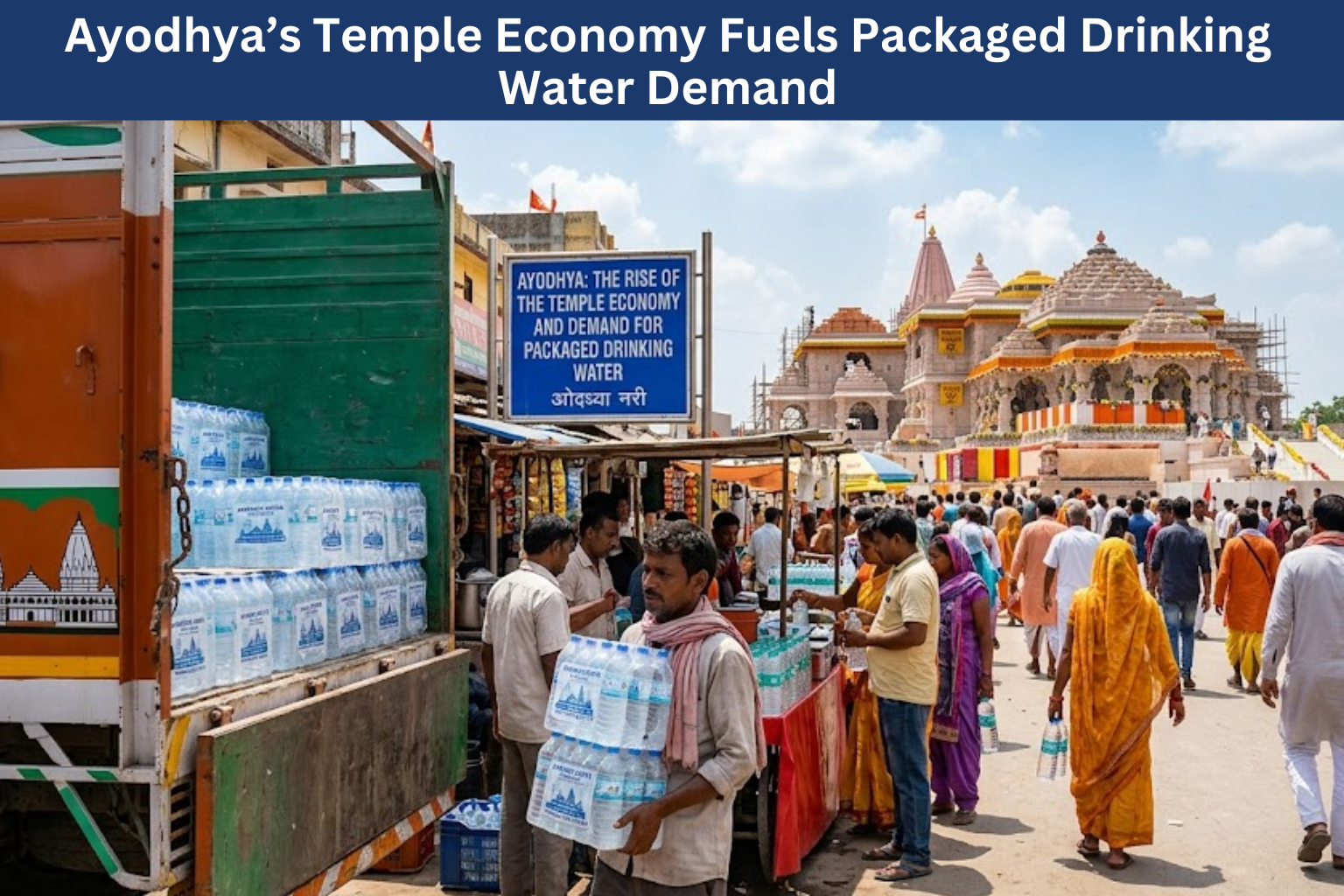
Ayodhya represents perhaps the most dramatic demand transformation of any city covered in this article. According to a January 2026 IIM Lucknow study titled The Economic Renaissance of Ayodhya, annual footfall jumped from around 1.7 lakh visitors in the years before the Ram Mandir’s consecration to more than 11 crore visitors in just the first six months following the temple’s January 2024 opening. Cumulative footfall since consecration had crossed roughly 22 crore visitors by mid October 2025, and the same study projects Ayodhya’s tourism economy could approach Rs 10,000 crore annually as the current growth trajectory continues.
What This Means for Packaged Drinking Water
- Temple distribution: The sheer scale of daily and festival day footfall around the temple complex has created an enormous, geographically concentrated demand point that simply did not exist before 2024.
- Pilgrim packs: Small, affordable pack sizes designed specifically for pilgrims travelling by road and rail represent a distinct product category from standard retail bottled water.
- Hotels and dharamshalas: Hotel room inventory in Ayodhya has grown from roughly 3,500 to 4,000 rooms in 2020 to over 5,000 rooms by 2025, with projections suggesting the city may need up to 12,500 rooms by 2031, and every one of these properties requires a dependable bottled water supply chain.
- Community kitchens: Large scale community kitchens and prasad distribution operations around the temple complex consume packaged water in bulk quantities for food preparation and serving.
OUR OTHER PRODUCT
The Opportunity: Private Label Religious Bottled Water
Ayodhya’s scale of pilgrim traffic creates a genuine opening for private label bottled water carrying temple linked or pilgrimage themed branding, sold through hotels, dharamshalas, temple trust outlets and roadside stalls along the main pilgrim routes. Investors researching this opportunity commonly ask how to start a mineral water bottling plant in Ayodhya, what the mineral water plant setup cost in Ayodhya looks like, and where to find suppliers of water treatment and bottling machinery near Ayodhya, questions this article addresses directly in the sections that follow.
 Email Us Now!
Varanasi: How Pilgrimage Tourism Creates a Massive Retail Water Market
Varanasi recorded an extraordinary 7.26 crore visitors in a recent year according to Uttar Pradesh government tourism data, a figure that placed the city ahead of both Goa and Agra in total tourist arrivals and made it one of India’s three largest spiritual tourism destinations alongside Prayagraj and Ayodhya. Much of this surge is credited to the redevelopment of the Kashi Vishwanath Dham corridor and the extensive beautification of the Ganga ghats, both of which have made the city dramatically more accessible to large volumes of pilgrims and tourists.
Where Water Demand Concentrates in Varanasi
- The ghats: The riverside ghats, where pilgrims spend extended periods for rituals, boat rides and the daily Ganga Aarti ceremony, are dense, continuous points of retail bottled water demand throughout the day.
- Hotels: Varanasi’s rapidly growing hotel and homestay sector, expanding alongside the broader spiritual tourism boom, requires consistent bulk water supply.
- Boat operators: The city’s large fleet of boat operators serving ghat to ghat pilgrim traffic represents a steady informal retail channel for bottled water.
- Tourist buses and railway stations: Varanasi Junction and Varanasi Cantt railway stations, along with the tourist bus terminals serving pilgrim groups, are among the highest footfall retail points for packaged water in the entire city.
Brands Commonly Available and the Opportunity for Local Bottlers
National brands maintain a strong presence at Varanasi’s railway stations, airport and larger hotels, but the sheer density of ghat side kiosks, small hotels, boat operators and street vendors creates substantial room for local and regional bottlers who can offer better margins and faster replenishment during the city’s frequent festival driven demand surges, such as Mahashivratri and the holy month of Sawan. Entrepreneurs evaluating this market frequently ask how much capital is needed to set up a small mineral water production unit in Varanasi, what the regulatory requirements are for starting a packaged drinking water plant in Varanasi, and which government schemes support food processing industries in Varanasi district, all covered later in this article.
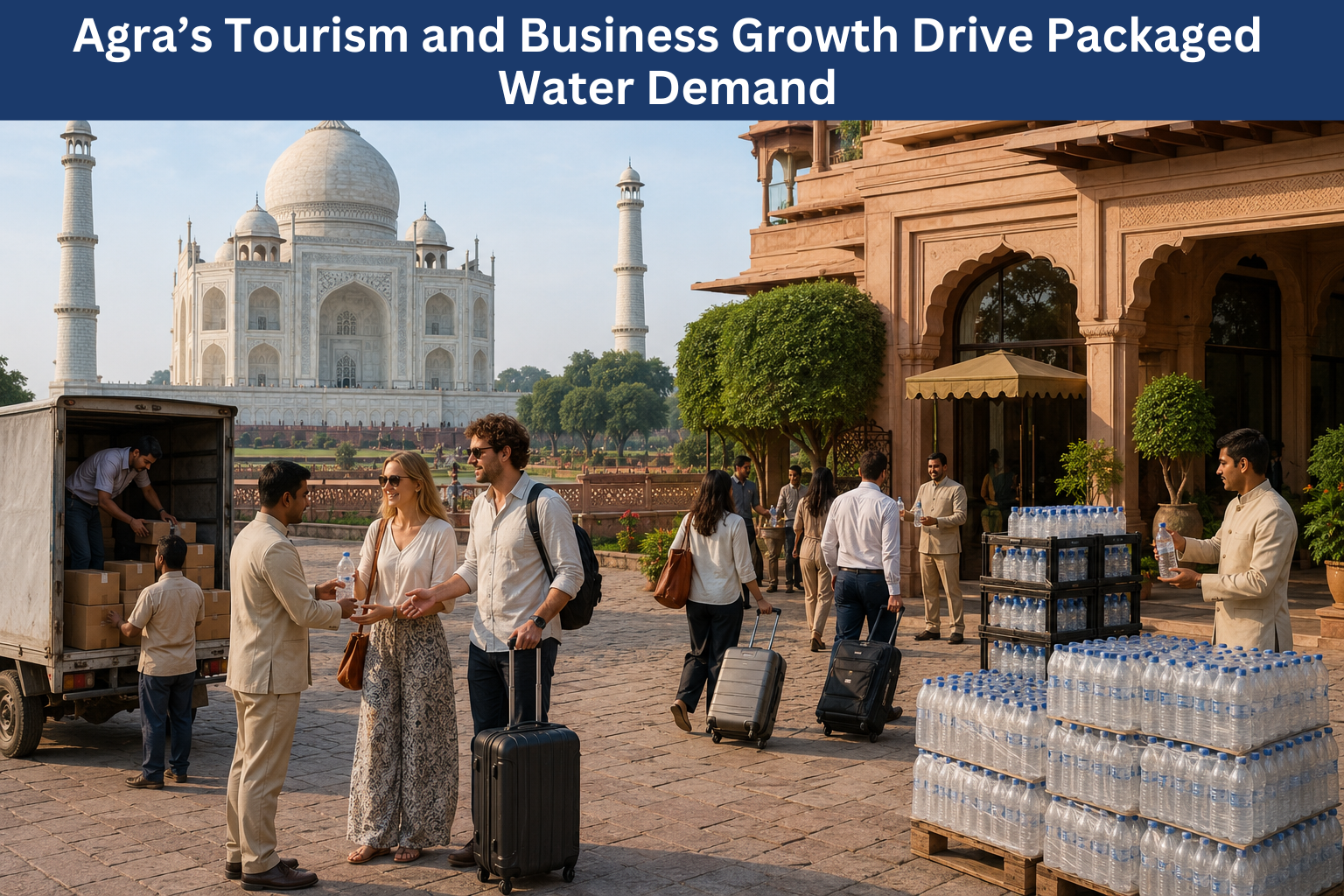
Agra: Tourism, Hotels and Export Businesses Fuel Water Consumption
Agra’s water demand is anchored by one of the world’s most recognisable monuments. The Taj Mahal recorded approximately 6.9 million visitors in the 2024 to 2025 fiscal year according to official tourism data, making it consistently the single most visited ticketed monument in India, alongside strong numbers at the nearby Agra Fort.
Key Demand Drivers in Agra
- Taj Mahal tourism: Peak season, roughly October through March, regularly sees more than 10,000 daily visitors at the Taj Mahal alone, each of whom is a potential bottled water purchaser during a typically hot, extended outdoor visit.
- Luxury hotels: Agra’s hospitality sector, built almost entirely around monument tourism, includes numerous five star and boutique properties that require premium bottled water for guest service.
- Restaurants: The city’s large tourist focused restaurant sector, concentrated around the Taj Mahal East and West gates and the Fatehabad Road hotel belt, consumes significant volumes of bottled water for dine in service.
- Travel agencies: Agra’s tour operator and travel agency ecosystem frequently bulk purchases bottled water for inclusion in day tour packages for both domestic and international visitors.
Investors examining this city often search for the best mineral water plants near Agra, the average cost to establish a small scale mineral water bottling unit in Agra, and licensing requirements for a new water bottling business in Uttar Pradesh, all addressed in the government policy and setup sections below.
Which Brands Dominate Different Cities: A Comparison
City | National Brands Present | Regional and Local Brands | Private Label Activity | Where the Opportunity Lies |
Lucknow | Bisleri, Kinley, Aquafina, Bailley widely available in retail | Multiple town and district level local brands | Growing among banquet halls and coaching institutes | Institutional contracts with government offices, hospitals and coaching centres |
NCR (Noida and Greater Noida) | Bisleri, Kinley, Aquafina strong in modern retail and hotels | Fewer, since national distribution is strongest here | Fast growing among corporate offices, real estate developers and events | Custom branded private label water for corporate and event clients |
Ayodhya | Bisleri and Kinley visible at hotels and larger retail points | Emerging rapidly since 2024 alongside new hotel and dharamshala supply chains | High growth potential, still largely untapped | Pilgrim pack private label and temple linked branding |
Varanasi | Strong presence at railway stations, airport and larger hotels | Significant presence around ghats, boat operators and smaller hotels | Growing among ghat side kiosks and homestays | Local bottling for ghat, boat and homestay supply chains |
Agra | Strong presence in hotels, Taj Mahal precinct retail | Present in local markets and among smaller restaurants | Moderate, concentrated in tour operator packages | Hotel and travel agency bulk supply contracts |
Retail Survey: Which Bottled Water Brands Do Consumers Buy Most?
Consumer purchase behaviour for bottled water varies significantly by retail channel across Uttar Pradesh’s cities:
- Railway stations: Rail Neer, produced specifically for Indian Railways, dominates platform and onboard sales, though national brands and small local vendors also operate at larger stations such as Varanasi Junction and Lucknow Charbagh.
- Airports: Premium national brands, particularly Himalayan and Kinley, dominate airport retail given the higher price tolerance of air travellers, notably at Lucknow, Varanasi and the newly operational Noida International Airport.
- Bus stations: Local and regional brands often outsell national names at bus stations due to significantly lower price points, an important factor for the price sensitive intercity bus traveller segment.
- Hotels: Premium properties favour Himalayan and other premium branded water, while budget hotels and dharamshalas, particularly in Ayodhya and Varanasi, frequently rely on local or private label suppliers.
- Restaurants: Mid market and budget restaurants across all five cities commonly stock a mix of one or two national brands alongside a locally sourced option to manage cost.
- Kirana stores: Small neighbourhood stores remain the strongest channel for regional and local brands, given better retailer margins and strong dealer relationships built over years.
- Modern retail: Supermarkets and organised retail chains in Lucknow, Noida and Greater Noida favour national brands almost exclusively, given supplier compliance and volume requirements.
- Highway dhabas: Independent roadside dhabas along the Purvanchal Expressway, Yamuna Expressway and Lucknow Agra Expressway frequently stock regional brands due to better margins, while branded highway food courts and fuel station outlets favour national names.
What Makes a Local Mineral Water Brand Successful?
Across Uttar Pradesh’s most resilient regional bottled water businesses, a consistent set of success factors tends to appear:
Success Factor | What It Looks Like in Practice |
Dealer network | Long standing relationships with a defined set of local distributors, built on consistent, on time supply |
Distribution | Delivery routes designed around the plant’s actual local catchment area, rather than trying to compete with national brands across an entire state |
Pricing | Prices positioned clearly below national brands while still protecting production margin, appealing to price sensitive retail and institutional buyers |
Bottle quality | Consistent PET bottle clarity, proper sealing and tamper evidence, which protects consumer trust even without heavy advertising |
Packaging | Clean, professional labeling that meets FSSAI and BIS marking requirements while still standing out on a crowded shelf |
Availability | Reliable stock levels that avoid the shortages that frustrate retailers and push them toward switching suppliers |
Retail margins | Margins generous enough to keep small shopkeepers loyal, even when national brands offer promotional schemes |
How Successful Brands Expand From One City to an Entire State
A recognisable growth pattern appears among Uttar Pradesh’s most successful regional bottled water brands, typically beginning in a single anchor city and expanding outward along logical transport and demand corridors:
Start in Lucknow ↓ Expand to Kanpur ↓ Ayodhya ↓ Prayagraj ↓ Varanasi ↓ Gorakhpur ↓ Entire Uttar Pradesh
This sequencing generally reflects transport connectivity along the Lucknow Agra corridor and the Purvanchal belt, as well as the practical logic of building distribution density in one region before investing in the next, rather than attempting to cover the entire state from a single plant on day one.
Private Label Bottled Water: The Fastest Growing Business Opportunity
Across all five cities covered in this article, private label bottled water stands out as the single fastest growing segment of the packaged drinking water business, driven by demand from:
- Hotels and resorts, which increasingly want custom branded water bearing their own property name rather than a generic national brand, as a low cost way to reinforce brand identity during a guest’s stay.
- Restaurants, particularly in tourist heavy cities such as Agra and Varanasi, where branded water reinforces a premium dining experience.
- Temples and religious trusts, especially in Ayodhya and Varanasi, where devotee facing branded water can double as a small revenue stream for the trust itself.
- Corporate gifting, where custom labelled water bottles are increasingly included in welcome kits, conference gift bags and festival hampers across NCR’s corporate sector.
- Airlines, which require compact, lightweight branded water packs for inflight service, a niche but steady institutional demand category.
- Events, including weddings, conferences and religious gatherings, which represent some of the highest volume, short duration demand spikes anywhere in this market.
For a new entrant, private label manufacturing offers a meaningful advantage over trying to build a competing consumer brand from scratch, since it relies on the client’s existing brand recognition rather than requiring years of independent marketing investment.
 WhatsApp!
 What New Investors Can Learn From Uttar Pradesh’s Most Successful Bottled Water Brands
Several consistent lessons emerge from studying how both national and successful regional brands have grown across Uttar Pradesh:
- Branding: Even a modest regional brand benefits from clean, consistent visual identity and a name that is easy to recall and pronounce across different linguistic regions of the state.
- Distribution: Sustainable growth depends on building distribution density in one region before expanding into the next, rather than spreading thin across too wide a geography too quickly.
- Manufacturing: Consistent product quality, verified through regular BIS and FSSAI compliant testing, protects a brand’s reputation far more effectively than advertising spend alone.
- Dealer network: Long term relationships with a loyal set of distributors and retailers tend to matter more for sustained growth than short term promotional discounting.
- Quality: Bottle integrity, seal quality and consistent taste and clarity remain the single biggest driver of repeat purchase, particularly among institutional and hotel buyers who cannot afford quality complaints from their own guests or staff.
- Marketing: Local sponsorships, visibility at religious festivals and community events, and simple point of sale branding tend to deliver stronger returns for regional brands than expensive mass media campaigns.
Read Our Article
Government Policies, Standards and Compliance Relevant to Uttar Pradesh
Entrepreneurs planning a new plant across Lucknow, NCR, Ayodhya, Varanasi or Agra need to navigate a consistent national regulatory framework, along with state level industrial incentives:
Requirement or Scheme | Relevance |
FSSAI licensing | Mandatory food safety license for all packaged drinking water, soft drink and juice manufacturers operating anywhere in India, including Uttar Pradesh |
BIS certification (IS 14543 for packaged drinking water, IS 13428 for packaged natural mineral water) | Mandatory quality certification administered by the Bureau of Indian Standards |
Uttar Pradesh Pollution Control Board consent | Consent to establish and consent to operate required before and after plant commissioning |
Central Ground Water Authority guidelines | Governs groundwater extraction for water intensive industries, including packaged water manufacturing |
Prime Minister’s Employment Generation Programme (PMEGP) | Subsidy linked credit support for new micro and small manufacturing units |
Ministry of Food Processing Industries schemes | Infrastructure and processing capacity support relevant to water and beverage manufacturing units, including schemes specifically promoted for food processing industries in districts such as Varanasi |
Uttar Pradesh state industrial policy | State level incentives, subsidies and simplified approvals for new industrial units, including those in designated food processing and beverage clusters |
Make in India initiative | Broader central government push encouraging domestic manufacturing across the food and beverage sector |
Entrepreneurs are encouraged to verify current eligibility criteria and subsidy details directly through the official portals of FSSAI (fssai.gov.in), the Bureau of Indian Standards (bis.gov.in), the Ministry of Food Processing Industries (mofpi.gov.in) and the Uttar Pradesh government’s industrial development portals, since scheme details are revised periodically.
The Equipment Ecosystem Behind a Modern Water Plant
A typical packaged drinking water or private label bottling project in any of these five cities is likely to require some combination of the following:
Equipment or Plant Type | Function |
Packaged drinking water plant | Complete treatment and packaging system for bottled and jar water |
Commercial and industrial RO plant | High capacity reverse osmosis treatment for bulk water purification |
Removes hardness causing minerals ahead of RO or process applications | |
Bottle filling machine | Automated or semi automated filling of treated water into bottles |
Converts PET preforms into finished bottles on site | |
Applies branded BOPP film labels at production speed, useful for private label runs | |
Applies adhesive sticker labels for smaller batch or private label production | |
Groups bottles into shrink wrapped multi packs for retail and institutional supply | |
Cleans and sanitises returnable 20 litre jars before refilling | |
Prints manufacturing date, batch number and expiry information for regulatory compliance | |
Fills low cost water pouches suited to price sensitive pilgrim and rural retail segments |
Investors researching this topic frequently look for suppliers of water treatment and bottling machinery in Uttar Pradesh, reputable machinery manufacturers for water bottling in India, and water purification systems suited to bottling plants in the NCR region, all of which point toward the value of working with a single, experienced turnkey partner rather than sourcing each machine separately.
Mineral Water Plant
Capacity: 500 LPH to 50,000 LPH
(USD 27,500 to USD 16,49,000)
How Dharmanandan Techno Projects Pvt. Ltd. (DTPPL) Can Help You Set Up a Water Treatment Plant in Uttar Pradesh
For entrepreneurs evaluating a new plant in Lucknow, Noida, Greater Noida, Ayodhya, Varanasi or Agra, Dharmanandan Techno Projects Pvt. Ltd. (DTPPL) offers turnkey design, supply and installation support across the full range of water treatment and packaging infrastructure, including:
- Packaged mineral water plants sized for retail, institutional or private label supply
- Commercial and industrial RO plants for bulk purification requirements
- Water softening plants for hardness removal ahead of RO or process applications
- PET bottle manufacturing lines, including automatic and semi automatic blow moulding machines
- Complete bottle filling, capping, labeling (BOPP and sticker), shrink wrapping and jar washing lines
- Batch coding and water pouch filling machinery for regulatory compliance and pilgrim or rural market reach
Because these five cities each present a distinct demand pattern, a steady institutional market in Lucknow, a fast growing private label corporate segment in NCR, an extreme pilgrim driven seasonal spike in Ayodhya and Varanasi, and a tourism anchored hospitality demand pattern in Agra, right sizing a plant’s capacity and product mix matters as much as the underlying machinery quality. DTPPL supports entrepreneurs through the full project lifecycle, from initial project cost estimation and machinery selection through installation and commissioning, allowing first time investors to work with a single technical partner rather than coordinating multiple vendors across RO systems, bottling lines and packaging machinery.
Frequently Asked Questions
How to start a mineral water plant in Lucknow with low investment?
Begin with a modest capacity RO and bottling setup focused on 20 litre jar supply to a defined set of institutional buyers, such as coaching institutes or small offices, before scaling into retail bottle production once distribution relationships are established. Typical setup costs vary widely depending on capacity, so it is worth getting a project specific estimate from an experienced turnkey supplier such as DTPPL.
What permits are required for a packaged drinking water unit in Uttar Pradesh?
Core requirements include an FSSAI license, BIS certification under IS 14543 or IS 13428 as applicable, and consent to establish and operate from the Uttar Pradesh Pollution Control Board, in addition to standard business registration and groundwater extraction clearance where applicable.
What is the mineral water plant setup cost in Ayodhya?
Setup cost depends heavily on capacity, source water quality and the specific machinery configuration chosen, and can range from a modest small scale investment to a significantly larger sum for a high capacity, fully automated line. Because Ayodhya’s demand is highly seasonal, many investors choose a flexible, scalable configuration rather than a single large fixed capacity plant, which changes the cost calculation considerably from a standard city based plant.
How much capital is needed to set up a small mineral water production unit in Varanasi?
A small scale unit focused on local ghat side, hotel and homestay supply typically requires a lower initial investment than a large retail focused plant, though exact figures depend on chosen capacity, machinery automation level and whether the plant targets jar water, bottled water or both.
Where can I find suppliers for mineral water plant machinery in India?
Reputable turnkey engineering partners such as DTPPL supply and install RO plants, water softening systems, blow moulding machines, filling lines and labeling and packaging equipment as part of a complete project package, which is generally more efficient than sourcing each machine from a separate vendor.
What are the regulatory requirements for starting a packaged drinking water plant in Varanasi?
The same national framework applies as elsewhere in Uttar Pradesh: an FSSAI license, BIS certification, and Uttar Pradesh Pollution Control Board consent, alongside any additional local approvals administered through the Varanasi district industries office.
Which types of water purification technologies are best for mineral water production?
Reverse osmosis remains the core purification technology for most Indian packaged drinking water plants, frequently combined with pre treatment steps such as sand filtration, activated carbon filtration and water softening depending on the source water’s total dissolved solids and hardness levels, followed by ultraviolet or ozone disinfection before filling.
Is there still business opportunity for new entrants given how strong Bisleri, Kinley and Aquafina already are across Uttar Pradesh?
Yes. India’s packaged drinking water market remains only partially organised nationally, and national brands cannot efficiently serve every institutional contract, private label request, temple trust supply need or rural retail point across a state as large as Uttar Pradesh, leaving substantial room for regional and private label manufacturers.
What government schemes support food processing industries in Varanasi district and elsewhere in Uttar Pradesh?
Relevant support includes central schemes administered by the Ministry of Food Processing Industries, the Prime Minister’s Employment Generation Programme, MSME development schemes, and Uttar Pradesh’s own state industrial policy incentives for food processing and beverage manufacturing units. Current eligibility and subsidy details should be verified directly through the respective official government portals.
Conclusion
Uttar Pradesh’s packaged drinking water market, estimated at roughly Rs 5,500 to Rs 6,000 crore today, sits at the intersection of the state’s massive population base, its position as India’s leading domestic tourism destination, and a wave of religious tourism growth in Ayodhya and Varanasi that has fundamentally reshaped local demand patterns in just the past two years. National brands such as Bisleri, Kinley, Aquafina, Bailley, Rail Neer and Himalayan have built strong distribution networks and consumer trust across the state’s retail landscape, but Lucknow’s institutional buyers, NCR’s fast growing private label corporate segment, Ayodhya and Varanasi’s pilgrim driven seasonal surges, and Agra’s tourism and hospitality demand all continue to leave meaningful room for regional brands and new entrants who can offer local responsiveness, competitive retailer margins and flexible private label manufacturing. Entrepreneurs evaluating this opportunity are well advised to study each city’s specific demand pattern in detail, work through the applicable FSSAI, BIS and state government requirements, and partner with an experienced turnkey provider such as DTPPL to design a plant that is right sized, compliant and built for long term growth.
Our associates

































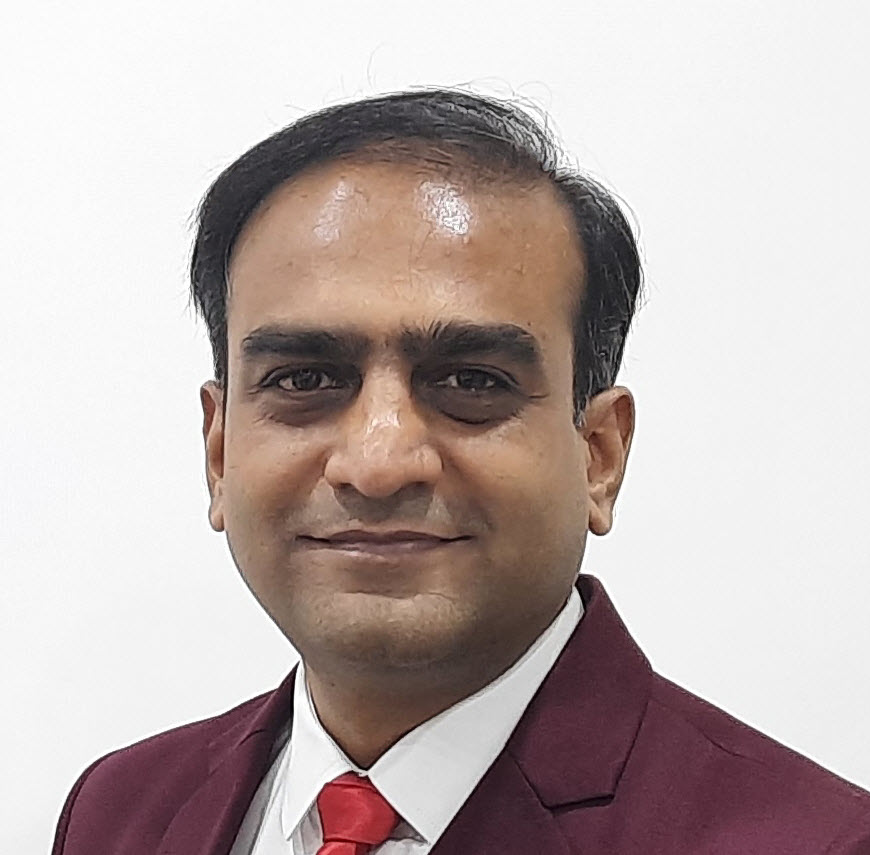
Director – Global Marketing and Sales
Mr. Bhavesh from Dharmanandan Techno Projects Pvt. Ltd. has played a pivotal role in elevating the DTPPL brand to the global stage, leveraging his exceptional expertise in marketing and communications. He is committed to helping clients achieve significant growth while strengthening their own brands. Dharmanandan Techno Projects Pvt. Ltd. is a leading manufacturer and supplier of water purification systems and turnkey solutions for mineral water plants. With years of experience in designing and delivering high-quality water treatment solutions, the company provides end-to-end services, including system design, installation, maintenance, and ongoing support. Specializing in scalable and customizable water plants, DTPPL has successfully served industries worldwide, ensuring clean and safe drinking water across diverse applications.