



Listening Article
Table of Contents
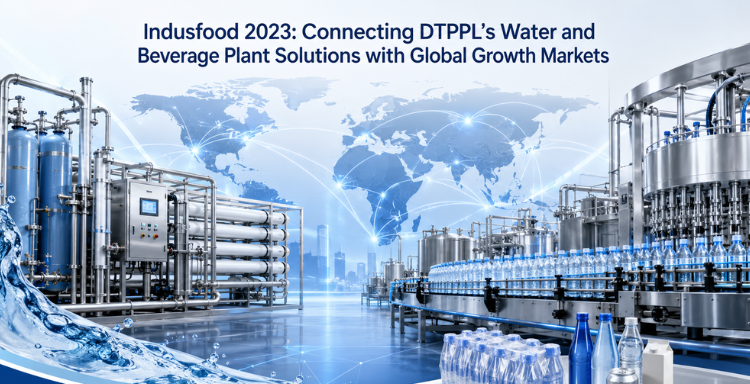
Indusfood 2023: Connecting DTPPL’s Water and Beverage Plant Solutions with Global Growth Markets
July 14, 2026
AI Summary
Indusfood Ahmedabad 2026 will bring together food and beverage manufacturers, exporters, importers, retailers, technology providers and investors from India and international markets. Scheduled for 24–26 July 2026 at the Helipad Exhibition Centre in Gandhinagar, Gujarat, the exhibition will create a valuable setting for discussing new manufacturing projects, production expansion and supply-chain partnerships.
For businesses planning mineral water plants, packaged drinking water facilities, juice production lines or carbonated soft drink plants, the event presents an opportunity to evaluate the machinery and infrastructure needed to move from a product idea to commercial production. Dharmanandan Techno Projects Pvt. Ltd. (DTPPL) supports these requirements through water treatment, beverage processing, bottle manufacturing, filling, labelling and secondary packaging solutions.
Indusfood Ahmedabad 2026: A Business Platform for the F&B Industry
The 2023 image used as a reference contains outdated event information and should not be used for the upcoming edition. According to the current official event website, Indusfood Ahmedabad 2026 will take place from 24 to 26 July 2026, between 10:00 AM and 6:00 PM, at the Helipad Exhibition Centre, Sector 17, Gandhinagar, Gujarat, India.
Organised by the Trade Promotion Council of India (TPCI) and supported by the Government of India, Indusfood Ahmedabad is positioned as Western India’s prominent food and beverage trade platform. The exhibition is expected to connect global buyers and sellers with food processors, manufacturers, exporters, supermarket and retail chains, HoReCa representatives, distributors and technology providers.
The official visitor information highlights an anticipated audience of more than 15,000 trade visitors and participation from over 40 supermarket and retail chains. Its programme also addresses food exports, automation, AI, supply-chain efficiency, packaging technology, product authentication and brand protection.
This business-oriented environment is particularly relevant to manufacturers who are not only sourcing finished food and beverage products but also planning the infrastructure required to manufacture, bottle and package them.
From Product Demand to Production Infrastructure
A growing beverage brand eventually faces questions that cannot be answered through product sourcing alone:
- What water treatment process is suitable for the available raw water?
- Which plant capacity aligns with projected market demand?
- Should bottles be manufactured in-house or sourced externally?
- Which filling technology is appropriate for water, juice or carbonated beverages?
- How can labelling and secondary packaging be integrated into the line?
- Can the facility be expanded when distribution reaches additional markets?
Indusfood Ahmedabad 2026 can help bring investors, processors, equipment manufacturers and trade buyers into the same commercial setting. This allows a proposed plant to be considered as a complete production system rather than as a collection of unrelated machines.
It is within this context that DTPPL’s engineering portfolio becomes relevant to beverage manufacturers, packaged water companies and industrial users.
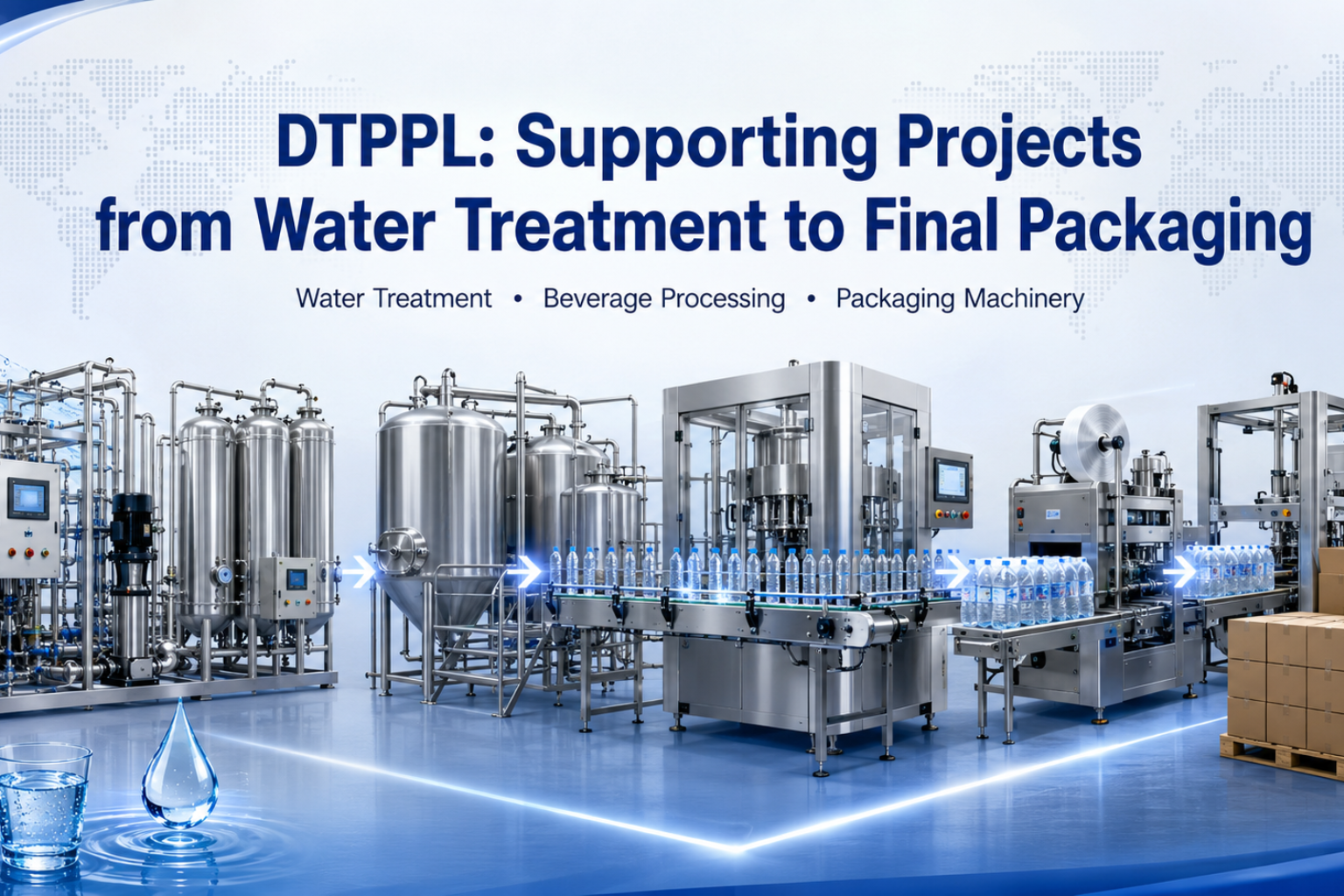
DTPPL: Supporting Projects from Water Treatment to Final Packaging
Established in 2011, Dharmanandan Techno Projects Pvt. Ltd. manufactures and supplies water treatment, beverage processing and packaging machinery. The company’s solutions cover mineral water plants, packaged drinking water plants, carbonated soft drink plants, juice manufacturing plants, reverse osmosis systems, industrial RO plants and water softening systems.
Its wider portfolio supports several stages of the production cycle:
- Water treatment: RO systems, industrial RO plants, water softeners and related treatment infrastructure.
- Beverage processing: Mineral water, packaged drinking water, juice and carbonated soft drink plants.
- Container production: Automatic and semi-automatic PET blow moulding machines.
- Filling operations: Water bottle filling, juice filling, carbonated beverage filling, jar filling and liquid pouch filling machinery.
- Product presentation: BOPP labelling, sticker labelling and shrink-sleeve application systems.
- End-of-line packaging: Automatic and semi-automatic shrink wrapping machines.
- Supporting equipment: Jar washing machines, batch coding machines, water chillers and Water ATMs.
This integrated range can help project owners coordinate the movement of a product from treatment and processing through to container preparation, filling, identification and dispatch packaging. It also reduces the need to plan each production stage without considering its impact on the next.
Client Review
“DTPPL’s Mineral Water Processing Plant exceeded our expectations on both build quality and operational performance. The plant runs seamlessly with exceptional energy efficiency and minimal downtime, which has significantly optimized our production costs. From precise filtration standards to excellent after-sales service, DTPPL has proven to be a dependable business partner. Highly recommended for any beverage company seeking high-capacity, hassle-free bottling solutions.”
– Surbhi Parekh
How Different Industries Can Benefit from DTPPL’s Solutions
Mineral Water and Packaged Drinking Water Manufacturers
For a packaged water business, the treatment plant is only the beginning. Commercial output also depends on bottle availability, hygienic filling, secure capping, accurate labelling, coding and transport-ready packaging.
DTPPL can assist with the configuration of these connected stages according to the proposed capacity, container format, automation level and available factory space. Start-ups may require a carefully scaled line that controls initial investment, while established manufacturers may be looking for faster filling, automated bottle production or improved secondary packaging.
The discussion at an international exhibition can therefore focus on the manufacturer’s real business model: local retail bottles, institutional jars, water pouches, hospitality supply or multi-format distribution.
OUR OTHER PRODUCT
Juice and Fruit-Based Beverage Producers
Juice manufacturers must consider characteristics such as product composition, temperature, pulp content, filling conditions, bottle format and cleaning requirements. A general water-filling arrangement may not be appropriate for every juice product.
DTPPL’s juice manufacturing and juice filling solutions can support businesses developing packaged fruit beverages or expanding an existing range. PET bottle production, labelling and shrink wrapping can also be planned alongside the processing and filling sections, helping manufacturers create a more coordinated production line.
Carbonated Soft Drink Manufacturers
Carbonated beverages require controlled processing and filling to maintain consistency and carbonation. Manufacturers must also balance production speed with bottle strength, closure performance, presentation and pack stability.
DTPPL supplies carbonated soft drink plants and associated packaging machinery that can be configured around the intended product range and output. This is relevant to established beverage companies as well as regional brands developing flavoured carbonated drinks for local and export markets.
Food, Hospitality and Industrial Operations
Water treatment is equally important outside retail beverage production. Hotels, restaurants, food-processing facilities, institutions and industrial units may require treated process water, softened water or reliable purified-water infrastructure.
Industrial RO systems and water softeners can be considered according to the source-water condition and the intended application. DTPPL’s Water ATM solutions-combining purification, dispensing and optional chilling-can also support public, institutional and community water-access projects.
 Call Now
International Demand, Trends and Opportunities
The global opportunity for water and beverage plants is not uniform. Each market requires a different combination of capacity, product format, automation and distribution planning.
Africa: Local Production and Accessible Pack Formats
Many African markets present opportunities for local packaged water and beverage manufacturing because of expanding cities, developing retail networks and the continuing need for dependable drinking-water access.
The commercial requirement may range from PET bottling plants for urban distribution to jar-filling, pouch-packing or Water ATM projects for institutional and community applications. Equipment selection must consider local power conditions, operator availability, spare-parts planning and achievable distribution radius.
For investors in countries such as Kenya, Tanzania, Ghana, Nigeria, Uganda and Zambia, a scalable plant can provide a practical route into local manufacturing while leaving room for future automation or additional beverage categories.
Middle East: Premium Products and Consistent High-Volume Output
Markets across the UAE, Saudi Arabia, Oman and other Gulf countries have strong requirements for packaged water, hospitality beverages and dependable industrial water treatment. Climate, tourism, institutional consumption and premium retail presentation influence plant planning.
Manufacturers targeting this region may prioritise consistent bottle quality, automated filling, accurate labelling and durable shrink-wrapped packs. Juice and functional beverage businesses may also require flexible lines capable of supporting multiple pack sizes for retail, hospitality and food-service channels.
Southeast Asia: Diversified Beverage Portfolios
Indonesia, Vietnam, the Philippines, Thailand and neighbouring markets have active beverage sectors shaped by large consumer populations, warm climates and extensive convenience-retail networks.
Manufacturers may begin with packaged water and later add juice, flavoured drinks or carbonated beverages. A modular project strategy can help them plan common packaging infrastructure while selecting product-specific processing and filling systems. PET blow moulding and adaptable labelling equipment can be particularly useful when a business operates several bottle sizes or brands.
South America: Regional Brands and Production Modernisation
Brazil, Colombia, Peru and other South American markets offer opportunities for bottled water, fruit beverages and carbonated drinks. Regional producers may seek to replace labour-intensive operations, improve filling consistency or bring bottle manufacturing in-house.
For such projects, DTPPL’s relevance extends beyond supplying an individual machine. Discussions can address how water treatment, filling, PET bottle production, labelling and shrink wrapping should be balanced so that one section does not restrict the capacity of the entire line.
OUR OTHER PRODUCT
Developed Markets: Efficiency, Traceability and Specialised Production
In the United States, Europe and Australia, project decisions are strongly influenced by production efficiency, repeatability, documentation, traceability and the ability to serve specialised product segments.
Potential opportunities include regional bottled-water operations, private-label beverage production, contract packing and manufacturing plants serving specific communities. Equipment proposals for these markets must be evaluated alongside applicable local regulations, electrical standards, packaging requirements and service expectations.
Why Indusfood Ahmedabad 2026 Matters for International Project Discussions
International plant procurement requires more than comparing machine specifications. Buyers need to consider raw-water analysis, product formulation, bottle sizes, target output, factory layout, labour, utilities, local compliance and future expansion.
Indusfood Ahmedabad 2026 provides a suitable environment for turning these variables into structured project discussions. Prospective investors can arrive with details of their market and production goals, while technology providers can help identify the machinery combination required to achieve them.
For DTPPL, the exhibition is relevant as a bridge between food and beverage demand and the engineering infrastructure behind it. For international buyers, it offers an opportunity to explore how an India-based water treatment and packaging machinery manufacturer can support a project intended for another country.
Mineral Water Plant
Capacity: 500 LPH to 50,000 LPH
(USD 27,500 to USD 16,49,000)
Conclusion
Indusfood Ahmedabad 2026 represents more than a finished-product sourcing event. It is a platform where the future capacity of the food and beverage industry can be discussed—from export growth and retail expansion to automation, packaging and new manufacturing investment.
DTPPL’s portfolio enables mineral water producers, juice manufacturers, carbonated beverage companies and industrial users to evaluate solutions across the production chain. By aligning water treatment, processing, bottle manufacturing, filling, labelling and final packaging, businesses can develop plants that reflect their current market while remaining prepared for future growth.
For investors considering a new beverage facility or the expansion of an existing plant, the exhibition can serve as the starting point for a technically informed, market-specific project discussion.
Frequently Asked Questions
When and where will Indusfood Ahmedabad 2026 take place?
Indusfood Ahmedabad 2026 is scheduled for 24–26 July 2026, from 10:00 AM to 6:00 PM, at the Helipad Exhibition Centre, Sector 17, Gandhinagar, Gujarat, India. These are the current official details and replace the outdated 2023 information in the reference image.
Who hosts Indusfood Ahmedabad 2026?
The exhibition is organised by the Trade Promotion Council of India (TPCI) and supported by the Government of India. It is designed to connect food and beverage manufacturers, exporters, buyers, retailers, distributors and industry solution providers.
Which DTPPL solutions are relevant to mineral water manufacturers?
DTPPL’s portfolio includes mineral water and packaged drinking water plants, RO systems, bottle filling lines, PET blow moulding machines, jar filling and washing systems, pouch packing machines, labelling machines, batch coding and shrink wrapping equipment.
Can DTPPL support juice and carbonated beverage projects?
Yes. DTPPL provides juice manufacturing and filling plants as well as carbonated soft drink processing and filling solutions. Supporting bottle production, labelling and secondary packaging equipment can also be incorporated into the project plan.
How should an international buyer prepare for a plant discussion?
The buyer should bring available raw-water information, proposed products, bottle or pouch sizes, target production capacity, available factory space, utility details, desired automation level and destination-country requirements. This enables a more relevant technical assessment.
Can a plant be planned for future expansion?
A project can be evaluated with expansion in mind, but this should be discussed at the planning stage. Treatment capacity, filling speed, bottle production, labelling and packaging must be balanced to prevent future bottlenecks.
Is DTPPL useful only for beverage manufacturers?
No. Food-processing units, hotels, institutions, commercial facilities and other industries may require industrial RO systems, water softeners, treated process-water systems or automated drinking-water dispensing solutions.
Our associates




































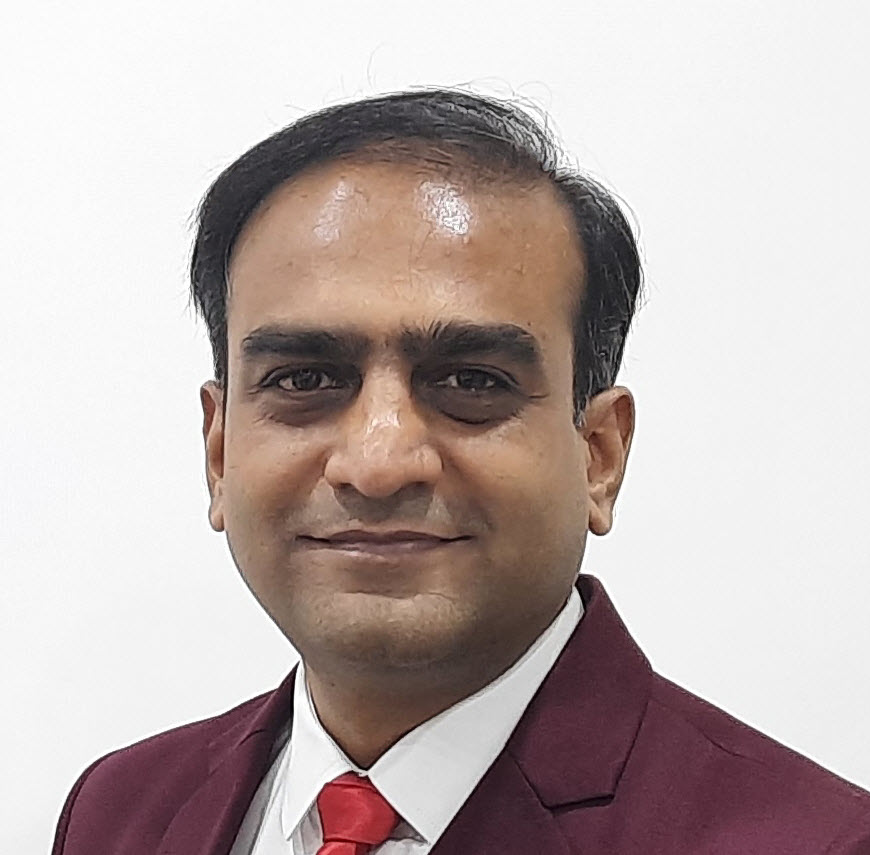
Director – Global Marketing and Sales
Mr. Bhavesh from Dharmanandan Techno Projects Pvt. Ltd. has played a pivotal role in elevating the DTPPL brand to the global stage, leveraging his exceptional expertise in marketing and communications. He is committed to helping clients achieve significant growth while strengthening their own brands. Dharmanandan Techno Projects Pvt. Ltd. is a leading manufacturer and supplier of water purification systems and turnkey solutions for mineral water plants. With years of experience in designing and delivering high-quality water treatment solutions, the company provides end-to-end services, including system design, installation, maintenance, and ongoing support. Specializing in scalable and customizable water plants, DTPPL has successfully served industries worldwide, ensuring clean and safe drinking water across diverse applications.