


Table of Contents
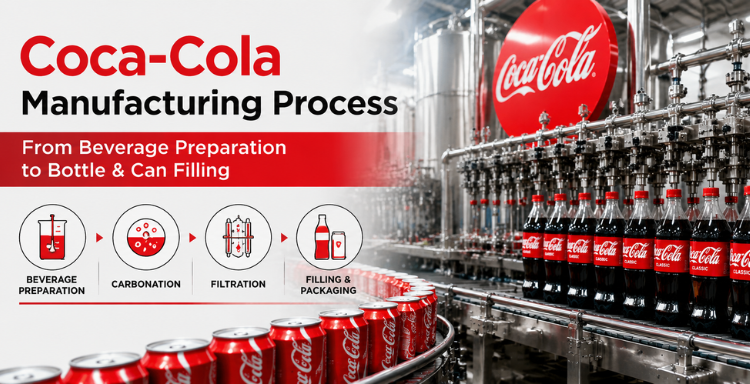
Coca-Cola Manufacturing Process: From Beverage Preparation to Bottle & Can Filling
July 16, 2026
Few products in the world are as instantly recognizable as a chilled bottle or can of Coca-Cola. Yet behind every serving lies one of the most sophisticated and precisely engineered production systems in the food and beverage industry. The Coca-Cola manufacturing process combines advanced water treatment, precision ingredient blending, controlled carbonation, and high-speed filling technology – all executed at a scale that delivers more than 2 billion servings every single day across the globe.
Whether you are a beverage entrepreneur planning your own carbonated soft drink (CSD) plant, a student of food technology, or a manufacturer evaluating filling and packaging equipment, understanding the production process of Coca-Cola offers a masterclass in modern beverage manufacturing. In this comprehensive guide, we break down every stage – from raw materials and syrup preparation to how soda cans are manufactured and filled – and explain the processing equipment that makes it all possible.
Introduction to Coca-Cola Manufacturing
Overview of Carbonated Soft Drink Production
Carbonated soft drink production is a multi-stage industrial process that transforms treated water, sweeteners, flavour concentrates, and carbon dioxide into a finished, packaged beverage. The manufacturing process of Coca-Cola follows the same fundamental principles used across the CSD industry, but with exceptionally tight quality standards that ensure a Coca-Cola produced in India tastes identical to one produced in Brazil, Japan, or the United States.
At its core, Coca-Cola production involves four pillars:
- Water treatment – purifying water to a consistent global standard
- Syrup and beverage preparation – blending concentrate, sweetener, and water
- Carbonation – dissolving CO₂ into the chilled beverage under pressure
- Filling and packaging – transferring the finished drink into bottles or cans without losing carbonation
How Modern Beverage Manufacturing Plants Operate
A modern Coca-Cola bottling plant is a highly automated facility where the beverage travels from raw water intake to palletized finished goods with minimal human contact. Production lines commonly run at speeds of 300 to over 2,000 containers per minute, monitored by inline sensors, automated inspection systems, and centralized PLC/SCADA controls. Hygiene is maintained through Clean-in-Place (CIP) systems that sanitize tanks, pipelines, and fillers without dismantling equipment.
This level of automation, consistency, and hygiene is exactly what any serious beverage manufacturer must replicate – and it starts with understanding each stage of the process in detail.

Raw Materials Used in Coca-Cola Production
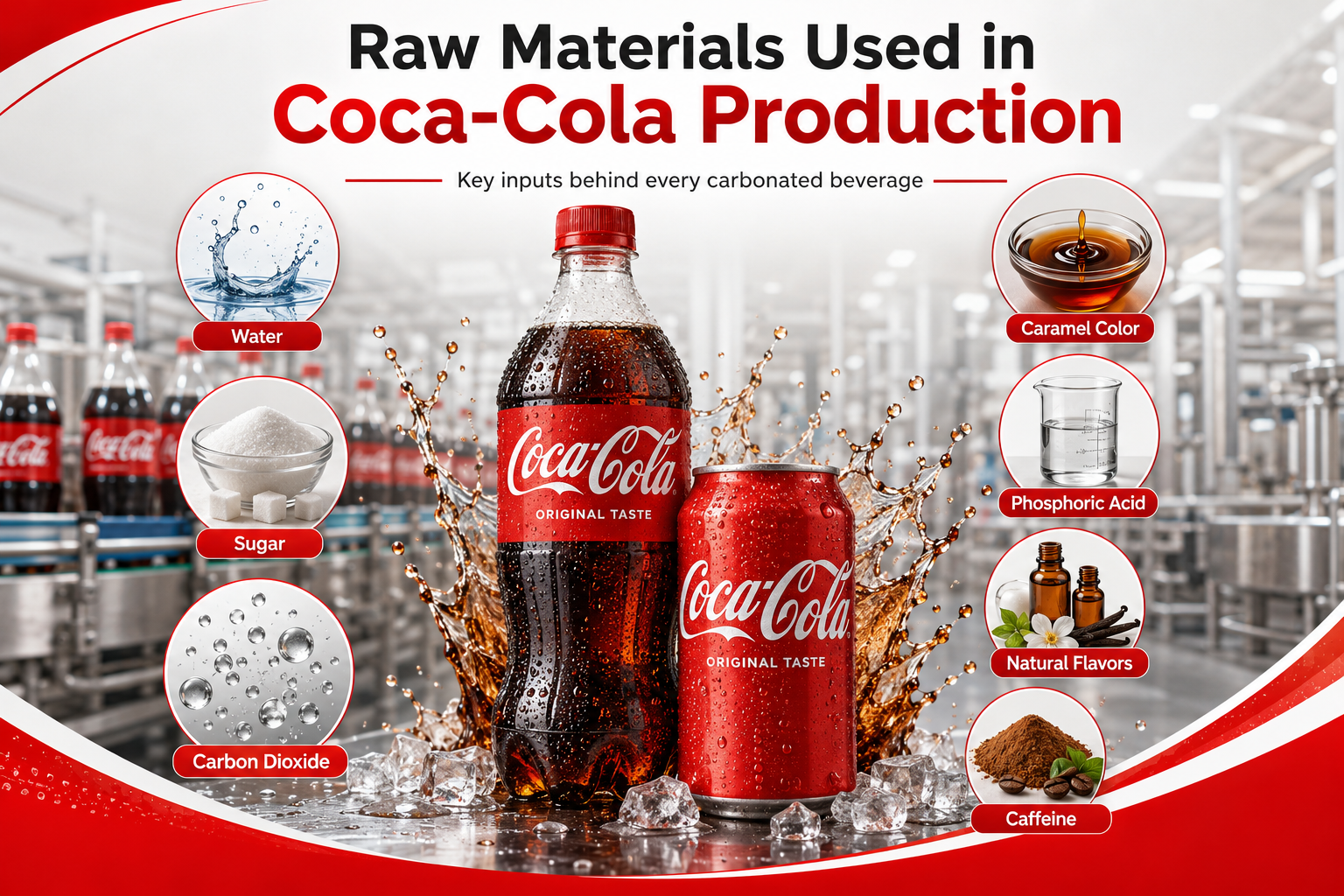
The quality of any carbonated beverage begins with its inputs. The key Coca-Cola materials used in production include:
Water
Water makes up roughly 85–90% of a carbonated soft drink, making it the single most important raw material. Municipal or borewell water is never used directly; it must first pass through a multi-barrier water treatment system to remove suspended solids, dissolved minerals, chlorine, organic matter, and microorganisms. Consistent water quality is the foundation of consistent taste.
Sweeteners
Depending on the market and product variant, sweeteners may include refined cane sugar (sucrose), high-fructose corn syrup (HFCS), or non-nutritive sweeteners such as aspartame, acesulfame potassium, sucralose, or stevia extracts for zero-sugar and diet variants.
Flavour Concentrates
The heart of the beverage is the proprietary flavour concentrate – the famous “secret formula” in Coca-Cola’s case. The Coca-Cola Company manufactures the concentrate at dedicated facilities and supplies it to authorized bottlers, who never handle the full recipe themselves. For other beverage manufacturers, flavour houses supply concentrates and emulsions engineered for specific taste profiles.
Client Review
“DTPPL has truly impressed us with a well-designed Soft Drink Plant that ensures smooth operation, dependable output, and excellent product consistency. Built with a strong focus on hygiene, accuracy, and durability, the plant is perfectly suited for modern beverage production needs. Their team handled the project with great professionalism, from installation through commissioning and ongoing support, always responding quickly and efficiently. We are pleased to work with a reliable partner known for delivering high-quality soft drink processing solutions.”
– Pushpa Kapoor
Carbon Dioxide (CO₂)
Food-grade carbon dioxide provides the signature fizz, sharp mouthfeel, and mild preservative effect of a carbonated drink. CO₂ must meet strict purity standards (typically 99.9%+ food grade) and is stored in bulk cryogenic tanks at the plant.
Other Food-Grade Ingredients
Additional ingredients include phosphoric acid or citric acid (for acidity and tartness), caramel colour, caffeine, and preservatives where permitted. Every ingredient must comply with food safety regulations such as FSSAI (India), FDA (USA), or EFSA (Europe) standards.
OUR OTHER PRODUCT

Coca-Cola Manufacturing Process Step by Step
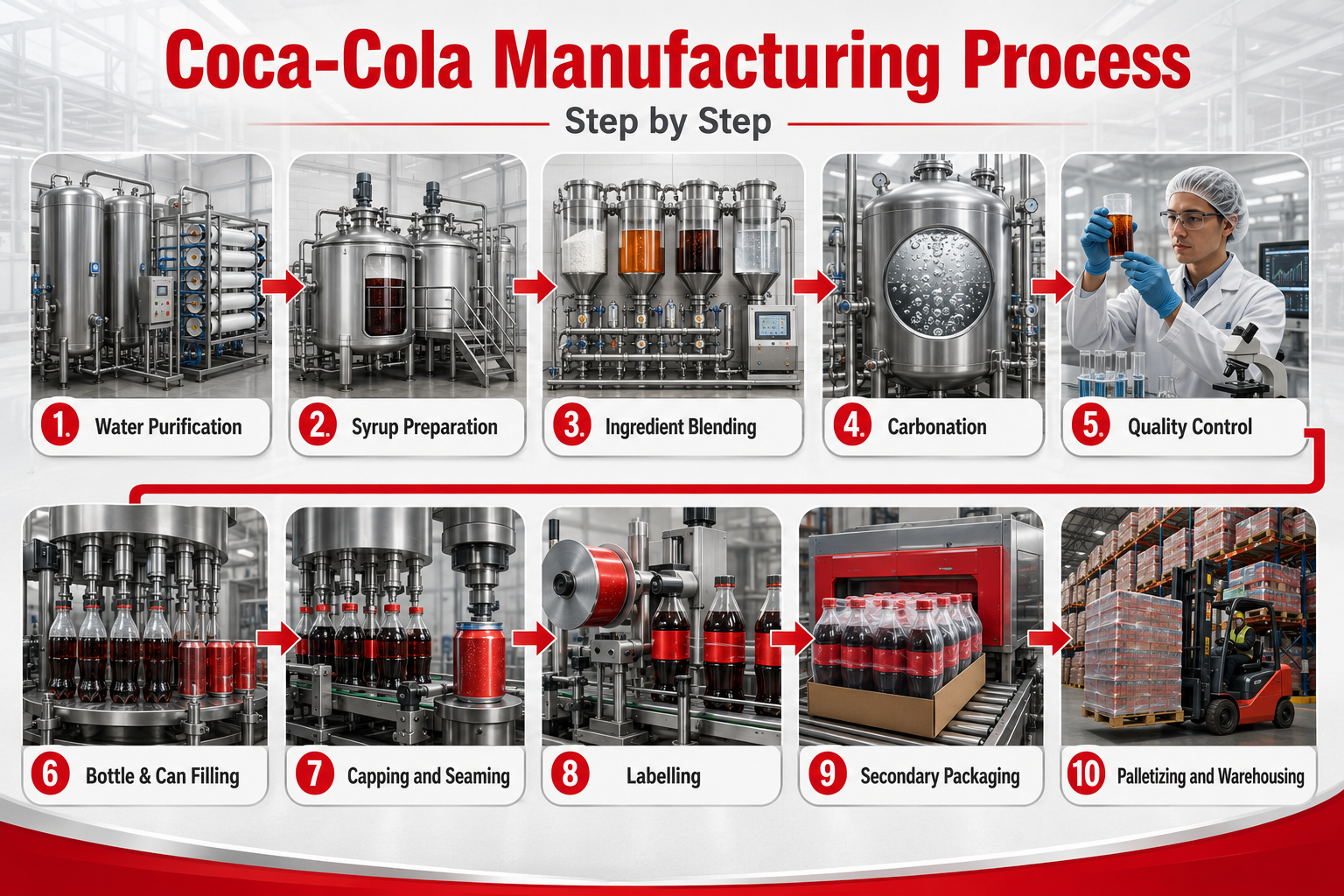
Here is the complete Coca-Cola production process, stage by stage – the same sequence followed in virtually every carbonated soft drink plant worldwide.
Step 1: Water Purification
Incoming raw water passes through a treatment train that typically includes:
- Coagulation and clarification to remove suspended particles
- Sand and activated carbon filtration to remove chlorine, odour, and organic compounds
- Reverse osmosis (RO) or ion exchange to control alkalinity and dissolved solids
- UV sterilization and micron filtration as final microbiological barriers
The result is standardized “treated water” with consistent hardness, alkalinity, and purity – regardless of the source water quality at any plant location.
Step 2: Syrup Preparation
In the syrup room, sugar is dissolved in treated water to create simple syrup, which is heated, filtered (often through carbon filtration to remove colour and impurities), and cooled. The proprietary flavour concentrate is then blended into the simple syrup to create finished syrup – the concentrated flavour base of the beverage.
Step 3: Ingredient Blending (Proportioning)
The finished syrup is precisely blended with treated water in a fixed ratio – typically around 1 part syrup to 5 parts water – using automated proportioning and blending systems. Inline Brix meters (measuring sugar content) and dosing controls ensure every batch matches the exact product specification.
Step 4: Carbonation
The blended beverage is chilled to around 4°C and passed through a carbonator, where food-grade CO₂ is dissolved into the liquid under pressure. Cold temperatures and elevated pressure allow the beverage to absorb the correct volume of CO₂ – typically 3.5 to 4 volumes for a cola. Precise carbonation control determines the drink’s fizz, bite, and shelf stability.
Step 5: Quality Control
Before and during filling, the beverage is tested for:
- Brix (sugar concentration)
- CO₂ volumes (carbonation level)
- Acidity/pH
- Microbiological purity
- Taste and appearance against reference standards
Modern plants use inline analyzers for real-time monitoring, backed by laboratory testing of samples from every production batch.
Read Our Article
Step 6: Bottle & Can Filling
The carbonated beverage flows to high-speed bottle filling machines. Because the drink is under CO₂ pressure, counter-pressure (isobarometric) filling technology is used – the container is first pressurized to match the filler bowl pressure, then filled gently to prevent foaming and CO₂ loss. (We cover filling in detail in Sections 5 and 6.)
Step 7: Capping and Seaming
Immediately after filling – within seconds – containers are sealed:
- PET bottles receive plastic screw caps applied by rotary capping machines
- Glass bottles receive crown corks via crowning heads
- Cans are sealed with aluminium lids using double-seaming technology
Speed matters here: any delay between filling and sealing allows CO₂ to escape.
Step 8: Labelling
Sealed containers pass through labelling machines – hot-melt glue labelers, pressure-sensitive labelers, or roll-fed OPP/BOPP labelers – which apply brand labels at line speed. Each container is also coded with batch number, manufacturing date, and expiry date using inkjet or laser coders.
Step 9: Secondary Packaging
Labelled bottles and cans are grouped and packed into shrink-wrapped bundles, cartons, or crates using automatic shrink wrapping machines and case packers.
Step 10: Palletizing and Warehousing
Finally, packed cases are stacked onto pallets by automatic palletizers, stretch-wrapped, and moved to the warehouse for distribution. From water intake to pallet, the entire journey can take just a few hours in a well-designed plant.

Bottle Filling vs Can Filling: What’s the Difference?
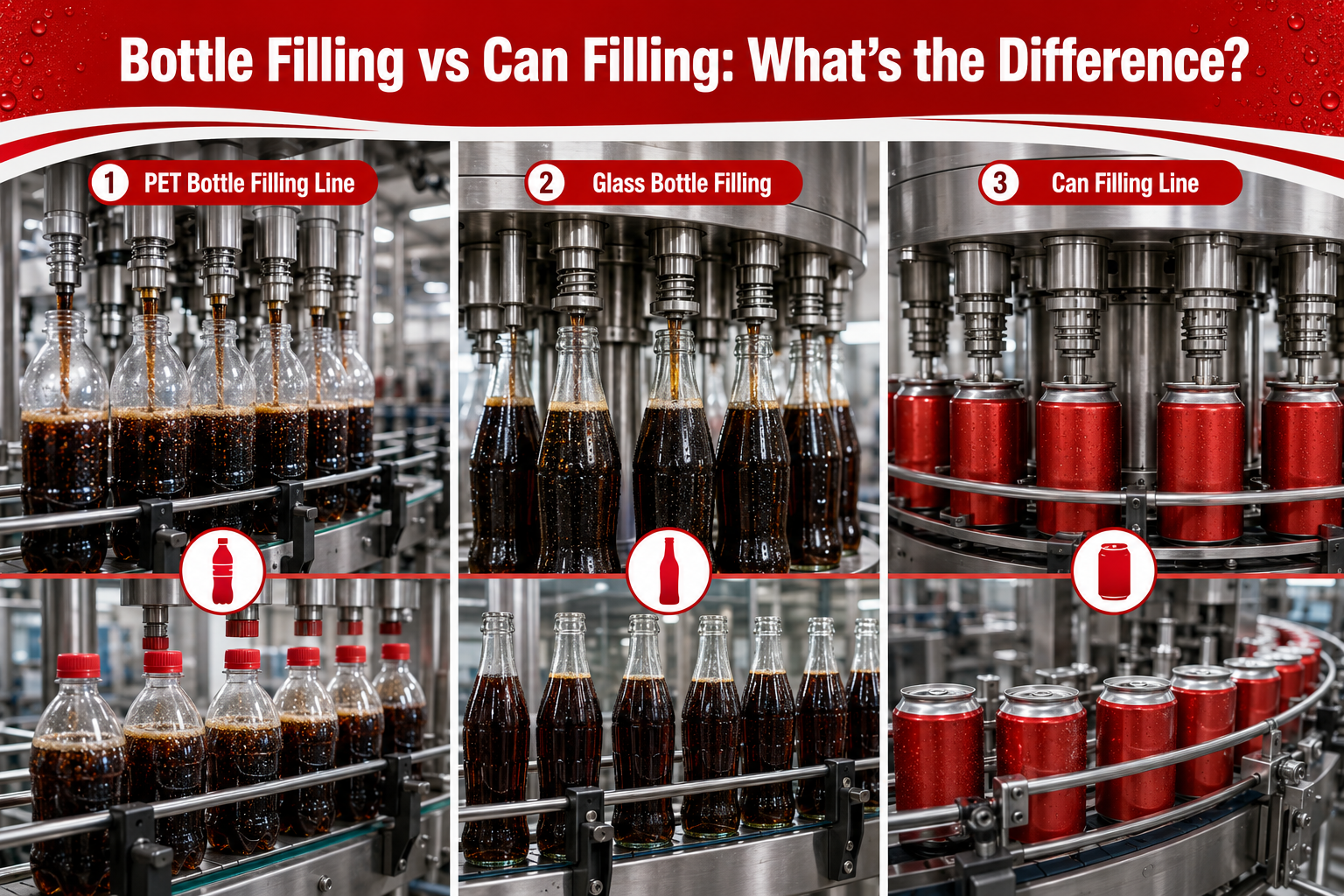
While the beverage inside is identical, the packaging route shapes the equipment line. Here’s how the three main formats compare.
PET Bottle Filling Line
PET (polyethylene terephthalate) bottles are usually blow-moulded on site from preforms, then air-conveyed directly to a rinser–filler–capper “monoblock.” Counter-pressure filling valves handle the carbonated product, and plastic screw caps are torqued on by a rotary capper. PET lines offer lightweight packaging, lower transport cost, and flexible bottle sizes – from 200 ml to 2.25 L.
Read Our Article
Auto Bottling Plant for Juice & Beverages: A Comprehensive Guide
Glass Bottle Filling
Glass is the classic Coca-Cola format. Returnable glass bottles are first washed in multi-stage bottle washers with caustic solutions, inspected by empty-bottle inspection (EBI) systems, then filled under counter-pressure and sealed with crown corks. Glass provides excellent CO₂ retention and premium brand presentation, but lines run somewhat slower and handling is heavier.
Can Filling Line
Can lines are the fastest of all – cans are lightweight, uniform, and easy to convey at extreme speeds. The filler–seamer monoblock, undercover gassing, and double seaming (described above) define this format. Cans also chill faster, stack efficiently, and offer 360° printed branding.
Choosing the Right Packaging Format
| Factor | PET Bottles | Glass Bottles | Aluminium Cans |
| Line speed | High | Moderate | Very high |
| Package weight | Lightest | Heaviest | Light |
| CO₂ retention | Good | Excellent | Excellent |
| Recyclability | Good | Excellent (returnable) | Excellent |
| Capital cost | Moderate | Higher (washing systems) | Higher (seaming, volumes) |
| Best for | Retail take-home, flexibility | Premium/HoReCa, returnable markets | High-volume, on-the-go |
Many large plants – including Coca-Cola bottling facilities – run multiple lines side by side to serve every packaging format from a common beverage preparation area.
OUR OTHER PRODUCT
Coca-Cola Production Around the World
Where Is Coca-Cola Produced?
A common question is where is Coca-Cola produced – and the answer is: almost everywhere. Rather than shipping finished beverages from a single mega-factory, The Coca-Cola Company operates a decentralized model. The company produces the concentrate, while a worldwide network of authorized bottling partners manufactures, packages, and distributes the finished beverages locally. This is why the answer to where is Coke manufactured is usually “close to where you bought it” – often within a few hundred kilometres.
The Global Bottling System
The Coca-Cola system operates in more than 200 countries and territories, with hundreds of bottling plants spread across every inhabited continent. Concentrate is produced at a smaller number of company-owned concentrate plants and shipped to bottlers, who add local treated water, sweetener, and CO₂.
Regional Manufacturing Facilities
Major bottling partners operate at enormous regional scale – for example, Coca-Cola Europacific Partners across Europe and Asia-Pacific, Coca-Cola FEMSA across Latin America, Arca Continental in the Americas, and Hindustan Coca-Cola Beverages along with franchise bottlers across India. Each regional bottler runs multiple plants with PET, glass, and can lines tailored to local market preferences.
The Franchise Bottling Model
This franchise model is one of the most successful manufacturing strategies in history. It allows local investment, local employment, and local distribution while the parent company safeguards brand standards, formula, and marketing. Every bottler must meet identical global quality requirements, audited regularly – which is why the product tastes the same everywhere.

Understanding the Coca-Cola System
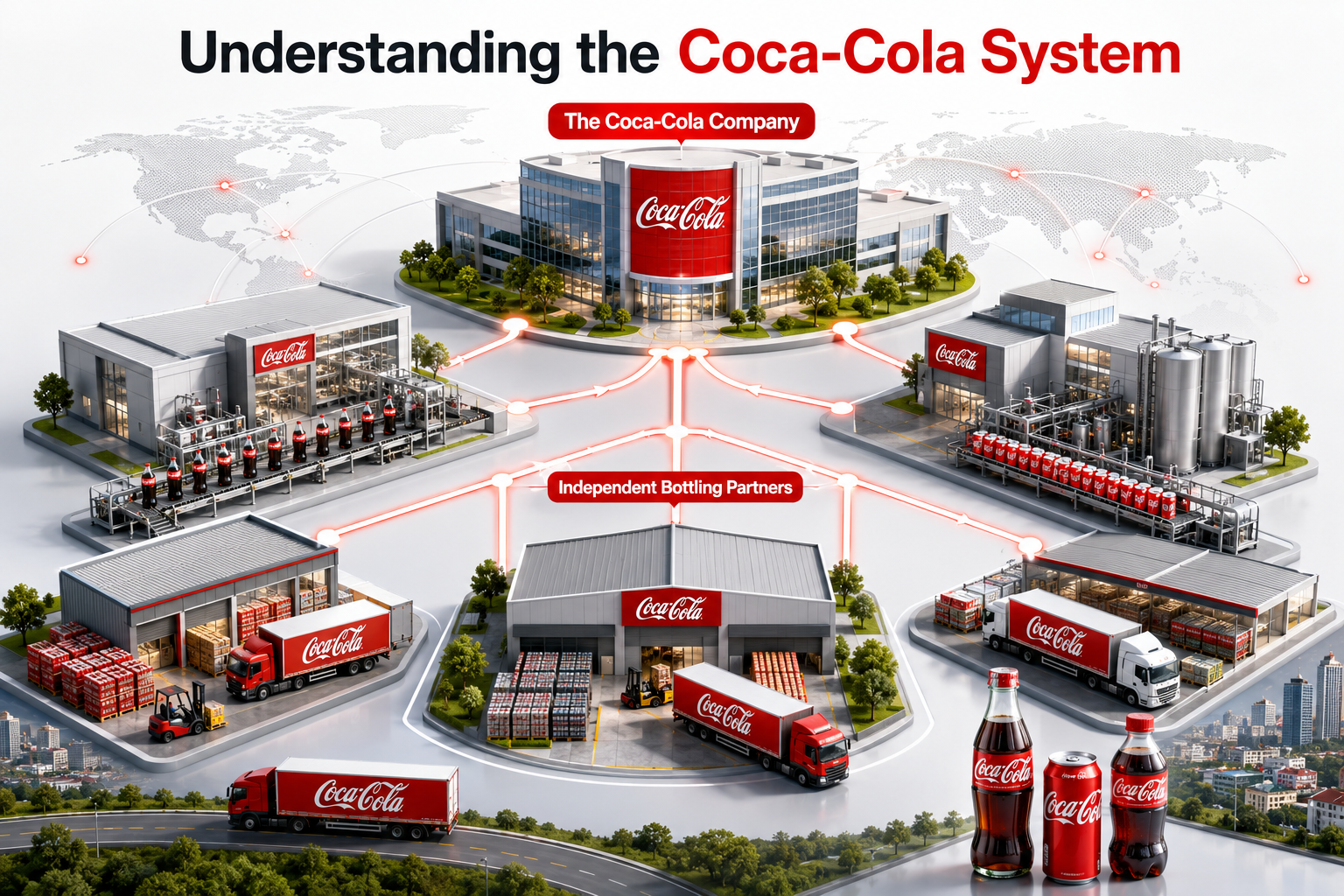
The term “Coca-Cola system” refers to the combined network of The Coca-Cola Company and its independent bottling partners.
The Coca-Cola Company
Headquartered in Atlanta, Georgia (USA), The Coca-Cola Company owns the brands and trademarks, develops products, manufactures and sells concentrates and syrups, and drives global marketing. It has been selling beverages in the United States since 1886.
Authorized Bottling Partners
The system comprises the Company and approximately 200 bottling partners worldwide. These independent bottlers hold franchise agreements for defined territories. They invest in plants, filling lines, trucks, and cold-drink equipment, and they manufacture and distribute the finished beverages.
The Manufacturing Network
Together, this networked structure combines global scale with local execution: consumers enjoy finished beverages bearing the company’s trademarks at a rate of over 2 billion servings a day, delivered through a network of bottling partners, distributors, wholesalers, and retailers. For any company designing a beverage business, the Coca-Cola system remains the benchmark model for scaling manufacturing across geographies.
Coca-Cola Product Line and Mix
The Coca-Cola product line and mix extends far beyond the flagship cola. So, how many products does Coca-Cola produce globally? The company today offers around 200 master brands worldwide (streamlined from more than 500 brands after a major portfolio rationalization in 2020), spanning thousands of individual products, flavours, and package variants. The portfolio covers:
- Carbonated soft drinks (Sparkling): Coca-Cola, Coca-Cola Zero Sugar, Diet Coke, Sprite, Fanta, Thums Up, Limca, Schweppes, Fresca
- Juices and juice drinks: Minute Maid, Maaza, Simply, Del Valle, innocent
- Packaged water: Kinley, Dasani, smartwater, Ciel, I LOHAS
- Sports drinks: Powerade, BODYARMOR, Aquarius
- Energy drinks: Coca-Cola Energy and partnerships/investments in the energy category (e.g., Monster)
- Ready-to-drink tea & coffee: Georgia coffee, Costa Coffee, Gold Peak, FUZE Tea, Honest Tea, Ayataka
This diversification matters for manufacturers: a plant originally designed for carbonated soft drinks can often be extended with hot-fill, aseptic, or still-beverage lines to produce juices, teas, and water – multiplying the return on core utilities like water treatment and syrup rooms.

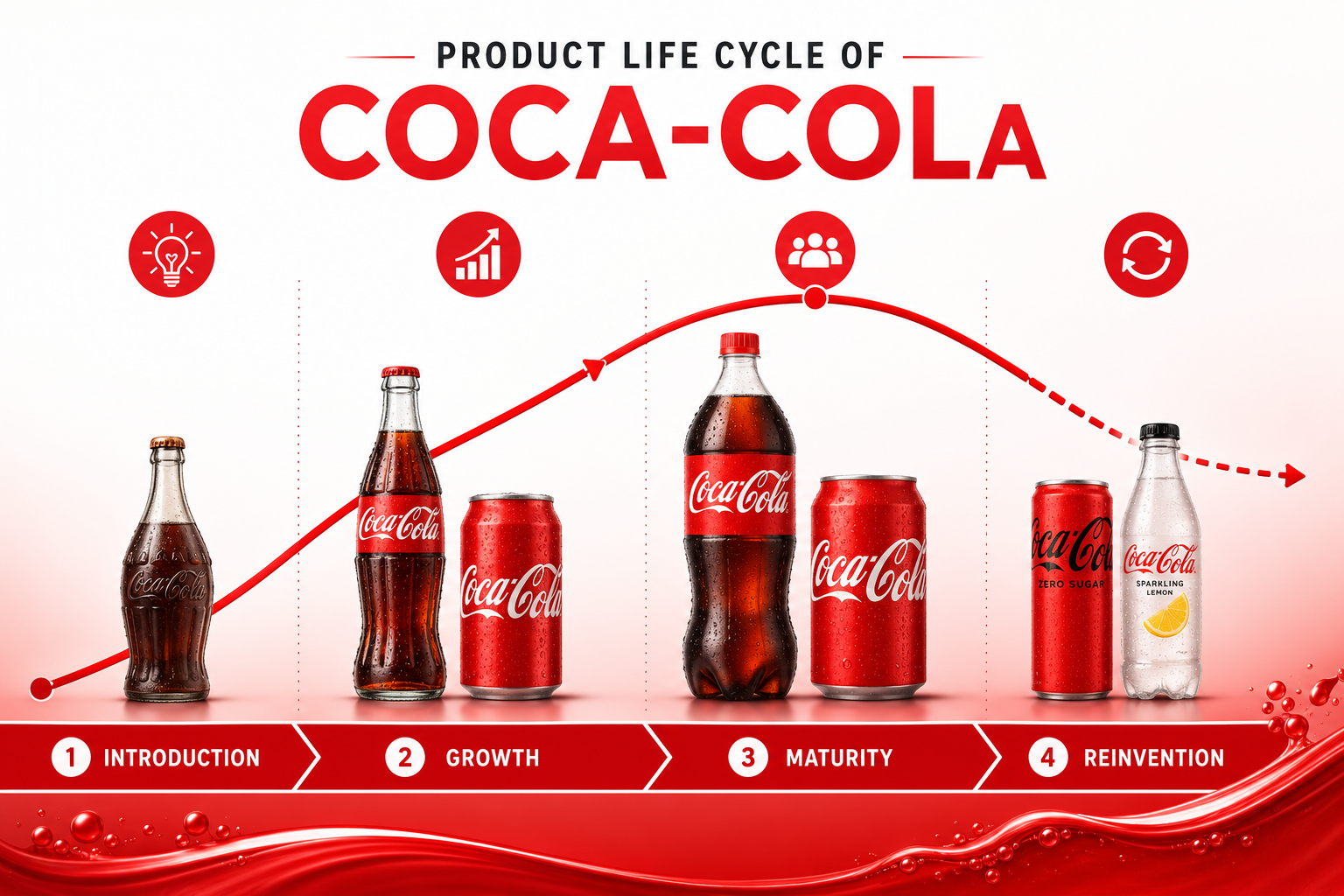
Product Life Cycle of Coca-Cola
The product life cycle for Coca-Cola is a textbook case studied in business schools – because the brand has managed to defy the typical decline stage for nearly 140 years.
- Introduction (1886–early 1900s): Invented by pharmacist Dr. John Pemberton in Atlanta in 1886, Coca-Cola began as a soda-fountain drink before bottling unlocked mass distribution.
- Growth (early–mid 20th century): Franchise bottling, the iconic contour bottle (1915), and global expansion – accelerated during World War II – turned Coke into a worldwide product.
- Maturity (late 20th century–present): In its maturity stage, the brand sustains demand through marketing, pricing strategy, and distribution depth rather than raw category growth.
- Innovation (avoiding decline): Rather than declining, Coca-Cola continually re-enters growth through product innovation – Diet Coke, Coca-Cola Zero Sugar, new flavours, limited editions like Coca-Cola Creations – and portfolio expansion into water, juice, tea, coffee, and energy.
- Packaging evolution: From returnable glass to crown-capped bottles, cans, PET, mini-cans, and increasingly recycled-PET (rPET) and lightweighted packaging, the pack itself has been a life-cycle extension tool.
The lesson for beverage businesses: manufacturing flexibility – the ability to launch new formulations and pack formats quickly – is what keeps a brand in perpetual maturity instead of decline.
Read Our Article
What is the Investment Cost, and Profit in the Soft Drink Business?

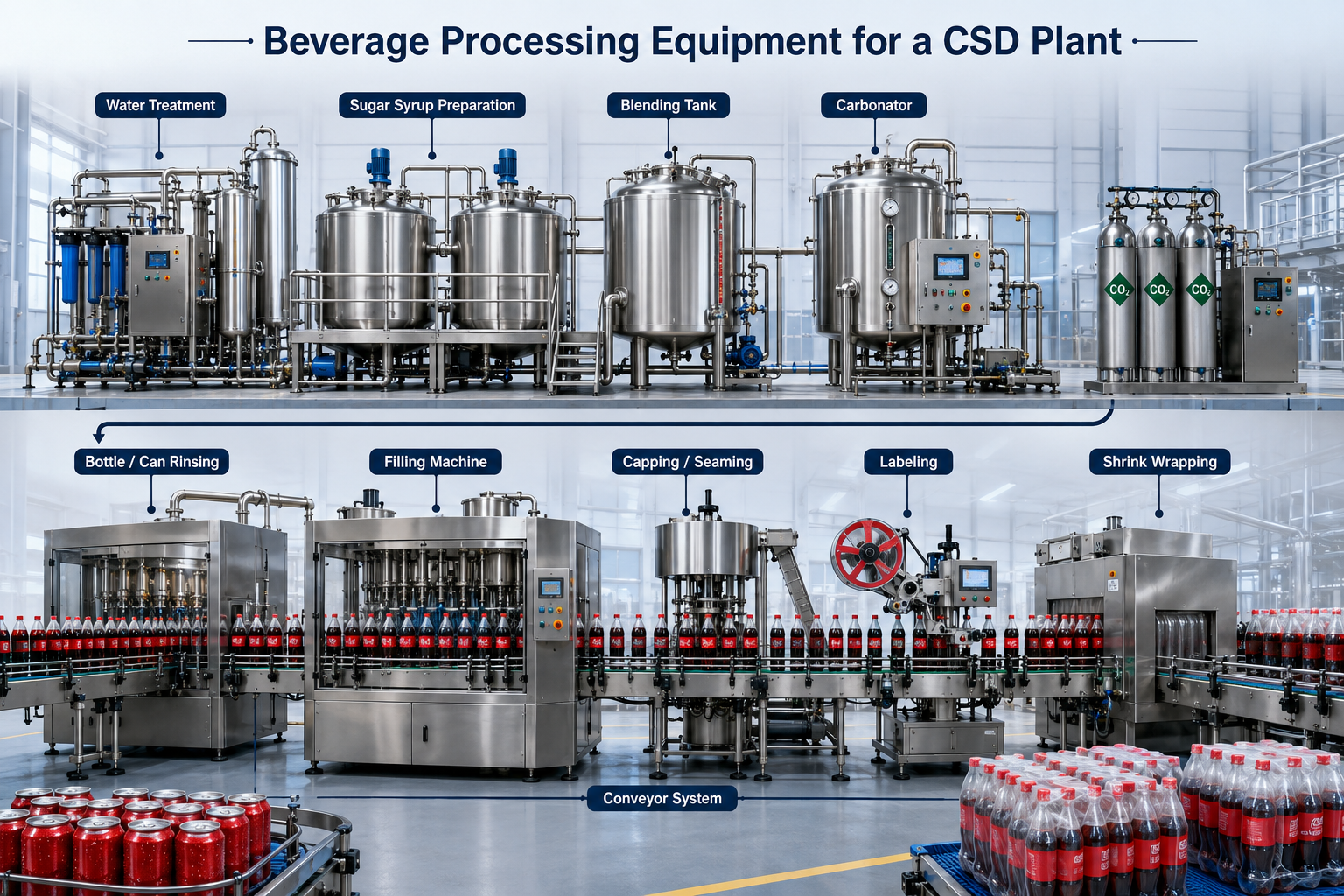
Beverage Processing Equipment Required for a Carbonated Soft Drink Plant
Replicating a Coca-Cola-style production line requires a carefully integrated set of processing and packaging equipment. Here is the essential machinery for a modern CSD plant:
Water Treatment Systems – Multi-stage treatment including clarification, activated carbon filtration, reverse osmosis, UV sterilization, and ozonation to deliver consistent, safe process water.
Sugar/Syrup Preparation Systems – Sugar handling, dissolving vessels with agitators, syrup heating and filtration units, and finished syrup blending tanks with precise dosing.
Beverage Mixing Tanks & Blending Systems – Sanitary stainless-steel tanks and automated inline proportioners that blend syrup and water with real-time Brix control.
Carbonation Systems – Chillers and inline carbonators that dissolve food-grade CO₂ into the beverage at controlled temperature and pressure for exact carbonation volumes.
Bottle Rinsing Machines – Rotary rinsers that sanitize PET or glass bottles immediately before filling.
Bottle Filling Machines – Counter-pressure rinser–filler–capper monoblocks for carbonated beverages in PET and glass, engineered for minimal CO₂ loss and foaming.
Can Filling Machines – High-speed can filler–seamer monoblocks with CO₂ purging and undercover gassing for aluminium can lines.
Capping & Seaming Machines – Rotary screw cappers for PET, crowners for glass, and double-seamers for cans, synchronized with the filler.
Labelling Machines – Hot-melt, roll-fed, or pressure-sensitive labelers with integrated batch coding.
Shrink Wrapping Machines & Secondary Packaging – Automatic shrink bundlers, carton packers, and tray formers for retail-ready packs.
Conveyors & Line Automation – Slat, air, and pack conveyors with accumulation tables, line-management controls, and PLC/SCADA integration for smooth, continuous flow.
CIP (Clean-in-Place) Systems – Automated cleaning skids that circulate caustic, acid, sanitizer, and rinse water through tanks, pipes, and fillers, ensuring food-safety-grade hygiene without dismantling.
The way these machines are sized, matched, and integrated determines the plant’s real-world efficiency – which is where an experienced turnkey partner becomes invaluable.
OUR OTHER PRODUCT

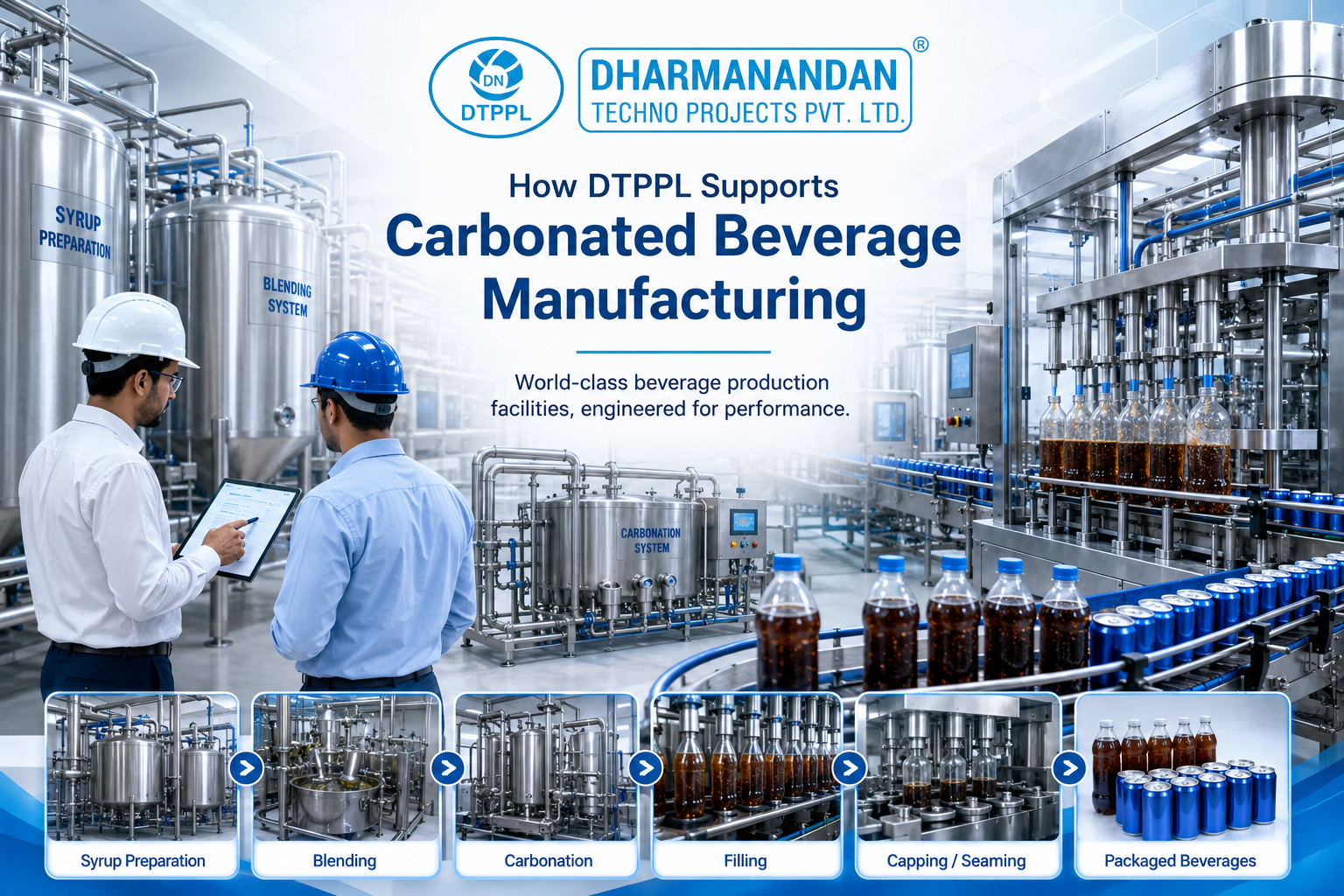
How DTPPL Supports Carbonated Beverage Manufacturing?
At DTPPL, we help beverage entrepreneurs and established manufacturers build world-class production facilities modelled on the same engineering principles that power global brands like Coca-Cola.
Turnkey Beverage Processing Plants
From raw water intake to palletized finished goods, DTPPL designs, manufactures, installs, and commissions complete beverage processing plants – covering water treatment, syrup rooms, blending, carbonation, filling, and packaging as a single integrated project.
Carbonated Soft Drink Production Lines
We supply complete CSD lines with precision proportioning, inline carbonation, and counter-pressure filling technology, engineered for consistent Brix, CO₂ volumes, and product quality at every speed range – from compact startup lines to high-output industrial plants.
Cold Drink Manufacturing Plant & Machine
Semi Automatic Capacity: 6 BPM to 40 BPM
Fully Automatic Capacity: 40 BPM to 90 BPM
(USD 33,000 to USD 10,99,500)
Bottle & Can Filling Solutions
Whether your market calls for PET bottles, returnable glass, or aluminium cans, DTPPL provides rinsing, filling, capping, crowning, and seaming solutions tailored to your package formats – along with labelling, shrink wrapping, conveying, and end-of-line packaging.
Customized Automation
Every DTPPL line is built around your capacity, product mix, and budget, with PLC/SCADA-based automation, inline quality monitoring, and CIP systems that meet international food safety standards.
End-to-End Engineering Support
Our team supports you across the full project life cycle – plant layout and capacity planning, utility design, equipment manufacturing, installation, commissioning, operator training, and after-sales service – so your plant achieves stable, efficient production from day one.
Conclusion
The Coca-Cola manufacturing process is a remarkable blend of chemistry, precision engineering, and logistics: treated water and syrup blended to exact specifications, carbonated under controlled conditions, and filled into bottles and cans at speeds exceeding a thousand containers per minute – replicated identically across hundreds of plants worldwide through the franchise-based Coca-Cola system.
For any business entering the beverage industry, this process is the proven blueprint. And with the right processing and filling equipment behind it, that blueprint is entirely achievable at any scale.
Ready to build your own carbonated beverage production line? Contact DTPPL today for a consultation on turnkey beverage processing plants, bottle and can filling machines, and complete end-to-end engineering solutions.
FAQs
What is the manufacturing process of Coca-Cola?
The production process of Coca-Cola involves water purification, syrup preparation from sugar and flavour concentrate, blending syrup with treated water, chilling and carbonation with food-grade CO₂, counter-pressure filling into bottles or cans, capping/seaming, labelling, packaging, and palletizing – with quality control at every stage.
How are soda cans manufactured?
Soda cans are made from aluminium sheet through cupping, drawing and ironing, trimming, washing, printing, internal lacquer coating, necking, and flanging, followed by automated inspection.
How are soda cans filled?
Cans are filled using counter-pressure (isobaric) fillers: each can is purged and pressurized with CO₂, filled with chilled carbonated beverage, gassed under the lid to remove air, and sealed with an airtight double seam – all within seconds.
Where is Coca-Cola produced?
Coca-Cola is produced locally in more than 200 countries and territories by a network of roughly 200 authorized bottling partners, who blend company-supplied concentrate with locally treated water, sweetener, and CO₂.
How many products does Coca-Cola produce globally?
The Coca-Cola Company offers around 200 brands worldwide across sparkling drinks, water, juice, sports drinks, energy drinks, and ready-to-drink tea and coffee – amounting to thousands of individual product and package variants.
What equipment is needed to make a carbonated soft drink like Coca-Cola?
A CSD plant requires water treatment systems, syrup preparation and blending systems, carbonators, rinsers, counter-pressure bottle and can filling machines, cappers/seamers, labellers, shrink wrappers, conveyors, and CIP systems – all of which DTPPL supplies as integrated turnkey solutions.
Our associates


Director – Global Marketing and Sales
Mr. Bhavesh from Dharmanandan Techno Projects Pvt. Ltd. has played a pivotal role in elevating the DTPPL brand to the global stage, leveraging his exceptional expertise in marketing and communications. He is committed to helping clients achieve significant growth while strengthening their own brands. Dharmanandan Techno Projects Pvt. Ltd. is a leading manufacturer and supplier of water purification systems and turnkey solutions for mineral water plants. With years of experience in designing and delivering high-quality water treatment solutions, the company provides end-to-end services, including system design, installation, maintenance, and ongoing support. Specializing in scalable and customizable water plants, DTPPL has successfully served industries worldwide, ensuring clean and safe drinking water across diverse applications.