




Listening Article
Table of Contents
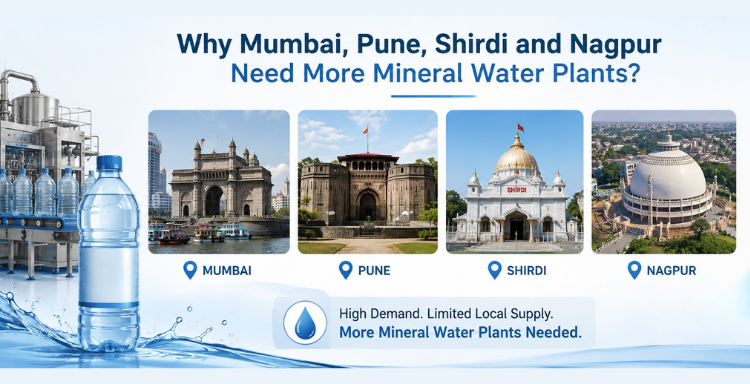
Why Mumbai, Pune, Shirdi and Nagpur Need More Mineral Water Plants?
August 3, 2026
AI Summary
Mumbai, Pune, Shirdi and Nagpur represent four of Maharashtra’s fastest growing consumption markets for packaged drinking water, yet local production capacity in each city struggles to keep pace with demand during peak summer months, festival seasons and pilgrim rushes. Mumbai’s financial district, local trains, airports and film industry create round the clock institutional demand. Pune’s IT parks, student population and manufacturing belt are driving corporate and bulk water consumption. Shirdi welcomes an estimated eight million pilgrims a year, with single day footfall crossing several lakh visitors during major festivals, creating extreme seasonal spikes that local bottling units cannot always absorb. Nagpur, positioned at the geographic centre of India and anchored by the MIHAN multi product Special Economic Zone, is emerging as a distribution hub for Central India’s beverage and food processing trade. Together these four cities illustrate a broader national pattern in which urban growth, tourism inflow and industrial expansion are outrunning local packaged drinking water, PET bottle, soft drink and juice manufacturing capacity, opening up genuine business potential for new mineral water plants, RO plants, water softening plants, PET bottle plants, soft drink and juice plants and allied packaging machinery across the region. This article examines the demand drivers city by city, reviews relevant government schemes and standards, and outlines how a turnkey water treatment plant partner such as Dharmanandan Techno Projects Pvt. Ltd. (DTPPL) can support new entrants setting up such facilities.
Introduction
India’s packaged drinking water industry is one of the fastest expanding segments within the country’s food and beverage sector. Multiple independent industry analyses place the Indian bottled and packaged water market in the range of roughly USD 4 billion to USD 11 billion in 2026, depending on the scope of products covered, with most analysts projecting compound annual growth rates between 10 percent and 14 percent through the early 2030s. Even at the more conservative end of these estimates, the trajectory is unmistakable: demand for safe, packaged drinking water in India is rising steadily and shows no signs of slowing.
Maharashtra sits at the centre of this growth story. It is home to India’s financial capital, its second largest information technology hub, one of the country’s most visited religious tourism destinations, and a fast developing logistics and food processing corridor in the centre of the country. Mumbai, Pune, Shirdi and Nagpur each represent a distinct demand pattern, yet all four share a common thread: population growth, urban expansion, commercial activity and tourist inflow are increasing faster than local bottling, RO treatment and beverage packaging capacity can comfortably absorb, particularly during peak seasons.
This article explores why these four Maharashtra cities need additional packaged drinking water plants, commercial RO plants, water softening plants, PET bottle manufacturing units, soft drink and juice plants, and the supporting machinery ecosystem including blow moulding machines, bottle filling lines, labeling and shrink wrapping equipment, jar washing machines, water pouch filling machines and batch coding systems. It also outlines the regulatory framework, sustainability considerations, and how an experienced turnkey project partner like DTPPL can help entrepreneurs and existing manufacturers scale their operations.
Maharashtra’s Four High Growth Cities Are Driving India’s Next Wave of Packaged Drinking Water Demand
Why Mumbai, Pune, Shirdi and Nagpur?
These four cities were chosen because each represents a different but equally powerful demand driver for packaged drinking water and allied beverages:
- Mumbai represents dense urban population, corporate consumption and round the clock institutional demand.
- Pune represents IT led economic growth, a large student population and an expanding industrial base.
- Shirdi represents religious tourism with extreme seasonal spikes in short term visitor demand.
- Nagpur represents logistics, warehousing and food processing growth as Central India’s emerging distribution hub.
Population Growth
Mumbai Metropolitan Region is one of the most populous urban agglomerations in the world, with estimates placing the wider metro region’s population at well over 20 million and the extended MMR area at over 26 million residents across nine municipal corporations. Pune’s urban agglomeration has grown rapidly on the back of IT and manufacturing employment, drawing migrants from across Maharashtra and neighbouring states. Nagpur, the third largest city in Maharashtra, continues to expand around its airport linked industrial corridor. Shirdi, in contrast, has a modest resident population but experiences a multiplier effect from transient pilgrim traffic that dwarfs its permanent population many times over on any given day.
Urban Expansion
All four cities are witnessing significant horizontal and vertical expansion. Mumbai’s suburban belt, Pune’s satellite townships around Hinjewadi, Wagholi and Chakan, Nagpur’s MIHAN corridor along Wardha Road, and Shirdi’s growing hospitality zone around the temple complex are all adding new residential, commercial and institutional water demand points every year.
Client Review
“Hands down one of the best manufacturers for mineral water plant machinery. DTPPL's equipment quality is top-notch, but what really sets them apart is their customer support. Whenever we’ve needed assistance, their team has been responsive and ready to help without delay. Truly reliable, fairly priced, and focused on doing right by the client. Fantastic job, team-keep up the great work!”
– Arindam Sen
Infrastructure Projects
Large infrastructure projects such as metro rail expansion in Mumbai and Pune, the Mumbai Trans Harbour Link, airport modernisation in Nagpur under the MIHAN project, and highway connectivity upgrades linking Shirdi with Nashik, Ahmednagar and Aurangabad are all bringing construction workforces, new commercial establishments and higher footfall, each of which needs a reliable packaged drinking water supply chain.
Rising Disposable Income
Higher disposable income across Maharashtra’s urban population is shifting consumption habits from unbranded or municipal water toward branded packaged drinking water, particularly among younger, health conscious consumers in Mumbai and Pune, and among pilgrims and tourists who prefer sealed bottled water while travelling through Shirdi and Nagpur.
Why Drinking Water Demand Is Rising Faster Than Ever
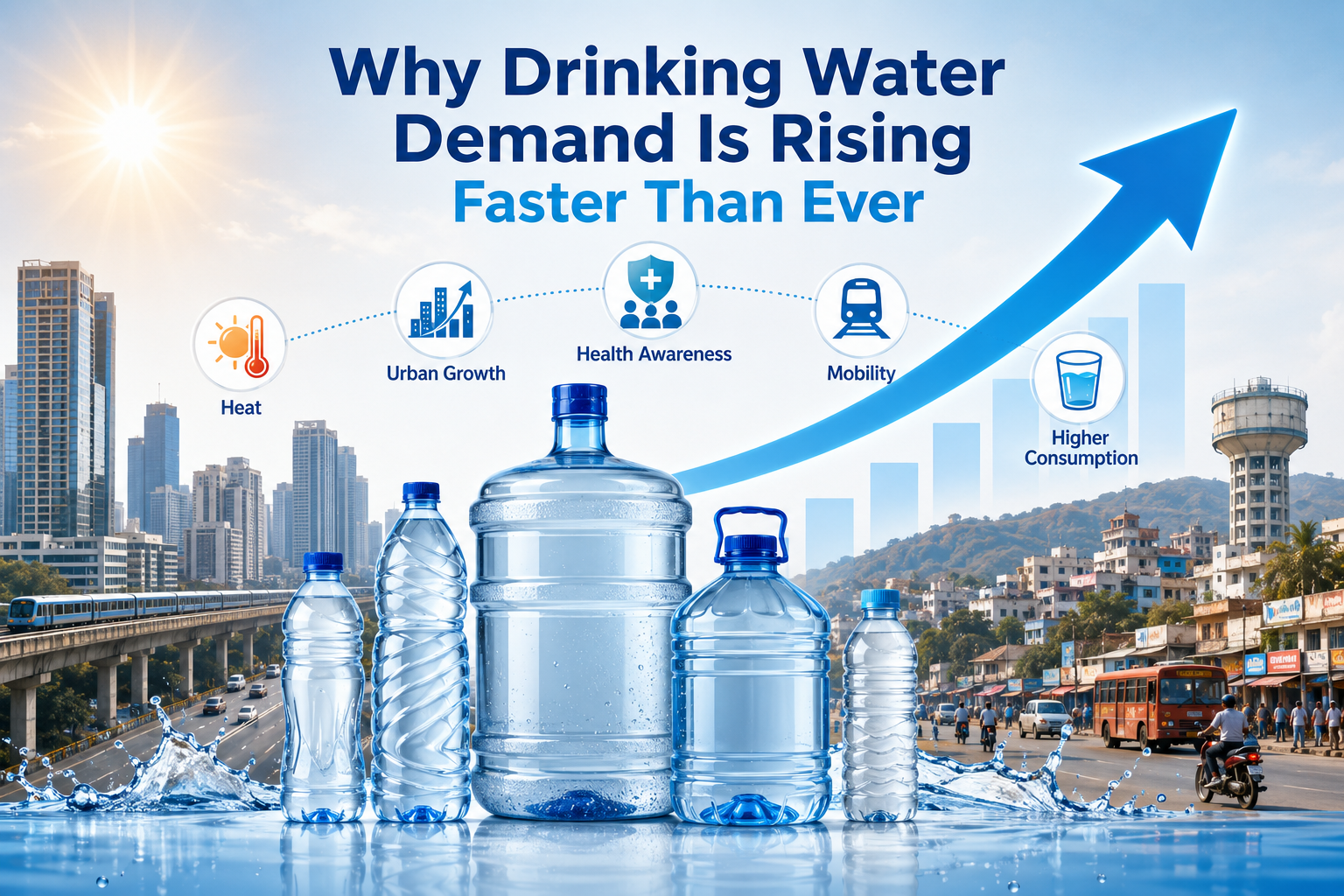
Several converging factors are pushing packaged drinking water demand upward across Maharashtra’s urban and semi urban belt:
| Demand Driver | Impact on Packaged Water Consumption |
| Population increase | More households, more daily consumption points |
| Commercial establishments | Offices, malls and retail chains require bulk jars and bottles |
| Hotels | Guest rooms, banquets and room service depend on branded bottled water |
| Hospitals | Patient care, visitor areas and canteens require certified purified water |
| Schools and colleges | Campuses increasingly install water ATMs and bulk dispensers |
| Offices and IT parks | Corporate campuses consume large volumes of 20 litre jars daily |
| Industrial parks | Worker canteens and process water needs add steady demand |
| Construction sector | Labour camps and site offices require reliable water supply |
Water quality concerns also continue to support structural demand. According to Central Pollution Control Board assessments cited by industry researchers, a substantial share of India’s surface water bodies show signs of contamination, and periodic outbreaks of waterborne illness linked to contaminated piped supply have been reported across multiple Indian cities in the past two years. The World Health Organization and UNICEF Joint Monitoring Programme estimates that a meaningful share of India’s population still lacks access to safely managed drinking water at the household level. These realities keep pushing households, offices and institutions toward certified packaged drinking water as a safer alternative to untreated tap or borewell water.
Read Our Article
Why India's Top Corporate Leaders Trust Our Mineral Water Plants
Mumbai: India’s Financial Capital Needs Continuous Packaged Drinking Water Supply
Mumbai is India’s financial, commercial and entertainment capital, and its packaged drinking water requirement reflects the sheer diversity of its economy.
Who Drives Demand in Mumbai
- Corporate offices across Bandra Kurla Complex, Nariman Point, Lower Parel and Andheri
- Local train commuters, numbering in the millions daily, who purchase bottled water at stations
- Chhatrapati Shivaji Maharaj International Airport and its high footfall terminals
- Mumbai Port and Jawaharlal Nehru Port cargo and logistics operations
- Hotels and restaurants across South Mumbai, the western suburbs and the eastern business district
- Hospitals and healthcare institutions with round the clock water needs
- Large scale events, weddings and exhibitions held across the city
- The Hindi film and television industry, with its dispersed shooting locations and long production days
- Ongoing construction projects including metro lines, the coastal road and redevelopment sites
 Call Now
Huge Daily Bottled Water Consumption
With a metropolitan population that industry demographers place well above 20 million, and millions of additional daily commuters, tourists and business visitors entering the city, Mumbai’s aggregate daily packaged water consumption is enormous even under conservative per capita estimates. Because the city runs on a dense, always on service economy, this demand does not taper off outside daylight hours the way it might in smaller towns.
Mineral Water Demand in Peak Summer
Between March and June, Mumbai experiences a sharp seasonal spike in bottled water sales as temperatures and humidity rise sharply before the monsoon arrives. Retailers, railway stalls and hospitality outlets routinely report inventory shortages of chilled and ambient packaged water during this window, particularly in high footfall zones such as railway stations and beaches.
Distribution Pressure and Last Mile Delivery Challenges
Mumbai’s geography, a narrow peninsula with intense traffic congestion, makes last mile delivery of bulk 20 litre jars and bottled water cases genuinely difficult. Suburban housing societies, office towers and construction sites often face delayed deliveries during peak demand periods, which is precisely the gap that additional, well distributed local bottling capacity can help close.
Pune’s IT Boom Is Creating Massive Demand for Mineral Water
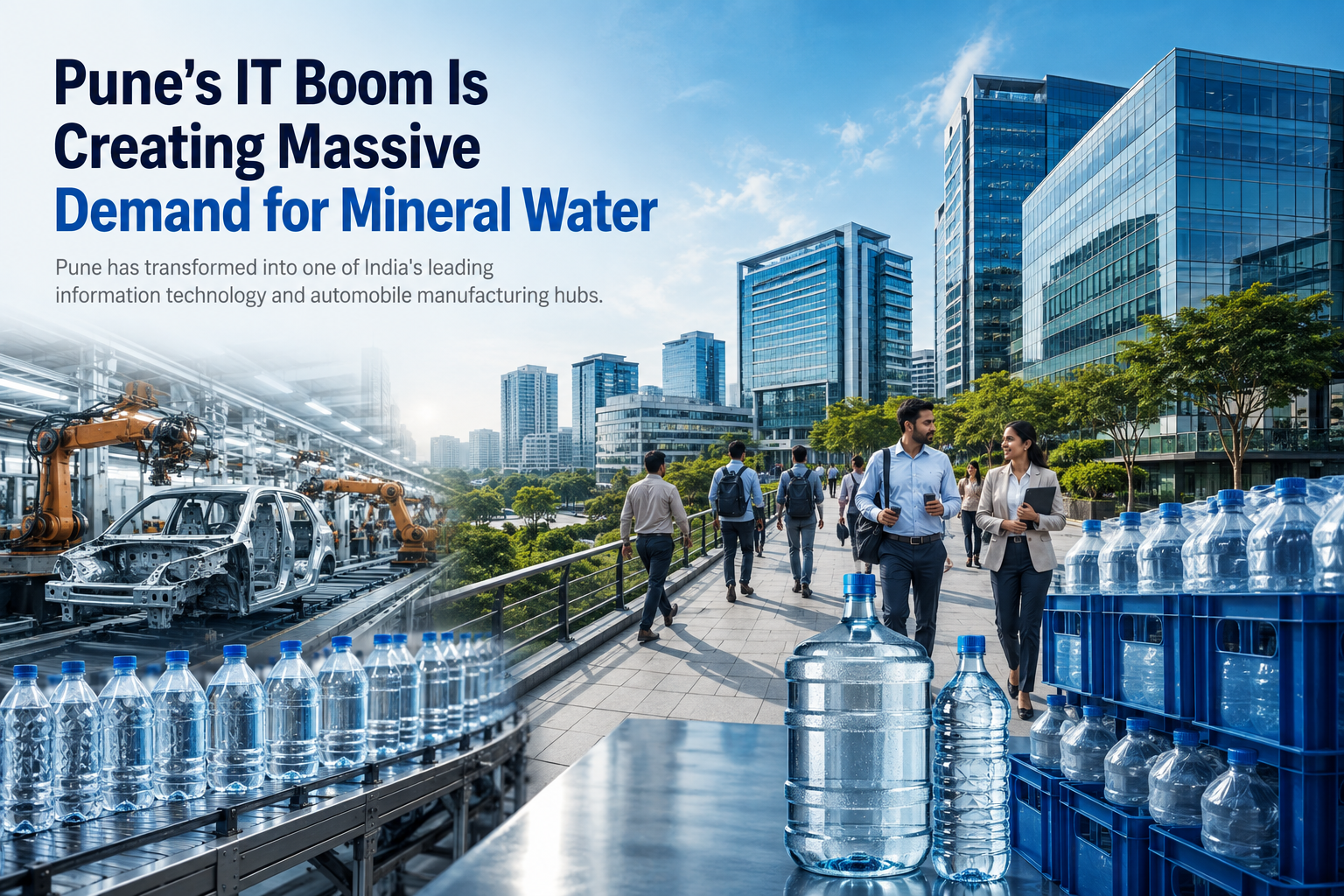
Pune has transformed over the past two decades from an educational and manufacturing town into one of India’s leading information technology and automobile manufacturing hubs.
Key Demand Drivers in Pune
- IT parks in Hinjewadi, Kharadi, Magarpatta and Viman Nagar housing thousands of employees who consume bottled and jar water daily
- Automobile and precision manufacturing industries around Chakan, Pimpri Chinchwad and Talegaon
- A very large student population drawn from across India to Pune’s engineering, management and medical colleges, each of whom is a daily bottled water consumer
- Corporate campuses with cafeterias, meeting rooms and guest facilities requiring continuous purified water supply
- New housing townships along the outer ring road corridor that add fresh residential demand every year
Opportunity Areas in Pune
Pune’s rapid formal employment growth translates directly into opportunities for:
- Commercial RO plants supplying office campuses and residential townships in bulk
- Bottle filling plants serving the retail and quick commerce channel
- PET bottle manufacturing units supplying preforms and finished bottles to nearby bottling units, reducing transport time and cost
Because Pune’s growth is concentrated in specific IT and industrial corridors rather than spread evenly across the city, locally sited water treatment and bottling capacity close to these corridors offers a meaningful logistics advantage over water transported in from farther away.
 Email Us
Why Shirdi Requires Round the Year Packaged Drinking Water
Shirdi presents perhaps the most striking seasonal demand pattern of the four cities, driven almost entirely by religious tourism.
The Scale of Religious Tourism in Shirdi
Academic research on religious tourism in Maharashtra estimates that Shirdi draws an annual footfall in the range of eight million short term visitors, against a permanent resident population of only a few tens of thousands. On an average day, the Sai Baba Samadhi Mandir sees tens of thousands of pilgrims, and on major festival days such as Ram Navami, Guru Purnima and the Punyatithi (death anniversary) observed around October, single day footfall can reportedly climb toward several lakh visitors.
Who Needs Water in Shirdi
- Hotels and resorts catering to pilgrim families and tour groups
- Dharamshalas and trust run accommodation operated by the Shri Saibaba Sansthan Trust and private operators
- Restaurants, canteens and prasad kitchens serving thousands of meals daily
- Pilgrims themselves, many of whom travel long distances by road and rail and rely entirely on packaged bottled water during transit and their stay
Tourist Numbers Fluctuate Dramatically
Unlike Mumbai or Pune, where demand grows steadily with population and employment, Shirdi’s packaged water requirement swings dramatically with the religious calendar. Weekday footfall can be a fraction of festival day footfall, which means local bottling operations need flexible production planning and reliable supply chain arrangements with nearby cities such as Nashik and Ahmednagar to avoid running short during pilgrim season peaks, while also avoiding overcapacity during quieter periods. This is precisely the kind of demand pattern that benefits from nearby, scalable bottling capacity rather than water transported over long distances.
Nagpur Is Becoming Central India’s Beverage Manufacturing Hub
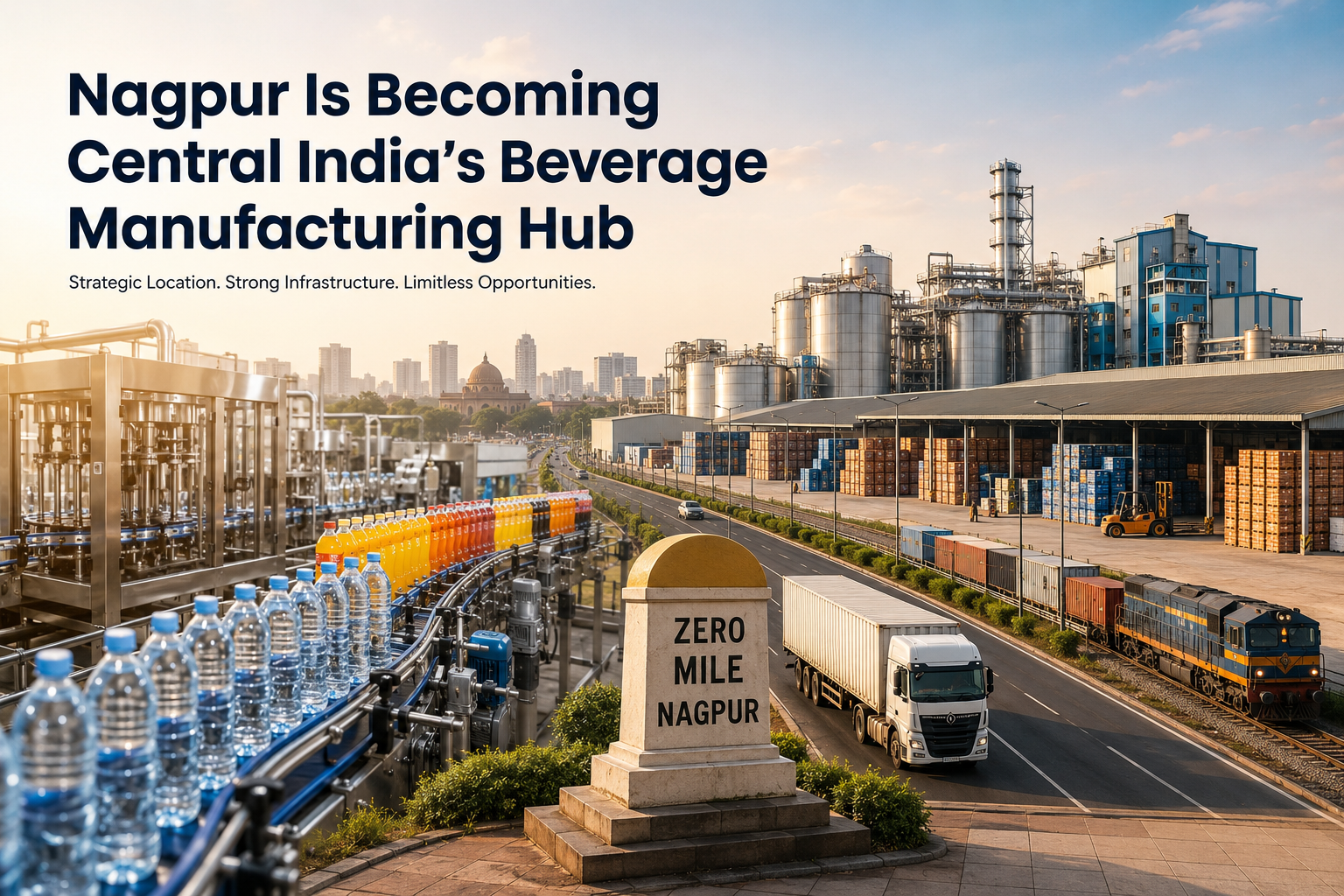
Nagpur occupies a strategic position at the geographic centre of India, a fact commemorated by the city’s well known Zero Mile marker, and this centrality is now being reinforced by large scale infrastructure investment.
The MIHAN Advantage
The Multi modal International Cargo Hub and Airport at Nagpur (MIHAN) is one of India’s largest multi product Special Economic Zones, combining an expanded international airport, road and rail cargo terminals, and dedicated industrial land. The zone already supports tens of thousands of jobs across IT, pharmaceuticals, aerospace and food processing, and it includes a large dedicated food park development on land allocated for agro processing. This kind of anchor infrastructure typically pulls ancillary industries, including beverage bottling and packaging, into the surrounding region because of the ready access to warehousing, cold chain and multi modal transport.
Why Nagpur Suits Beverage Manufacturing
- Warehousing and logistics infrastructure built specifically for national distribution
- A well established orange processing industry, given the Nagpur region’s status as a major citrus growing belt, which naturally supports juice manufacturing
- Growing food processing investment inside and around the MIHAN food park
- Central location that allows same day or next day distribution to Madhya Pradesh, Chhattisgarh, Telangana and large parts of Maharashtra
Business Opportunity in Nagpur
Nagpur’s combination of citrus agriculture, logistics infrastructure and central geography creates a genuine opening for juice plants, soft drink plants and mineral water plants that can serve not just the city itself but the wider Central Indian market, reducing the transport distance and cost that currently applies when beverages are shipped in from Mumbai, Pune or other manufacturing centres farther away.
City Comparison at a Glance
| City | Primary Demand Driver | Peak Season | Best Fit Manufacturing Opportunity |
| Mumbai | Corporate, transit and hospitality density | March to June, festival and event season | Packaged water plants, PET bottle plants, high speed bottle filling lines |
| Pune | IT campuses, manufacturing, student population | Year round with summer peak | Commercial RO plants, bottle filling plants, PET bottle manufacturing |
| Shirdi | Religious tourism and pilgrim footfall | Festival days, Ram Navami, Guru Purnima, October Punyatithi | Flexible capacity mineral water plants, jar and pouch filling |
| Nagpur | Logistics, MIHAN SEZ, citrus and food processing | Summer heat plus year round distribution demand | Juice plants, soft drink plants, mineral water plants for Central India distribution |
Seasonal Water Demand During Summer Creates Business Opportunities
Across all four cities, the months of March through June consistently produce the sharpest spike in packaged drinking water and beverage demand, driven by a combination of factors that compound one another:
- Heatwaves: Rising temperatures across Maharashtra directly increase per capita water and beverage consumption.
- Tourism season: Summer holidays bring family travel to Shirdi and other pilgrim destinations, and increase intercity travel through Mumbai, Pune and Nagpur.
- Festivals: Several major religious festivals fall within or close to this window, adding short bursts of concentrated demand.
- Marriage season: The traditional wedding season in Maharashtra, concentrated in parts of this period, drives large scale catering and hospitality water consumption.
- Schools reopening: The new academic year begins in June, adding fresh institutional demand from schools and colleges for water ATMs and bulk supply.
- Highway travel: Increased road travel between cities during the summer months drives bottled water sales at highway dhabas, fuel stations and rest stops along routes connecting Mumbai, Pune, Nashik, Shirdi and Nagpur.
This predictable, recurring seasonal surge is exactly the type of demand pattern that existing production capacity in the region often cannot fully absorb, which is why flexible, scalable manufacturing capacity, rather than a single large fixed capacity plant, tends to offer the strongest return on investment for new entrants.
Existing National and Regional Brands Serve a Large Market, but Demand Continues to Grow
India’s organised packaged drinking water segment includes several well established national brands such as Bisleri, Kinley, Aquafina, Bailley, Oxyrich and Rail Neer, alongside a large number of regional and state level brands operating across Maharashtra. These brands have built strong distribution networks across retail, HoReCa (hotels, restaurants and cafes) and quick commerce channels, and they continue to expand their retail presence year on year as urban demand grows.
Industry analyses consistently note that India’s organised bottled water market remains highly fragmented, with thousands of local and regional players operating alongside the top national brands, and even the five largest players together account for only a minority share of the overall market. This fragmentation itself is evidence of continued opportunity: no single brand or handful of brands can realistically cover every institutional contract, every hotel supply agreement, every construction site and every private label retail requirement across a state as large and as fast growing as Maharashtra.
For new entrants, this creates several practical pathways:
- Supplying private label packaged water to hotel chains, hospitals, offices and educational institutions
- Becoming a regional distribution partner or contract bottler for an established brand
- Building a standalone regional brand focused on one or two of these four cities and their surrounding districts
- Supplying bulk 20 litre jars to the institutional and office segment, which is typically underserved by large national brands that focus on retail bottle formats
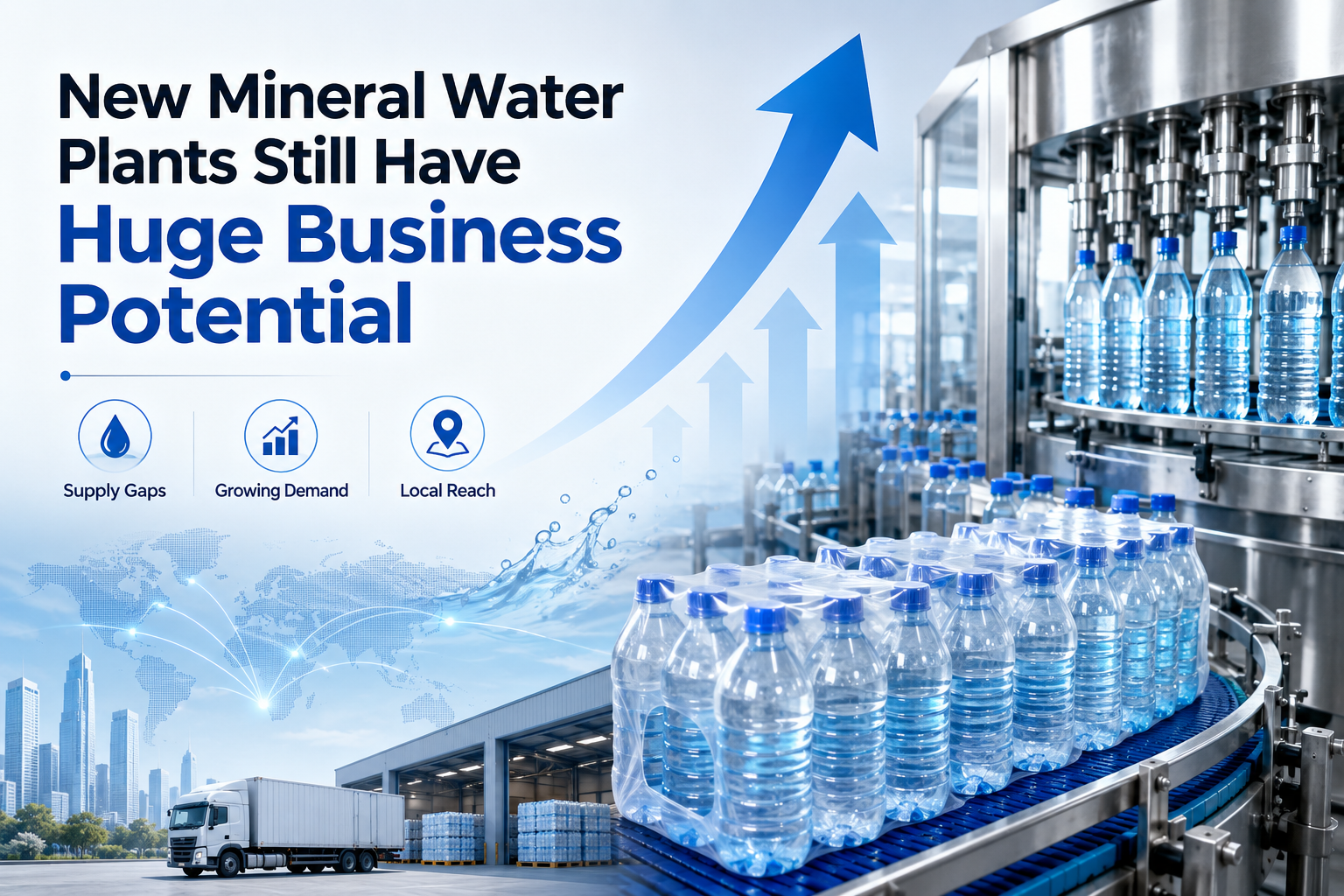
Why New Mineral Water Plants Still Have Huge Business Potential
Even with established brands already active in the market, several structural gaps continue to favour new, well located manufacturing capacity:
- Local distribution: Water bottled closer to the point of consumption reduces transit time and spoilage risk for jar water in particular.
- Faster deliveries: Proximity to demand centres such as IT parks, hospitals and hotel clusters allows same day replenishment, which large centralised plants often cannot guarantee.
- Lower transportation cost: Packaged water is heavy and bulky relative to its value, so freight costs eat significantly into margins when water travels long distances. Local production directly improves unit economics.
- Fresh production: Shorter time between bottling and consumption supports better product quality and shelf appeal.
- Rural and semi urban penetration: Areas surrounding Mumbai, Pune, Shirdi and Nagpur, including satellite towns and highway corridors, remain comparatively underserved by organised packaged water brands.
- Hotel supply contracts: Hospitality establishments in all four cities, particularly Shirdi’s dharamshalas and hotels, prefer dependable local suppliers who can guarantee delivery during peak pilgrim and tourist season.
- Institutional supply: Hospitals, schools, colleges and corporate campuses increasingly prefer annual supply contracts with certified local manufacturers over retail bottle purchases.
Why PET Bottle Manufacturing Is Growing Alongside Water Plants
Packaging remains one of the largest cost components in packaged drinking water production, and industry data shows that PET bottles account for the overwhelming majority of India’s bottled water packaging format, with cans and other formats still representing a small minority share. This dominance of PET as a packaging material creates a parallel growth opportunity for:
- PET preform manufacturing, supplying the raw preforms that are blow moulded into finished bottles
- Bottle production through automatic and semi automatic blow moulding machines
- Cap manufacturing, an often overlooked but essential component of the packaging chain
- Label production, including BOPP labels and sticker labels used for branding and regulatory information
Locating PET bottle manufacturing capacity close to bottling plants in Mumbai, Pune, Nagpur and the Shirdi region reduces both transport cost and the risk of packaging shortages during peak demand months, when preform and bottle supply chains from distant manufacturing hubs can become stretched.
Why Soft Drink and Juice Plants Can Share the Same Manufacturing Infrastructure
One of the most efficient strategies for new entrants in this space is to design manufacturing infrastructure that can produce more than one beverage category on shared or adjacent lines.
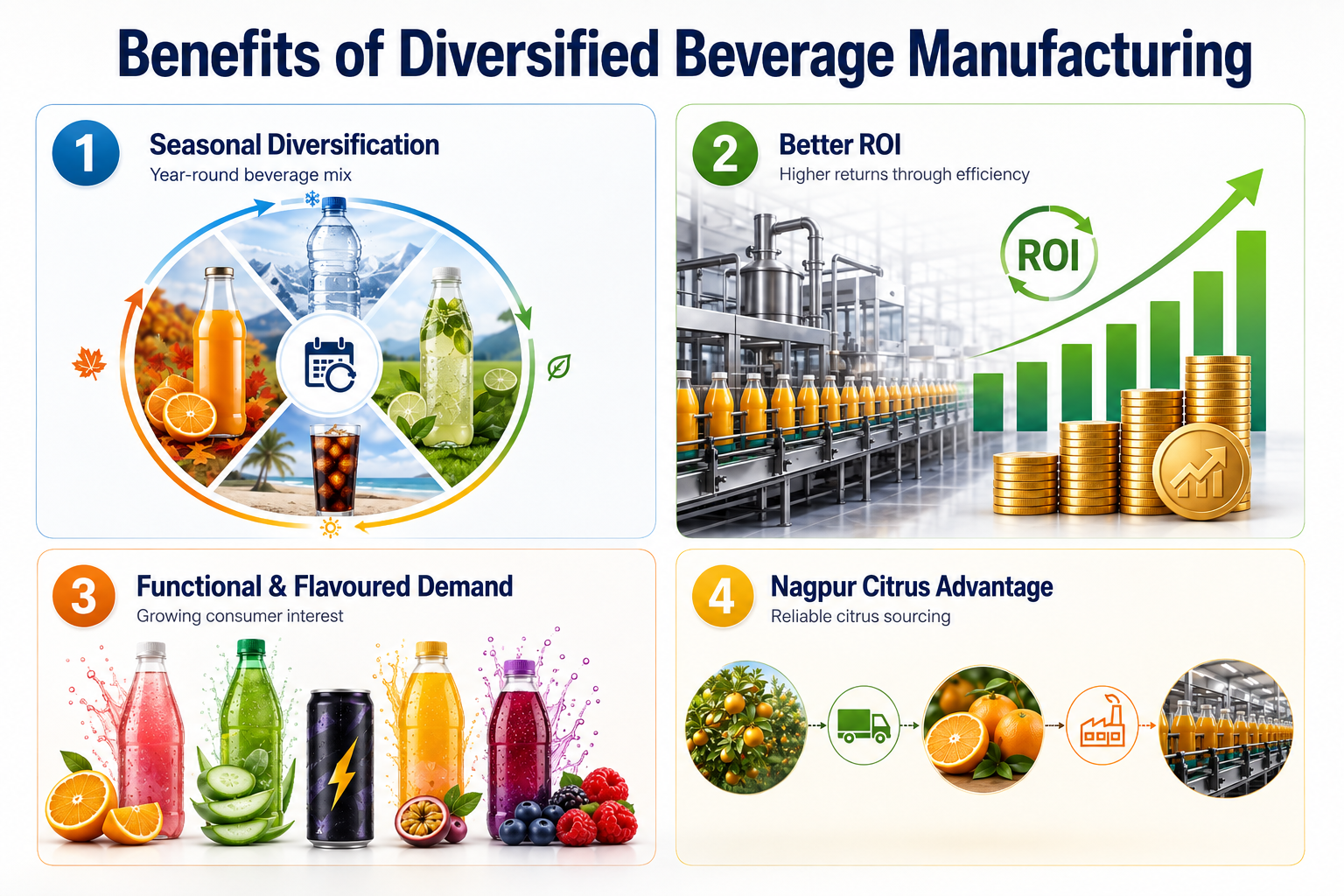
Benefits of Diversified Beverage Manufacturing
- Seasonal diversification: Packaged water demand peaks in summer, while juices and soft drinks maintain more consistent demand through festivals, weddings and the cooler months, smoothing out plant utilisation across the year.
- Better return on investment: A single facility with modular RO treatment, filling and packaging lines that can be configured for water, carbonated soft drinks and fruit based beverages spreads fixed costs across multiple product lines.
- Rising demand for functional and flavoured beverages: Consumers, particularly in Pune and Mumbai, are increasingly drawn to flavoured and fortified water, packaged fruit juices and carbonated beverages, categories that are growing faster than plain packaged water in several market studies.
- Access to Nagpur’s citrus belt: Given the region’s established orange growing and processing industry, a Nagpur based facility is particularly well positioned to combine mineral water production with fruit juice manufacturing using locally sourced raw material.
Government Policies Encouraging Food and Beverage Manufacturing
Several central and state government schemes actively support entrepreneurs and manufacturers looking to set up new water treatment, bottling and beverage packaging facilities:
| Scheme or Framework | Relevance to Water and Beverage Manufacturing |
| Make in India initiative | Encourages domestic manufacturing and machinery localisation across sectors including food and beverage processing |
| Prime Minister’s Employment Generation Programme (PMEGP) | Offers subsidy linked credit support for new micro and small manufacturing units, including packaged water and beverage plants |
| MSME development schemes | Provide credit guarantee, technology upgradation and cluster development support for small and medium beverage manufacturers |
| Ministry of Food Processing Industries schemes (PMKSY and related programmes) | Support infrastructure, cold chain and processing capacity for food and beverage units, including juice manufacturing |
| Maharashtra Industrial Policy | Offers incentives, subsidies and simplified approvals for new industrial units set up within the state, including in designated food processing zones |
| FSSAI licensing framework | Mandatory food safety licensing for all packaged drinking water, soft drink and juice manufacturers operating in India |
| BIS certification (IS 14543 for packaged drinking water and IS 13428 for packaged natural mineral water) | Mandatory quality certification administered by the Bureau of Indian Standards for packaged water sold in India |
Entrepreneurs evaluating a new plant in Maharashtra are encouraged to consult the official portals of FSSAI (fssai.gov.in), the Bureau of Indian Standards (bis.gov.in), the Ministry of Food Processing Industries (mofpi.gov.in) and the Maharashtra Industrial Development Corporation (midcindia.org) for the most current eligibility criteria, subsidy structures and application procedures, since scheme details and thresholds are revised periodically.
Sustainability Is Becoming a Competitive Advantage
As packaged water and beverage consumption grows, so does scrutiny of the environmental footprint associated with production. Manufacturers that build sustainability into their plant design from the outset are increasingly better positioned to win institutional contracts and long term retail partnerships.
- Water recycling: Modern RO systems can be designed to recover and reuse a significant share of reject water for cleaning, cooling and non potable applications within the plant, reducing overall freshwater draw.
- Rainwater harvesting: Plants located across Mumbai, Pune, Nagpur and the Shirdi region can supplement borewell or municipal source water with harvested rainwater, easing pressure on local groundwater tables.
- Energy efficient RO systems: High pressure pumps and membrane systems designed for lower energy consumption per litre of treated water reduce both operating cost and carbon footprint.
- Lightweight PET bottles: Reducing the gram weight of PET bottles without compromising strength lowers raw material consumption and transport weight simultaneously.
- Solar power integration: Rooftop solar installations at bottling plants can meaningfully offset grid electricity consumption, particularly relevant given Maharashtra’s strong solar irradiance.
- Wastewater reuse: Treating and reusing plant wastewater for landscaping, floor washing and utility functions supports both cost savings and regulatory compliance with state pollution control board norms.
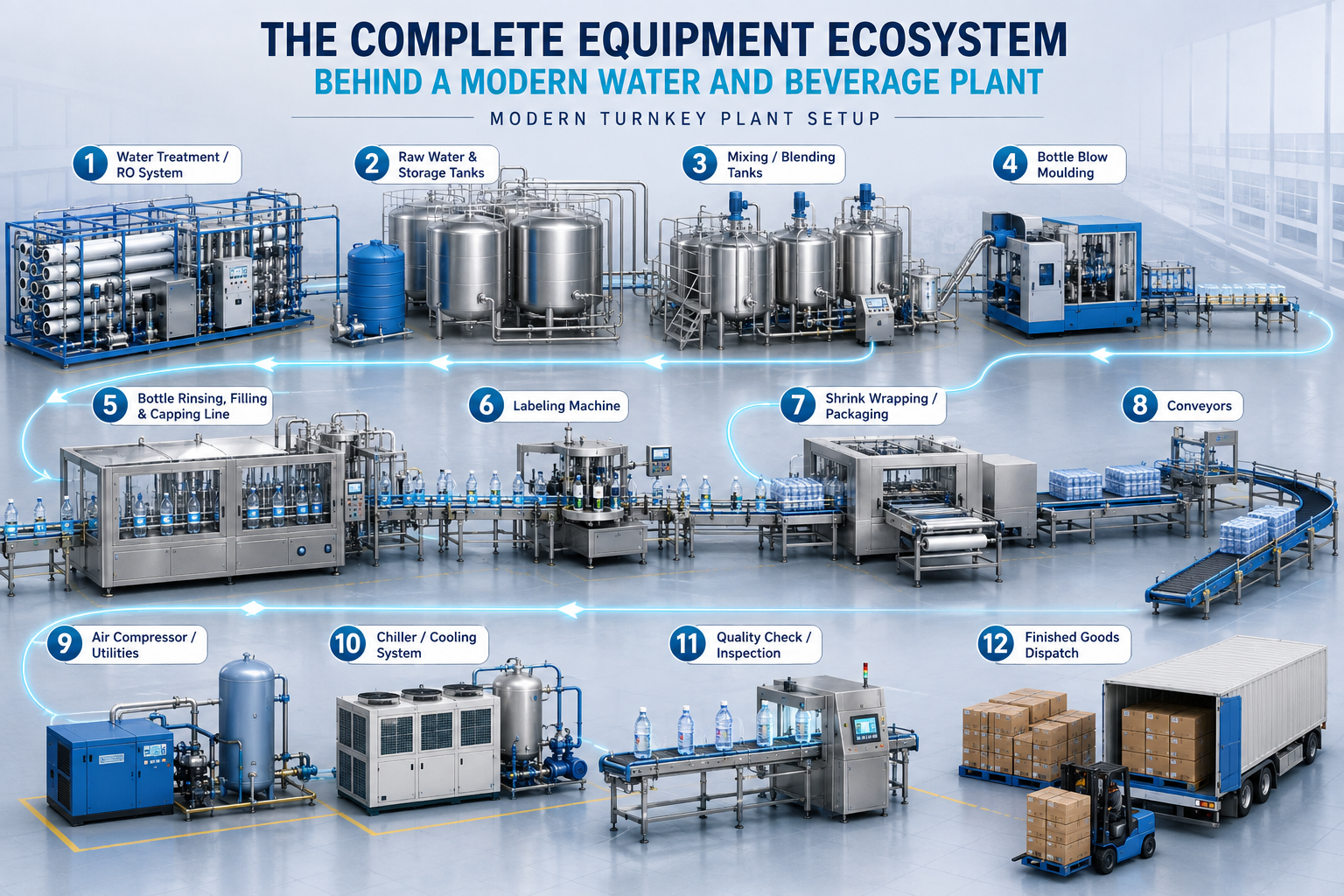
The Complete Equipment Ecosystem Behind a Modern Water and Beverage Plant
Setting up a packaged drinking water, soft drink or juice manufacturing facility involves far more than a single RO system. A typical turnkey project in Mumbai, Pune, Shirdi or Nagpur is likely to require some combination of the following:
| Equipment or Plant Type | Function in the Production Line |
| Packaged drinking water plant | Complete treatment and packaging system for bottled and jar water |
| Soft drink manufacturing plant | Carbonation, syrup blending and filling for carbonated beverages |
| Juice manufacturing plant | Processing, pasteurisation and filling for fruit based beverages |
| PET bottle manufacturing plant | Preform to bottle conversion for packaging supply |
| Commercial and industrial RO plant | High capacity reverse osmosis treatment for bulk water purification |
| Water softening plant | Removes hardness causing minerals ahead of RO or boiler feed applications |
| Bottle filling machine | Automated or semi automated filling of treated water or beverages into bottles |
| Automatic and semi automatic blow moulding machine | Converts PET preforms into finished bottles on site |
| BOPP labeling machine | Applies branded BOPP film labels to bottles at production speed |
| Sticker labeling machine | Applies adhesive sticker labels for smaller batch or jar production |
| Shrink wrapping machine | Groups bottles into shrink wrapped multi packs for retail and institutional supply |
| Sleeve applicator | Applies tamper evident and branding sleeves to bottle necks or bodies |
| Jar washing machine | Cleans and sanitises returnable 20 litre jars before refilling |
| Batch coding machine | Prints manufacturing date, batch number and expiry information for regulatory compliance |
| Water pouch filling machine | Fills low cost water pouches for price sensitive and rural retail segments |
Selecting the right combination and capacity of this equipment depends heavily on the target market segment (retail bottles, institutional jars, HoReCa supply or rural pouch distribution), the expected daily volume, and the specific city’s demand pattern discussed earlier in this article.
How Dharmanandan Techno Projects Pvt. Ltd. (DTPPL) Can Help You Set Up a Water Treatment Plant
For entrepreneurs and existing beverage companies evaluating new capacity in Mumbai, Pune, Shirdi, Nagpur or anywhere else in Maharashtra, the technical and regulatory complexity of setting up a compliant, efficient plant can be significant. This is where an experienced turnkey engineering partner becomes valuable.
Dharmanandan Techno Projects Pvt. Ltd. (DTPPL) works with entrepreneurs, hoteliers, institutions and beverage manufacturers to design, supply and install complete water treatment and packaging solutions, including:
- Packaged mineral water plants sized for local, regional or institutional supply
- Commercial and industrial RO plants for bulk purification requirements
- Water softening plants for hardness removal ahead of RO or process applications
- PET bottle manufacturing lines including automatic and semi automatic blow moulding machines
- Complete bottle filling, capping, labeling (BOPP and sticker), shrink wrapping and sleeve application lines
- Jar washing and jar filling systems for returnable 20 litre container supply
- Batch coding and water pouch filling machinery for regulatory compliance and rural market reach
Because DTPPL supports the full project lifecycle, from initial project cost estimation and machinery selection through to installation and commissioning, entrepreneurs evaluating a new plant in a high growth market like Mumbai, Pune, Shirdi or Nagpur can approach a single technical partner rather than coordinating multiple vendors for RO systems, bottling lines and packaging machinery separately. This is particularly valuable for first time entrants who need guidance on right sizing capacity to match the seasonal demand patterns described earlier in this article, whether that means a flexible, scalable setup suited to Shirdi’s pilgrim driven peaks or a higher throughput institutional supply line suited to Pune’s IT corridor.
 WhatsApp
 How to Set Up a Mineral Water Plant: A Step by Step Overview
- Conduct market and location study: Assess local demand patterns, competing supply, target customer segments (retail, institutional, HoReCa) and proximity to your chosen city, whether Mumbai, Pune, Shirdi or Nagpur.
- Test the source water: Get borewell or municipal source water tested for total dissolved solids, hardness, and microbiological quality to determine the RO and treatment configuration required.
- Finalise plant capacity and machinery: Decide on daily production capacity and select RO capacity, blow moulding machines, filling lines and packaging equipment accordingly.
- Register the business and obtain FSSAI licensing: All packaged drinking water, soft drink and juice manufacturers must obtain a valid FSSAI license before commencing production.
- Obtain BIS certification: Packaged drinking water requires certification under IS 14543, and packaged natural mineral water requires certification under IS 13428, administered by the Bureau of Indian Standards.
- Secure state pollution control board consent: Consent to establish and consent to operate from the Maharashtra Pollution Control Board is required before and after plant commissioning.
- Install treatment and packaging infrastructure: Set up the RO plant, water softening system, blow moulding machine, filling lines, labeling, shrink wrapping and batch coding equipment.
- Conduct trial production and quality testing: Run trial batches and test finished product against BIS and FSSAI parameters before commercial launch.
- Build distribution partnerships: Establish supply agreements with hotels, hospitals, offices, retailers or institutional buyers appropriate to your target city and segment.
- Plan for seasonal scaling: Build in flexibility to scale production during peak periods such as summer months in Mumbai and Pune, or festival season in Shirdi.
Mineral Water Plant
Capacity: 500 LPH to 50,000 LPH
(USD 27,500 to USD 16,49,000)
Frequently Asked Questions
Why do Mumbai, Pune, Shirdi and Nagpur need more packaged drinking water plants?
Each city faces a distinct but significant demand pressure. Mumbai’s dense corporate, transit and hospitality economy, Pune’s IT and student population growth, Shirdi’s extreme pilgrim season spikes, and Nagpur’s emerging logistics and food processing hub around MIHAN all create demand that current local production capacity does not always comfortably meet, particularly during peak seasons.
What is the peak season for packaged water demand in Maharashtra?
Demand typically peaks between March and June due to heatwaves, summer travel, marriage season and schools reopening in June. Shirdi additionally sees sharp festival day peaks tied to the religious calendar rather than the calendar season alone.
Is there still business opportunity for new mineral water plants given existing national brands?
Yes. India’s organised bottled water market remains highly fragmented, with thousands of regional and local players operating alongside national brands, and even the largest players collectively hold only a minority market share. Local production offers advantages in delivery speed, transport cost, freshness and access to institutional and rural segments that centralised national supply chains do not always serve efficiently.
What government approvals are required to set up a packaged drinking water plant in Maharashtra?
Key requirements typically include an FSSAI license, BIS certification under IS 14543 for packaged drinking water or IS 13428 for packaged natural mineral water, and consent to establish and operate from the Maharashtra Pollution Control Board, in addition to standard business registration.
Why is Shirdi's water demand different from Mumbai or Pune?
Shirdi’s demand is driven almost entirely by pilgrim tourism rather than resident population or industrial activity. With an estimated eight million visitors annually and single day festival footfall reportedly reaching several lakh pilgrims, Shirdi requires flexible, scalable production capacity that can respond quickly to sharp seasonal swings.
Can one plant produce both mineral water and juice or soft drinks?
Yes. Many manufacturers design modular facilities with shared RO treatment and filling infrastructure that can be configured across packaged water, soft drinks and fruit juices, which helps smooth out plant utilisation across the year since different beverage categories peak in different seasons.
What machinery is essential for a new packaged water or beverage plant?
A typical setup includes a commercial or industrial RO plant, water softening plant, bottle filling machine, automatic or semi automatic blow moulding machine, labeling machines (BOPP or sticker), shrink wrapping machine, jar washing machine, batch coding machine and, where relevant, a water pouch filling machine.
How can DTPPL help someone planning a new plant in these cities?
Dharmanandan Techno Projects Pvt. Ltd. (DTPPL) provides turnkey design, supply and installation support for packaged mineral water plants, commercial and industrial RO plants, water softening plants, PET bottle manufacturing lines and the full range of filling, labeling and packaging machinery, allowing entrepreneurs to work with a single technical partner across the full project lifecycle.
Why is Nagpur considered a good location for beverage manufacturing?
Nagpur sits at the geographic centre of India, benefits from the MIHAN multi product Special Economic Zone’s logistics, warehousing and food processing infrastructure, and is located within the country’s citrus growing belt, making it well suited to juice, soft drink and mineral water production aimed at Central Indian distribution.
Conclusion
Mumbai, Pune, Shirdi and Nagpur each tell a different chapter of the same underlying story: urban growth, industrial expansion and tourism inflow across Maharashtra are generating packaged drinking water and beverage demand that continues to outpace the flexible, locally sited production capacity needed to serve it efficiently, particularly during peak summer months, festival periods and pilgrim seasons. Established national and regional brands have built a strong foundation, but the scale, fragmentation and seasonal complexity of this market leave genuine room for new entrants, whether through standalone mineral water plants, PET bottle manufacturing units, shared water and juice production facilities, or private label institutional supply. Entrepreneurs evaluating this opportunity are well advised to study each city’s specific demand pattern, work through the applicable FSSAI, BIS and state government requirements, and partner with an experienced turnkey provider such as DTPPL to design a plant that is right sized, compliant and built for long term growth.
Our associates








































Director – Global Marketing and Sales
Mr. Bhavesh from Dharmanandan Techno Projects Pvt. Ltd. has played a pivotal role in elevating the DTPPL brand to the global stage, leveraging his exceptional expertise in marketing and communications. He is committed to helping clients achieve significant growth while strengthening their own brands. Dharmanandan Techno Projects Pvt. Ltd. is a leading manufacturer and supplier of water purification systems and turnkey solutions for mineral water plants. With years of experience in designing and delivering high-quality water treatment solutions, the company provides end-to-end services, including system design, installation, maintenance, and ongoing support. Specializing in scalable and customizable water plants, DTPPL has successfully served industries worldwide, ensuring clean and safe drinking water across diverse applications.