
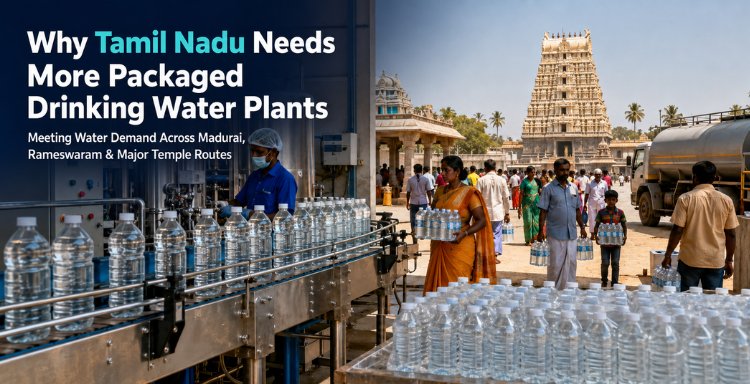




Listening Article
Table of Contents
Why Madurai, Rameshwaram & Tamil Nadu Need More Packaged Drinking Water Plants
August 18, 2026
AI Summary
Tamil Nadu combines two structural pressures that together sustain unusually strong demand for packaged drinking water. The state’s own per capita water resource availability, at roughly 900 cubic metres a year according to state environment data, is less than half the national average of about 2,200 cubic metres, a scarcity made worse by heavy dependence on the long disputed, interstate Cauvery river system and by summer heatwaves that regularly push interior cities such as Madurai, Tiruchirappalli, Vellore and Dharmapuri above 38 to 41 degrees Celsius. Layered on top of this water stress is one of India’s densest multi city temple circuits, spanning Madurai, Rameshwaram, Thanjavur, Palani and Kanyakumari, each drawing sustained pilgrim and tourist traffic that depends on reliable bottled water. This article examines Tamil Nadu’s water resource data, its temple economy, and how Dharmanandan Techno Projects Pvt. Ltd. (DTPPL) can support new RO and packaged water plant investment across the state.
Tamil Nadu’s Temple Trail and the Cauvery Water Reality: Why Madurai, Rameshwaram and the State Need More Packaged Drinking Water Plants
Tamil Nadu is unusual among the states in this series because its water challenge is not concentrated in a single city or district, it is a statewide structural condition, driven by comparatively low per capita water availability, heavy reliance on the Cauvery river, and a hot, dry interior climate. At the same time, the state hosts one of India’s most geographically dispersed and continuously active pilgrimage economies, with major temple towns spread from Kanyakumari in the deep south to Rameshwaram on its own island and Tiruchirappalli and Madurai in the interior. Understanding both halves of this picture is essential to seeing where new packaged drinking water and RO plant capacity makes the strongest sense.
Read Our Article
Mineral Water Plants in Andhra Pradesh for Tourism Water Needs
Tamil Nadu’s Structural Water Scarcity
According to Tamil Nadu’s own state environment data, per capita water resource availability in the state is only around 900 cubic metres a year, against a national average of about 2,200 cubic metres, a gap that reflects the state’s limited river systems and heavy dependence on monsoon timing. Agriculture alone consumes roughly 75% of the state’s available water, leaving comparatively little slack for growing urban and industrial demand. The state’s dependence on the Cauvery river, whose sharing arrangement with Karnataka has been a long running and periodically contentious interstate issue, adds a further layer of supply uncertainty that does not affect most other Indian states in quite the same way.
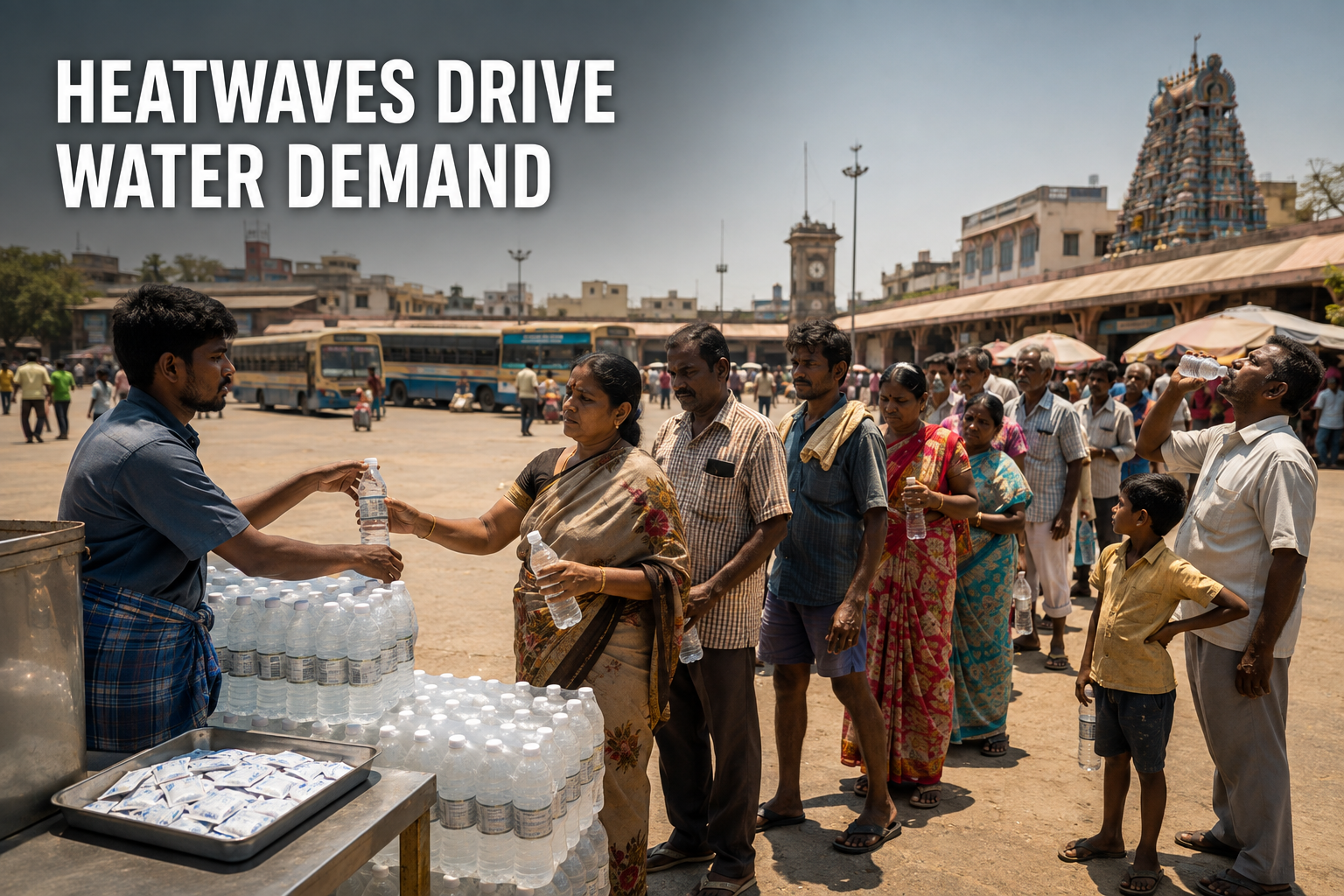
Heatwaves Intensify Demand of Drinking Water Across the Interior
Tamil Nadu’s interior cities regularly experience severe summer heat, with recent heatwave conditions pushing temperatures to 41 degrees Celsius in Vellore and Karur and close to 39 degrees in Madurai, prompting the state government to set up emergency water distribution points at more than a thousand locations, including bus terminuses and markets, along with distributing oral rehydration solution packets during peak heat events. This kind of recurring, government acknowledged heat stress across Madurai, Tiruchirappalli and Tirunelveli sustains a baseline of bottled water demand that goes well beyond ordinary seasonal variation.
A Temple Circuit, Not a Single Pilgrimage Town
Where a state like Uttar Pradesh concentrates pilgrimage demand in a handful of named towns, Tamil Nadu spreads it across a genuinely dense network of active temple destinations, including the Meenakshi Amman Temple in Madurai, the Ramanathaswamy Temple in Rameshwaram, the Brihadishwara Temple in Thanjavur, the Murugan temple at Palani and the southern tip pilgrimage and tourism hub of Kanyakumari. Rameshwaram’s position on an island connected to the mainland by the Pamban rail and road link adds its own logistics dimension, since packaged water and other essentials must move across this crossing rather than simply by direct road from a mainland production hub, a genuine point of difference from any single, mainland pilgrimage town.
OUR OTHER PRODUCT
Comparing Tamil Nadu’s Key Water Demand Centres
| City or Region | Core Demand Driver | Water Situation | Strongest Opportunity |
| Chennai | Coastal metro, corporate and residential demand | Reliant partly on desalination capacity | Commercial RO plant and packaged water for offices and hotels |
| Madurai and Tiruchirappalli | Temple tourism and severe interior heat | Among the hottest, most water stressed interior cities | Packaged drinking water plant for temple and retail demand |
| Rameshwaram | Island temple town with cross strait logistics | Limited local supply, dependent on mainland transport | Locally sited plant reducing dependence on Pamban crossing transport |
| Kanyakumari and the south | Year round pilgrim and tourist convergence point | Coastal, tourism driven demand | Retail and hotel focused packaged water supply |
Client Review
“We are highly satisfied with the Packaged Drinking Water Plant supplied by DTPPL. The system is well-designed, easy to operate, and delivers consistent water quality throughout production. Their team provided excellent technical guidance during installation and commissioning, ensuring smooth operation from the beginning. We appreciate their reliable equipment, professional service, and timely support.”
– Mina Kumari
Government Standards and Water Framework Relevant to Tamil Nadu
- FSSAI licensing and BIS certification under IS 14543 or IS 13428 apply uniformly to all packaged drinking water production in Tamil Nadu.
- The Tamil Nadu Water Supply and Drainage Board (TWAD) manages rural and combined water supply schemes across the state, an important reference point when assessing local supply reliability for a new plant.
- The Tamil Nadu Pollution Control Board issues consent to establish and operate for new water treatment and bottling facilities.
- Given the state’s known dependence on the Cauvery system, new plants are well advised to build in groundwater and, where feasible, recycled water contingency rather than relying on a single source.
How Dharmanandan Techno Projects Pvt. Ltd. (DTPPL) Can Help in Tamil Nadu
DTPPL supports entrepreneurs across Chennai, Madurai, Tiruchirappalli, Rameshwaram and Tamil Nadu’s wider temple circuit with turnkey design, supply and installation of commercial and industrial RO plants, water softening plants and packaged mineral water plants, including complete bottle filling, labeling and shrink wrapping lines. Because Tamil Nadu’s water challenge is structural rather than confined to one city, DTPPL helps entrepreneurs design plants that account for the state’s genuine water scarcity from the outset, including appropriately sized reverse osmosis and softening capacity, supporting the project from water testing and capacity planning through to installation and commissioning.
 Call Us Now!
How to Set Up a Water Treatment Plant in Tamil Nadu: Step by Step
- Test source water and assess local supply reliability, particularly important given Tamil Nadu’s dependence on the Cauvery system and monsoon timing.
- Select an RO and softening configuration appropriate to your water source, whether groundwater, municipal supply or, in coastal areas, desalinated water.
- Register the business and obtain FSSAI licensing and BIS certification under IS 14543 or IS 13428.
- Secure Tamil Nadu Pollution Control Board consent to establish and operate.
- If targeting a temple town such as Rameshwaram, plan logistics around any bridge, causeway or island access constraints from the outset.
- Build supply relationships with temple trusts, hotels, retail outlets and institutional buyers appropriate to your chosen city.
OUR OTHER PRODUCT
Frequently Asked Questions
Why does Tamil Nadu need more packaged drinking water plants despite having a coastline?
Tamil Nadu’s per capita water resource availability is only around 900 cubic metres a year, less than half the national average, and the state depends heavily on the Cauvery river system and monsoon timing, so its coastline does not resolve the state’s underlying freshwater scarcity.
How hot does it get in interior Tamil Nadu cities like Madurai and Tiruchirappalli?
Recent heatwave conditions have pushed temperatures to 41 degrees Celsius in cities such as Vellore and Karur and close to 39 degrees in Madurai, prompting the state government to set up emergency water distribution points at over a thousand locations statewide.
What makes Rameshwaram different from other temple towns for water supply planning?
Rameshwaram sits on an island connected to the mainland by the Pamban rail and road link, so packaged water and other essentials must move across this crossing, making a locally sited plant more valuable than in a directly road connected mainland temple town.
What regulatory requirements apply to a packaged water plant in Tamil Nadu?
A new plant needs FSSAI licensing, BIS certification under IS 14543 or IS 13428, and consent to establish and operate from the Tamil Nadu Pollution Control Board, alongside any applicable groundwater extraction clearance.
How can DTPPL help set up a commercial RO plant in Chennai or Madurai?
DTPPL provides turnkey design, supply and installation for commercial and industrial RO plants and packaged water plants, helping entrepreneurs in Chennai, Madurai and across Tamil Nadu account for the state’s structural water scarcity from the initial planning stage.
Mineral Water Plant
Capacity: 500 LPH to 50,000 LPH
(USD 27,500 to USD 16,49,000)
Conclusion
Tamil Nadu’s case for new water treatment plant rests on a combination that few other states share: comparatively low per capita water availability, heavy dependence on a contested interstate river system, punishing interior heat, and a temple economy spread across a dozen or more active pilgrimage destinations rather than concentrated in one. From Chennai’s corporate and hospitality demand to Madurai’s temple tourism and Rameshwaram’s island logistics, the state offers multiple distinct entry points for a new commercial RO plant or packaged drinking water plant, and entrepreneurs who plan for Tamil Nadu’s specific water resource constraints, working with an experienced partner such as DTPPL, are well positioned to build a resilient business.
Our associates
























































Director – Global Marketing and Sales
Mr. Bhavesh from Dharmanandan Techno Projects Pvt. Ltd. has played a pivotal role in elevating the DTPPL brand to the global stage, leveraging his exceptional expertise in marketing and communications. He is committed to helping clients achieve significant growth while strengthening their own brands. Dharmanandan Techno Projects Pvt. Ltd. is a leading manufacturer and supplier of water purification systems and turnkey solutions for mineral water plants. With years of experience in designing and delivering high-quality water treatment solutions, the company provides end-to-end services, including system design, installation, maintenance, and ongoing support. Specializing in scalable and customizable water plants, DTPPL has successfully served industries worldwide, ensuring clean and safe drinking water across diverse applications.