



Listening Article
Table of Contents
Why West Bengal’s Groundwater Crisis Makes RO Purification and Festival Ready Beverage Plants Essential
August 21, 2026
AI Summary
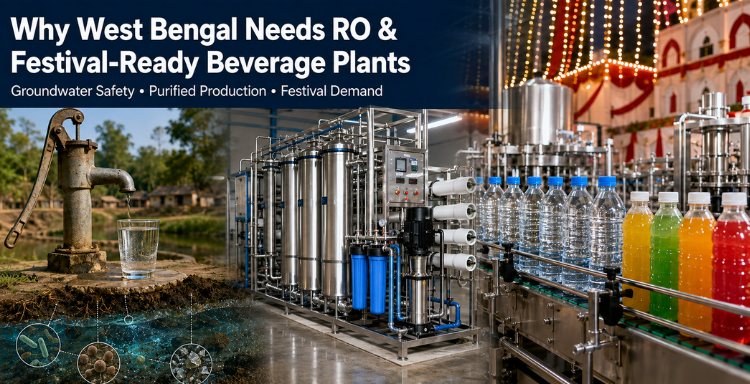
West Bengal sits at the centre of one of the world’s largest documented natural groundwater arsenic contamination zones, with peer reviewed research and government assessments identifying nine districts, including Murshidabad, Nadia, North and South 24 Parganas, Malda, Howrah, Hooghly, Bardhaman and Kolkata itself, where arsenic levels regularly exceed the World Health Organization’s permissible limit, affecting an estimated tens of millions of residents across the Gangetic delta. This is a well evidenced, geochemical driver, distinct from the salinity, depletion or fluoride stories covered elsewhere in this series, and it makes a direct, factual case for reverse osmosis based packaged drinking water plants across Kolkata and the delta districts. At the same time, Bengal’s Durga Puja season, an economy estimated at roughly Rs 65,000 crore in a recent year according to industry tracking, generates an intense, calendar bound surge in beverage and soft drink consumption. This article examines West Bengal’s arsenic contamination data, its festival driven beverage demand, and how Dharmanandan Techno Projects Pvt. Ltd. (DTPPL) can support new RO purification and beverage plant investment across the state.
Bengal’s Arsenic Belt
Few Indian states have a water quality problem as well studied and as severe as West Bengal’s arsenic contamination. Decades of peer reviewed research, much of it led by Jadavpur University’s School of Environmental Studies, has mapped the scale of the problem block by block across the state’s delta districts. At the same time, Kolkata’s Durga Puja is not just a religious festival but one of India’s largest annual consumer spending events, generating a well documented surge in food and beverage consumption over a concentrated ten day window. Together, these two forces, chronic groundwater contamination and an enormous seasonal demand spike, make West Bengal a genuinely distinct market for both purification focused and festival ready beverage manufacturing capacity.
The Scale of West Bengal’s Arsenic Contamination
Research spanning more than two decades has consistently identified nine West Bengal districts as severely affected by groundwater arsenic contamination: Malda, Murshidabad, Nadia, North 24 Parganas, South 24 Parganas, Bardhaman, Howrah, Hooghly and Kolkata itself. Peer reviewed studies estimate that around 20% of West Bengal’s population across these nine districts is affected, with some assessments putting the number exposed to unsafe arsenic levels at approximately six million people, and one broader national estimate suggesting over 70 million people across six Indian states, including West Bengal, are at risk of groundwater arsenic toxicity. The contamination is naturally occurring, or geogenic, arising from the Ganges Brahmaputra delta’s underlying geology rather than industrial pollution, which means it cannot be resolved simply by regulating a factory, it requires ongoing, at scale water treatment.
Why Reverse Osmosis Is Central to the Solution
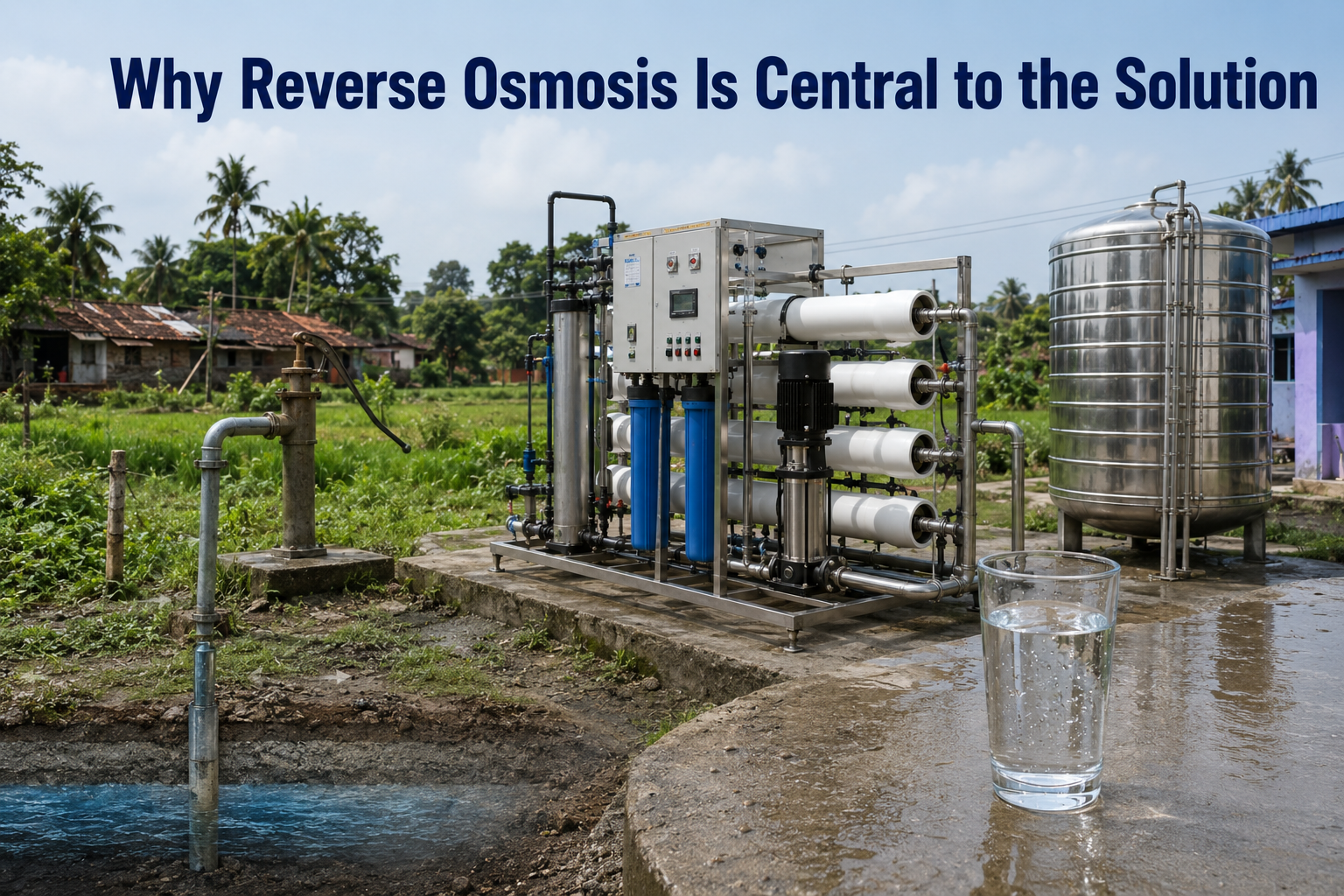
Because arsenic contamination in West Bengal is geogenic and widespread across the shallow aquifer rather than confined to isolated sources, reverse osmosis remains one of the most reliable technologies for reducing arsenic to safe levels at both household and commercial scale, alongside dedicated arsenic removal plants and deeper tube wells that draw from less contaminated strata. For a new packaged drinking water plant serving Kolkata or the delta districts, a properly specified RO plant is not a premium feature, it is close to a baseline requirement given the documented state of local groundwater.
OUR OTHER PRODUCT
Durga Puja: A Ten Day Demand Spike Worth Tens of Thousands of Crores
West Bengal’s Durga Puja economy was estimated at roughly Rs 65,000 crore in a recent year according to industry tracking reported in the state’s press, with Kolkata alone contributing close to 70% of that total, and food and beverage businesses among the clearest winners, with restaurants reporting a 20 to 25% rise in footfall during the festival period. Around 2,500 puja committees in Kolkata and thousands more across the state organise pandals that draw enormous, sustained crowds over ten days, each a concentrated point of demand for packaged water and soft drinks. This creates a demand pattern that is intense but highly predictable and calendar bound, well suited to a beverage plant that can scale production up sharply each autumn.
 Drop Us an Email!
Comparing West Bengal’s Key Water & Beverage Demand Centres
| Location | Core Challenge or Driver | Water or Demand Situation | Strongest Opportunity |
| Kolkata | Durga Puja festival economy plus urban demand | Roughly Rs 65,000 crore festival economy in a recent year | Soft drink plant and packaged water scaled for festival season |
| Murshidabad and Nadia | Among the most arsenic affected districts | Groundwater arsenic frequently above WHO limits | RO based arsenic removal and packaged drinking water plants |
| North and South 24 Parganas | Severely arsenic affected, dense delta population | Large population directly exposed to contaminated groundwater | Reverse osmosis plant capacity for household and institutional supply |
| Howrah and Hooghly | Industrial belt with arsenic affected pockets | Combination of industrial and drinking water demand | Commercial RO plant serving both institutional and retail buyers |
Commercial RO Plant (Reverse Osmosis System)
Capacity: 100 LPH to 1,000 LPH
(USD 4,200 to USD 49,500)
Government Standards and Mitigation Framework
- FSSAI licensing and BIS certification under IS 14543 or IS 13428 apply to all packaged drinking water production in West Bengal.
- The World Health Organization’s provisional guideline value for arsenic in drinking water is 0.01 milligrams per litre, the benchmark referenced throughout Indian and international arsenic mitigation research.
- The West Bengal Public Health Engineering Department has run successive mitigation programmes, including deep tube wells, surface water treatment plants and dedicated arsenic removal plants, across the worst affected blocks.
- The West Bengal Pollution Control Board issues consent to establish and operate for new water treatment and beverage manufacturing facilities.
Client Review
“Dharmanandan has a large manufacturing facility with skilled technicians, supportive staff, and high-quality machinery for mineral water and soft drink plants. They provide reliable solutions and excellent technical support. I can confidently say that Dharmanandan is one of the leading companies in this field, offering complete solutions for mineral water and soft drink plant requirements.”
– Navneet Malhotra
How Dharmanandan Techno Projects Pvt. Ltd. (DTPPL) Can Help in West Bengal
DTPPL supports entrepreneurs and institutional buyers across Kolkata and West Bengal’s delta districts with turnkey design, supply and installation of reverse osmosis plants configured for arsenic reduction, packaged mineral water plants and soft drink plant lines built to scale for Durga Puja and other festival seasons, including bottle filling, shrink wrapping machine and batch coding equipment. Because West Bengal’s water challenge is geochemical rather than seasonal, while its beverage demand spike is calendar bound rather than constant, DTPPL helps entrepreneurs design plants that address both realities, supporting the project from water testing and capacity planning through installation and commissioning.
 Call Now
How to Set Up an RO or Beverage Plant in West Bengal: Step by Step
- Test source water specifically for arsenic, iron and other geogenic contaminants common across West Bengal’s delta districts.
- Select an RO configuration sized appropriately for arsenic reduction, in line with WHO and BIS guidance.
- Register the business and obtain FSSAI licensing and BIS certification under IS 14543 or IS 13428.
- Secure West Bengal Pollution Control Board consent to establish and operate.
- If targeting Durga Puja and other festival demand, plan production scheduling and storage capacity to scale sharply for the ten day festival window.
- Build supply relationships with puja committees, retailers and institutional buyers ahead of the festival calendar.
Frequently Asked Questions
Which districts in West Bengal are most affected by arsenic contamination?
Research consistently identifies nine districts as severely affected: Malda, Murshidabad, Nadia, North 24 Parganas, South 24 Parganas, Bardhaman, Howrah, Hooghly and Kolkata, with Nadia, North 24 Parganas and Murshidabad frequently cited as the most extreme cases.
How many people in West Bengal are affected by arsenic in groundwater?
Estimates vary by study, with some assessments citing around six million people exposed to unsafe arsenic levels within West Bengal’s nine affected districts, and broader national estimates suggesting over 70 million people across six Indian states are at risk.
How large is Kolkata's Durga Puja economy?
Industry tracking reported in the West Bengal press estimated the state’s Durga Puja economy at roughly Rs 65,000 crore in a recent year, with Kolkata contributing close to 70% of that figure and food and beverage businesses reporting notable growth in footfall.
Is reverse osmosis effective against arsenic contamination?
Yes. Reverse osmosis is among the most reliable and widely used technologies for reducing arsenic to safe levels in contaminated groundwater, and is central to most arsenic mitigation programmes operating across West Bengal’s affected districts.
How can DTPPL help a business plan for both arsenic removal and festival season beverage demand?
DTPPL designs and installs RO systems configured for arsenic reduction alongside soft drink and packaged water lines that can scale production for Durga Puja and other festival periods, supporting the project from initial water testing through commissioning.
Conclusion
West Bengal presents a genuinely distinctive combination of challenge and opportunity: one of the world’s most thoroughly documented natural groundwater arsenic contamination zones, affecting millions of residents across nine delta districts, sitting alongside one of India’s largest and most predictable seasonal consumer spending events in Durga Puja. A reverse osmosis plant addressing the state’s well evidenced arsenic problem and a soft drink or packaged water plant built to scale for the festival calendar are not competing priorities, they can be designed as complementary parts of the same business, and entrepreneurs who partner with an experienced provider such as DTPPL are well placed to serve both needs.
Our associates



































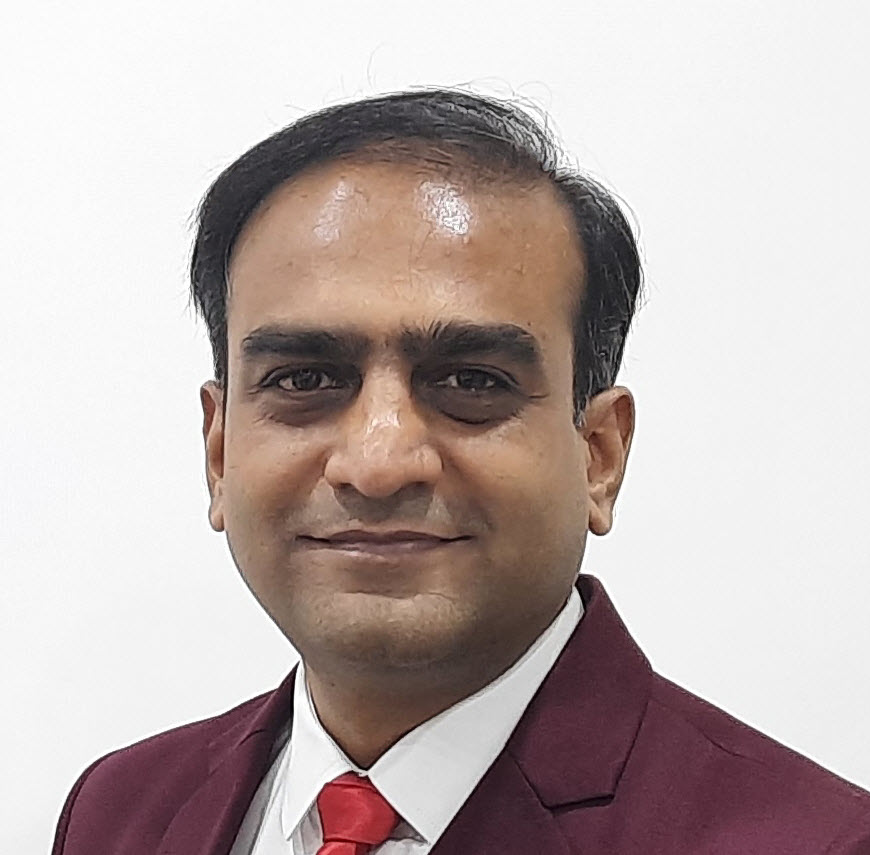
Director – Global Marketing and Sales
Mr. Bhavesh from Dharmanandan Techno Projects Pvt. Ltd. has played a pivotal role in elevating the DTPPL brand to the global stage, leveraging his exceptional expertise in marketing and communications. He is committed to helping clients achieve significant growth while strengthening their own brands. Dharmanandan Techno Projects Pvt. Ltd. is a leading manufacturer and supplier of water purification systems and turnkey solutions for mineral water plants. With years of experience in designing and delivering high-quality water treatment solutions, the company provides end-to-end services, including system design, installation, maintenance, and ongoing support. Specializing in scalable and customizable water plants, DTPPL has successfully served industries worldwide, ensuring clean and safe drinking water across diverse applications.