



Listening Article
Table of Contents
Commercial and Industrial RO Plants: How to Improve Water Recovery and Manage Reject Water
October 21, 2026
AI Summary
Improving water recovery in a commercial or industrial RO plant requires balancing usable water output, membrane protection and responsible reject management. This article explains the factors affecting RO recovery, causes of performance loss, reuse opportunities and treatment approaches such as secondary treatment and Zero Liquid Discharge.
Water recovery has become an important planning factor for facilities operating industrial and Commercial RO plants. As process water costs rise and sustainability targets tighten, plant engineers, ESG teams and facility managers are paying closer attention to how much usable water an RO system produces from a given volume of feed water, and how the remaining reject stream is handled.
Commercial and industrial RO plant water recovery is often treated as a single figure to maximise, but that view misses the bigger picture. RO plant performance depends on stable operation and membrane protection, not on recovery percentage alone. Achievable recovery also varies with RO plant capacity, feed water characteristics and the intended application. Industrial RO water recovery, RO wastewater reuse and reducing RO reject water are connected outcomes of decisions about feed water, system design and operating conditions.
Understanding Water Recovery and Rejection in RO Plants
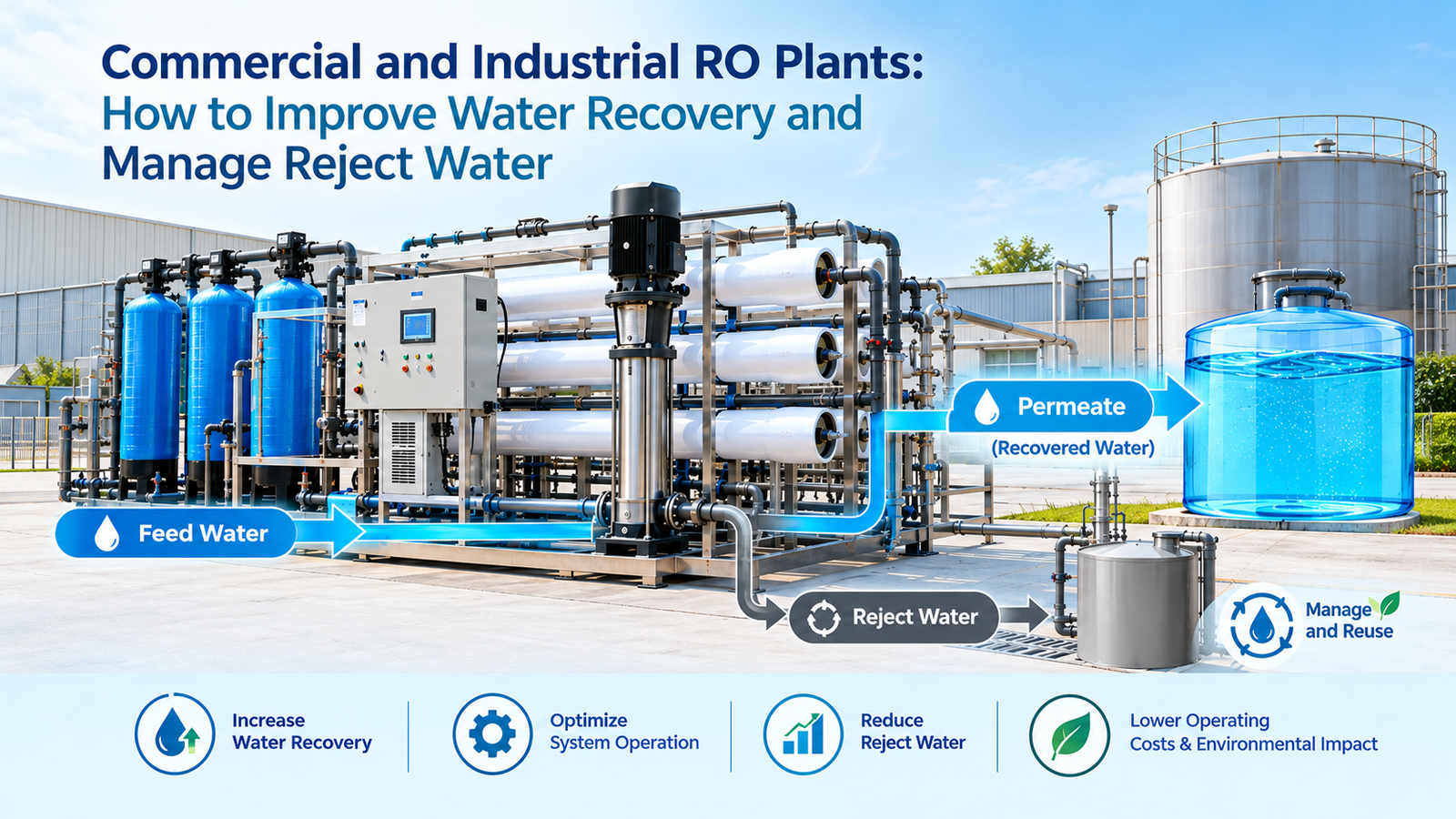
An RO system separates feed water into two streams. Permeate is the treated water that passes through the membrane. Concentrate, or reject, carries the dissolved solids and impurities the membrane filters out.
Recovery rate is the proportion of feed water converted to usable permeate. Rejection describes how effectively the membrane removes dissolved contaminants from that permeate. These are separate indicators, and pushing recovery higher does not automatically improve rejection. Judging performance on recovery alone overlooks water quality, which is usually the reason the plant was installed.
 Call Now !
Feed Water Limitations That Affect RO Plant Recovery Rate
Before setting a recovery target, it helps to understand what the feed water itself allows. Total dissolved solids, mineral concentration and hardness all influence how much feed water can become permeate before the remaining concentrate becomes too saturated to handle safely. Water with high scaling potential, such as calcium carbonate or silica, limits how far recovery can be pushed without risking deposits on the membrane surface. Feed water that varies across a day or a season adds further complexity, since a setting suited to one condition may not suit another.
Recovery planning should start with proper water analysis rather than a target percentage borrowed from another site, since two facilities with similar RO plant capacity can have very different practical recovery limits depending on their source water.
Read Our Article
Understanding RO Reject Water and Concentrate Characteristics
As permeate is drawn off, the water left behind becomes increasingly concentrated, carrying a higher load of dissolved minerals, salts and other impurities than the original feed water. Understanding this composition matters more than simply measuring reject volume, since two plants producing the same quantity of reject water can have very different concentrate chemistry depending on source water and recovery rate. That chemistry determines what can safely be done with the stream afterward, whether that is a non potable reuse application or a particular disposal route.
Recovery Rate Versus Membrane Scaling Risk
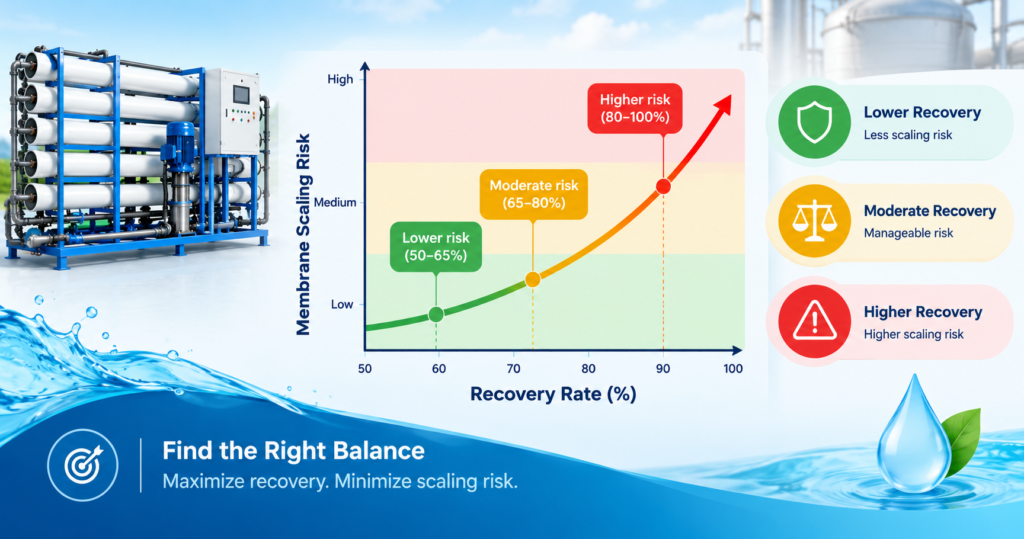
As recovery increases, dissolved solids concentrate near the membrane surface, raising the likelihood of scaling, along with fouling from organic matter or suspended particles. These are not simply inconveniences. They increase cleaning frequency, reduce permeate flow over time and can shorten membrane life if left unmanaged.
Improving recovery therefore means weighing higher usable water output against the chemical limits of the feed water. A recovery level that looks efficient on paper can prove costly if it leads to frequent cleaning or premature membrane replacement.
OUR OTHER PRODUCT
Client Review
“Commissioning our RO plant was a smooth and well-coordinated process thanks to DTPPL. Their engineering team managed equipment delivery, system installation, and operational calibration efficiently. The plant delivers consistent water purification performance with minimal maintenance requirements.”
– Rudra Naik
Common Causes of Low RO Plant Recovery Rate
When an RO plant produces less usable water than expected, the cause is usually operational rather than a fixed limit of the equipment. Membrane fouling from organic matter, biological growth or suspended solids restricts flow and lowers recovery over time. Incorrect pressure settings, whether too low to drive adequate permeate flow or set without accounting for changing feed conditions, also reduce output.
Inadequate pretreatment allows particles and scale forming compounds to reach the membrane surface faster than intended, while scaling itself, once established, steadily reduces effective membrane area. Damaged membranes caused by chemical exposure, poor cleaning practices or severe fouling can permanently reduce performance until replacement, and fluctuating feed quality can cause recovery to drift below its expected range even when the system is otherwise functioning correctly. Identifying which of these applies is usually the first step before adjusting recovery targets.
 Email Us
Staged RO Design for Improving Industrial RO Water Recovery
System design plays a real role in how much recovery a plant can achieve within safe operating limits. Multi stage RO system configurations, where the reject from one stage becomes the feed for the next, allow a facility to extract additional permeate from water that would otherwise be discharged after a single pass.
Additional pretreatment aimed at scaling control can also support higher recovery in some applications, but the right configuration depends on the water quality involved and what the facility is trying to achieve. Flexibility to adjust configuration as conditions change tends to serve a facility better over time than a fixed setup.
RO Reject Water Collection and Management
How reject water is collected and handled once it leaves the RO system affects both compliance and overall water efficiency. A properly designed collection system routes concentrate to storage or downstream processing rather than treating it as waste for discharge without consideration.
Storage capacity should reflect actual reject volumes and any variability in the production schedule, while safe handling and routing based on the concentrate’s chemical characteristics protect both equipment and the surrounding environment.
RO Wastewater Reuse Opportunities for Industrial Facilities
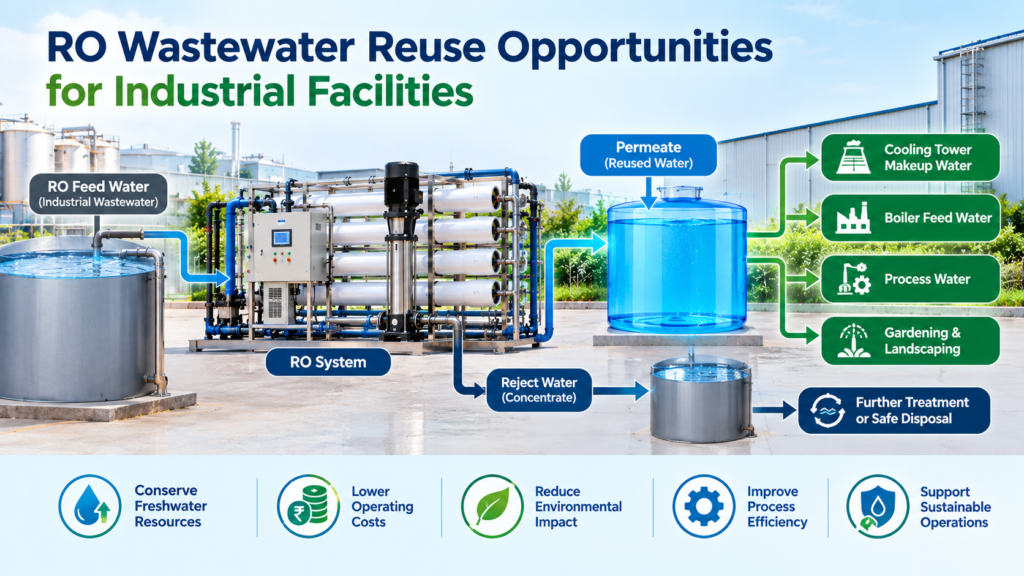
Reject water from an RO plant does not always need to be discharged. Many facilities evaluate reuse for streams suited to non potable applications, including cooling tower makeup water, floor washing, utility cleaning, dust suppression and construction activities where high purity is not required.
Facilities with significant non potable water demand can sometimes offset overall water consumption by directing suitable reject streams into these uses. What a given stream can be used for comes down to its actual concentrate quality, so reuse planning works best when it is evaluated stream by stream rather than assumed to carry over from one facility to another.
OUR OTHER PRODUCT
Secondary Treatment Options to Reduce RO Reject Water
In some cases, the direct reuse options available for a reject stream are limited by its quality, and additional treatment becomes worth considering, since secondary filtration or other treatment steps applied before reuse can expand the applications a reject stream suits.
This does not mean every facility needs secondary treatment. Many sites manage reject water effectively through collection and reuse alone, and the decision to add treatment steps comes down to the reuse goals and reject characteristics specific to that site.
ZLD Considerations for Industrial RO Plant Applications
Some industries operate under discharge requirements strict enough that they evaluate Zero Liquid Discharge approaches, where essentially no liquid effluent leaves the facility. This typically involves treatment steps beyond a standard RO system, such as evaporation, crystallisation and recovery or disposal of the remaining salts, rather than simply cutting reject volume through the RO stage alone.
Pursuing ZLD generally means weighing additional equipment, energy use and operating costs against the regulatory or sustainability drivers behind it. It is not a solution every commercial or industrial RO plant requires, and feasibility evaluation should come before committing to it.
Monitoring Water Balance in Commercial and Industrial RO Plants
Ongoing monitoring gives a facility the information it needs to manage recovery and reject water responsibly. Tracking feed water quantity, permeate production and reject generation together builds a picture of the plant’s overall water balance rather than looking at any single figure in isolation.
This kind of tracking supports identifying performance drift before it becomes a larger problem, catching early faults such as fouling or a failing seal, and informing decisions on when to adjust recovery settings or schedule membrane cleaning.
Factors to Consider Before Reducing RO Reject Water
Reducing reject water volume is a business decision as much as a technical one, and it should be evaluated before any modification is made to an operating system. Feed water quality sets the practical ceiling for how far reject can realistically be reduced, and existing RO design affects what changes are even possible without significant rework.
Current operating conditions influence how much room there is to adjust recovery before scaling or fouling risk increases. Reuse opportunities at the site shape whether reducing reject volume is the most useful goal, and regulatory requirements around discharge quality and quantity need to be factored in as well. Modifying a system without this evaluation can create new problems, including increased cleaning frequency or reduced membrane life.
How an RO Plant Manufacturer Supports Water Recovery Planning
An experienced RO system manufacturer with commercial and industrial water treatment expertise can help businesses evaluate recovery targets, plant configuration and reject management strategies for their application. This support generally starts with understanding a facility’s source water, production schedule and regulatory constraints, then evaluating whether a staged design or particular pretreatment approach fits the application.
For companies sourcing water treatment systems, choosing an experienced Commercial RO Plant Manufacturer or Industrial RO Plant Manufacturer helps ensure that recovery targets, treatment stages and reject management strategies are considered during system design. Businesses looking for overseas supply support can also evaluate manufacturers with Commercial RO Plant Exporter capabilities for project execution and technical coordination. Dharmanandan Techno Project Pvt. Ltd. supports businesses during this evaluation stage by helping assess suitable RO configurations, treatment approaches and project requirements before final equipment selection.
FAQs
What factors influence water recovery in an industrial RO plant?
Feed water quality, including dissolved solids and scaling potential, along with system design and operating conditions, set the practical limits on achievable recovery.
Can RO reject water be reused in industrial applications?
In many cases, yes. Reject water can suit applications such as cooling tower makeup, cleaning or dust suppression, though suitability depends on the quality of that particular stream.
Does increasing RO recovery always improve water efficiency?
Not necessarily. Pushing recovery too high can increase scaling and fouling risk, which may raise maintenance needs and offset the benefit of the extra permeate produced.
How can industries manage RO reject water effectively?
Effective management combines proper collection and storage, ongoing monitoring of reject flow and quality, and evaluation of reuse or secondary treatment options based on the concentrate’s characteristics.
Why is water analysis important before improving RO recovery?
Water analysis identifies the scaling potential and mineral content of the feed, which determines how far recovery can safely be increased without risking membrane damage or excessive cleaning frequency.
How can industries improve RO plant water recovery without damaging membranes?
Industries can improve RO plant water recovery by optimising pretreatment, monitoring feed water quality, controlling scaling risk and selecting suitable RO configurations. Increasing recovery without evaluating membrane limitations can create fouling problems and higher maintenance costs.
Our associates






























Director – Global Marketing and Sales
Mr. Bhavesh from Dharmanandan Techno Projects Pvt. Ltd. has played a pivotal role in elevating the DTPPL brand to the global stage, leveraging his exceptional expertise in marketing and communications. He is committed to helping clients achieve significant growth while strengthening their own brands. Dharmanandan Techno Projects Pvt. Ltd. is a leading manufacturer and supplier of water purification systems and turnkey solutions for mineral water plants. With years of experience in designing and delivering high-quality water treatment solutions, the company provides end-to-end services, including system design, installation, maintenance, and ongoing support. Specializing in scalable and customizable water plants, DTPPL has successfully served industries worldwide, ensuring clean and safe drinking water across diverse applications.