




Listening Article
Table of Contents
Fully Automatic BOPP Labeling Machine for Mineral Water Plant: Electrical Panel, PLC Troubleshooting and Preventive Maintenance Guide
October 22, 2026
BOPP Labeling Machine: AI Summary
A Fully Automatic BOPP Labeling Machine for Mineral Water Plant relies on its electrical panel, PLC settings and a steady maintenance routine to run without interruption. The panel houses motor drives, protection devices, contactors and controller cards that coordinate servo motion, cutting and glue heating. The PLC manages homing, label length, offset and missed eye mark settings, along with input and output monitoring and heater control. Daily, weekly and monthly maintenance protects alignment, glue delivery and vacuum performance.
Understanding BOPP Labeling Machine Controls and Maintenance
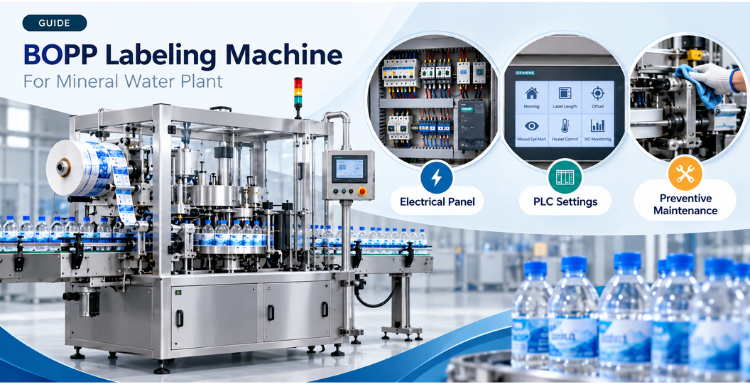
A Fully Automatic BOPP Labeling Machine for Mineral Water Plant, built by Dharmanandan Techno Project Pvt. Ltd. (DTPPL), combines an electrical panel, a PLC interface and a maintenance schedule that plant teams manage together on the shop floor.
What follows walks through each panel component, the PLC screens operators use day to day, and the maintenance intervals that keep the line running at its rated speed.
How the Electrical Panel Controls the BOPP Labeling Machine
Motor Drives
The panel includes a servo drive that works with the homing motor and its encoder to position the label. A separate main machine drive sets running speed, and the attached conveyor shares the same circuit so both move together.
A dedicated glue pump drive allows speed adjustment from the panel or the PLC potentiometer. The infeed conveyor has its own independently adjustable drive.
The exact number of drives can vary between BOPP labeling machine models, so this is representative rather than fixed.
Power Supply and Protection
A transformer supplies the control voltage the electronics require, commonly around 220 V on the described machine, a value specific to that configuration rather than universal. An SMPS converts this incoming AC supply into DC voltage for the PLC and related circuits.
Small fuses protect the 24 V DC line; a failed fuse cuts the PLC’s supply and prevents it from powering on. A phase sequence relay checks incoming phase order and blocks startup if it is reversed.
Multiple MCBs serve separate circuits for the main machine, PLC, heater and vacuum pump.
Contactors, Relay Card and Controllers
Dedicated contactors switch power to the vacuum pump, the glue tank heater and the roller heater. A relay card shows which commanded functions are active, and a fault on the card can stop that function even while the rest of the machine runs normally.
Two controller cards sit at the centre of the electrical panel design, often referred to as the Trio and the DTC card. The Trio supports servo motion, label positioning and cutting; while it is described as a durable component when supplied with a stable input, no controller is immune to failure over time.
The DTC card carries the stored program and issues commands telling the machine which routine to run.
Understanding BOPP Labeling Machine Operator Switches and PLC Functions
Physical Controls and Indicators
Below the PLC screen, a row of switches and indicators controls the machine’s basic functions. The infeed conveyor switch starts the conveyor feeding bottles in, and the glue pump switch turns glue supply to the drum on or off.
A master sensor indicator shows cutter related sensing activity, while a separate eye mark indicator blinks each time the eye mark sensor detects the printed mark. The emergency stop halts the machine immediately if a problem occurs, functioning as an emergency stop rather than electrical isolation for maintenance.
A manual and auto selector sets the operating mode, and start and stop buttons run or halt the machine. The jog button moves it in small, limited increments rather than a calibrated distance, and separate switches operate the cutter and the vacuum pump.
Auto, Manual, IO and PID Screens
The PLC screen has auto, manual, IO list and PID views. The auto view includes start and homing controls, along with label length, offset and missed mark settings covered below.
The manual view repeats key functions, including homing, cutter, gate and glue, so operators can run each individually for checking rather than a full auto cycle.
Cutter delay and gate delay settings determine when the cutter engages and when the gate opens and closes during each cycle. Exact values are set during commissioning and vary by bottle and label format.
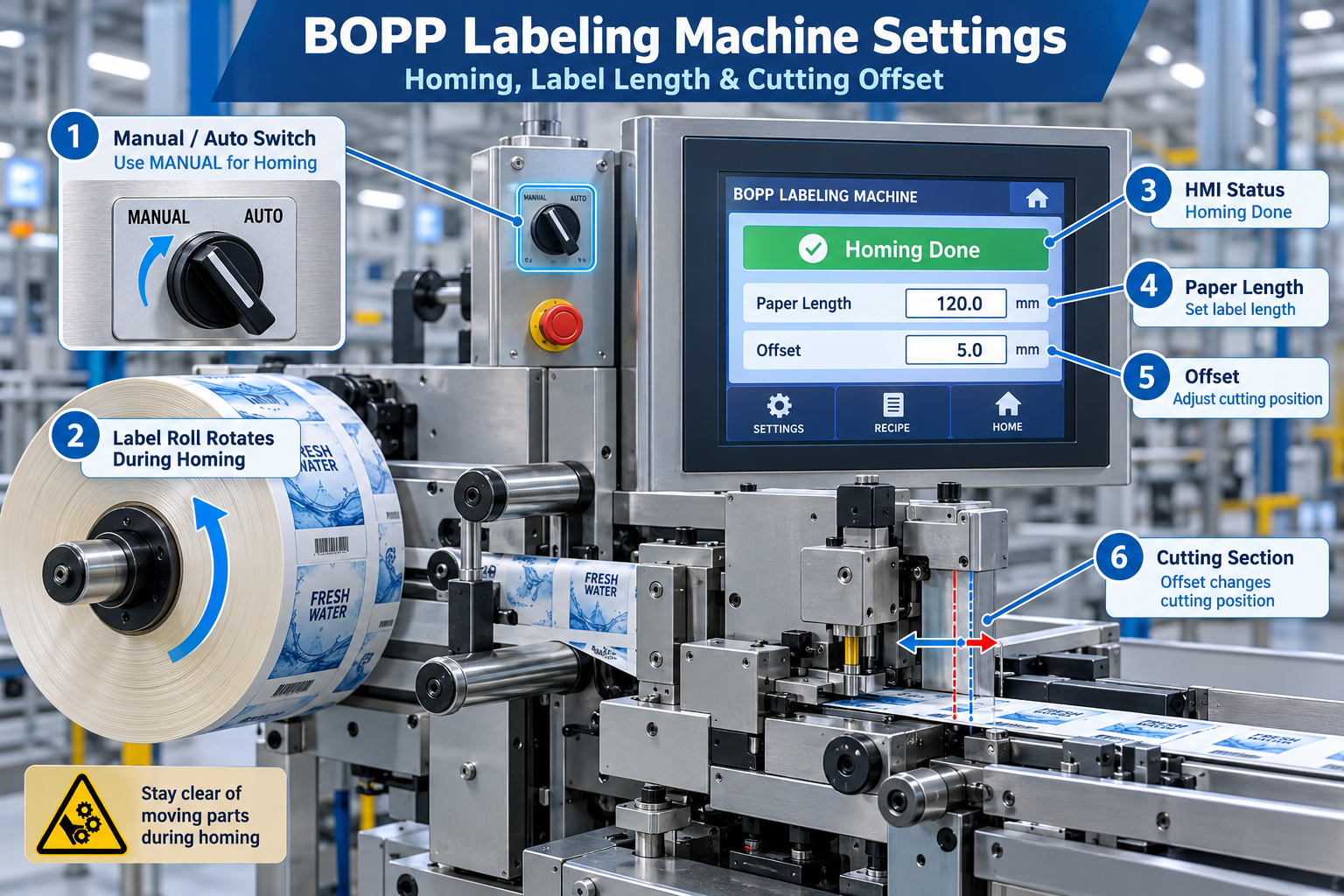
BOPP Labeling Machine Homing, Label Length and Cutting Offset Settings
Homing only runs when the manual and auto selector is set to manual; attempting it in auto will not start the routine. Once initiated from either the auto or manual screen, the roll rotates as part of the sequence, and a homing done message appears once it finishes. Personnel should stay clear of moving components during this process.
Label length, shown as paper length on screen, is preset according to the bottle and label format being run. Offset adjusts the cutting position relative to the eye mark, and commissioning technicians typically set both values during changeover.
If adjustment is needed, moving the offset gradually helps align the cut with the eye mark. Specific offset numbers on one machine should be treated as an example rather than a universal recommendation.
A missed eye mark setting determines how many consecutive missed detections the machine tolerates before stopping automatically, protecting against a situation where an operator may not notice incorrect cutting.
This count should not be raised simply to keep production running through a developing fault. An active eye mark reading alone does not confirm every label has been applied correctly.
Monitoring BOPP Labeling Machine Inputs, Outputs and Glue Heater Controls
The IO list shows which inputs and outputs are currently active, including an indication when the eye mark input is sensed. An active signal confirms the PLC is receiving or sending that signal, but it does not by itself confirm correct mechanical operation, so it works best alongside a visual check.
When a fault occurs, an alarm appears directly on the PLC screen.
The PID screen manages the glue tank heater and roller heater separately, each showing a set temperature alongside the actual, displayed reading, with heating output switching as the reading moves toward target. Displayed temperatures on one machine are specific to that configuration and adhesive, not a universal setting.
Heater settings should follow the adhesive manufacturer’s guidance and the machine’s own instructions rather than being changed casually for weather alone. Glue heating can be enabled or disabled from the PID screen when needed.
 Email Us Today!
Common BOPP Labeling Machine Control Problems and Supported Checks
The table groups common symptoms with the relevant component and a supported first check. A listed component is one possible cause, not the only one.
Symptom | Relevant Component or Setting | Supported Check or Next Step |
PLC not powering on | 24 V DC fuses, SMPS | Check whether the fuses are intact and confirm the SMPS is supplying DC voltage before assuming a deeper fault |
Startup inhibited by phase sequence protection | Phase sequence relay | Confirm incoming phase sequence is correct; do not bypass the relay to force a start |
Homing not occurring | Manual and auto selector switch | Confirm the selector is set to manual before attempting homing again |
Incorrect cutting position | Offset setting | Review the offset against the eye mark and adjust in small increments, or contact Dharmanandan Techno Project Pvt. Ltd. (DTPPL) if the setting is uncertain |
Stopping after repeated missed eye marks | Missed mark count, eye mark sensor | Inspect the eye mark sensor and label alignment rather than raising the missed mark count to bypass the stop |
A commanded function not operating | Relay card, associated contactor | Check the relay card indication for that function and the related contactor before assuming a mechanical fault |
Glue heating requiring investigation | PID set and actual temperature, heater contactor | Compare the set and actual temperature readings and confirm the heater output is switching as expected |
Daily, Weekly and Monthly BOPP Labeling Machine Preventive Maintenance
Daily Maintenance
Daily checks focus on tightening the bolts on the drum and the star plate, along with other accessible fasteners on the frame.
Checking for looseness and retightening where necessary, following the machine’s own instructions, helps keep alignment steady and avoids mid shift stoppages. Indiscriminate tightening beyond what is loose should be avoided.
Weekly Maintenance
Weekly tasks include oiling and greasing the chain below the main drive and checking the associated gear bolts for looseness, though not every point needs both oil and grease together.
Glue deposits inside the drum pad and its passages should be cleaned weekly using appropriate tools handled by trained personnel, following manufacturer approved procedures rather than improvised objects.
The vacuum pump mesh, accessed by removing the two Allen bolts holding it in place, should also be cleaned weekly to maintain vacuum performance.
Monthly Maintenance
Monthly maintenance covers the glue tank. Old glue should be removed completely, the tank cleaned, and refilled with fresh, approved adhesive.
Cleaning materials should match what the equipment manufacturer or adhesive supplier recommends; routine use of petrol or diesel as a cleaning agent is not recommended. Following these intervals consistently supports smoother operation, though preventive maintenance reduces the likelihood of breakdowns rather than eliminating it entirely.
 Call Us Now!
BOPP Labeling Machine Safety and Checks Before Restarting
Internal electrical work should remain the responsibility of qualified personnel, with relevant power and other energy sources safely isolated before maintenance begins. Live electrical testing is not recommended for plant staff.
During jogging, homing and any test run, personnel should stay clear of moving parts. Protective devices, guards and stop functions should never be bypassed. Precautions suited to heated glue equipment, including protection from hot surfaces, should be followed near the tank or roller heater.
Before restarting, all components and guards removed during maintenance should be restored, and settings, lubricants, adhesives and cleaning materials used should match what is approved. A controlled, closely observed test run is a reasonable step before returning to normal production.
Client Review
“DTPPL provides useful insights into mineral water plant planning, particularly when comparing in-house PET bottle manufacturing with purchasing ready-made bottles. Their guidance helps businesses understand equipment requirements, operating costs, storage needs, and production efficiency before making an investment decision.”
– Rudra Shah
When to Contact DTPPL for BOPP Labeling Machine Assistance
Some issues call for support beyond routine operator checks. Electrical faults unresolved after basic checks such as fuses, MCBs and the phase sequence relay are worth raising with a qualified technician.
The same goes for uncertain PLC settings such as label length, offset or missed mark values, persistent cutting problems, and maintenance beyond operator authorisation.
As a BOPP Labeling Machine Manufacturer and BOPP Labeling Machine Supplier, Dharmanandan Techno Project Pvt. Ltd. (DTPPL) supports customers with commissioning, troubleshooting and spare parts. DTPPL can be contacted for a site visit, a technical consultation or a bopp labeling machine price quotation for a new line.
About Dharmanandan Techno Project Pvt. Ltd. (DTPPL)
Dharmanandan Techno Project Pvt. Ltd. (DTPPL), based in Surat, manufactures mineral water plants and related packaging machinery, including the Fully Automatic BOPP Labeling Machine for Mineral Water Plant described above. Its product range also covers bottle washing, filling and capping lines, water treatment systems, and labeling equipment for mineral water, soft drink and juice packaging lines.
DTPPL designs the electrical panel, PLC programs and maintenance support for each plant’s labeling speed and bottle format, which is why the details above apply directly to the machines it supplies.
BOPP Labeling Machine Conclusion
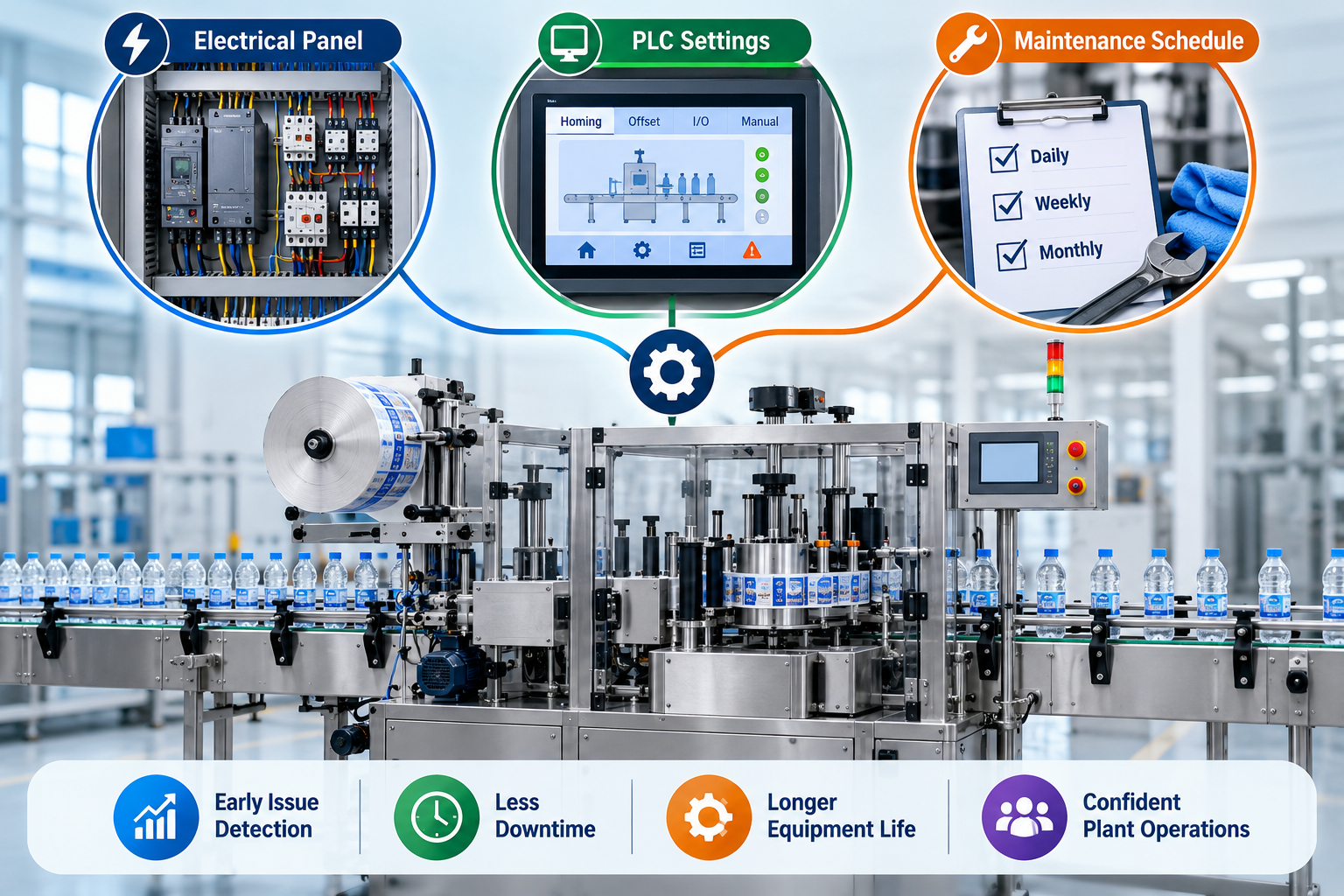
A Fully Automatic BOPP Labeling Machine for Mineral Water Plant performs best when its electrical panel, PLC settings and maintenance schedule are managed as one system rather than separate tasks.
Recognising what each drive, contactor and controller does, reading the PLC’s homing, offset and IO screens correctly, and following the daily, weekly and monthly maintenance intervals helps plant teams catch early symptoms and carry out supported checks confidently. None of this removes the need for occasional professional support, but it reduces avoidable downtime and extends the practical life of the equipment.
BOPP Labeling Machine Frequently Asked Questions
Which components control a BOPP labeling machine's operation?
A combination of motor drives, a transformer and SMPS for power, protection devices such as fuses and the phase sequence relay, contactors, a relay card and two controller cards work together, alongside the PLC interface used for settings and monitoring. Dharmanandan Techno Project Pvt. Ltd. (DTPPL) engineers these components to suit the labeling speeds and bottle formats used in mineral water plants.
Why might a BOPP labeling machine's PLC fail to power on?
Checking the 24 V DC line fuses and the SMPS output is the quickest starting point, since either one failing stops the PLC from receiving power.
Why must the selector be in manual position for BOPP labeling machine homing?
The homing sequence is linked to the manual position on the described machine, so leaving the selector in auto prevents it from starting.
What do cutting offset and missed mark settings control in a BOPP labeling machine?
Offset shifts where the cut falls relative to the eye mark, while the missed mark setting sets how many consecutive missed detections are allowed before the machine halts on its own.
Which BOPP labeling machine maintenance tasks are daily, weekly and monthly?
Daily checks focus on tightening drum and star plate bolts, weekly tasks cover chain lubrication, gear bolt checks, drum pad cleaning and vacuum mesh cleaning, and monthly maintenance covers removing, cleaning and refilling the glue tank.
How can I request a bopp labeling machine price quotation from DTPPL?
Reaching out to Dharmanandan Techno Project Pvt. Ltd. (DTPPL) with details of the required bottle size, label format and production speed allows the team to prepare a suitable bopp labeling machine price quotation for a mineral water, soft drink or juice packaging line.
Our associates











































Director – Global Marketing and Sales
Mr. Bhavesh from Dharmanandan Techno Projects Pvt. Ltd. has played a pivotal role in elevating the DTPPL brand to the global stage, leveraging his exceptional expertise in marketing and communications. He is committed to helping clients achieve significant growth while strengthening their own brands. Dharmanandan Techno Projects Pvt. Ltd. is a leading manufacturer and supplier of water purification systems and turnkey solutions for mineral water plants. With years of experience in designing and delivering high-quality water treatment solutions, the company provides end-to-end services, including system design, installation, maintenance, and ongoing support. Specializing in scalable and customizable water plants, DTPPL has successfully served industries worldwide, ensuring clean and safe drinking water across diverse applications.