




Listening Article
Table of Contents
Ahmedabad Mineral Water Plants: Matching Bottling Lines with Seasonal and Institutional Demand
October 26, 2026
AI Summary
A mineral water plant in Ahmedabad cannot be sized on average monthly sales alone, since summer peaks, retail counters, industrial estates, and institutional contracts each pull on the same mineral water bottling machine differently. Incorrect capacity selection can affect machine utilisation, operating cost, and the ability to secure long term institutional contracts. Businesses running a mineral water bottling line in Ahmedabad, launching a water bottling business, or expanding a commercial water bottling plant get more reliable supply by planning daily output against peak output, buffer stock, warehouse space, and preventive maintenance well in advance.Why Average Monthly Sales Should Not Decide Mineral Water Plant Capacity
Average monthly sales figures are useful for financial planning, but they hide the shape of demand across the year. A plant that produces exactly enough to meet the yearly average will almost certainly be undersupplied during peak months and oversupplied during quieter ones. This mismatch shows up in two ways: lost sales and strained customer relationships when summer or event demand cannot be met, and idle capacity or high fixed costs when winter demand falls well below the average.
Realistic mineral water production planning starts by separating demand into its components, daily baseline consumption, seasonal peaks, institutional contracts, and one off large orders, and then sizing the line, the workforce, and the storage space around the combination of these, not around a single blended number. The same reasoning holds for a mineral water plant in Ahmedabad, an automatic mineral water plant in Gujarat, or any business trying to read packaged water demand in Ahmedabad before finalising capacity.
Summer Demand Planning for a Mineral Water Plant in Ahmedabad
Ahmedabad’s summer months bring a sharp rise in water consumption across households, offices, construction sites, and public spaces. Demand does not rise gradually. It can climb over a short window, typically from around April, and stay elevated for several weeks at a stretch. A plant that has not planned for this window in advance often finds itself choosing between refusing orders or scrambling to arrange additional stock at short notice, both of which affect customer trust.
Seasonal forecasting is the practical tool here. It means reviewing packaging material planning, labour planning, and raw material contracts well ahead of April, rather than reacting once demand has already climbed. Businesses that treat the summer peak as a known, recurring event, rather than a surprise each year, are better placed to protect their retail relationships and take on additional institutional or event orders during the same period.
 Email Us Today!
Daily Versus Peak Output for a Mineral Water Bottling Line
A useful way to think about capacity is to separate two numbers: the output needed on a typical operating day, and the output needed on the busiest days of the year. These two figures can be very different, and a plant designed only around the first will struggle with the second.
This is really a question of machine utilisation. Rated capacity, operating hours, and shift patterns all determine how much production headroom exists above daily output. Running close to maximum output every single day on the existing water bottling machinery leaves no room for a large institutional order, a slowdown, or a sudden spike in retail demand. Businesses that build in some headroom between daily output and rated peak output are better positioned to absorb these variations without disrupting regular supply.
Retail Demand Patterns for a Mineral Water Plant in Ahmedabad
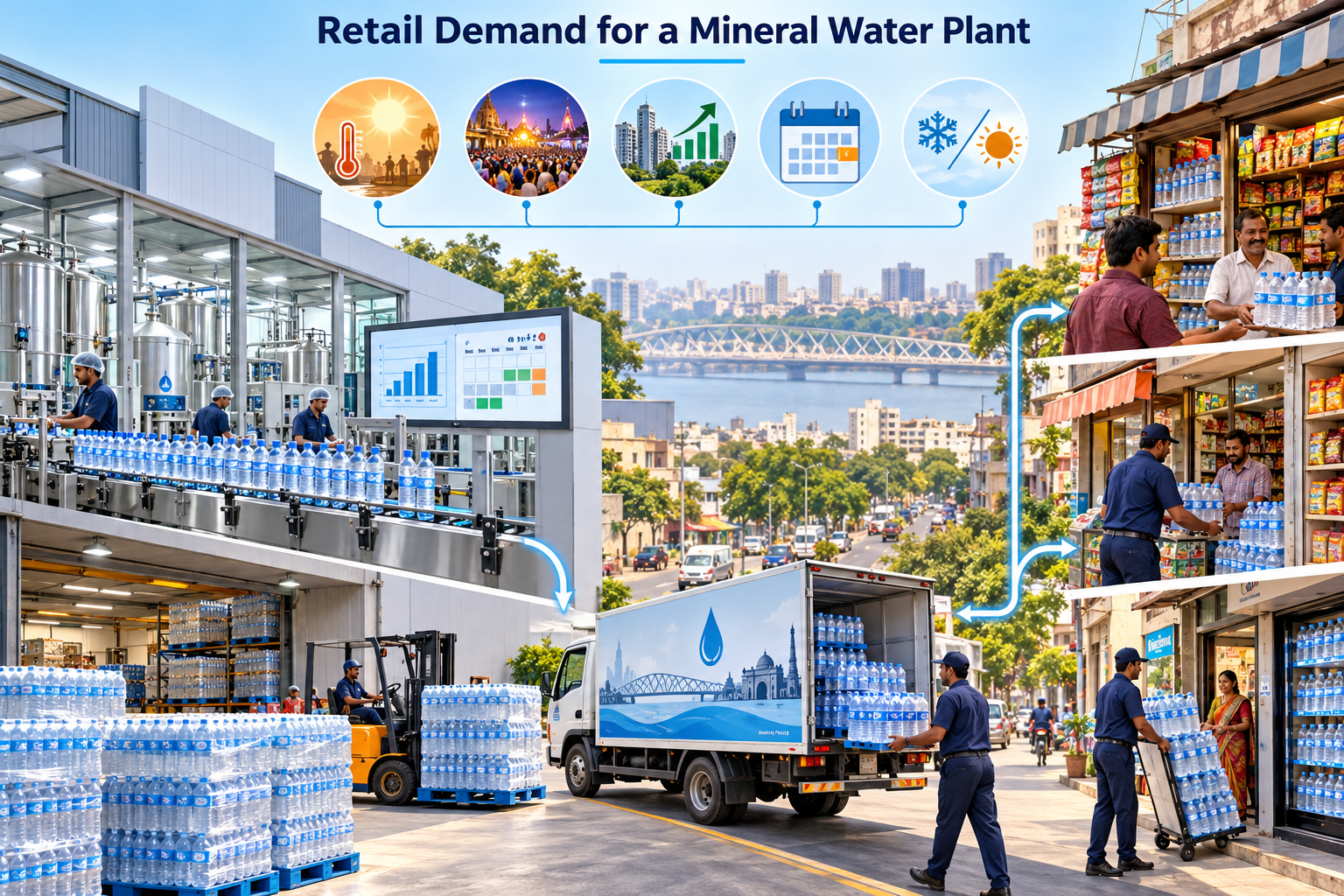
Retail demand in Ahmedabad is shaped by everyday consumption across kirana stores, general stores, and local distributors. This segment tends to be more predictable than institutional or event demand, but it still moves with weather, local events, and neighbourhood growth. A plant supplying retail customers needs consistent daily output and dependable delivery timing, since retail counters generally do not carry large reserve stock themselves and expect regular replenishment.
Understanding how retail demand behaves through the week and through the year helps a business plan production schedules that keep counters stocked without building up unnecessary finished goods inventory.
Client Review
“Commissioning our RO plant was a smooth and well-coordinated process thanks to DTPPL. Their engineering team managed equipment delivery, system installation, and operational calibration efficiently. The plant delivers consistent water purification performance with minimal maintenance requirements.”
– Rudra Naik
Industrial Area Consumption Near an Ahmedabad Mineral Water Plant
Ahmedabad’s industrial estates and GIDC belts represent a distinct demand segment. Factories, warehouses, and industrial offices consume packaged water steadily through the working week, often in bulk formats rather than single bottles. This demand is generally less seasonal than retail or event demand, but it depends on factors such as shift patterns, workforce size, and whether a facility runs additional shifts during its own busy periods.
Businesses supplying industrial customers need to plan dispatch schedules around factory working hours and understand whether their industrial customers have their own seasonal cycles that could add to or offset the plant’s summer peak.
Email Us
Institutional Contracts for a Commercial Water Bottling Plant
Hospitals, educational institutions, corporate offices, and government establishments often commit to standing supply arrangements rather than ad hoc purchases. Institutional contracts bring a degree of predictability, known quantities over known periods, but they also carry an obligation: a missed delivery to an institutional customer can affect a contractual relationship, not just a single sale.
Because institutional demand is contracted rather than optional, it should be planned for as a fixed layer of production and dispatch capacity for a commercial water bottling plant, separate from the more flexible retail and industrial demand. A plant that treats institutional supply as an afterthought risks either under delivering on contracts or pulling stock away from retail customers to honour them.
Event and Catering Orders for a Water Bottling Business
Weddings, functions, exhibitions, and catering assignments generate large, short notice orders that do not follow a weekly or monthly pattern. A single event can require several days’ worth of regular output delivered within a narrow window. A water bottling business that serves caterers and event organisers needs a way to absorb these orders without disrupting supply to retail counters or institutional contracts running at the same time.
Event orders create short delivery windows that require scheduling flexibility and available production capacity. A plant that has already committed every hour of its schedule to retail and institutional supply has little room left to accept these bookings without pushing something else back.
Production Scheduling for a Full Machinery Line for Water Bottling
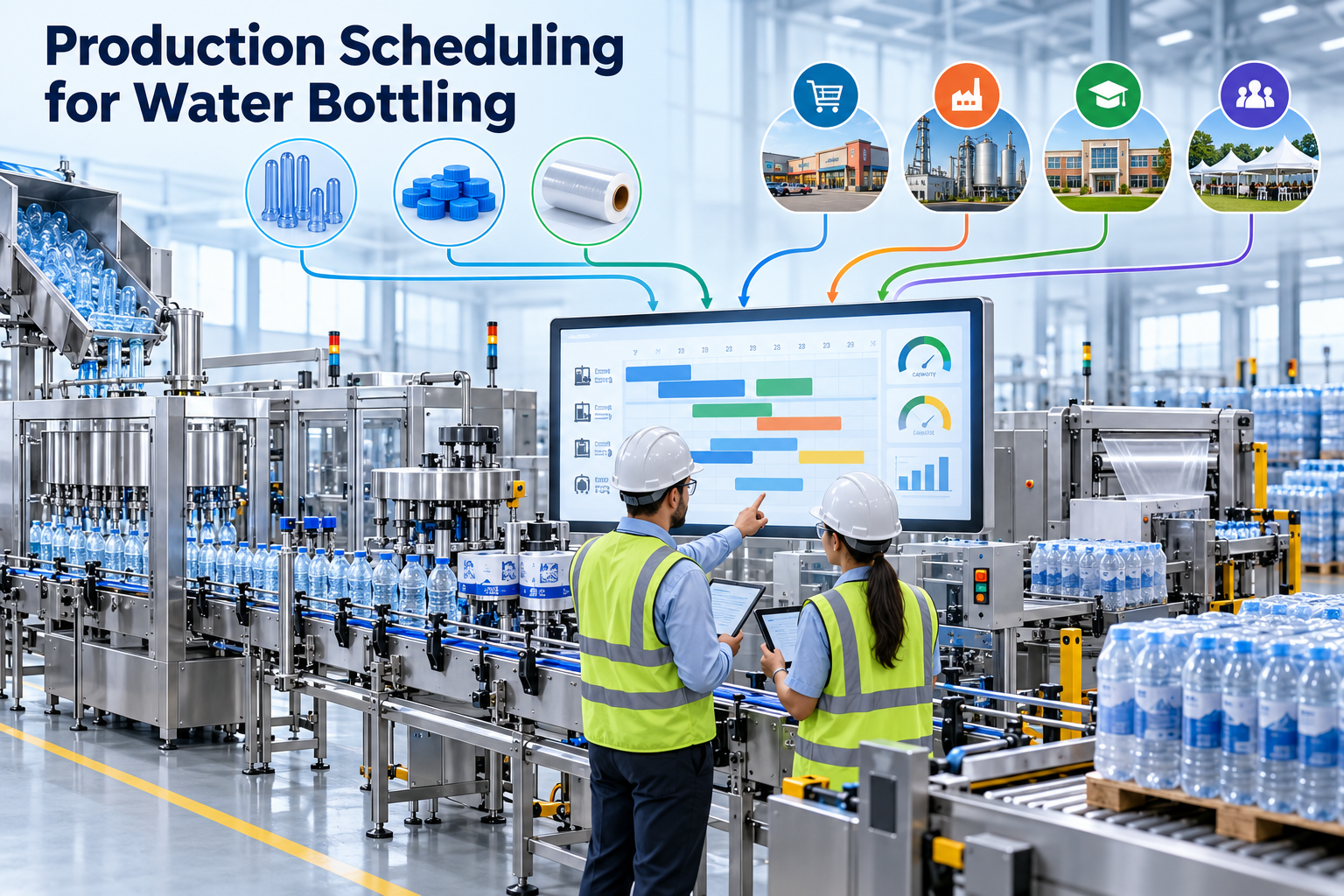
With retail, industrial, institutional, and event demand all drawing on the same line, production scheduling becomes a planning exercise in its own right. A workable schedule accounts for known institutional commitments first, builds in retail replenishment cycles, and leaves flexibility for event orders and seasonal peaks. Scheduling decisions also need to account for raw material and packaging material lead times, since even a full machinery line for water bottling can only run as fast as its preform, cap, and film supply allows.
Businesses that document and review their production schedule regularly are better able to spot early signs of strain, for example, a line running at or near capacity on most working days well before the summer season even begins.
Buffer Stock Planning for a Mineral Water Plant in Ahmedabad
Buffer stock is best treated as an inventory strategy rather than a fixed number set once and forgotten. It is a planned finished goods reserve that allows a business to absorb short term spikes and take on emergency orders without turning away customers or missing institutional deliveries. The right buffer stock level depends on how volatile a business’s demand is. A plant serving mostly steady industrial or institutional customers may need a smaller reserve than one that regularly takes on last minute event and catering orders.
Buffer stock planning should be reviewed seasonally, since the appropriate cushion ahead of the summer peak is different from what is needed during a quieter month.
Warehouse Capacity for a Mineral Water Bottling Line
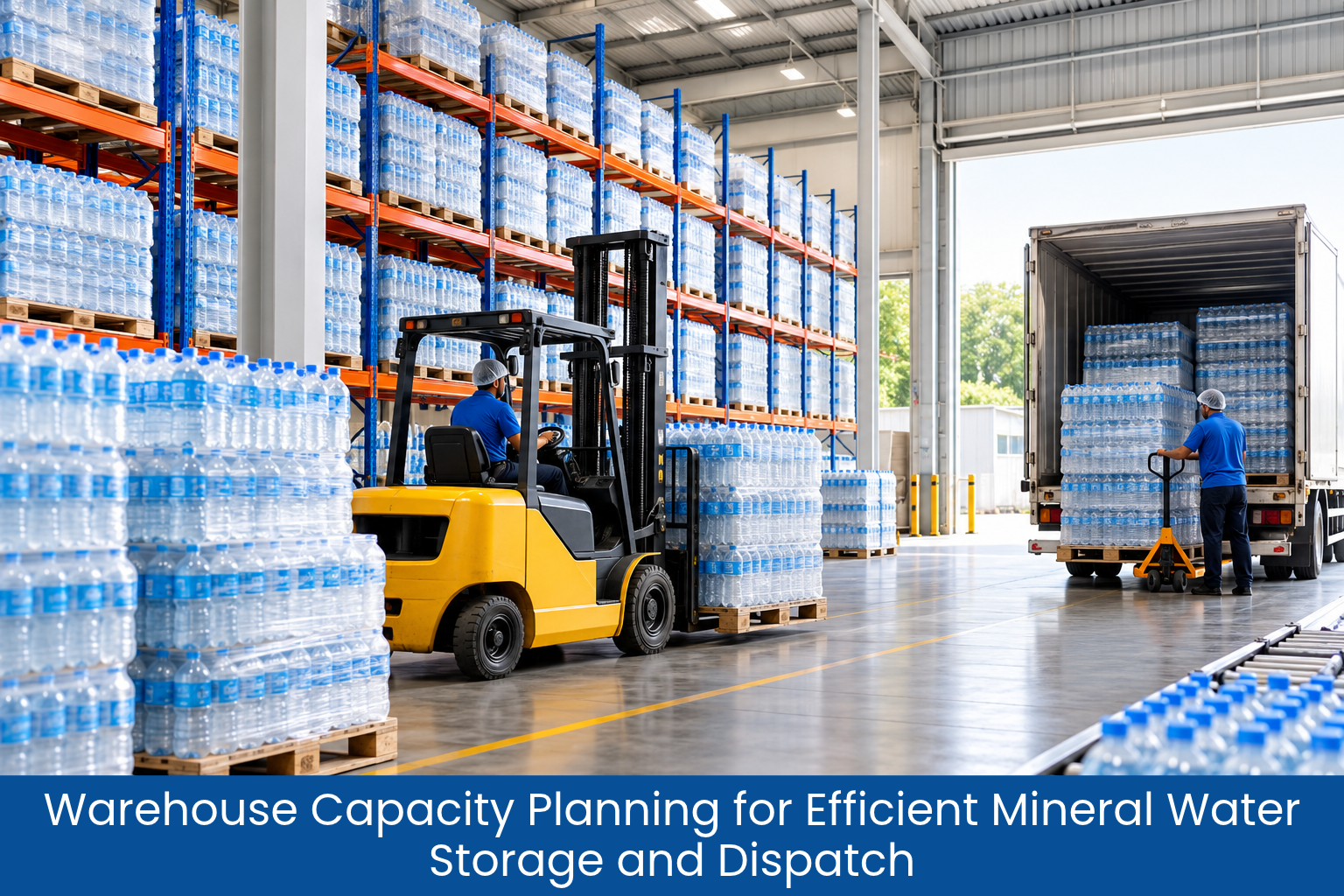
Storage capacity determines how much finished product a plant can hold at any time, which is what turns a planned reserve into something the business can actually draw on. Storage layout affects how efficiently stock can be organised, while loading efficiency determines how quickly it can be picked, loaded, and dispatched during high demand periods, when delivery schedules are tightest. Warehouse planning should be considered alongside production capacity rather than as an afterthought, particularly for businesses that build up stock ahead of the summer season or hold inventory for institutional and event commitments.
A plant that has invested in production capacity but not in matching storage space often finds that its true bottleneck during peak season is space, not output.
Preventive Maintenance for a Mineral Water Bottling Machine
Unplanned downtime is expensive at any time of year, but it is most damaging when it falls during a demand peak or against an institutional contract deadline. Preventive maintenance, servicing the mineral water bottling machine, checking treatment systems, and replacing wear parts before they fail, is one of the most effective ways to protect supply continuity through the summer months and other high demand periods.
Businesses that schedule maintenance work during quieter months, rather than once the season is already underway, reduce the risk of a breakdown coinciding with exactly the weeks when spare capacity is least available.
Capacity Upgrade Signals for an Automatic Mineral Water Plant in Gujarat
Recognising when a plant has genuinely outgrown its capacity is different from reacting to a single busy month. Some signals are worth tracking over time: production running close to its rated output on most working days, buffer stock being drawn down repeatedly rather than occasionally, institutional or event orders being declined or delayed, and warehouse space consistently running tight.
When these signals appear together and persist across more than one season, they generally indicate that capacity planning needs to be revisited for an automatic mineral water plant in Gujarat, rather than just short term scheduling adjustments. Upgrade decisions are best based on this kind of sustained evidence rather than a single strong month or a short term forecast.
Selecting Bottling Line Capacity Based on Ahmedabad Market Requirements
Buyers researching a mineral water plant in Ahmedabad often compare capacity brackets such as 30 BPM, 60 BPM, 90 BPM, and 120 BPM lines. There is no single correct starting point. The right bracket depends less on a fixed number and more on how closely a plant’s output lines up against the demand it actually needs to serve, as set out below.
| Demand Type | Capacity Consideration |
| Local retail supply | Lower capacity with frequent dispatch |
| Distributor network | Medium to higher capacity |
| Institutional supply | Higher output with planned storage |
| Regional expansion | Scalable automated line |
This framework is a starting reference rather than a fixed recommendation. A business that expects its demand mix to change over the next few years should factor that trajectory into its capacity decision, not just its current order book.
Matching Plant Capacity With Ahmedabad Demand
The right capacity approach also depends on which type of demand a business primarily serves. The table below sets out, at a general level, how the planning focus can differ by business model.
| Business Model | Capacity Planning Approach |
| Local retail supply | Smaller line with frequent production and dispatch cycles |
| Distributor network | Higher output with storage and route planning |
| Institutional supply | Reliable capacity with delivery buffer |
| Event and catering supply | Flexible production scheduling with reserve capacity |
These approaches are not mutually exclusive. Many businesses in Ahmedabad serve more than one segment at once, which is exactly why capacity, storage, and scheduling need to be planned together rather than in isolation.
How Dharmanandan Techno Project Pvt Ltd Supports Mineral Water Plant Planning
Dharmanandan Techno Project Pvt Ltd (DTPPL) assists businesses in evaluating production capacity, selecting suitable bottling line configurations, planning plant layouts, and integrating water treatment, filling, packaging, and automation systems according to their market requirements. This includes working through capacity calculation, RO and treatment section sizing, filling line selection, and the appropriate level of automation for a given scale of operation. For businesses planning a mineral water bottling line in Ahmedabad, or evaluating a new water bottling business altogether, this kind of structured planning conversation, along with installation support, helps ensure that a capacity decision is grounded in the business’s actual demand pattern.
Conclusion
Matching a bottling line to Ahmedabad’s demand means treating seasonal peaks, retail replenishment cycles, industrial consumption, institutional contracts, and event driven orders as distinct layers of the same production plan rather than a single blended figure. Planning production scheduling, storage, and preventive maintenance around this full picture is what allows a mineral water plant in Ahmedabad to supply reliably through the year. Working through this planning with an experienced project partner such as Dharmanandan Techno Project Pvt Ltd can help ensure capacity decisions are grounded in realistic demand rather than assumption. Businesses looking to discuss plant capacity, seasonal planning, or project requirements are welcome to reach out for a planning conversation.
Frequently Asked Questions
Why shouldn't average monthly sales be used to size a bottling line?
Average figures blend high demand and low demand periods together, which can lead to undersupply during peak months such as summer and oversupply during quieter months. Capacity planning works better when seasonal peaks, institutional contracts, and event orders are considered separately.
Which bottling line capacity is suitable for a mineral water plant in Ahmedabad?
The suitable bottling line capacity depends on customer coverage, production targets, seasonal demand, and expansion plans. Businesses supplying local markets may consider smaller capacities, while distributor and institutional focused operations generally require higher output with storage and logistics planning.
What capacity mineral water plant is suitable for Ahmedabad demand?
There is no single figure that fits every business, since suitable capacity depends on the mix of retail, industrial, institutional, and event demand a plant serves. A local retail supplier can often work with a smaller line and frequent dispatch, while a business also serving distributors or institutional contracts generally needs higher output along with storage and buffer planning.
What factors affect mineral water plant capacity selection in Ahmedabad?
Capacity selection depends on customer segments, expected daily demand, summer peak requirements, delivery radius, storage capability, and future expansion plans. Businesses supplying only local retail markets may require a different setup compared with those serving distributors, institutions, or industrial customers.
How does summer demand affect mineral water plant capacity selection?
Summer typically brings a sharp, sustained rise in demand, which means capacity decisions should account for this peak window rather than an average month. Businesses that plan production, staffing, and packaging material supply ahead of the season are better placed to meet the rise without turning away orders.
What is the difference between institutional and event based demand?
Institutional demand usually comes through standing contracts with predictable quantities over a fixed period, while event and catering orders are typically large, short notice, and irregular. Both need to be planned for, but in different ways, institutional supply as a fixed capacity layer, and event orders through scheduling flexibility and reserve capacity.
How does buffer stock help with seasonal and institutional demand?
Buffer stock acts as a cushion that allows a business to meet short term spikes, a large event order or an unexpected institutional requirement, without disrupting regular retail supply. The right buffer level depends on how variable a business’s demand pattern is.
What signals suggest a mineral water plant needs a capacity upgrade?
Recurring signs include production running near full capacity on most working days, buffer stock being depleted repeatedly, institutional or event orders being turned away, and warehouse space running consistently tight. These signals are more reliable when observed over more than one season rather than during a single busy month.
Our associates






































Director – Global Marketing and Sales
Mr. Bhavesh from Dharmanandan Techno Projects Pvt. Ltd. has played a pivotal role in elevating the DTPPL brand to the global stage, leveraging his exceptional expertise in marketing and communications. He is committed to helping clients achieve significant growth while strengthening their own brands. Dharmanandan Techno Projects Pvt. Ltd. is a leading manufacturer and supplier of water purification systems and turnkey solutions for mineral water plants. With years of experience in designing and delivering high-quality water treatment solutions, the company provides end-to-end services, including system design, installation, maintenance, and ongoing support. Specializing in scalable and customizable water plants, DTPPL has successfully served industries worldwide, ensuring clean and safe drinking water across diverse applications.