




Listening Article
Table of Contents
Mumbai, Navi Mumbai, Thane or Palghar Mineral Water Plant: How Market Reach Affects Plant Planning?
October 22, 2026
AI Summary
Choosing a mineral water plant location in Mumbai, Navi Mumbai, Thane, or Palghar should be based on market reach, not city preference. Mumbai suits businesses targeting dense retail, commercial, and institutional demand. Navi Mumbai fits distributors serving organised industrial and commercial zones. Thane works for regional coverage across connecting areas of the MMR. Palghar suits businesses planning larger operational footprints and longer term expansion. The right choice depends on the target customer base, distribution radius, logistics requirements, and capacity needs, factors covered in detail below.
Mineral Water Plant in Mumbai: Evaluating Location Through Market Reach
Choosing where to set up a manufacturing facility is one of the most consequential decisions in a packaged drinking water business. For a promoter evaluating a mineral water plant in Mumbai, the Mumbai Metropolitan Region (MMR) offers several possible sites, each opening up a different set of business possibilities depending on customer location, distribution requirements, delivery planning, and expansion strategy.
It is tempting to assume Mumbai is automatically the right starting point simply because it is the most recognised city in the region. In practice, the right location depends less on city reputation and more on market reach: who the customers are, how far the product must travel, and what distribution network the business plans to build. A local retail brand, a distributor serving multiple districts, and an industrial supplier may each require a different location strategy. For some businesses, a mineral water plant in Mumbai may provide closer access to urban customers, while others may find Navi Mumbai, Thane, or Palghar more suitable depending on logistics, available space, customer coverage, and expansion requirements. These considerations are equally important for businesses planning a water bottling plant Mumbai Metropolitan Region operation, or a packaged water plant Maharashtra serving customers beyond a single city. This article looks at how market reach should guide these decisions, and what operational factors deserve attention before a site is finalised.
| Location | Suitable For | Key Advantage |
| Mumbai | Retail and institutional supply | High customer density |
| Navi Mumbai | Industrial and distributor networks | Regional connectivity |
| Thane | Mixed regional coverage | Access to multiple markets |
| Palghar | Large scale production | Space availability |
This comparison is a starting reference only. The sections below explain the reasoning behind each location and the operational factors a business should evaluate before finalising a site.
Understanding Market Reach Before Selecting a Plant Location
Before comparing locations, a business should define who it intends to serve, since market reach shapes the entire operation, from production line size to fleet requirements. Local city supply generally means shorter, frequent delivery runs around a compact set of accounts. Regional distribution across the MMR involves multiple delivery zones, longer routes, and often more than one storage point. Institutional customers, including hotels, offices, hospitals, and manufacturing units, typically expect scheduled bulk deliveries rather than routine restocking. A distributor led model changes the picture again, since the plant’s “customer” becomes the distributor’s warehouse.
Each model places different demands on location, transportation, storage, and scheduling. Market reach needs defining before a location is chosen, not adjusted afterward to fit a site already picked.
 Call Now !
Defining the Target Geography for a Mineral Water Plant Business
Once the distribution model is clear, the next step is identifying customer segments, since each has different servicing expectations: residential markets need consistent, smaller quantity deliveries; commercial establishments often order in bulk on a fixed schedule; hospitality businesses require reliable, larger volume supply with little tolerance for delay; industrial customers need steadier process use volumes; and offices order regularly in moderate quantities. This mix shapes delivery frequency, the distribution model the plant needs, and the geographic coverage it must realistically reach.
Mineral Water Plant in Mumbai: Location Considerations
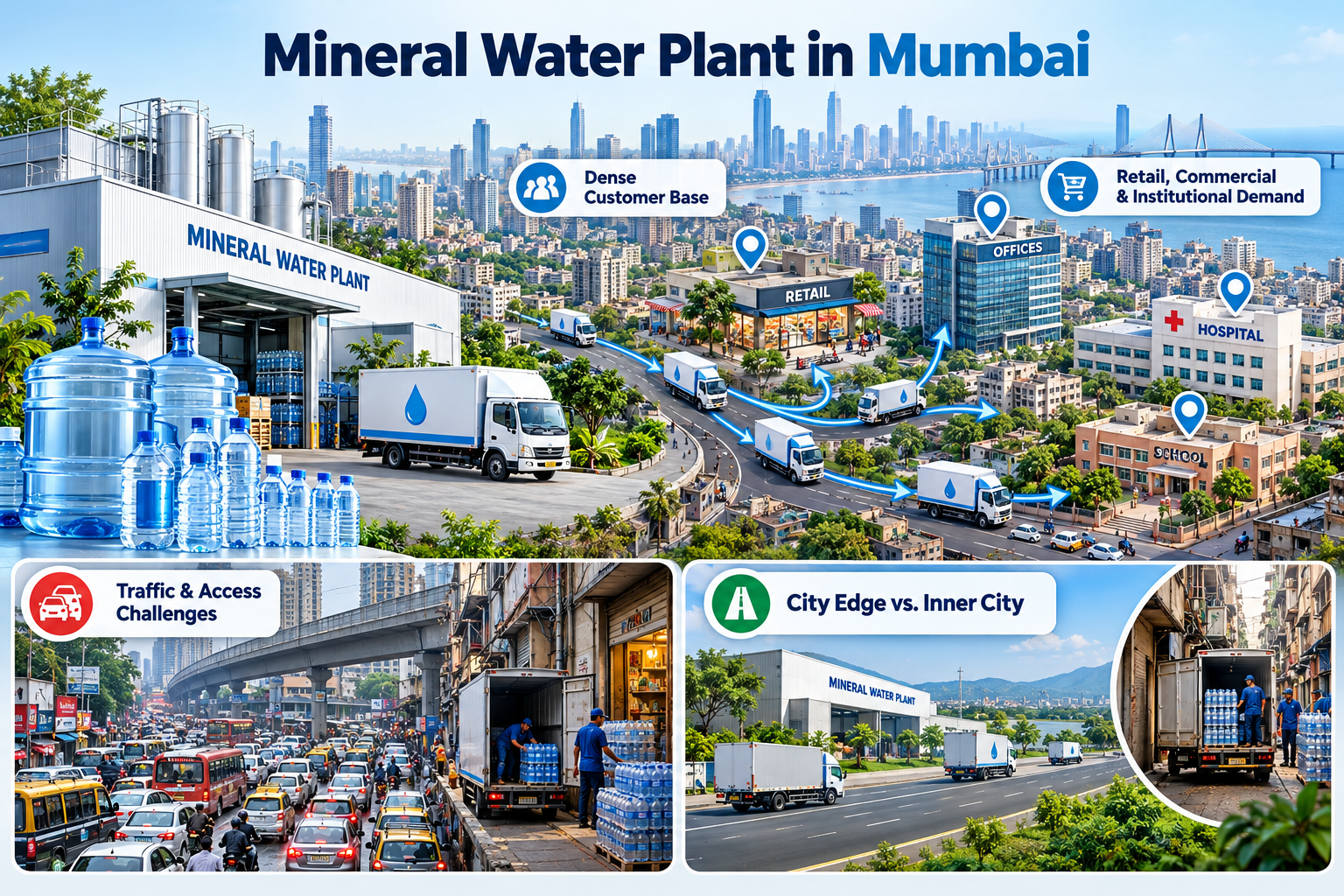
For businesses evaluating a mineral water plant in Mumbai, the core consideration is dense customer concentration: many potential retail, commercial, and institutional customers within a compact area, simplifying last mile delivery. At the same time, urban delivery brings its own challenges, including traffic, vehicle access constraints, and the difficulty of moving stock through a dense environment. Businesses should evaluate whether their customer base genuinely benefits from this proximity, or whether it could be served just as effectively from the city’s edge with easier vehicle movement.
For brands targeting hotels, restaurants, corporate offices, retail outlets, and institutional buyers across South Mumbai, the Western suburbs, and central Mumbai, proximity can reduce delivery turnaround time. However, higher land costs and vehicle movement restrictions can influence the feasibility of manufacturing within city limits, which is why many businesses evaluate whether production should sit inside Mumbai or on its outer edge with a distribution point closer in.
Client Review
“Commissioning our RO plant was a smooth and well-coordinated process thanks to DTPPL. Their engineering team managed equipment delivery, system installation, and operational calibration efficiently. The plant delivers consistent water purification performance with minimal maintenance requirements.”
– Rudra Naik
Mineral Water Plant in Navi Mumbai: Location Considerations
A packaging drinking water plant in Navi Mumbai is often evaluated by businesses wanting strong regional connectivity rather than a base in a single dense urban core. Its organised industrial and commercial zones tend to appeal to businesses supplying commercial and industrial customers rather than relying on retail volume alone. Navi Mumbai’s MIDC industrial areas, warehousing infrastructure, and highway connectivity make it a location businesses consider when supplying distributors, industrial clients, and commercial establishments across the MMR. Distribution planning here should account for how well the customer base is actually served relative to other parts of the MMR. Nearby accounts may make it well suited, while customers elsewhere will still need longer routes. Businesses should also evaluate whether Navi Mumbai provides better access to their intended customer clusters compared with locations farther away. A plant positioned close to industrial estates, commercial zones, or distributor networks can reduce delivery complexity, but only when those areas match the actual demand pattern of the business.
 Email Us
Mineral Water Plant in Thane: Location Considerations
Evaluating a mineral water plant in Thane involves looking at customer coverage across Thane city and the wider region it connects to, relevant for businesses planning regional rather than single city supply. Thane can suit businesses targeting a balance between urban customers and surrounding growth corridors. Its position between Mumbai, Navi Mumbai, and nearby industrial areas can support mixed distribution models, where retail supply, institutional customers, and regional dealers are served from one operational base. Thane can act as a balancing point for businesses serving both residential demand and commercial customers across Mumbai’s eastern and western corridors, a role distinct from Navi Mumbai’s industrial focus or Mumbai’s dense urban core. Before finalising a site, a business should map delivery routes to its actual target customers rather than assuming connectivity alone guarantees efficient distribution.
Mineral Water Plant in Palghar: Location Considerations
A water bottling plant in Palghar tends to be considered by businesses with different priorities than those focused on immediate urban markets, particularly initial land availability and room for future production expansion. Lower urban density can support larger operational footprints and longer term expansion plans, relevant for businesses planning significant production scale. Because Palghar sits outside the more densely populated parts of the MMR, businesses considering it need to plan deliberately for logistics and distribution network development, since a plant here depends more on well planned outbound distribution than on local density alone. However, businesses selecting Palghar should account for additional planning around transport scheduling, dealer coverage, and dispatch frequency. The lower density of nearby customers means success depends more heavily on an organised distribution network rather than relying only on local demand.
Local Distribution vs MMR Wide Water Bottling Plant Coverage
Two broad approaches emerge once market reach is defined.
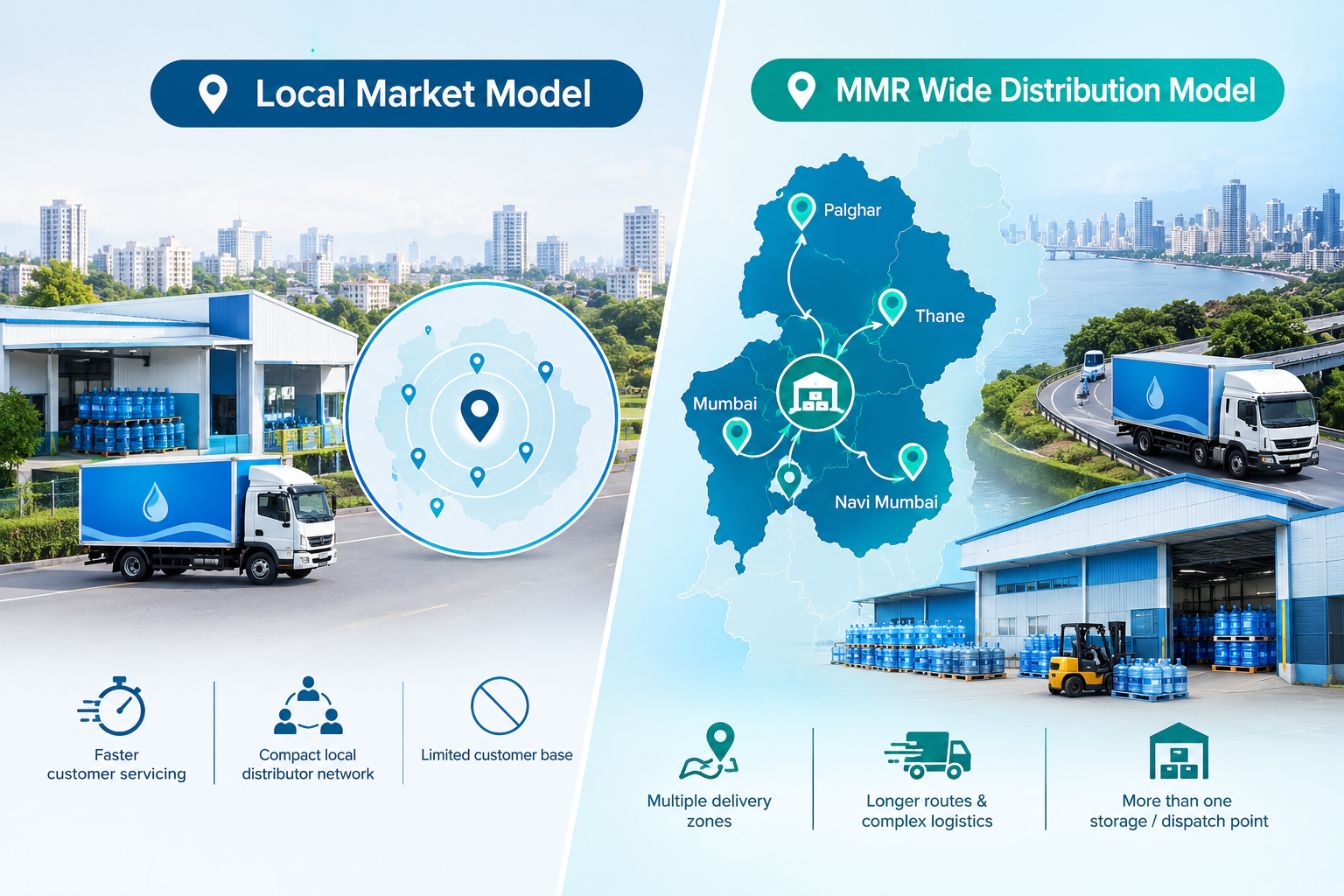
Local Market Model: A short delivery radius allows faster customer servicing and a compact local distributor network, but limits the customer base to what a single city or sub region can support.
MMR Wide Distribution Model: This prioritises wider coverage across Mumbai, Navi Mumbai, Thane, and Palghar, involving more complex logistics, including multiple delivery zones, longer routes, and often more than one storage or dispatch point.
The chosen model bears directly on plant location: a local model favours proximity to a target city’s customer base, while an MMR wide model favours a site with practical connectivity across the region, even where it is not the most central point for any single part of it.
Delivery Time and Freight Planning
Transportation planning matters because the product is bulky, heavy, and time sensitive to fulfil. Delivery frequency needs to match customer expectations: near daily for some commercial and hospitality accounts, less frequent for retail outlets. Route planning should account for realistic travel conditions rather than straight line distance. A location requiring long transit times to reach the core customer base will need a larger fleet or additional storage points to maintain the same service level as one closer to that base.
OUR OTHER PRODUCT
Retail Density and Market Accessibility
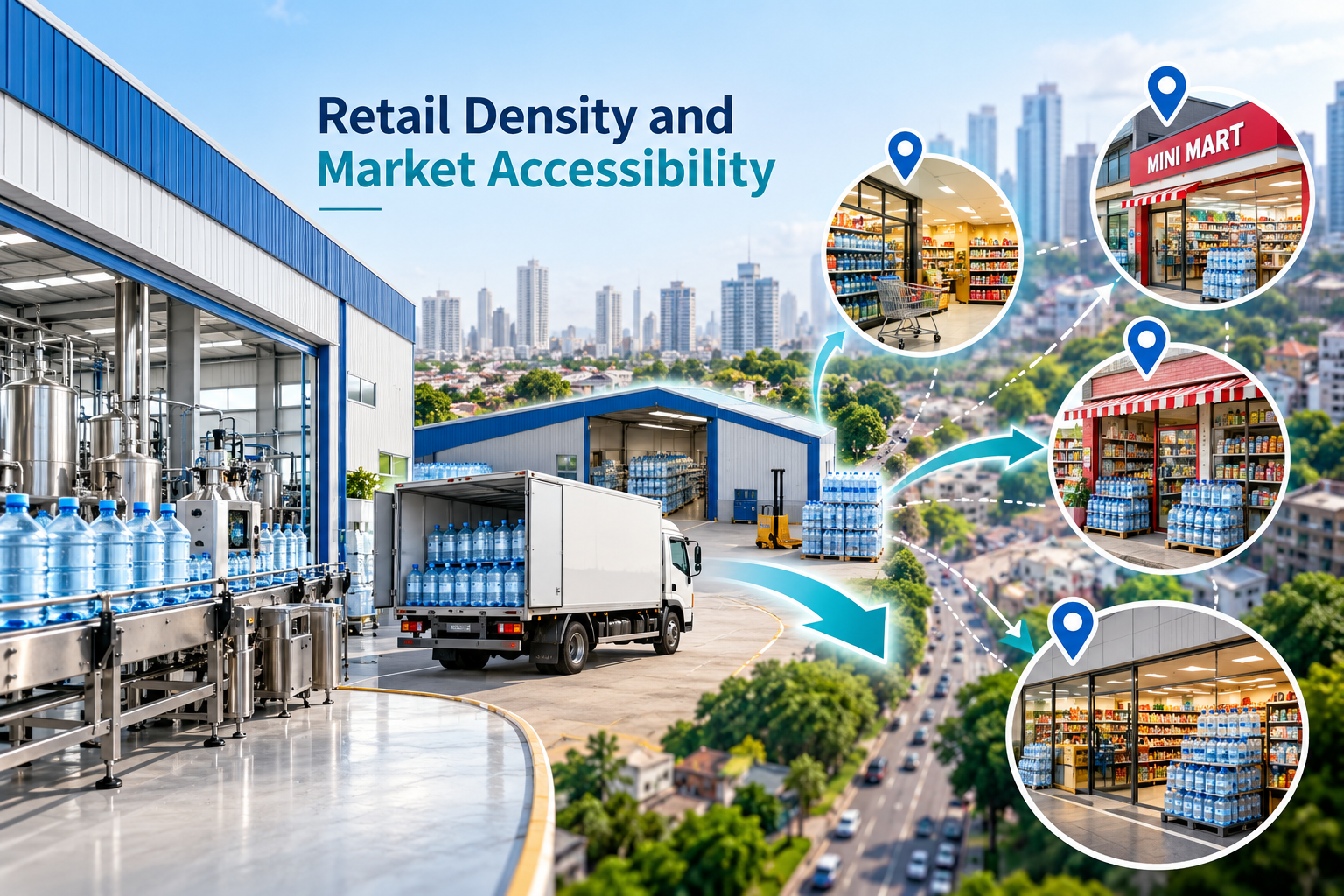
For retail focused businesses, the density and spread of retail outlets in the target area is a key planning factor, shaping distributor requirements and how availability is maintained across outlets. Stock movement between the plant, any storage points, and outlets needs to happen smoothly enough to avoid stockouts. Businesses should evaluate whether a prospective location genuinely supports their retail strategy, or whether it would need an additional layer of distribution to bridge the gap.
Industrial and Institutional Customer Opportunities
Bulk customers, including industrial facilities, corporate offices, hotels, institutions, and commercial properties, often influence location decisions differently than retail customers. These accounts typically order larger volumes on a scheduled basis, reducing delivery trips relative to volume supplied, but each account carries more weight in planning. A business focused on bulk customers may prioritise efficient road access to industrial zones over maximum retail density, a clear example of why location suitability depends on business model rather than city alone.
Warehouse Location and Storage Planning
Warehouse planning should be considered alongside the plant location itself. Storage capacity affects how much buffer stock a business can maintain to absorb demand fluctuations, while a warehouse can extend a plant’s effective reach beyond what direct dispatch allows. This matters more as the geographic spread of customers increases. A warehouse positioned strategically relative to the customer base, rather than necessarily co located with the plant, can support wider coverage.
Road Access and Transportation Infrastructure
Accessibility affects daily operations at every stage, not only outbound delivery. Raw material movement, finished product dispatch, and distribution scheduling all depend on how easily vehicles can reach and leave the site. A location with constrained road access can create bottlenecks even if it otherwise sits close to the target market, so accessibility deserves the same attention as customer proximity.
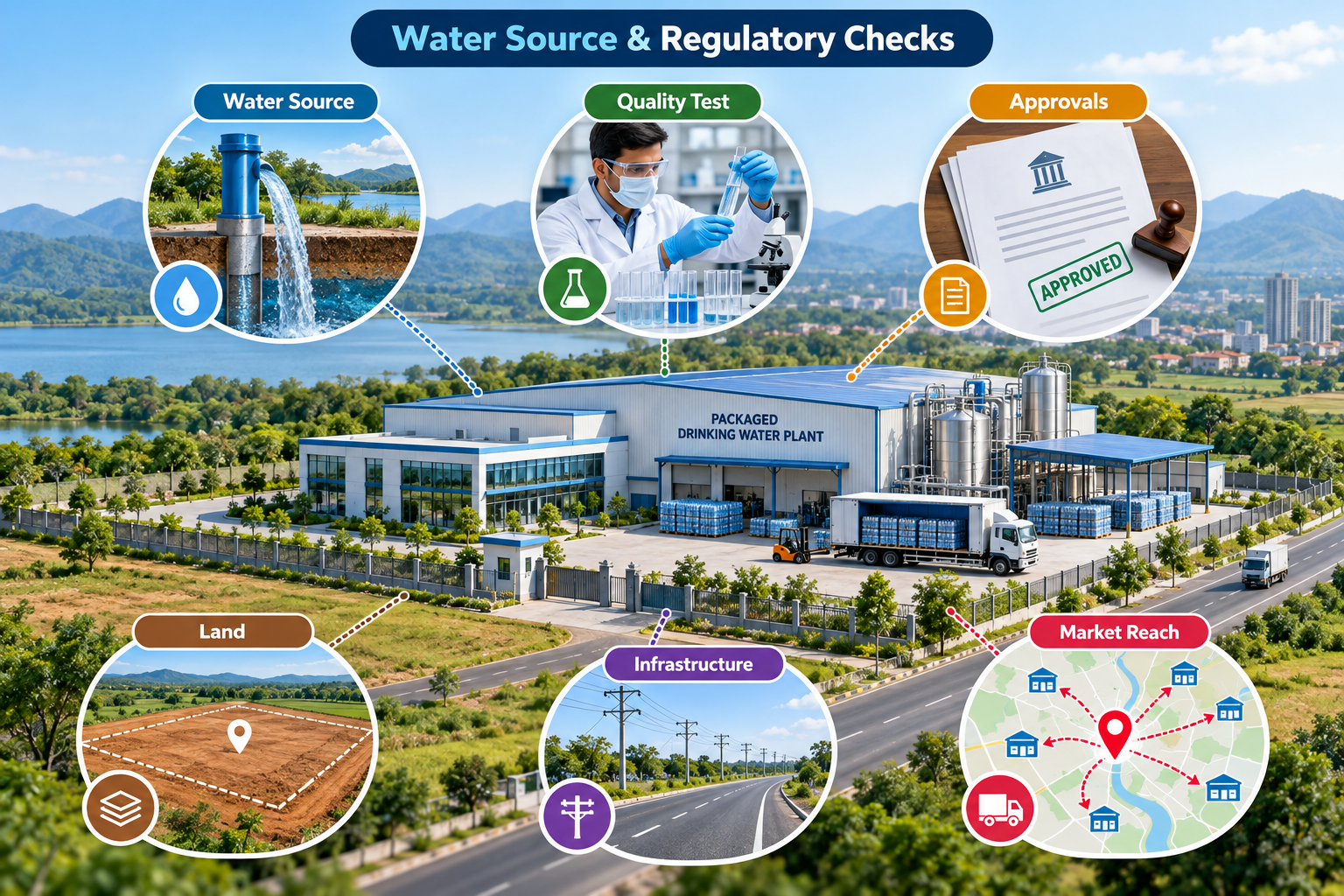
Water Source and Regulatory Considerations Before Finalising Location
While market reach is central to location planning, a plant site must also be evaluated from a technical feasibility perspective. Availability of suitable water sources, water quality testing, required regulatory approvals, land conditions, and infrastructure readiness can influence whether a location is practical for a packaged drinking water plant, regardless of how strong its market reach may be. These factors are typically assessed alongside customer geography rather than after a location is finalised, since a site with strong market access but limited water source feasibility may still require significant additional investment before production can begin.
How Location Influences Mineral Water Plant Capacity Planning
Market reach also bears directly on how much production capacity a plant should be built for. Local demand within a smaller, well defined market may support a modest initial capacity, while distributor requirements, regional plans, and institutional supply opportunities can call for higher output from the outset. Capacity should be selected based on realistic demand a chosen location and customer base can support, rather than sized purely on future assumptions or the belief that larger capacity is automatically safer.
Satellite Distribution Points and Market Expansion
Businesses that outgrow the natural delivery radius of their plant often extend market penetration into new pockets of demand through additional distribution points rather than relocating or duplicating production. Regional warehouses and distribution hubs in secondary areas can extend market servicing without a second manufacturing facility, provided they are planned around genuine customer concentrations rather than added speculatively.
Expansion Planning for a Packaged Water Plant in Maharashtra
Long term planning deserves attention even at the initial setup stage, since site and layout decisions made early can affect how easily a business scales capacity later. Future customer growth, additional markets, and distribution network development should all be considered at a high level during initial planning, but expansion should follow demonstrated demand rather than precede it. A business that plans its site with room to grow, then scales production and distribution in response to actual order volumes, is generally better positioned than one that commits to large scale capacity before demand is established.
How Dharmanandan Techno Project Pvt. Ltd. Supports Mineral Water Plant Planning
Dharmanandan Techno Project Pvt. Ltd. (DTPPL) is a Surat based manufacturer and turnkey beverage plant provider that works with businesses at this planning stage. From initial capacity selection and plant layout planning to machinery configuration, installation, and commissioning, DTPPL helps entrepreneurs develop a packaged drinking water project suited to their target market and operational goals. This includes configuration discussions, documentation guidance, and planning support at each stage of setting up a mineral water, soft drink, or juice plant. For businesses evaluating a plant in Mumbai, Navi Mumbai, Thane, Palghar, or elsewhere in Maharashtra, this kind of structured support can help translate a market reach strategy into a practical, workable setup.
OUR OTHER PRODUCT
Conclusion
Deciding between a mineral water plant exporter in Mumbai, Navi Mumbai, Thane, or Palghar is not a matter of picking the most familiar or popular location. It depends on evaluating market reach carefully: who the customers are, how they need to be served, what logistics the chosen model demands, and how the business intends to expand over time. Location, distribution planning, and capacity decisions are closely linked, and getting the market assessment right makes every downstream decision easier.
Proper technical and project planning matters just as much as location strategy. Working through these considerations with an experienced partner such as Dharmanandan Techno Project Pvt. Ltd. can help businesses move from a general location preference to a plan grounded in their actual market reach. Businesses planning a mineral water plant in Mumbai, Navi Mumbai, Thane, Palghar, or other parts of Maharashtra can evaluate suitable plant capacity, production requirements, layout planning, and turnkey execution options with DTPPL’s technical team before finalising their project.
Frequently Asked Questions
What factors should businesses consider before selecting a mineral water plant location in MMR?
Businesses should evaluate their target customer base, distribution radius, logistics requirements, available infrastructure, and long term expansion goals, rather than choosing based on city preference alone.
Is a Mineral Water Plant in Mumbai suitable for every business model?
Not necessarily. Mumbai’s dense customer concentration suits some retail and commercial models well, but businesses with different customer bases or distribution plans may find another MMR location more practical.
How does location affect mineral water distribution planning?
Location also affects fleet utilisation, fuel costs, delivery frequency, and whether a business needs secondary storage points to maintain reliable service across its target market.
Should businesses prioritise customer proximity or operational advantages while selecting a plant location?
Both matter, and the balance depends on the business model. A retail focused brand may weigh customer proximity more heavily, while a bulk or industrial supplier may prioritise road access and site scale instead.
How does market reach influence mineral water plant capacity planning?
Capacity should reflect the realistic demand a business can service from its chosen location and customer base, rather than being set purely on future assumptions or the idea that more capacity is always better.
What is the best location for a mineral water plant near Mumbai?
The best location depends on the target market, delivery radius, available infrastructure, and expansion plans. Mumbai may suit businesses focused on dense urban demand, while Navi Mumbai, Thane, and Palghar may offer advantages for regional distribution, operational space, and long term expansion.
What should businesses check before setting up a mineral water plant in Maharashtra?
Businesses should evaluate water source quality, target market demand, plant capacity requirements, logistics connectivity, regulatory approvals, and future expansion plans before selecting a location and finalising a packaged water plant setup.
How can businesses choose the right location for a mineral water plant in the Mumbai region?
Businesses should evaluate customer concentration, delivery distance, transportation access, available land, production capacity requirements, and future expansion plans before selecting a location. The ideal site depends on whether the business targets retail supply, institutional customers, distributors, or wider MMR coverage.
How much land is required for a mineral water plant near Mumbai?
Land requirement depends on plant capacity, automation level, storage requirements, and future expansion plans. Larger plants generally require more space for production areas, raw material storage, finished goods storage, vehicle movement, and utilities.
Is Palghar suitable for setting up a packaged drinking water plant?
Palghar can be suitable for businesses prioritising land availability, larger production setups, and future expansion. However, distribution planning becomes important because customer density is lower compared with Mumbai and nearby urban centres.
Our associates








































Director – Global Marketing and Sales
Mr. Bhavesh from Dharmanandan Techno Projects Pvt. Ltd. has played a pivotal role in elevating the DTPPL brand to the global stage, leveraging his exceptional expertise in marketing and communications. He is committed to helping clients achieve significant growth while strengthening their own brands. Dharmanandan Techno Projects Pvt. Ltd. is a leading manufacturer and supplier of water purification systems and turnkey solutions for mineral water plants. With years of experience in designing and delivering high-quality water treatment solutions, the company provides end-to-end services, including system design, installation, maintenance, and ongoing support. Specializing in scalable and customizable water plants, DTPPL has successfully served industries worldwide, ensuring clean and safe drinking water across diverse applications.