




Listening Article
Table of Contents
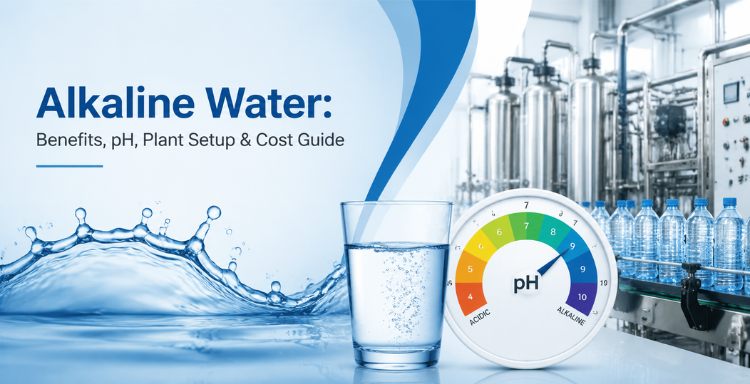
Alkaline Water: Benefits, pH, Plant Setup & Cost Guide
July 10, 2026
AI Summary
Alkaline water is distinguished by its balanced mineral composition and alkaline pH, achieved naturally or through controlled manufacturing processes. Commercial production involves purification, remineralization, pH stabilization, disinfection, and hygienic bottling to ensure consistent product quality.
Setting up an alkaline water plant requires careful evaluation of source water, production capacity, treatment technology, automation level, and packaging requirements. Since every project is unique, plant costs and pricing depend on technical specifications rather than a fixed standard investment.
For businesses entering the premium packaged water market, a well-engineered alkaline water bottling plant provides the foundation for consistent quality, operational efficiency, and sustainable growth.
Introduction
Consumer awareness about drinking water quality has evolved significantly over the last decade. Along with purified water, mineral water, and packaged drinking water, alkaline water has emerged as a premium category in the global beverage industry. Many consumers actively search for information about its pH, mineral composition, production methods, and potential benefits before making a purchase.
At the same time, entrepreneurs and bottled water manufacturers are exploring opportunities to establish alkaline water bottling plants to meet growing market demand. This has increased interest in topics such as alkaline water plant setup, alkaline water plant cost, alkaline water machine price, and commercial manufacturing processes.
Unlike ordinary drinking water, alkaline water is carefully produced to achieve a controlled mineral balance and pH while complying with applicable quality standards. However, understanding alkaline water requires much more than simply knowing its pH value. The source of the water, the minerals it contains, the production technology, and the intended application all play important roles.
This comprehensive guide explains everything from the meaning of alkaline water and its mineral composition to commercial production methods, bottling plant setup, investment considerations, and the factors that influence alkaline water plant pricing.
What is alkaline water?
Alkaline water is drinking water that has a pH higher than neutral water and contains naturally occurring or carefully added alkaline minerals. These minerals contribute to the water’s alkalinity and help distinguish it from standard purified drinking water.
The term alkaline refers to the water’s ability to maintain a pH above 7 while containing beneficial mineral ions.
These commonly include:
- Calcium
- Magnesium
- Potassium
- Sodium (in controlled amounts)
- Bicarbonates
These minerals help create the alkaline characteristics of the water while also contributing to its taste and overall composition.
In simple words, alkaline water is water whose pH and mineral composition have been adjusted naturally or through controlled treatment processes to create a balanced drinking water profile.
 Email Us
What Makes Water Alkaline?
Contrary to popular belief, simply increasing the pH does not automatically create high quality alkaline water.
A well designed alkaline water production process focuses on achieving the correct balance between:
- Mineral composition
- Water purity
- pH stability
- Taste
- Microbiological safety
This is why commercial alkaline water manufacturers rely on engineered treatment systems instead of simply adding chemicals to water.
Water may become alkaline through one of the following methods:
Natural Mineral Contact
As groundwater travels through mineral rich rocks, it dissolves naturally occurring alkaline minerals.
This results in natural alkaline water, which is often sourced from protected underground aquifers or natural springs.
Controlled Remineralization
In commercial manufacturing, purified water is passed through specially designed mineral dosing or remineralization systems.
These systems restore carefully selected minerals to achieve the desired composition and pH.
This approach provides greater consistency than relying entirely on natural water sources.
Water Ionization
Some systems use electrolysis to separate acidic and alkaline streams of water.
This technology is commonly associated with water ionizer alkaline water machines designed for residential or small scale applications.
Commercial bottling plants generally use engineered remineralization systems because they offer better consistency and production control.
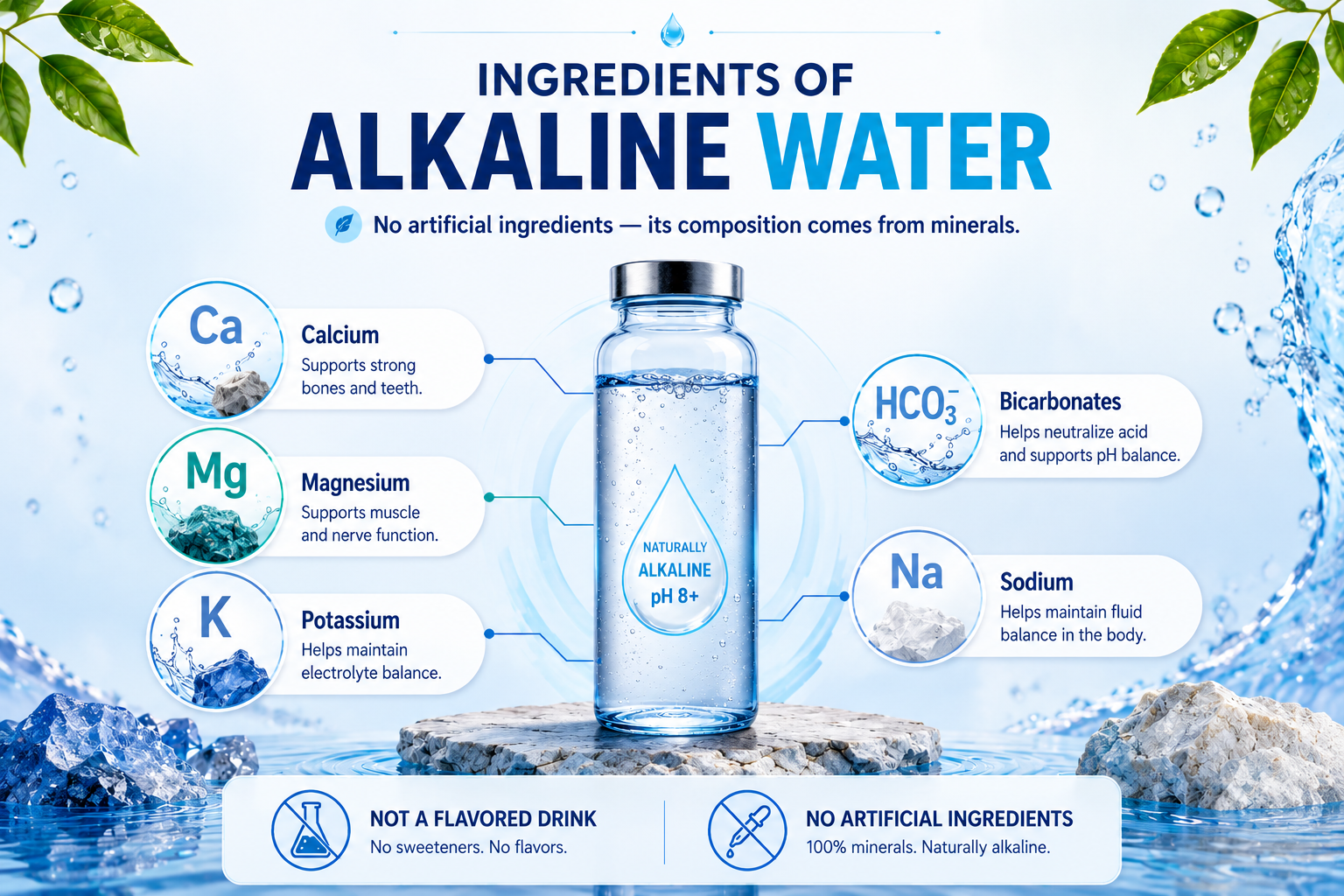
Ingredients of Alkaline Water
Many consumers ask about the ingredients of alkaline water or the contents of alkaline water.
Unlike flavoured beverages, alkaline water does not contain artificial ingredients. Instead, its composition is determined by naturally occurring or carefully added minerals.
Common alkaline water contents include:
| Mineral | Purpose |
| Calcium | Supports mineral balance and taste |
| Magnesium | Contributes to alkalinity |
| Potassium | Helps maintain mineral composition |
| Bicarbonates | Influence alkalinity and buffering capacity |
| Purified Water | Primary component |
The exact mineral composition depends on the production process and applicable quality standards.
Read Our Article
What Is the pH of Purified Water? Complete Guide to Water pH Levels
Natural Alkaline Water vs Commercially Produced Alkaline Water
Consumers often assume that every alkaline water product comes directly from natural springs. In reality, alkaline water can originate from different production methods.
| Natural Alkaline Water | Commercial Alkaline Water |
| Naturally mineralized underground sources | Produced through engineered treatment systems |
| Mineral composition varies with geography | Mineral composition is carefully controlled |
| Limited availability | Can be manufactured consistently |
| Dependent on natural source quality | Consistent production quality |
Both approaches can produce high quality alkaline drinking water when managed correctly.
Why Has Alkaline Water Become So Popular?
The increasing popularity of alkaline water is influenced by several factors:
- Rising consumer awareness about water quality
- Growth of premium bottled water brands
- Increasing preference for mineral enriched beverages
- Expansion of fitness and wellness markets
- Growing demand for value added packaged drinking water
For entrepreneurs, these trends have also created opportunities to invest in alkaline water bottling plants and premium packaged water businesses.
Key Takeaways
✔ Alkaline water is drinking water with a pH above neutral and a balanced mineral composition.
✔ Its alkaline characteristics are influenced by minerals such as calcium, magnesium, potassium, and bicarbonates.
✔ Alkaline water may occur naturally or be produced through controlled commercial treatment processes.
✔ Mineral composition is just as important as pH when evaluating alkaline water quality.
✔ The growing popularity of alkaline water has increased demand for commercial bottling plants and specialized production systems.
Why pH Alone Does Not Define Water Quality
Consumers often compare different bottled water brands based only on their pH values.
This approach can be misleading.
Two water samples may have identical pH values but differ significantly in:
- Mineral composition
- Taste profile
- Total dissolved solids
- Treatment process
- Source water quality
- Shelf stability
For this reason, professional water treatment systems monitor multiple quality parameters rather than focusing solely on the alkaline water pH value.
Comparing Different Types of Drinking Water
Many consumers are uncertain about the differences between alkaline water, purified water, mineral water, and reverse osmosis water.
Each type serves a different purpose and is produced through a different process.
| Water Type | Primary Characteristic | Typical Production Process |
| Purified Water | Removal of impurities | Purification technologies such as RO and filtration |
| Reverse Osmosis Water | Low dissolved contaminants | Reverse osmosis system |
| Mineral Water | Naturally occurring minerals | Protected natural source |
| Alkaline Water | Controlled mineral balance and alkaline pH | Remineralization or specialized treatment |
This comparison helps consumers understand that alkaline water is defined by its controlled mineral profile and alkaline characteristics rather than by pH alone.
Alkaline Water vs Reverse Osmosis Water
Reverse osmosis systems are designed primarily to remove dissolved impurities from water.
During this purification process, many naturally occurring minerals are also reduced.
Commercial alkaline water production often begins with purified water generated through reverse osmosis. Carefully selected minerals are then added back under controlled conditions to achieve the desired product characteristics.
This sequential approach enables manufacturers to produce water with consistent quality while maintaining strict process control.
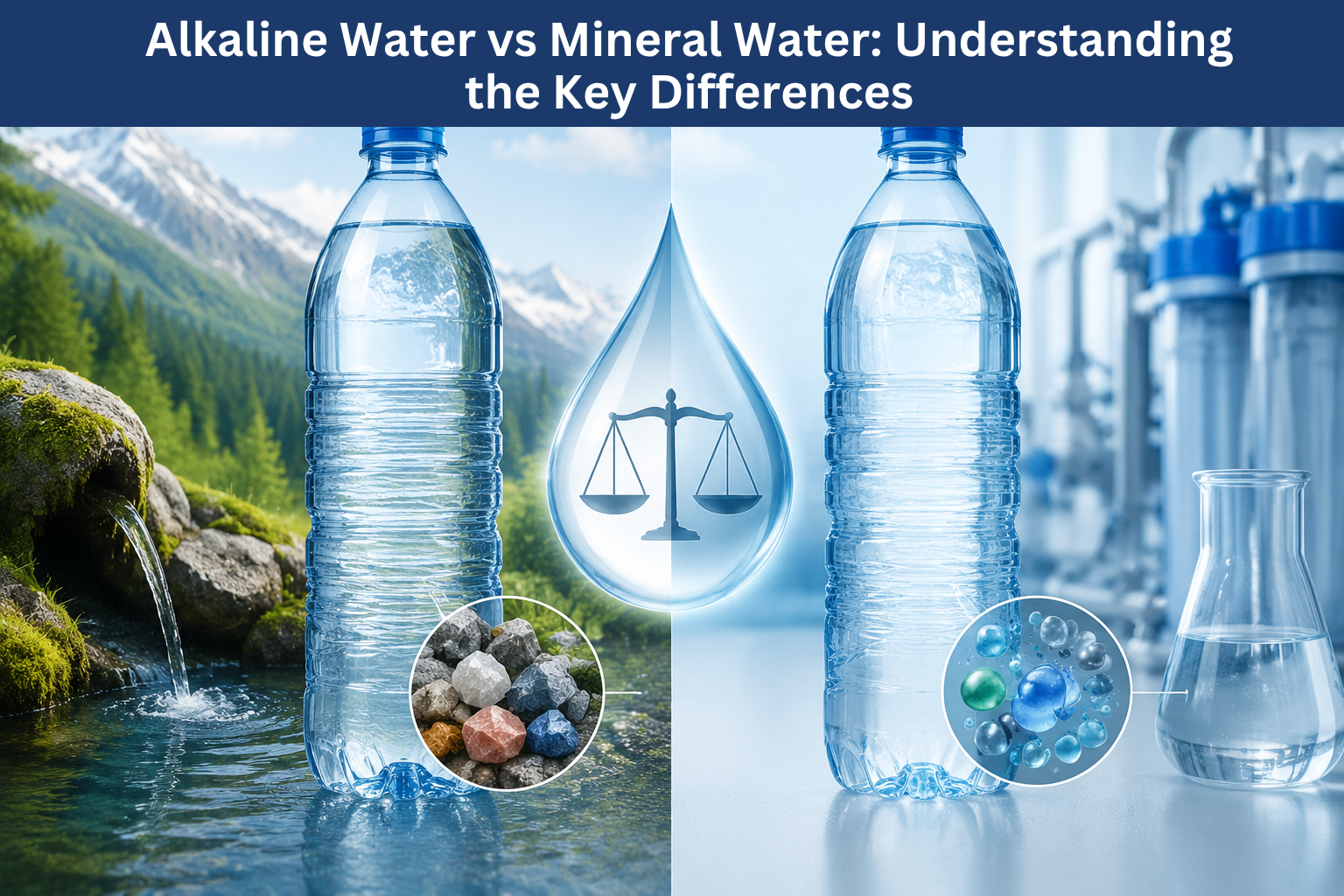
Alkaline Water vs Mineral Water
Although these terms are often used interchangeably, they do not always describe the same product.
Natural mineral water derives its mineral composition from protected underground sources.
Commercial alkaline water may be produced through controlled treatment processes in which purified water is remineralized to achieve a consistent mineral balance and pH.
Some bottled water products may combine both characteristics, while others are produced using only one approach.
Understanding this distinction helps consumers make informed purchasing decisions.
OUR OTHER PRODUCT
Benefits of Drinking Alkaline Water
Interest in the benefits of alkaline water has increased significantly over the past decade. While many claims circulate online, it is important to separate consumer preferences from scientifically established facts.
Some consumers choose alkaline drinking water because they prefer:
- Pleasant taste preferred by many consumers
- Carefully controlled mineral balance
- Availability in premium packaged drinking water formats
- Consistent quality through engineered production systems
Commercially produced alkaline water is also valued for its consistency, which is achieved through controlled manufacturing and quality monitoring.
Rather than relying on exaggerated claims, consumers should evaluate alkaline water as part of an overall healthy hydration routine.
 Call Now
Is Alkaline Water Good for Health?
This is one of the most searched questions worldwide.
The answer is best approached with balance.
For most healthy individuals, alkaline water can be consumed as part of a normal hydration routine when it is produced according to applicable drinking water quality standards.
In reality, scientific research continues to evaluate the long-term effects of alkaline drinking water in different situations.
Current evidence suggests that the most important factors for safe drinking water remain:
- Microbiological safety
- Appropriate mineral composition
- Compliance with drinking water standards
- Reliable manufacturing practices
- Proper storage and packaging
These factors apply equally to alkaline water, purified water, and other packaged drinking water products. However, no single type of drinking water should be viewed as a substitute for a balanced diet, healthy lifestyle, or medical treatment.
Consumers with specific health conditions or dietary restrictions should consult a qualified healthcare professional before making significant changes to their drinking water choices.
Common Uses of Alkaline Water
The popularity of alkaline water extends beyond household consumption.Today it is widely used in:Packaged Drinking Water Industry
Premium bottled alkaline water has become an important product category for beverage manufacturers.Hotels and Hospitality
Hotels often provide premium bottled water options to enhance the guest experience.
Corporate Offices
Many organizations offer alkaline drinking water as part of employee wellness initiatives.
Fitness Centres and Sports Facilities
Health clubs frequently include alkaline bottled water among their beverage offerings.
Retail Stores and Supermarkets
Growing consumer demand has increased the availability of alkaline bottled water across modern retail outlets.
Cafes and Restaurants
Premium dining establishments increasingly offer alkaline bottled water as an additional beverage choice.
Client Review
“We are highly satisfied with the Alkaline Water Plant provided by DTPPL. The system boasts advanced ionization and filtration technology, ensuring a precise pH balance and excellent taste profile required for our market. It operates with remarkable energy efficiency and minimal maintenance. DTPPL’s technical expertise and prompt after-sales support have made them an invaluable partner in our production journey. Highly recommended for premium water processing solutions.”
– Lavina Israni
Common Myths About Alkaline Water
Growing popularity has also led to widespread misconceptions.
Myth 1: Higher pH Always Means Better Water
Fact: Water quality depends on several parameters, including mineral composition, microbiological safety, source quality, and manufacturing controls.
Myth 2: All Bottled Water Is Alkaline
Fact: Bottled water products include purified water, mineral water, packaged drinking water, spring water, and alkaline water. Each follows different production methods.
Myth 3: Every Alkaline Water Brand Has the Same Mineral Composition
Fact: Mineral content varies depending on source water, treatment technology, and product formulation.
Myth 4: Alkaline Water Is Produced Simply by Adding Chemicals
Fact: Professional alkaline water manufacturing uses controlled purification, remineralization, and quality monitoring processes to achieve consistent product quality.
Key Takeaways
✔ The pH of alkaline water is only one indicator of water quality and should always be considered alongside mineral composition and safety standards.
✔ Reverse osmosis water, mineral water, purified water, and alkaline water are different categories with distinct production processes and characteristics.
✔ Many consumers choose alkaline water for its balanced mineral profile, taste, and premium positioning rather than pH alone.
✔ Responsible manufacturers focus on consistent quality through controlled treatment and quality assurance rather than relying solely on high pH values.
✔ Understanding the science behind alkaline water helps consumers make informed choices based on facts rather than marketing claims.
Commercial Alkaline Water Production Process
The manufacturing process generally consists of the following stages.
Step 1: Raw Water Collection
The process begins with collecting water from an approved source, which may include:
- Borewell water
- Municipal water supply
- Surface water
- Treated industrial water source
Before treatment, the source water undergoes laboratory testing to determine its chemical and microbiological characteristics.
Step 2: Pretreatment
Pretreatment protects downstream equipment and improves the efficiency of the purification system.
Depending on the raw water quality, pretreatment may include:
- Multi grade sand filtration
- Activated carbon filtration
- Water softening
- Micron filtration
These stages remove suspended particles, chlorine, colour, odour, and hardness that could interfere with later treatment processes.
Step 3: Reverse Osmosis Purification
Reverse osmosis is commonly used as the primary purification stage.
The RO system removes:
- Dissolved salts
- Heavy metals
- Organic impurities
- Microorganisms
- Excess minerals
The result is highly purified water that provides a consistent base for controlled mineral addition.
Step 4: Controlled Remineralization
After purification, carefully selected minerals are introduced to create the desired mineral balance.
Depending on product specifications, the remineralization process may restore minerals such as:
- Calcium
- Magnesium
- Potassium
- Bicarbonates
This stage is one of the most critical steps because it determines the final taste profile and mineral composition of the alkaline water.
Step 5: Controlled pH Stabilization
Following remineralization, the pH is adjusted and stabilized within the target operating range.
Rather than maximizing the pH, manufacturers focus on achieving a stable value that remains consistent during storage and transportation.
Maintaining this stability requires precise process control and continuous quality monitoring.
Step 6: Final Sterilization
Before packaging, the treated water undergoes final disinfection to ensure microbiological safety.
Depending on plant design, this may include:
- Ultraviolet disinfection
- Ozonation
- Combination sterilization systems
These processes help maintain product safety without affecting the water’s mineral balance.
Step 7: Hygienic Storage and Bottling
The finished alkaline water is transferred to sanitary storage tanks before entering the bottling line.
Automated filling systems then package the water into containers of different capacities while minimizing the risk of contamination.
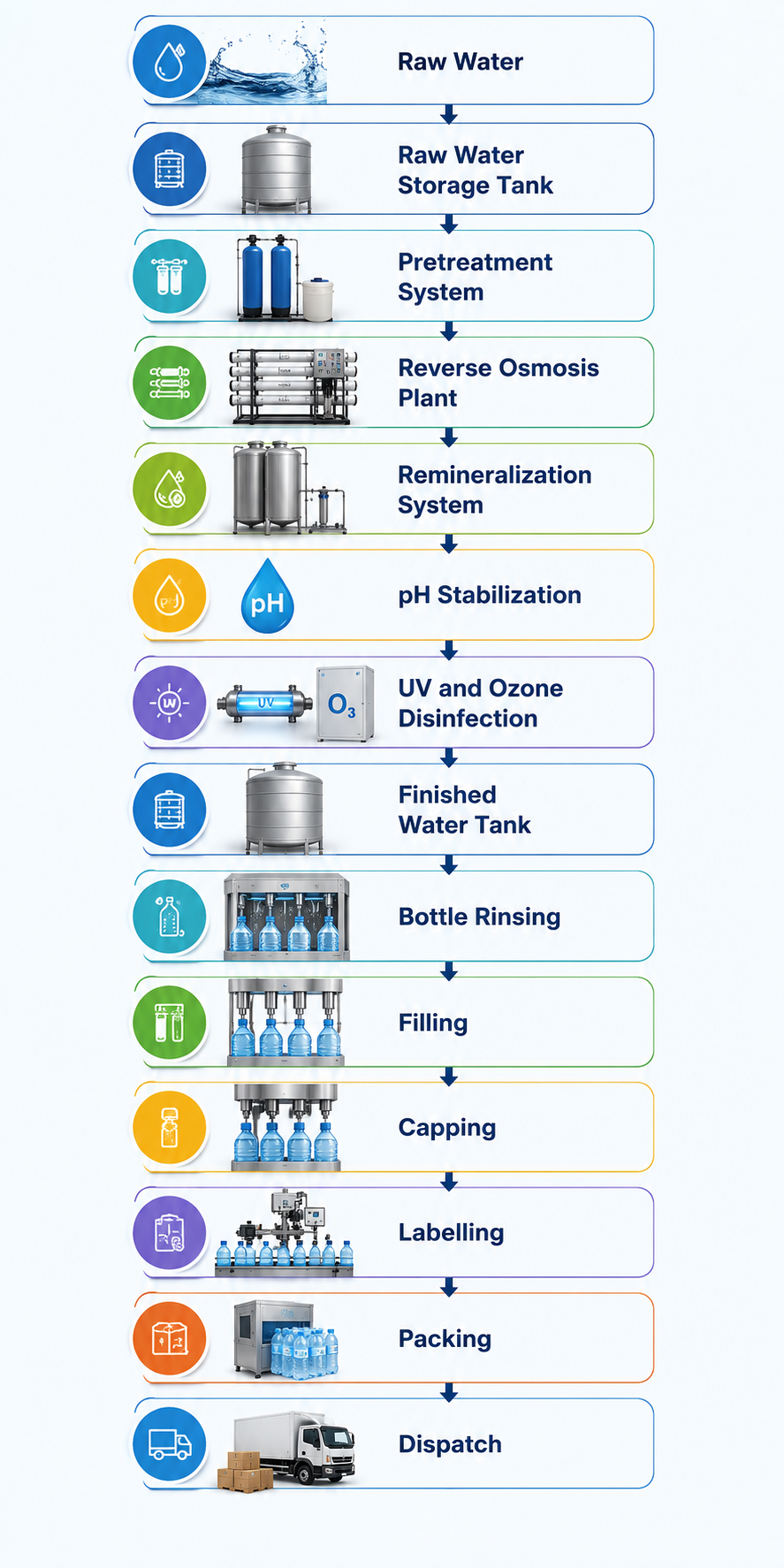
Process Flow of an Alkaline Water Plant
Water Ionizer vs Commercial Alkaline Water Production System
Many consumers search for a water ionizer alkaline water machine, assuming it performs the same function as a commercial alkaline water plant.
Although both are associated with alkaline water, they are designed for entirely different purposes.
| Parameter | Water Ionizer | Commercial Alkaline Water Plant |
| Typical Application | Residential use | Industrial production |
| Production Capacity | Low | High |
| Treatment Objective | Household drinking water | Commercial bottled water manufacturing |
| Process Control | Limited | Fully engineered |
| Mineral Adjustment | Basic | Precisely controlled |
| Packaging Capability | No | Integrated bottling line |
| Suitable for Commercial Distribution | No | Yes |
A water ionizer is intended for point of use applications, whereas a commercial alkaline water plant is designed for continuous, high volume production.
Alkaline Home Water Filter
Homeowners often search for an alkaline home water filter when looking for a domestic water treatment solution.
These systems are generally designed for household drinking water requirements and are available in different configurations.
Typical applications include:
- Kitchen drinking water
- Residential apartments
- Villas
- Small offices
However, a household filter is fundamentally different from a commercial production plant. It is intended for personal consumption rather than large scale bottling or retail distribution.
Alkaline Water Bottling Plant
As consumer demand continues to grow, many entrepreneurs are exploring opportunities to establish an alkaline water bottling plant.
A modern bottling facility combines water treatment with automated packaging to produce a hygienically packed finished product.
A typical alkaline water bottling plant includes:
- Raw water storage
- Pretreatment system
- Reverse osmosis plant
- Mineral dosing or remineralization system
- pH stabilization unit
- UV and ozone disinfection
- Finished water storage
- Bottle rinsing machine
- Filling machine
- Capping machine
- Labelling machine
- Shrink wrapping or secondary packaging system
Depending on production requirements, bottling lines can be designed for PET bottles, glass bottles, jars, or other packaging formats.
Quality Control Parameters in Alkaline Water Manufacturing
Consistent product quality depends on continuous monitoring throughout the production process.
Important quality parameters include:
| Parameter | Why It Is Important |
| pH | Maintains product consistency |
| Mineral Composition | Controls taste and formulation |
| TDS | Indicates dissolved mineral content |
| Microbiological Quality | Ensures product safety |
| Turbidity | Maintains water clarity |
| Residual Ozone | Supports shelf life management |
| Conductivity | Assists process monitoring |
Routine testing helps manufacturers maintain consistent product quality and comply with applicable standards.
Automation in Modern Alkaline Water Plants
Today’s alkaline water manufacturing facilities increasingly incorporate automation to improve efficiency and reduce operational variability.
Automation can provide:
- Consistent dosing accuracy
- Continuous process monitoring
- Reduced manual intervention
- Improved production efficiency
- Better traceability
- Enhanced quality assurance
Modern control systems also help manufacturers maintain stable operating conditions throughout the production cycle.
Key Takeaways
✔ Commercial alkaline water production begins with purified water and follows a controlled sequence of remineralization, pH stabilization, disinfection, and hygienic bottling.
✔ Reverse osmosis alone does not produce alkaline water. Controlled mineral balancing is an essential stage in the manufacturing process.
✔ A water ionizer, an alkaline water purifier, and a commercial alkaline water bottling plant are designed for different applications and production capacities.
✔ Maintaining consistent quality requires continuous monitoring of pH, mineral composition, microbiological safety, and other critical parameters.
✔ Automation plays an increasingly important role in achieving reliable, efficient, and scalable alkaline water production.
Alkaline Water Plant Setup: A Step by Step Guide for Commercial Manufacturing
With increasing consumer demand for premium packaged drinking water, many entrepreneurs are planning to establish an alkaline water bottling plant. However, a successful project involves much more than purchasing a few machines. It requires careful planning, engineering, quality control, and compliance with applicable regulations.
A professionally designed alkaline water plant setup focuses on producing consistent water quality, maintaining operational efficiency, and supporting future business growth.
Step 1: Evaluate the Raw Water Source
The first step in any alkaline water plant setup is to understand the quality of the available water source.
A laboratory analysis should evaluate:
- pH
- Total Dissolved Solids (TDS)
- Hardness
- Alkalinity
- Iron
- Fluoride
- Nitrate
- Microbiological quality
These results determine the treatment process and equipment configuration.
Step 2: Define Production Capacity
Production capacity should be selected according to the target market and business plan.
Factors to consider include:
- Daily production volume
- Bottle sizes
- Number of production shifts
- Distribution network
- Future expansion
Choosing the right capacity at the planning stage helps avoid unnecessary upgrades later.
OUR OTHER PRODUCT
Step 3: Select the Water Treatment Process
Every alkaline water plant should be designed around the characteristics of the raw water rather than a standard configuration.
A typical process may include:
- Pretreatment
- Reverse osmosis purification
- Controlled remineralization
- pH stabilization
- UV sterilization
- Ozonation
- Hygienic storage
The final process depends on both source water quality and the desired product specifications.
Step 4: Plan the Bottling Line
The packaging system should match the intended production capacity and product portfolio.
A complete alkaline water bottling plant may include:
- Bottle rinsing machine
- Filling machine
- Capping machine
- Labelling machine
- Batch coding system
- Shrink wrapping machine
- Secondary packaging
Automation levels can be selected according to production requirements.
Step 5: Establish a Quality Control System
Consistent product quality requires routine testing throughout production.
A quality assurance programme should monitor:
- pH
- Mineral composition
- TDS
- Microbiological quality
- Packaging integrity
- Finished product consistency
Regular monitoring helps maintain consumer confidence and supports regulatory compliance.
Alkaline Water Plant Setup Cost
There is no standard investment that applies to every project because each facility is designed according to its production objectives, water quality, automation level, and packaging requirements.
Instead of asking, “What is the cost of an alkaline water plant?”, a more useful question is:
“What factors determine the investment required for my specific project?”
Understanding these factors leads to more accurate planning and better long-term returns.
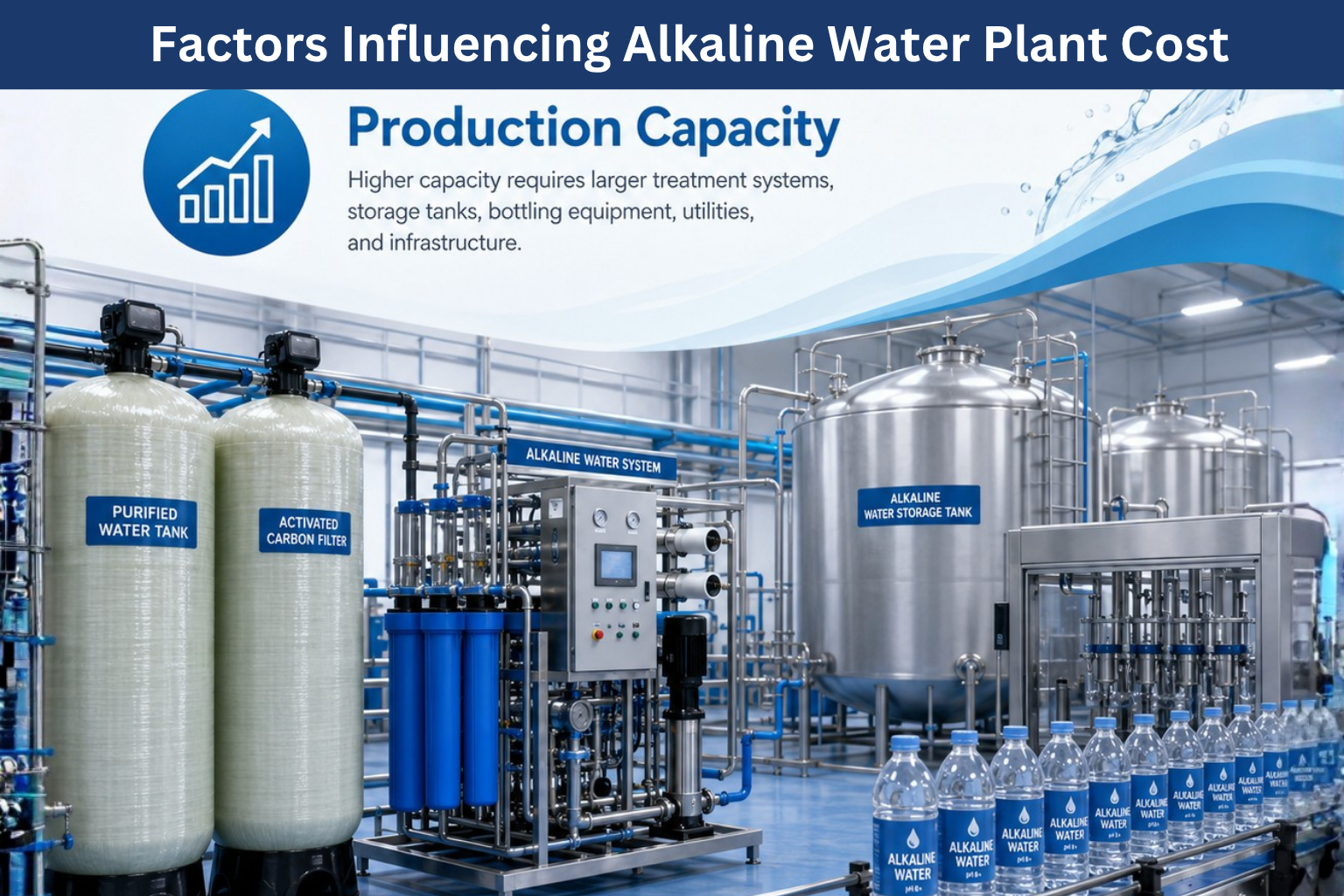
What Influences Alkaline Water Plant Cost?
The alkaline water plant cost depends on multiple engineering and commercial considerations.
Production Capacity
Higher production capacities require larger treatment systems, storage tanks, bottling equipment, utilities, and infrastructure.
Raw Water Quality
Water with higher levels of hardness, TDS, iron, or other contaminants may require additional treatment stages, increasing equipment requirements.
Automation Level
Plants may be designed with:
- Semi automatic bottling systems
- Fully automatic bottling lines
- Integrated process control systems
Greater automation generally improves efficiency and consistency while increasing initial investment.
Packaging Requirements
The selected packaging format significantly influences project cost.
Examples include:
- Small PET bottles
- Large PET bottles
- Glass bottles
- Bulk jars
- Institutional containers
Each format requires different packaging equipment and production configurations.
Utilities and Infrastructure
Project costs also depend on:
- Building readiness
- Electrical systems
- Water storage
- Air compressors
- Utility piping
- Drainage systems
These supporting facilities are essential for reliable plant operation.
 WhatsApp
 Alkaline Plant Pricing Factors
When evaluating alkaline water plant price, it is important to compare complete project solutions rather than individual machines.
The following alkaline plant pricing factors should be considered:
| Pricing Factor | Impact on Investment |
| Plant capacity | Determines overall system size |
| Raw water quality | Influences treatment complexity |
| Bottling speed | Affects production efficiency |
| Automation level | Impacts productivity and labour requirements |
| Packaging formats | Determines packaging equipment |
| Material of construction | Influences durability and hygiene |
| Instrumentation | Supports process monitoring |
| Utility requirements | Affects installation scope |
| Future expansion | Reduces long term modification costs |
Looking only at the purchase price often results in higher operating expenses over the life of the plant.
Alkaline Water Machine Selection Criteria
Instead of comparing quotations based only on price, businesses should evaluate:
- Engineering expertise
- Quality of components
- Automation capabilities
- Production efficiency
- Service support
- Spare parts availability
- Energy efficiency
- Expansion flexibility
A technically optimized system often delivers lower operating costs and better long-term value than the lowest initial quotation.
OUR OTHER PRODUCT
Why Choose DTPPL for Alkaline Water Plant Solutions?
At Dharmanandan Technologies Pvt. Ltd. (DTPPL), every alkaline water project begins with understanding the customer’s water source, production objectives, and long-term business goals.
Rather than offering a one-size-fits-all solution, DTPPL follows a systematic engineering approach that includes:
- Raw water analysis
- Process design
- Customized treatment solutions
- Integrated bottling systems
- Automation options
- Installation and commissioning support
- Technical assistance and after-sales service
This approach helps businesses establish reliable and scalable alkaline water production facilities tailored to their specific requirements.
Mineral Water Plant
Capacity: 500 LPH to 50,000 LPH
(USD 27,500 to USD 16,49,000)
Conclusion
Alkaline water has become an important category within the premium packaged drinking water industry due to its carefully balanced mineral composition and controlled production process. While consumer interest often focuses on pH, successful manufacturing depends on much more than achieving a specific pH value.
A reliable alkaline water production system integrates advanced purification, controlled remineralization, precise process control, and hygienic packaging to deliver consistent product quality. Businesses planning to establish an alkaline water plant should prioritize engineering design, water quality analysis, and long-term operational efficiency over initial purchase price alone.
Whether you are developing a new bottled water brand or expanding an existing manufacturing facility, investing in the right technology and process design is essential for producing high-quality alkaline drinking water that meets market expectations.
Frequently Asked Questions
What is alkaline water?
Alkaline water is drinking water with a pH above neutral that contains naturally occurring or carefully added alkaline minerals such as calcium, magnesium, potassium, and bicarbonates.
What is the typical pH of alkaline water?
Commercial alkaline drinking water is generally maintained within a controlled alkaline range, depending on product specifications and manufacturing standards.
Is alkaline water the same as mineral water?
No. Natural mineral water derives its mineral composition from protected natural sources, whereas alkaline water may be produced through controlled remineralization and pH adjustment.
Can reverse osmosis produce alkaline water?
Reverse osmosis purifies water by removing dissolved impurities. To produce alkaline water, purified water is typically remineralized and its pH is carefully stabilized.
What minerals are commonly present in alkaline water?
Calcium, magnesium, potassium, and bicarbonates are commonly used to create a balanced mineral profile.
What is an alkaline water bottling plant?
It is a manufacturing facility that integrates water treatment, remineralization, pH control, sterilization, and automated bottling for commercial production.
What factors affect alkaline water plant cost?
Production capacity, raw water quality, automation level, packaging format, infrastructure, utilities, and treatment process all influence the overall investment.
How is alkaline water different from ordinary purified water?
Purified water focuses on removing impurities, while alkaline water undergoes additional mineral balancing and pH stabilization to achieve its desired characteristics.
Is a water ionizer suitable for commercial production?
No. Water ionizers are generally designed for residential or small-scale use. Commercial alkaline water manufacturing requires an engineered production system.
How do I choose the right alkaline water plant?
The right plant should be selected based on raw water analysis, production capacity, target market, packaging requirements, and long-term business objectives rather than price alone.
Our associates







































Director – Global Marketing and Sales
Mr. Bhavesh from Dharmanandan Techno Projects Pvt. Ltd. has played a pivotal role in elevating the DTPPL brand to the global stage, leveraging his exceptional expertise in marketing and communications. He is committed to helping clients achieve significant growth while strengthening their own brands. Dharmanandan Techno Projects Pvt. Ltd. is a leading manufacturer and supplier of water purification systems and turnkey solutions for mineral water plants. With years of experience in designing and delivering high-quality water treatment solutions, the company provides end-to-end services, including system design, installation, maintenance, and ongoing support. Specializing in scalable and customizable water plants, DTPPL has successfully served industries worldwide, ensuring clean and safe drinking water across diverse applications.