




Listening Article
Table of Contents
How a 60 BPM Mineral Water Plant Supports District-Level Distribution and Brand Growth
October 6, 2026
AI Summary
A 60 BPM Mineral Water Plant can support businesses planning to expand beyond a single local market by aligning production with organised distribution and operational planning. Rather than focusing only on bottling capacity, this article explains how a 60 BPM water bottling plant can fit into a structured district-level water distribution strategy through distributor management, logistics, warehousing, retail availability and production planning. It also outlines key investment considerations, common expansion mistakes and practical factors to evaluate before developing a packaged drinking water business for wider regional growth.
60 BPM Mineral Water Plant for District-Level Business Growth
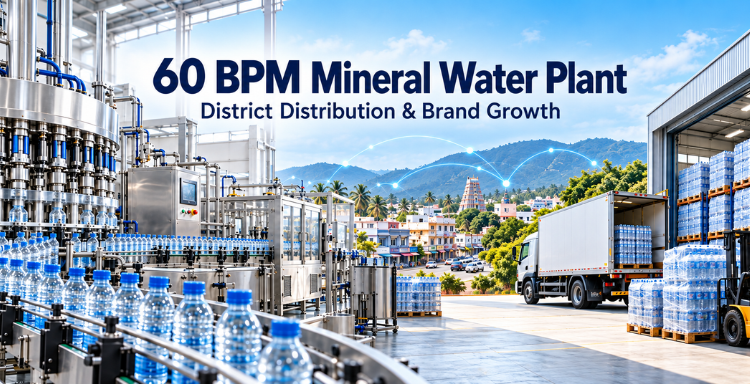
For entrepreneurs building a mineral water distribution business, moving beyond a single local market requires more than increasing production. A 60 BPM water bottling plant can become part of a broader operating model for supplying retailers, distributors and stockists across multiple territories. At this stage, production planning, distribution and brand development need to work together.
A 60 BPM Mineral Water Plant can be relevant to a founder building a name across a district, a distributor moving into manufacturing with an existing network, or a family business looking to create a more structured operation. This capacity can support the transition from a small-scale operation toward a structured manufacturing and distribution business.
For businesses developing a packaged drinking water brand, the decision should begin with the market rather than the machine alone. The business needs to understand territory demand, distributor requirements, storage, dispatch and the operational structure needed to support growth.
 Call Us Now!
60 BPM Water Bottling Plant Business Model
BPM means bottles per minute and represents the rated speed of the bottling setup. Rated speed should not be treated as guaranteed saleable output because actual performance can be influenced by bottle formats, changeovers, operating hours, stoppages, maintenance, packaging availability, quality checks and other operating factors.
At the 60 BPM level, the business model becomes more structured. Production needs to be supported by defined processes for sales, distribution, inventory, quality, maintenance and dispatch. The owner’s role can increasingly shift from managing individual daily activities toward managing the wider business.
This makes the plant part of a complete business model rather than an isolated production asset. A larger production setup is useful when there is a clear market and distribution structure capable of supporting it.

District-Level Distribution Strategy for a 60 BPM Plant
District-level water distribution requires clear territory planning. Instead of treating every nearby town as an independent opportunity, businesses can identify priority markets based on existing relationships, retailer coverage, demand patterns and practical delivery requirements.
The objective is to create a manageable distribution structure. Selected towns can be developed first, with distributors or stockists assigned clear responsibilities for their respective markets. This gives the business greater visibility into where products are moving and where additional channel development may be required.
A well-planned network can allow a manufacturer to supply multiple territories without creating unnecessary overlap between distributors. The emphasis should remain on sustainable market coverage rather than expanding into the maximum possible number of locations.
Distributor Network and Production Planning
A mineral water plant for distributors needs production planning that reflects the requirements of its channel partners. Distributor orders, repeat sales, territory performance and seasonal movement can provide useful inputs for planning production and stock replenishment.
The business should distinguish between confirmed or recurring demand and optimistic projections. This helps prevent production from getting too far ahead of market movement while still allowing stronger territories to receive timely supply.
Distributor planning also provides a useful foundation for future expansion. As the business records order frequency and territory performance, management can identify which markets justify additional attention and which require further development before more capacity is considered.
Client Review
“We chose DTPPL for our 60 BPM mineral water plant and were pleased with the equipment quality and installation support. The plant is easy to operate and helps us manage our daily bottling requirements. The team explained the setup clearly and guided us through the initial operation.”
– Amit Shah
District-Level Water Distribution Logistics
Once multiple territories are being served, logistics becomes a separate management function. Products need to move from production to storage and then through distributors or stockists to the relevant markets.
Delivery routes, dispatch schedules and stock movement should therefore be planned around territory requirements. Higher-volume markets may require a different replenishment rhythm from smaller towns.
Warehouse planning is equally important. An industrial-scale setup needs appropriate warehousing, planned vehicle movement and consideration for future growth. Good layout planning can help the business coordinate production, storage and dispatch as the distribution network develops.
OUR OTHER PRODUCT
Packaged Drinking Water Brand Retail Strategy
A packaged drinking water brand needs consistent retail presence to build recognition. District expansion is therefore not only a logistics exercise; it is also a brand-visibility exercise.
Businesses should identify priority retail markets and focus on maintaining dependable availability in those locations. Consistent packaging, retailer relationships and visible market presence can help establish recognition as the brand enters additional towns.
Availability can become an important part of brand building. When retailers consistently have the product available, consumers have more opportunities to recognise and purchase the brand.
Mineral Water Plant Price and Investment Factors
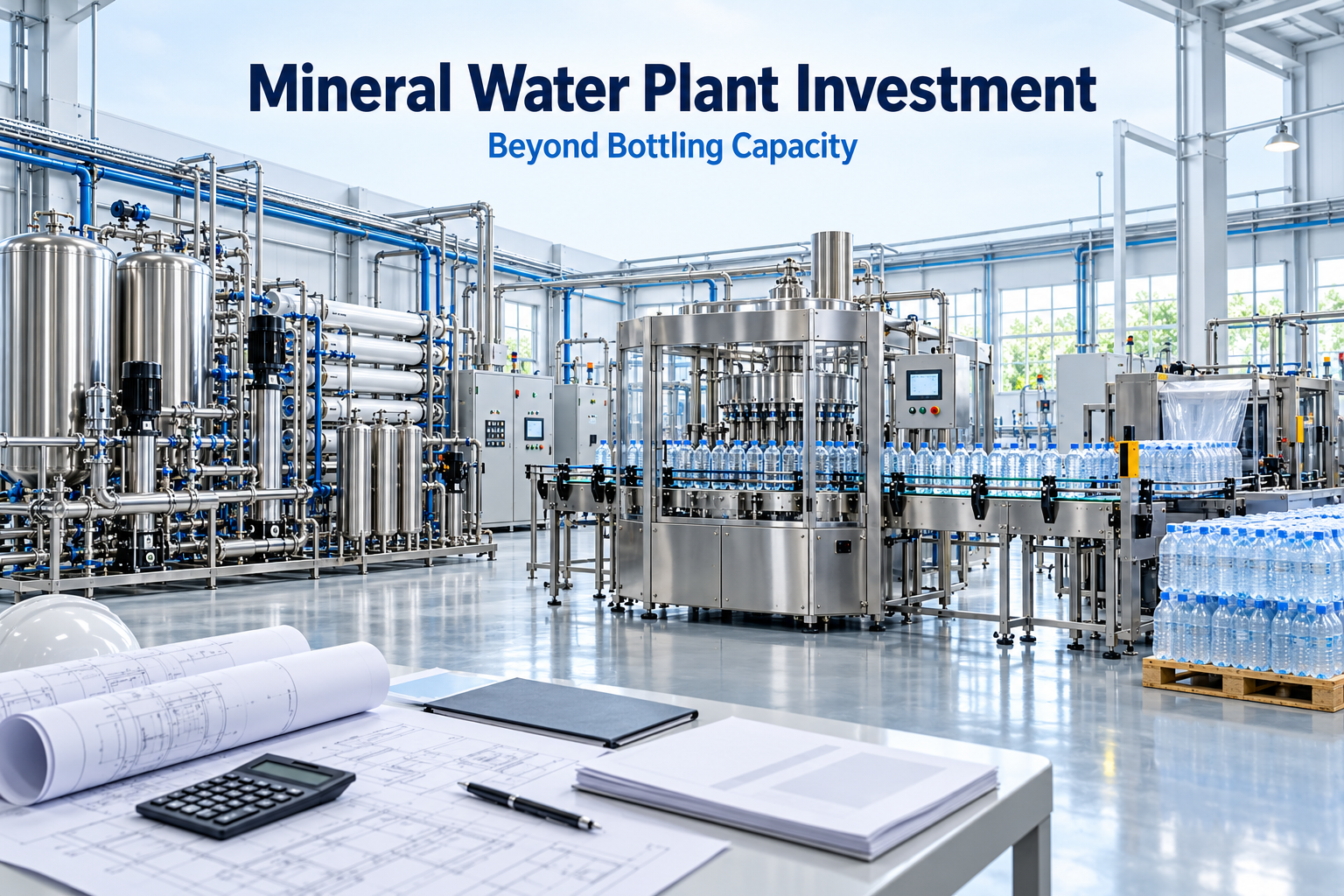
The investment for mineral water plant projects depends on the complete project configuration rather than BPM capacity alone. Equipment selection, treatment requirements, filling and packaging configuration, automation, utilities, installation and site infrastructure can all influence the overall project requirement.
For that reason, the mineral water plant price should be evaluated against the actual scope of supply. Businesses comparing quotations should check what equipment, services and project requirements are included rather than comparing only headline figures.
The project should also be assessed in relation to industrial space, warehousing, working capital and planned logistics. Exact investment figures should be established through a project-specific quotation rather than assumed from capacity.
Mineral Water Plant Manufacturers in India
When comparing mineral water plant suppliers in India, businesses should evaluate the complete supplier relationship rather than focusing only on machinery specifications.
Important considerations include the supplier’s ability to understand the intended project, recommend an appropriate configuration, support installation and commissioning where included in the agreed scope, and provide suitable technical assistance after the project.
Businesses should also investigate all applicable licences, water-quality requirements, testing obligations, packaging rules and local approvals separately before starting commercial operations. These requirements should be confirmed for the specific project rather than assumed from plant capacity.
 Email Us Now!
60 BPM Mineral Water Plant Business Models
A 60 BPM operation can fit several business situations:
- Existing distributor: A distributor with established retailer and market relationships may consider moving into manufacturing.
- Regional water brand: An existing packaged-water business may use the capacity as part of district-level expansion.
- New entrepreneur: A new promoter can evaluate the model when a clearly defined market and distribution strategy supports the proposed project.
The right approach depends on the business’s starting position, existing demand and ability to build the required distribution structure.
Read Our Article
Water Treatment Plants Ensuring Purity, Taste, and Compliance
60 BPM Mineral Water Plant Expansion Mistakes
One major mistake is assuming that a faster plant automatically creates sales. Production capacity must be supported by verified demand, working capital, packaging supply, storage, transport, channel partners and sales management.
Another mistake is expanding territories without creating clear distributor responsibilities. Businesses can also create operational pressure by increasing stock without monitoring actual market movement.
Management structure becomes increasingly important as the operation grows. Production, quality, maintenance, sales and distribution responsibilities should be organised through defined processes rather than remaining entirely dependent on the owner.
A business should also assess whether its existing market and distribution network are mature enough to support additional capacity. Expansion works best when demand, operations and channel development are progressing together.
60 BPM Mineral Water Plant Buying Questions
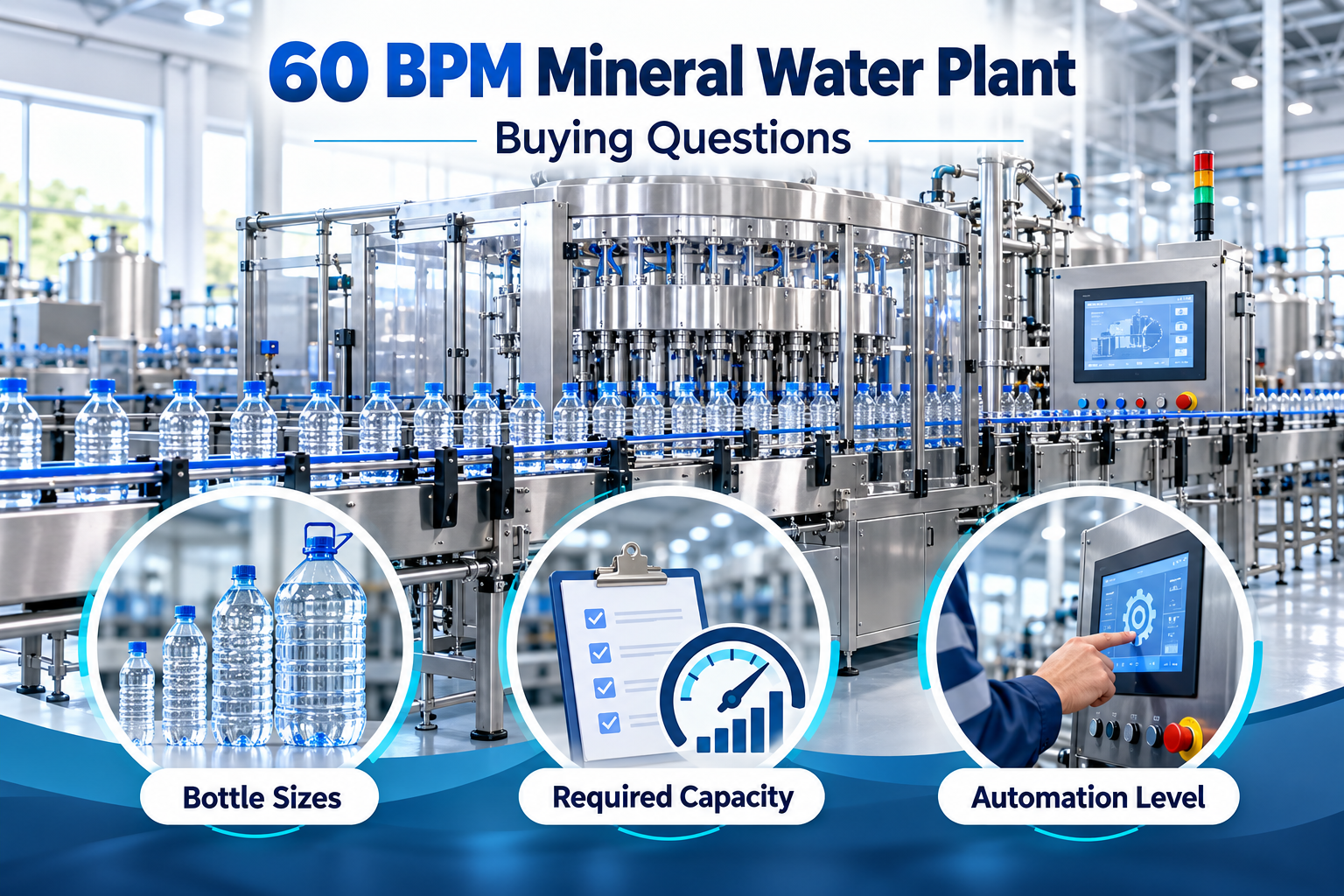
Before requesting a quotation, buyers should prepare information covering:
- Bottle sizes and products: What products and bottle formats are planned?
- Required capacity: What market requirement supports the proposed capacity?
- Automation level: What level of automation suits the operating model?
- Water treatment: What treatment requirements apply to the proposed source and product?
- Infrastructure: What site, utilities, warehousing and vehicle-movement requirements need to be considered?
- Installation and support: What installation, commissioning and technical support are included?
- Future expansion: How should the site and project be planned for the intended growth path?
A clear project brief allows manufacturers to respond to the actual business requirement rather than providing a generic proposal.
DTPPL Mineral Water Plant Solutions
Dharmanandan Techno Projects Pvt. Ltd. (DTPPL) provides solutions for the packaged drinking water and beverage industry, including mineral water plants, water treatment systems, filling and packaging machinery.
For businesses evaluating a 60 BPM project, the discussion can begin with the intended market, production requirement, distribution model, product configuration and site plan. This creates a stronger basis for evaluating the appropriate plant configuration and project scope.
60 BPM Mineral Water Plant FAQs
What is a 60 BPM Mineral Water Plant?
A 60 BPM Mineral Water Plant is a bottling setup with a rated capacity of 60 bottles per minute. It can be considered by businesses moving from a local operation toward a more structured manufacturing and district-level distribution model.
How many distributors can a 60 BPM plant support?
There is no universal number. Distributor coverage depends on territory demand, order frequency, product movement, logistics and the structure of the business’s channel network.
What factors affect the mineral water plant price?
Treatment requirements, filling and packaging configuration, automation, utilities, infrastructure, installation and the overall project scope can affect the quotation. A project-specific assessment is therefore preferable to a generic price.
Should a 60 BPM water bottling plant be automated?
The appropriate automation level depends on the proposed operation and project requirements. It should be evaluated as part of the overall plant configuration rather than as an isolated feature.
How do I choose mineral water plant manufacturers in India?
Compare technical capability, project understanding, equipment scope, installation and support arrangements, customization where required and after-sales technical assistance.
OUR OTHER PRODUCT
60 BPM Mineral Water Plant Conclusion
A 60 BPM Mineral Water Plant can support the transition from local bottled-water sales toward a more structured district-level business. Its commercial role extends beyond rated production speed to include distributor coverage, warehousing, logistics, retail presence and management systems.
For entrepreneurs, distributors and regional brands, the right approach is to assess market demand and distribution capability before finalising capacity. Production growth is most effective when supported by appropriate infrastructure, working capital, channel partners and sales management.
Businesses planning a 60 BPM Mineral Water Plant can evaluate their production requirement, target markets, infrastructure and future expansion plans with DTPPL to identify a suitable bottling solution.
Our associates
























































Director – Global Marketing and Sales
Mr. Bhavesh from Dharmanandan Techno Projects Pvt. Ltd. has played a pivotal role in elevating the DTPPL brand to the global stage, leveraging his exceptional expertise in marketing and communications. He is committed to helping clients achieve significant growth while strengthening their own brands. Dharmanandan Techno Projects Pvt. Ltd. is a leading manufacturer and supplier of water purification systems and turnkey solutions for mineral water plants. With years of experience in designing and delivering high-quality water treatment solutions, the company provides end-to-end services, including system design, installation, maintenance, and ongoing support. Specializing in scalable and customizable water plants, DTPPL has successfully served industries worldwide, ensuring clean and safe drinking water across diverse applications.