



Listening Article
Table of Contents
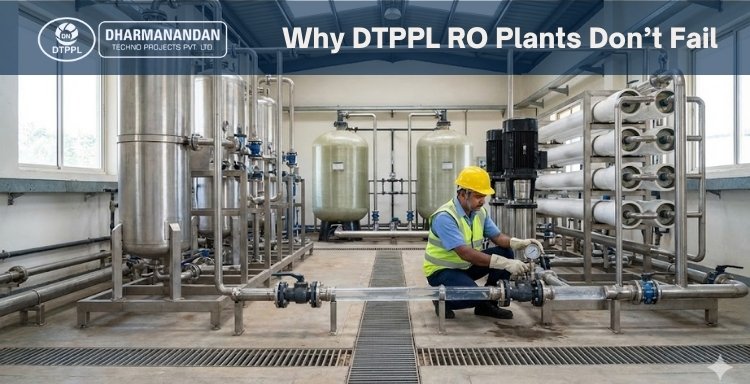
Why DTPPL RO Plant Machines Don’t Fail? (And Why Your Water/Beverage Business Won’t)
December 4, 2025
Objective
The objective of this article is to explain why DTPPL RO Plants achieve unmatched reliability and long-term performance through the company’s Total Quality Assurance (TQA) Doctrine. It aims to educate new mineral water and beverage entrepreneurs on how DTPPL’s rigorous raw material validation, precision manufacturing, automation integrity, and extreme Factory Acceptance Testing prevent failures, protect ROI, and ensure consistent production of pure, BIS-compliant water. The article also highlights how DTPPL eliminates technical fear and operational uncertainty, enabling entrepreneurs to build a stable, evergreen water business.
DTPPL Total Quality Assurance (TQA) Doctrine
Most people who enter the mineral water or beverage business are not technical experts. They are entrepreneurs, visionaries, and businesspeople. Here is the single most important truth you need to understand: Your business is not about bottles. It’s not about caps. It’s about water. If your water treatment fails, your entire business – your brand, your reputation, your investment – fails with it.
Dharmanandan Techno Projects Pvt Ltd (DTPPL) is the number one global brand in this water treatment industry for one reason, and one reason only: We understand that we are not just manufacturing machines. We are manufacturing your success.
And that success is forged in a system we call our Total Quality Assurance (TQA) Doctrine.
This isn’t just a marketing slogan. It’s a non-negotiable, multi-stage, exhaustive process of inspection, testing, and validation. You are worried about “Service Concerns”? Our TQA is designed to prevent the need for service in the first place. You are worried about “ROI”? Our TQA ensures your plant runs at peak efficiency, saving you money on power, water, and downtime from day one.
You don’t need to be a machine expert. Because we are.
Welcome to a behind-the-scenes look at the DTPPL TQA Doctrine. This is how we build the world’s most reliable water treatment plants. This is how we protect your investment.
Part 1: The Foundation – Quality Starts Before the First Weld
A machine can only be as good as the parts it’s made from. You cannot build a robust, 20-year-lifespan plant from cheap materials. This is where most new entrepreneurs get trapped. A supplier shows them two identical-looking RO plants, one 30% cheaper. The entrepreneur, lacking machine knowledge, chooses the cheaper option.
Six months later, the welds are leaking, the cheap pump motor has burned out, the RO membranes are “fouled” (clogged), and their water has a strange taste. Their business is failing.
At DTPPL, our quality check begins on the supplier’s factory floor, not ours. We call this Raw Material Validation.
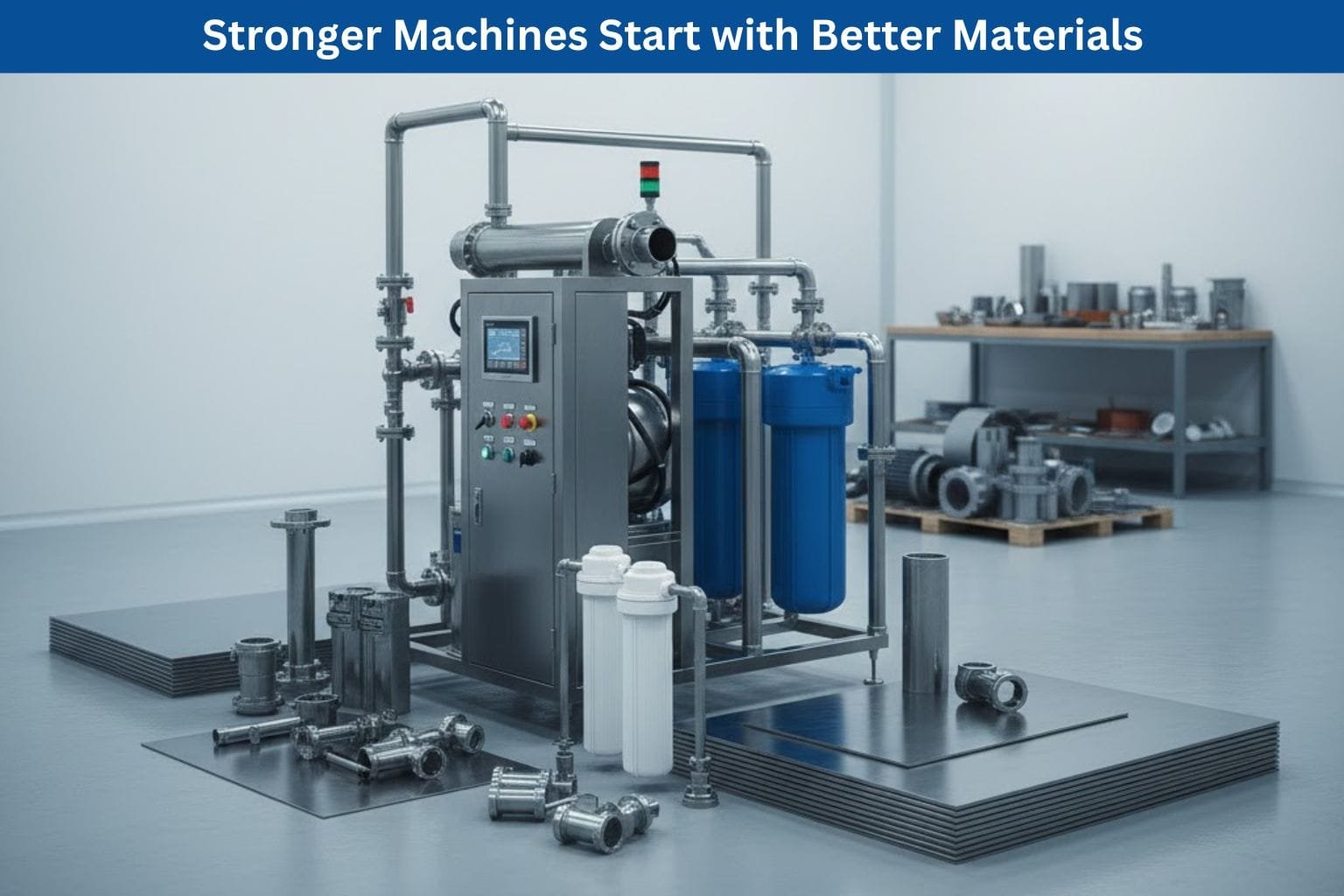
The Skeleton: Stainless Steel (SS) Grade Verification
The frame and tanks of your plant are its skeleton. They must be immune to rust and corrosion.
- The Problem: Low-grade steel (like SS 202) looks identical to high-grade, food-safe steel (SS 304 or SS 316L) when new. But it will rust within a year, contaminating your water.
- The DTPPL TQA: We don’t “trust.” We verify.
- Material Test Certificates (MTC): We mandate that every single sheet, pipe, and bar of steel arrives with an MTC from the mill, certifying its chemical composition.
- Positive Material Identification (PMI): We use an X-Ray Fluorescence (XRF) handheld analyzer. We literally shoot the steel with an X-ray gun to get an instant, on-the-spot reading of its grade. If a supplier sends SS 304 but the gun reads SS 202, the entire lot is rejected.
- Thickness Check: We use ultrasonic thickness gauges to ensure the 3mm sheet we ordered is actually 3.0mm, not 2.5mm. This structural integrity is vital for high-pressure vessels.
Why this matters to you: Your plant will not rust. It will not leak. It will pass any food safety audit. It will last for decades, securing your “Ever Green Business” goal.

The Circulatory System: Pumps, Pipes, and Valves
If the steel is the skeleton, the pipes, valves, and pumps are the heart and veins. This is what touches your water at every stage.
- The Problem: Non-food-grade PVC pipes can leach chemicals into the water. Inefficient pumps run up massive electricity bills, destroying your “High Profit Margin” goal.
- The DTPPL TQA:
- Piping: All “wetted” (water-touching) pipes and fittings (like UPVC) are checked for Food-Grade certification (e.g., NSF-certified). We pressure-test random samples to check for burst strength.
- Valves: We manually and pneumatically actuate valves in a test rig to check for 100% sealing. A single leaky valve can cause untreated water to mix with treated water, destroying your final product.
- Pumps (The Heart): This is one of your biggest operational costs. We don’t just check the brand (we only use world-class brands like Grundfos, CNP, etc.). We put them on a test bench.
- Flow vs. Pressure Test: We hook it up and measure: “Is it delivering the exact 2000 liters per hour at 15 bar pressure it claims?”
- Power Consumption Test: We check its “Amperage” (power draw). An inefficient pump will quietly steal your profits via your power bill. We catch it before it’s mounted.
- Seal Integrity: We run it for hours and check for any leaks from the motor seal. This is a primary point of failure that we eliminate.
Why this matters to you: You get the exact water output you paid for. Your power bills are low and predictable. Your profit margins are protected.
The Kidneys: Filtration Media (Sand, Carbon, Resin)
Your Multi-Grade Filter (MGF) and Activated Carbon Filter (ACF) are the “kidneys” of your plant. They remove the physical dirt, color, and odor.
- The Problem: Low-quality “activated” carbon is just cheap charcoal. It does nothing. Incorrectly sized sand won’t filter anything. This leads to customer complaints about “cloudy” or “funny-tasting” water.
- The DTPPL TQA:
- Sand/Gravel: We perform a “Sieve Analysis.” We physically pass the media through a series of screens to ensure the particle size distribution is perfect for optimal filtration.
- Activated Carbon: We only buy virgin, coconut-shell-based carbon. The key test is the “Iodine Value.” This number (e.g., 900-1100 IV) is a direct measure of the carbon’s ability to absorb (adsorb) impurities. We test this for every batch. Low IV carbon is rejected instantly.
- Softener Resin: We check the “Cross-linkage” percentage of the resin beads, which determines their durability and lifespan.
Why this matters to you: Your final product is crystal clear, odorless, and tastes pure. This is the key to building a “National Brand” that customers trust and ask for by name.
The Final Barrier: RO Membranes & Disinfection
This is where the magic happens – where dissolved salts (TDS) are removed.
- The Problem: Counterfeit or “B-grade” membranes are common. They have a low “salt rejection” rate, meaning your “mineral water” still has high TDS.
- The DTPPL TQA:
- RO Membranes: We are authorized partners with global leaders like DuPont (FilmTec), LG Chem, and Hydranautics. We check every membrane for its unique serial number against the manufacturer’s database to guarantee authenticity. They arrive in vacuum-sealed, tamper-proof bags.
- UV Lamps: We use a UV intensity meter to check that the lamp is emitting the correct “microwatt-seconds per square centimeter” of C-band UV light (UV-C) needed for 99.99% sterilization.
- Ozonators: We test the ozone generator’s output (measured in grams/hour) to ensure it’s powerful enough to sterilize your final product water and give it a long “shelf life.”
Why this matters to you: This is how you pass your ISI License test. This is how you legally call your product “Packaged Drinking Water.” We build your plant to exceed BIS (Bureau of Indian Standards) requirements from the very start.
Read Our Article: Reverse Osmosis Plant Price in India – Factors to Consider
Part 2: The Crucible – In-Process Quality Control During Manufacturing
So, we have a stockpile of certified, tested, 100% perfect raw materials. Now we build. A great recipe can still be ruined by a bad chef. Our “chefs” – our engineers and welders – are artisans who operate under a microscope of quality checks.
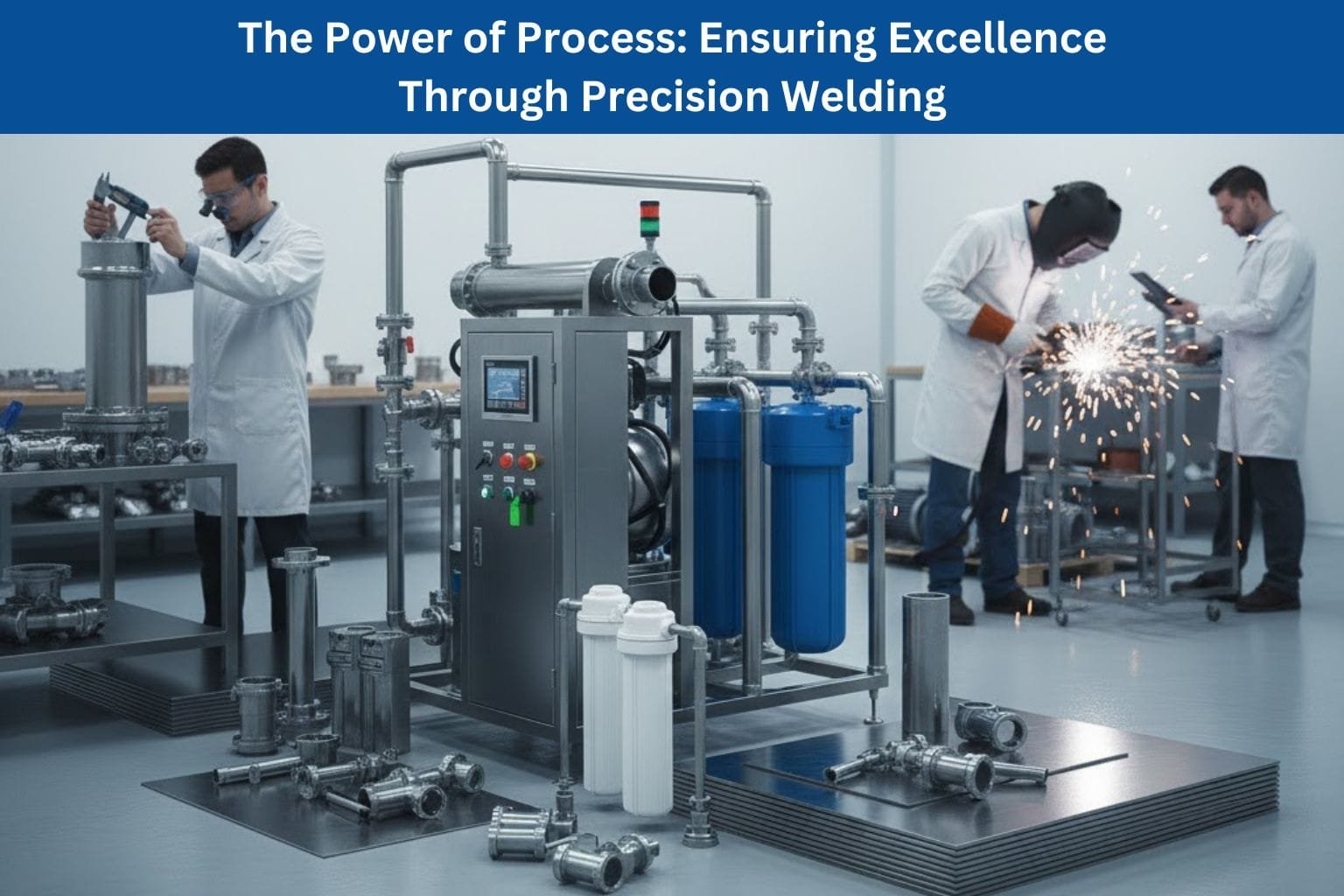
Fabrication & Welding: The Art of Purity
- The Process: We don’t use standard “arc welding.” For all SS 316L and 304 food-grade piping, we mandate TIG (Argon) Welding.
- The TQA Check:
- Weld Purity: Argon gas welding creates a “sanitary” or “hygienic” weld, a smooth internal surface where no bacteria can hide or grow.
- Visual & Finishing: A senior QC engineer inspects every single weld joint. Is it smooth? Is it fully penetrated? After welding, the joint is “pickled” and “passivated” (chemically treated) and then polished so that the weld joint is indistinguishable from the pipe itself.
- Dye-Penetrant Test: On critical high-pressure joints, we spray a special red dye. After wiping, we apply a developer. If there is a micro-fracture or pinhole leak invisible to the eye, the red dye will “bleed” out, identifying the fault. We grind it down and re-weld it perfectly.
Why this matters to you: This obsessive attention to detail prevents “bio-fouling” – the growth of slime and bacteria inside your pipes. This is a massive problem in cheaply made plants and a direct cause of “Fear of Failure” for new entrepreneurs. We eliminate it.
Assembly & Automation: The Brain Surgery
Your plant is run by a “brain” – the electrical control panel with its PLC (Programmable Logic Controller). This is what automates the entire plant.
- The Problem: Poor wiring, low-quality contactors, or bad programming can cause the plant to stop for no reason, or worse, not stop when it should (e.g., a tank overflows or a pump runs dry). This is a service nightmare.
- The DTPPL TQA:
- Component Check: We double-check that every component inside the panel (PLC, contactors, relays) matches the specification (e.g., Schneider Electric, Siemens).
- Wiring Integrity: Every wire is “ferruled” (given a proper end-cap) and labeled according to the electrical schematic. This isn’t just neat – it’s critical for future service.
- PLC Logic Test: Before the panel ever goes on the machine, our automation engineer “bench tests” the program logic. Does the low-level sensor trigger the pump? Does the high-level sensor stop it? Does the RO plant initiate its automatic “flush” cycle on startup? We test every “what-if” scenario.
Part 3: The Final Gauntlet – The Factory Acceptance Test (FAT)
This is the moment of truth.
The machine is fully assembled. It’s sitting on our factory floor. Before we even think about shipping it to you, we put it through hell. We call this the Factory Acceptance Test (FAT). We run your machine, with water, for 24-48 hours straight.
We are not just checking if it “turns on.” We are simulating your actual plant operation.
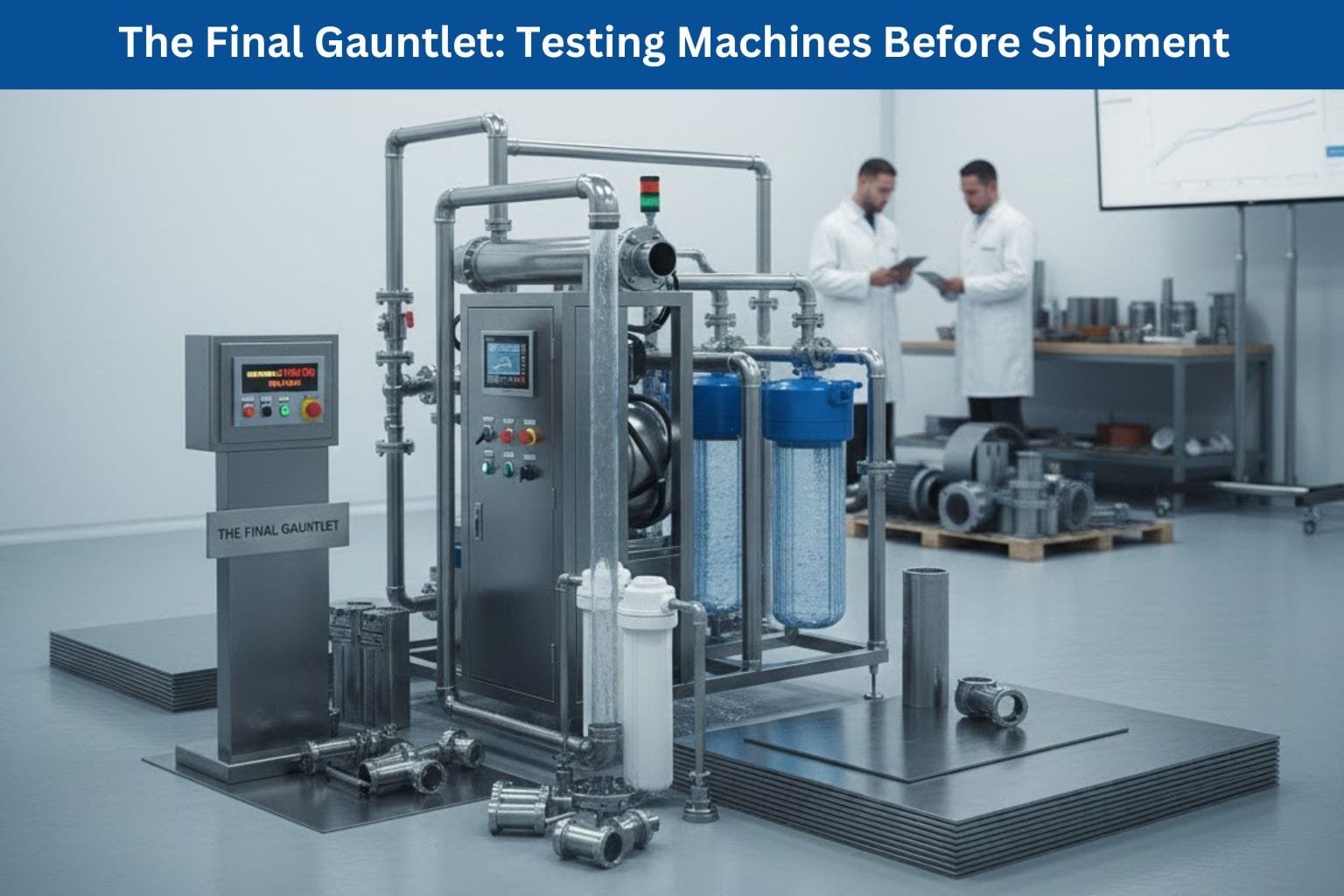
The Pre-Treatment Test (MGF, ACF, Softener)
- What we do: We hook up test water and run the entire pre-treatment line.
- What we check:
- Flow Rate: Do the MGF and ACF deliver the exact flow rate (e.g., 5000 LPH) they are designed for?
- Backwash & Rinse: We initiate the cleaning (backwash) cycle. Does the valve “multiport” valve (MPV) turn correctly? Does the water flow in reverse powerfully enough to “fluff” the media bed and eject the trapped dirt? Does the “rinse” cycle work to resettle the media? This is critical for filter life.
- Softener Regeneration: We test the entire 8-step regeneration cycle. Does it suck the salt water (brine) correctly? Does it rinse itself properly? We then test the output water for “0” hardness.
The RO Plant Test (The Main Event)
This is the most grueling test.
- What we do: We feed the pre-treated water to the High-Pressure Pump and run the RO system continuously for 24-48 hours.
- What we check:
- 100% Leak-Proofing: We run the plant at its full operating pressure (e.g., 150-200 PSI) and a DTPPL QC engineer inspects every single joint, seal, and connection with a dry cloth and a flashlight. One single drop is a “Fail.”
- Flow Rate Validation: We get two buckets and two stopwatches. We measure the “Product Water” (the good, pure water) and the “Reject Water” (the high-TDS waste water). Do they match the design parameters? This “recovery rate” is the key to your plant’s profitability.
- TDS Rejection % Test: This is the big one. We use a digital TDS meter. We measure the “In” water (e.g., 1000 TDS) and the “Out” water (e.g., 20 TDS). We calculate the “Salt Rejection Rate.” (In this case, 98%). This number must meet or exceed our promise to you. This is the proof that the membranes are genuine and the system is working perfectly.
- Safety Interlock Test: We force failures to see if the brain protects itself.
- We’ll cut the water supply. Does the “Low-Pressure Switch” detect it and instantly shut down the High-Pressure Pump (saving it from burning out)? Yes.
- We’ll simulate the product water tank being full. Does the “High-Level Switch” signal the plant to stop? Yes.
- We’ll simulate a power outage. When the power comes back, does the plant safely restart and begin its flush cycle? Yes.
The Post-Treatment Test (UV & Ozonator)
- What we do: We run the final product water through the disinfection loop.
- What we check:
- UV Alarm: Does the UV ballast “alarm” light up if the lamp fails? This ensures you know if your water isn’t being sterilized.
- Ozone Dosing: We use an ORP (Oxidation-Reduction Potential) meter to check that the ozone is dissolving into the water correctly, ensuring your water is safe and has a long shelf life.
Only when a machine has passed every single one of these tests does it receive the “DTPPL TQA Certified” stamp. It is now ready to be your business.
Part 4: Your Success is Our Final Quality Check
Client Review
“DTPPL has in-house Manufacturing facility for all the machinery. And very good support from whole team. Recently I have installed Ro plant and filling units and I m satisfied with machine quality. I recommend please once visit DTPPL and take machinery from them only. Very good service and after sales support. ’”
– Alexander
Our TQA doctrine doesn’t end when the machine leaves our factory. It extends to you.
- Guidance on Plant Design: Our TQA includes ensuring the design is right for your raw water.
- Intensive Training: Our TQA includes giving your team intensive training on the exact machine that has already passed our FAT.
- Guidance on ISI & Licenses: Our TQA means we know our machine will produce water that passes ISI standards. We guide you through that process.
- Good Service: Our TQA is the reason our service is so good. We have fewer breakdowns, and when you do call, our engineers know the machine (and its documentation) inside and out because of our rigorous process.
When you invest with DTPPL, you are not buying a machine. You are buying certainty.
You are buying the certainty that your water will be pure.
You are buying the certainty that your plant will run efficiently.
You are buying the certainty that your investment is protected by hundreds of hours of obsessive, expert quality assurance.
Your dream of becoming a successful entrepreneur is a big one. The “Fear of Failure” is real. But the DTPPL Total Quality Assurance Doctrine is your insurance policy. We’ve already found and fixed every problem, so you don’t have to.
You just get to focus on what you do best: building your brand and selling your product.
We’ve handled the rest.
Are you ready to build your “Ever Green Water/Beverage Business” on a foundation of “Zero-Defect” quality?
Don’t let your dream be a gamble. Talk to the DTPPL team today. Let our experts show you how we manufacture success, one perfect component at a time.
Reverse Osmosis Plant Stainless Steel
Capacity: 1000 LPH to 50,000 LPH
(USD 4,500 to USD 10,700)
FAQs About RO Plant Machines
Why do DTPPL RO plants have lower failure rates compared to cheaper alternatives?
Because DTPPL’s TQA Doctrine begins long before manufacturing—by validating every raw material, component, and process using scientific testing. From XRF steel verification to pump performance testing and membrane authentication, every element is proven, not assumed. This prevents the leaks, breakdowns, fouling, and electrical failures that commonly occur in low-quality RO systems.
How does DTPPL ensure the water quality meets BIS (ISI) standards?
DTPPL checks every critical stage of purification—filtration media quality, membrane rejection percentage, UV intensity, ozone output, and TDS reduction—during the 24–48-hour Factory Acceptance Test. Only machines that consistently achieve BIS-compliant purity and microbial safety receive TQA certification. This ensures your plant passes ISI testing without stress.
What tests are done before dispatch to ensure the RO plant works flawlessly at my site?
DTPPL conducts a full-scale Factory Acceptance Test (FAT), including:
Leak-proof high-pressure test
Flow & recovery test (product vs. reject water)
98%+ salt rejection verification
Media backwash and regeneration cycle checks
Electrical interlock testing (dry run protection, tank level sensors, startup flush cycle)
UV & ozone output validation
The entire plant is operated continuously for 24–48 hours to simulate real-world conditions.
How does DTPPL prevent common problems like bacterial growth, membrane fouling, and bad taste?
These problems mostly arise from poor fabrication, low-grade media, and contaminated piping. DTPPL eliminates them through TIG hygienic welding, pickling & passivation, precise sieve analysis of sand, high-iodine-value activated carbon, verified virgin resin, and authentic membranes. Every weld, pipe, and surface is sanitized to prevent bio-fouling, ensuring long-term purity and taste consistency.
What happens after the RO plant is delivered—does DTPPL provide training and support?
Yes. DTPPL’s TQA extends beyond manufacturing with:
Plant design guidance based on your raw water report
On-site commissioning by expert engineers
Intensive operator training on the exact machine that passed FAT
Support for ISI documentation and testing
Strong service backup with fewer breakdowns due to TQA-built reliability
You don’t need technical knowledge—DTPPL prepares your team to run the plant confidently from Day 1.
Our associates




































About Author
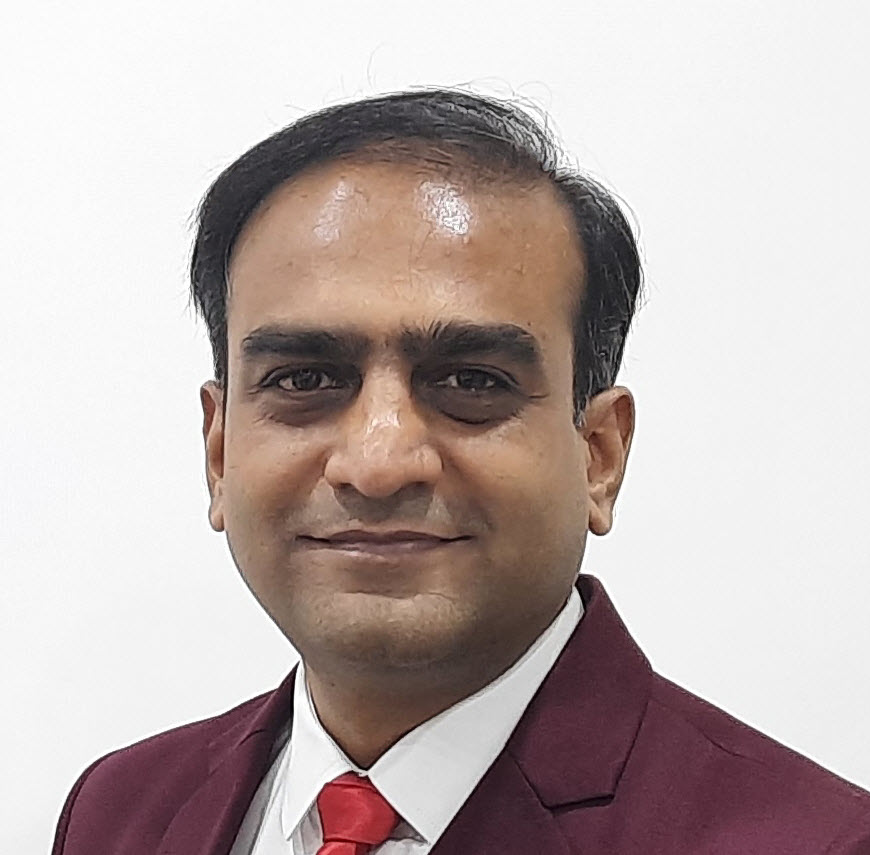
Director – Global Marketing and Sales
Mr. Bhavesh from Dharmanandan Techno Projects Pvt. Ltd. has played a pivotal role in elevating the DTPPL brand to the global stage, leveraging his exceptional expertise in marketing and communications. He is committed to helping clients achieve significant growth while strengthening their own brands. Dharmanandan Techno Projects Pvt. Ltd. is a leading manufacturer and supplier of water purification systems and turnkey solutions for mineral water plants. With years of experience in designing and delivering high-quality water treatment solutions, the company provides end-to-end services, including system design, installation, maintenance, and ongoing support. Specializing in scalable and customizable water plants, DTPPL has successfully served industries worldwide, ensuring clean and safe drinking water across diverse applications.