



Listening Article
Table of Contents
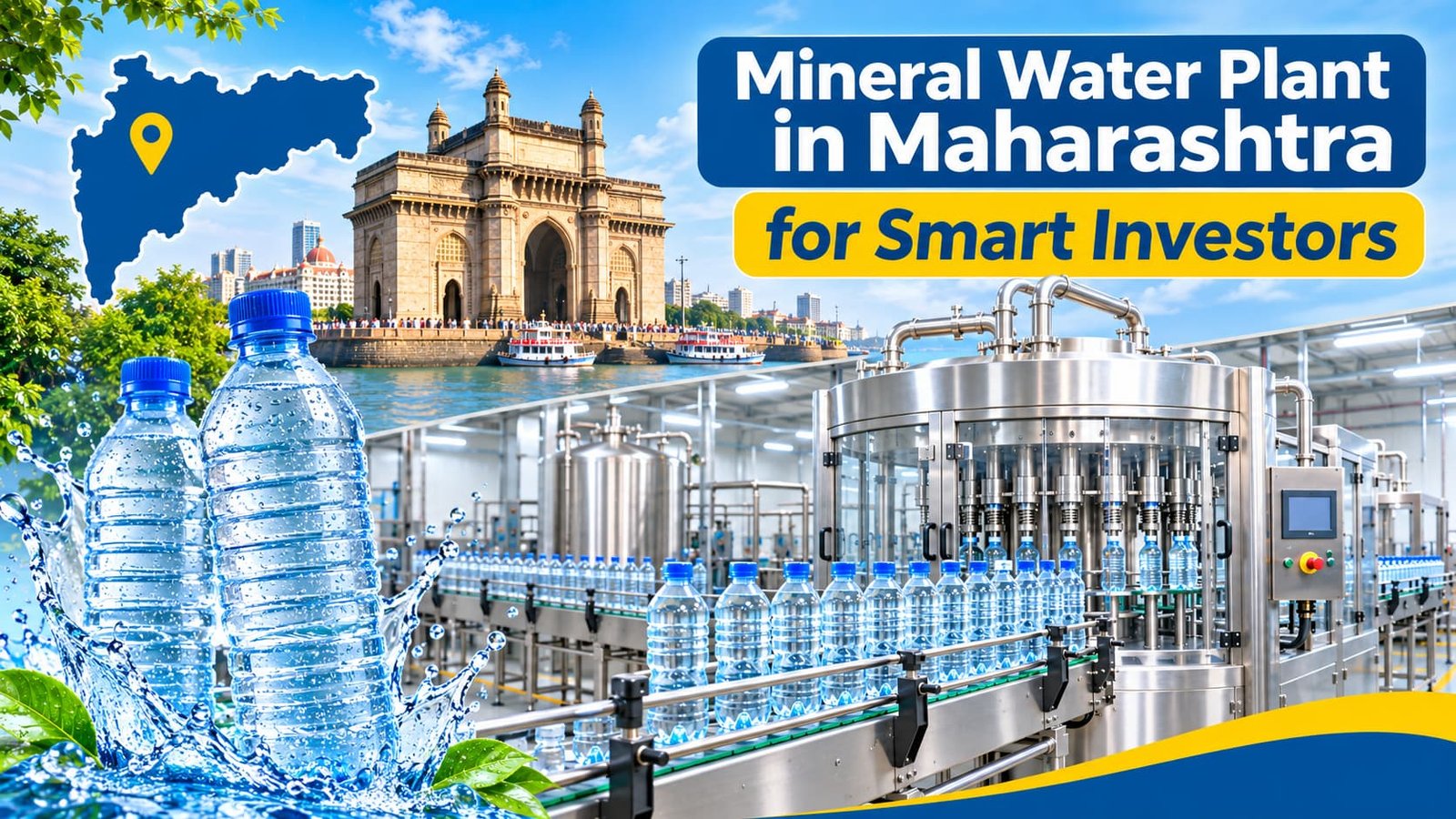
Mineral Water Plant in Maharashtra for Smart Investors
November 16, 2026
AI Summary
A mineral water plant in Maharashtra serves MIDC industrial belts, year round pilgrim traffic and some of India’s hottest summer districts. Dharmanandan Techno Projects Pvt. Ltd. (DTPPL) supplies fully automatic water and soft drink plants with licensing, layout and branding support, while PSI 2025 can refund up to 100% of fixed capital investment in eligible districts.
Water Bottle Business Opportunity in Maharashtra
Maharashtra has more than 112 million residents, over 45% of them in metropolitan or industrial clusters, and the state attracts over 114 million visitors a year. Its push toward a $1 trillion economy is funding the 700 km Samruddhi Mahamarg and the Mumbai Trans Harbour Link, opening fresh consumption corridors and faster distribution routes for packaged beverages.
Dharmanandan Techno Projects Pvt. Ltd. helps entrepreneurs turn this growth into a profitable water bottle business. Each packaged drinking water plant from DTPPL is planned around the formats Maharashtra buyers prefer, the compliance rules every brand must clear and the subsidy zones that shape project returns, so investors begin with a clear, bankable roadmap instead of guesswork.
 Email Us Now!
Mineral Water Plant in Maharashtra: Districts with the Strongest Demand
Thane and Palghar combine a large population base with the Taloja and Tarapur MIDC estates, whose factories employ a vast workforce needing safe drinking water on every shift. Nearby Raigad adds JNPT port logistics staff and Alibaug beach tourism. Lower land costs than Mumbai make these belts practical bases for a plant that supplies the city daily.
Pune offers Hinjewadi IT parks, the Chakan auto cluster and a large student base with strong purchasing power. Hard borewell water in many localities makes organised packaged water essential, and new residential complexes rely on regular delivery. A Mineral Water Plant in Pune therefore enjoys steady household and corporate demand throughout the year.
Ahmednagar includes Shirdi, whose daily flow of pilgrims keeps 1 litre bottles moving all year, and neighbouring Nashik adds Trimbakeshwar visitors and Sinnar MIDC units. A Mineral Water Plant in Shirdi or along its approach routes can serve temple visitors, lodges and hospitality venues, with demand that holds firm through every season and economic cycle.
Nagpur is the logistics gateway to central India, with MIHAN and Butibori MIDC adding corporate and institutional buyers. A Mineral Water Plant in Nagpur can supply offices, logistics parks and retail outlets across Vidarbha, and its central position makes it a natural hub for serving surrounding districts quickly and efficiently.
Akola and Amravati have recorded peaks of 46.9°C, and Chandrapur reaches 46.2°C alongside heavy mining activity. Rural markets in these districts remain underserved by large brands, giving a local producer room to build district leadership quickly, while industrial pollution around Chandrapur leaves residents relying on safe, certified packaged water every day.
Packaged Drinking Water Plant Formats That Sell Fastest
The 1 litre bottle is the entry priority and the format with the widest acceptance. Dhabas, ST bus stands, railway stations, toll plazas and pilgrimage routes to Shirdi, Mahabaleshwar and the Konkan coast move it fastest. Its quick retail turnover and medium to high margins also make it the strongest tool for early brand visibility.
The 20 litre jar anchors cash flow. Low recurring packaging cost and repeat orders from offices, factories, hospitals and housing societies keep a water jar business steady all year. Neighbourhood routes run by micro distributors on electric three wheelers keep delivery costs low, with a margin earned on every jar replaced at the customer’s door.
The 200 ml bottle suits Maharashtra’s large wedding and corporate event market, where larger bottles are often left half used and wasted. One event can need more than 10,000 bottles, so contracts signed with caterers and banquet halls before the winter and spring wedding seasons deliver dependable bulk orders and strong cash flow.
The 500 ml bottle serves cafes, theatres, students, solo travellers and quick commerce orders in large cities, where buyers value convenience. DTPPL sets up its filling lines to run all four sizes, so a single plant can cover retail, institutional and event demand without separate investments for each bottle format.
Fully Automatic Mineral Water Plant: The DTPPL Advantage
A fully automatic mineral water plant from DTPPL rinses, fills and caps bottles with no hand contact on the product. Consistent automated handling keeps every batch audit ready and protects against rejection, while uniform capping, straight labels and clean bottles let a new brand sit confidently beside national names on premium retail shelves.
Output is the second major gain. DTPPL plants range from 2,000 to 50,000 LPH, giving the speed to meet sudden surges during festivals and peak summer. Logic controlled automation runs with a small team, lowering operating cost in industrial belts where labour is scarce and wages keep rising, and keeping production steady through every season.
Automatic Blow Moulding Machine and Labelling Machine for Water Bottles
In packaged water, the bottle is the first advertisement. DTPPL’s automatic blow moulding machines turn preforms into rigid PET bottles with custom ribbed or diamond cut grips that resist crushing and signal quality at first touch. A custom mould also gives a regional brand a distinctive shape that local rivals cannot easily copy.
Machine applied shrink or BOPP labels sit evenly and stay put, carrying the FSSAI logo, ISI mark and nutritional details. Marathi text and brand names inspired by the Sahyadri ranges or regional rivers create local trust, while a glossy label finish lifts shelf appeal and supports a premium position in hotels and restaurants.
A branded cap in a distinctive colour such as dark blue, emerald green or deep red acts as a tamper signal for travellers wary of refilled bottles. Batch coding and shrink wrapping at the end of the DTPPL line keep every pack traceable, neatly bundled and ready for dispatch to distributors, retailers and event clients.
OUR OTHER PRODUCT
Soft Drink Plant for Vidarbha and Marathwada Summers
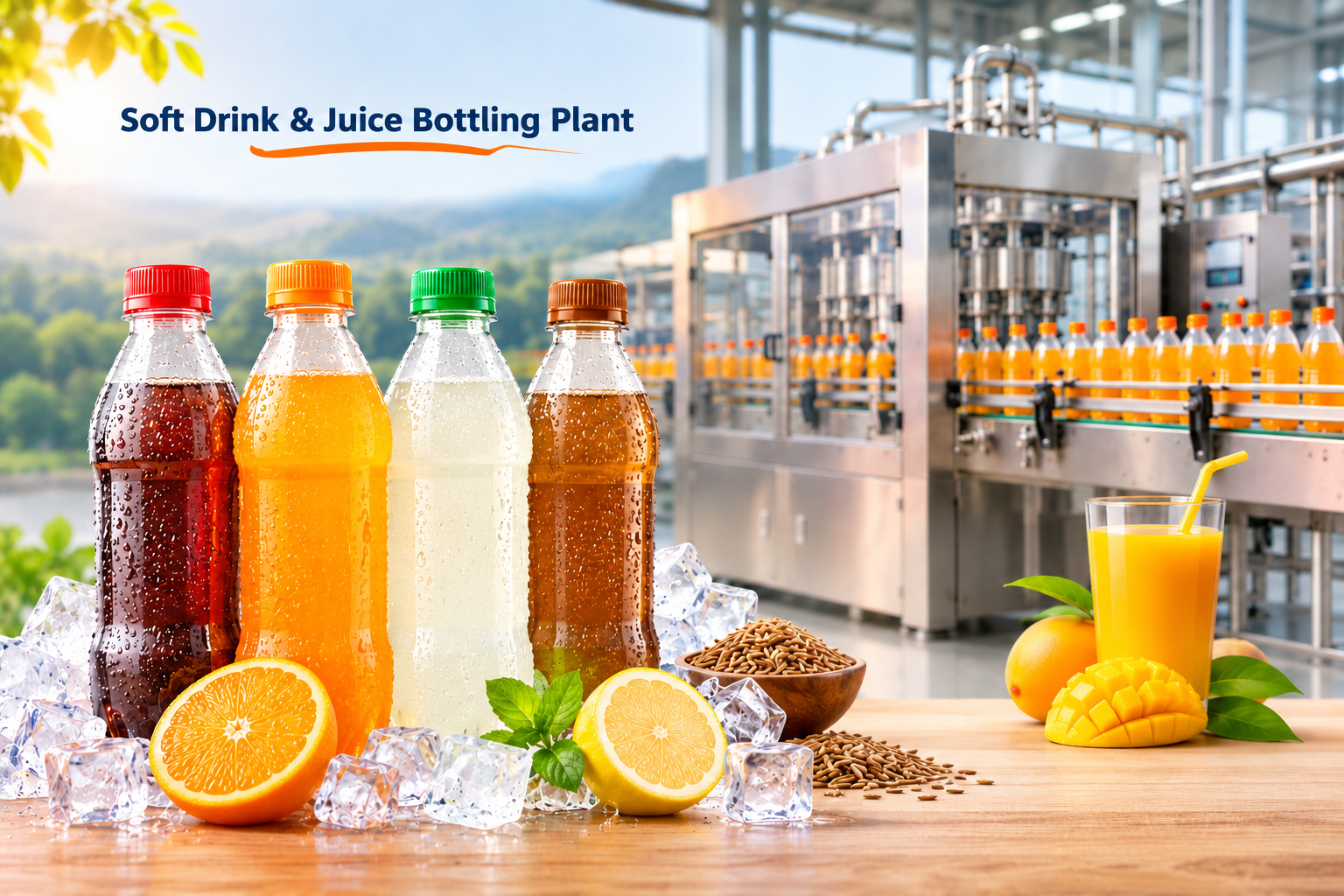
From March to June, interior districts shift toward cold, flavoured drinks, and affordability outweighs brand name. A DTPPL soft drink plant lets a water manufacturer add Jeera soda, Orange, Cola and Lemon variants suited to local taste, reaching rural and semi urban youth through the same distributors that already carry the water range.
A carbonated soft drink plant earns high margins and fast turnover through rural kirana stores and pan shops. Automated carbonation keeps flavour and fizz consistent from batch to batch, which builds loyal repeat buyers. DTPPL also offers juice filling lines, letting a growing brand add fruit based beverages and widen its portfolio as demand matures.
BIS Licensing for Water Plant and FSSAI Compliance
BIS licensing for a water plant begins with the ISI mark under IS 14543:2024, without which packaged drinking water cannot be sold in India. Every plant must also run an equipped in house laboratory, staffed by qualified chemists who test each batch with prescribed glassware, chemicals and media before any bottle leaves the factory gate.
Core IS 14543:2024 limits:
- pH between 6.0 and 8.5
- TDS capped at 500 mg/l
- Zero tolerance for microbes, heavy metals, pesticide residues and radioactive elements
BIS licence route:
- Internal testing of treated water in the plant laboratory
- Online application on the BIS portal
- Inspection of the factory, machinery and lab by a BIS officer
- Independent sample testing at a NABL accredited lab, followed by licence grant
The FSSAI licence for packaged drinking water runs alongside. Its Scheme of Testing for Packaged Drinking Water, effective January 2026, requires test records and notified NABL laboratories, plus a clean filling room, drainage and pest control built into the layout. The licence number on every label also opens doors to modern trade and institutional buyers.
DTPPL designs plant layouts around these hygienic zoning rules from day one, so inspections move smoothly. Director Mr. V.S. Patel guides clients through documentation, lab setup and factory inspections, helping projects clear testing and reach commercial launch faster, while investors stay focused on building distribution instead of handling regulatory paperwork.
Client Review
“Dharmanandan Techno Projects provided excellent guidance in setting up our mineral water plant. Their machinery quality, technical support and professional service made the entire process smooth and hassle-free.”
– Amit Sharma
Water Plant Subsidy Options in Maharashtra
The main water plant subsidy in Maharashtra, the Package Scheme of Incentives (PSI) 2025, rewards plants set up outside the Mumbai and Pune corridors. It works through an Investment Promotion Subsidy, refunded as SGST against fixed capital investment (FCI), with higher shares for districts that are less industrially developed, as the table shows.
Zone | Maximum Refund (share of FCI) |
| Zone C | Up to 50% |
| Zone D | Up to 60% |
| Zone D+ | Up to 70% |
| Vidarbha, Marathwada and Aspirational Districts | 80% to 100% |
The refund is spread over 7 to 10 years, effectively recovering much of the plant investment. Eligible units also receive 100% stamp duty exemption on land and loan documents, a 5% annual interest subsidy on term loans for fixed assets, and a 3 year power tariff subsidy that eases RO and chilling costs.
Central government support:
- PMEGP: 15% to 35% margin money for new manufacturing units
- PMFME: 35% credit linked subsidy for carbonated and fruit based drinks
- CGTMSE: collateral free bank loans for micro and small enterprises
- Stand Up India: bank loans for SC, ST and women entrepreneurs starting greenfield units
Udyam registration and an eligibility certificate from the MAITRI portal, obtained before production starts, secure the state benefits. Since scheme terms are revised periodically, investors should confirm current eligibility during project planning, and DTPPL’s guidance on project finance helps align plant location, capacity and documentation with the incentive route that fits best.
Read Our Article
Mineral Water Plant Capacity Options from 2,000 to 10,000 LPH
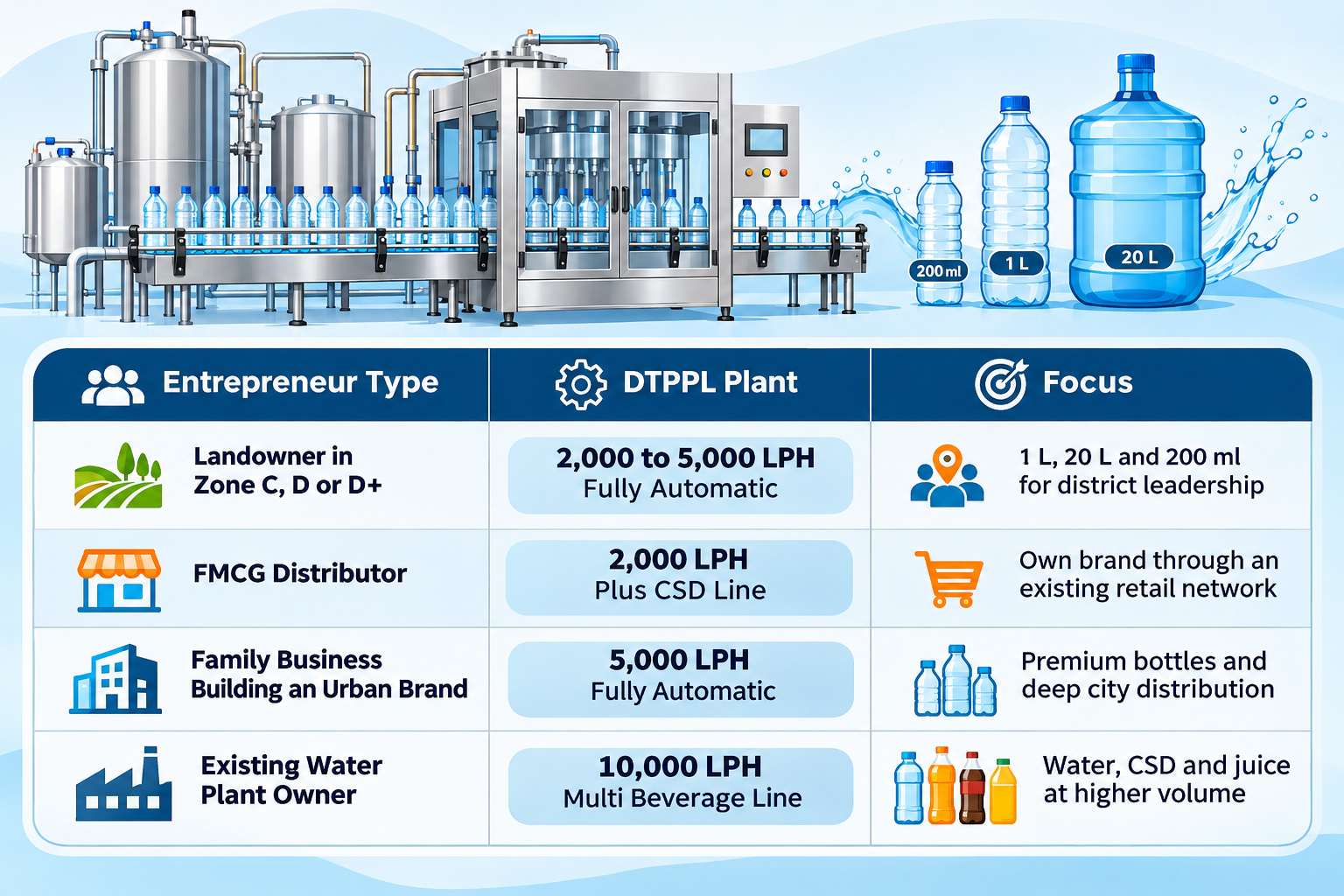
The right capacity depends on the buyer’s starting point, and Dharmanandan Techno Projects Pvt. Ltd. supplies a configuration for each path. Landowners, distributors, family businesses and existing plant owners each bring different assets, so DTPPL matches plant size, automation and product mix to the market they already control and the growth they plan next.
Entrepreneur Type | DTPPL Plant | Focus |
| Landowner in Zone C, D or D+ | 2,000 to 5,000 LPH fully automatic | 1 L, 20 L and 200 ml for district leadership |
| FMCG distributor | 2,000 LPH plus CSD line | Own brand through an existing retail network |
| Family business building an urban brand | 5,000 LPH fully automatic | Premium bottles and deep city distribution |
| Existing water plant owner | 10,000 LPH multi beverage line | Water, CSD and juice at higher volume |
 Call Us Now!
Scaling a Mineral Water Business Across Maharashtra and Beyond
In the first 12 months, a new mineral water business should focus on leading the home district while plant routines settle. Kirana shop front banners, ST bus stand hoardings, WhatsApp updates sharing NABL reports with caterers, and short factory videos build trust at low cost and give buyers visible proof of quality.
In years one to three, expand into three to five neighbouring districts through super stockists and supply 200 ml bottles to Ganeshotsav mandals and Pandharpur Wari hydration stalls. Distributor margins 15% to 20% higher, with protected territories, speed up growth, while a larger delivery fleet keeps supply reliable across the wider region.
In years three to five, introduce premium variants such as alkaline water, then enter Gujarat via Palghar, Madhya Pradesh from the Vidarbha belt and Belagavi in Karnataka via Kolhapur, using bilingual labels for local acceptance. DTPPL plants scale up in capacity to match this growth, so the brand expands without replacing its core production line.
About DTPPL: Mineral Water Plant Manufacturer in India
Dharmanandan Techno Projects Pvt. Ltd. is an ISO 9001:2015 certified manufacturer from Kadodara, Surat, serving clients in more than 30 countries. Its range covers mineral water plants, soft drink and juice lines, and bottle making and packaging machinery, backed by a team experienced in guiding first time founders into successful beverage brands.
OUR OTHER PRODUCT
Conclusion: Invest in a Fully Automatic Water Bottling Plant
Success in Maharashtra comes from matching format to region, staying compliant and presenting a premium pack. A fully automatic plant from DTPPL covers all three with hygienic production, custom bottles and a ready path into soft drinks, while guidance on licensing and incentives keeps the project moving from planning to commercial launch.
For entrepreneurs ready to invest in a mineral water plant in Maharashtra, Dharmanandan Techno Projects Pvt. Ltd. is the partner that turns this opportunity into a profitable, scalable brand. Connect with the DTPPL team to choose the right capacity, plan your layout and start building a beverage business designed for long term growth.
FAQs on Mineral Water Plant Setup in Maharashtra
How should I choose the site for a mineral water plant in Maharashtra?
Look for industrial land close to major expressways in emerging logistics hubs such as Jalna, Wardha or Washim, where a central plant can serve several districts. Weigh distance to your main buyers, water source quality and incentive zone together. DTPPL plans the plant layout to suit the chosen plot and its expected volumes.
Which licences does a packaged drinking water plant need?
Every packaged drinking water plant needs a BIS licence under IS 14543:2024 and an FSSAI State or Central licence before sales begin. Operating without them risks factory sealing, penalties and product seizures that can end a brand early. DTPPL plants are designed for compliance, giving investors a secure, approval ready start.
Which sales channels bring the fastest orders?
Highway route sales vans serving dhabas and outlets along the Mumbai Pune Expressway and other busy state highways move volume quickly, especially with retail margins of 25% or more. Hotels, restaurants and cafes reward direct institutional supply with volume discounts, while modern trade and quick commerce platforms build visibility for a growing brand in major cities.
Is a mineral water plant in Maharashtra a profitable long term investment?
Climate trends point to longer and more intense summers, which extend the beverage season across the state. Expanding micro cities around Pune and Navi Mumbai will depend on organised jar delivery for years, and stricter FSSAI and BIS enforcement keeps pushing buyers toward compliant local brands built on DTPPL automatic plants.
What factors decide the cost of a mineral water plant?
Plant cost depends on capacity in LPH, level of automation, number of bottle formats, blow moulding and packaging equipment, laboratory setup and land. Location also affects building and logistics expenses. DTPPL plans the project around your entry model, so every part of the investment supports the formats and markets you intend to serve.
Does DTPPL handle installation and operator training?
Yes. DTPPL provides turnkey installation of the complete line, from RO treatment to filling and packing, and trains operators on daily running, cleaning and quality testing routines. This support helps the team become productive soon after commissioning and keeps the plant running smoothly through festival rushes and peak summer demand.
How can a new regional brand compete with established names?
Large national brands often offer thin retailer margins and limited supply in deep rural areas, while unorganised jar suppliers lack proper certification. A compliant local brand wins by guaranteeing reliable supply, building local pride and stressing safety and purity. A DTPPL plant gives that brand the consistent quality needed to hold its shelf space.

Director – Global Marketing and Sales
Mr. Bhavesh from Dharmanandan Techno Projects Pvt. Ltd. has played a pivotal role in elevating the DTPPL brand to the global stage, leveraging his exceptional expertise in marketing and communications. He is committed to helping clients achieve significant growth while strengthening their own brands. Dharmanandan Techno Projects Pvt. Ltd. is a leading manufacturer and supplier of water purification systems and turnkey solutions for mineral water plants. With years of experience in designing and delivering high-quality water treatment solutions, the company provides end-to-end services, including system design, installation, maintenance, and ongoing support. Specializing in scalable and customizable water plants, DTPPL has successfully served industries worldwide, ensuring clean and safe drinking water across diverse applications.
Mineral Water Plant Manufacturer & Supplier Across India
Serving industrial & commercial customers across Indian states and territories.
Mineral Water Plant Manufacturer & Exporter Across The Globe
Global installations and export capabilities.