




Listening Article
Table of Contents
How to Fix Common Labeling Faults in a Fully Automatic BOPP Labeling Machine for Mineral Water Plant
October 22, 2026
AI Summary
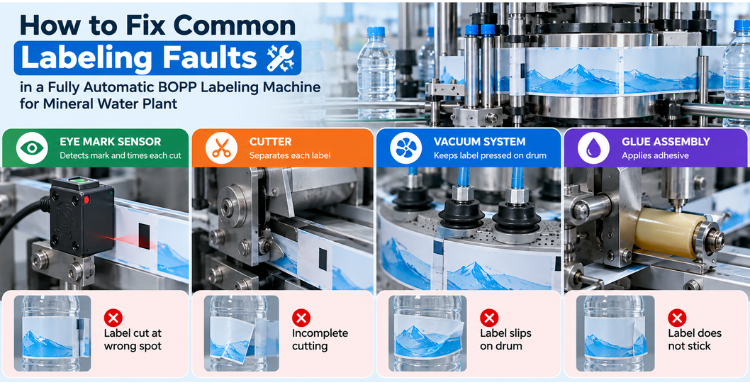
A Fully Automatic BOPP Labeling Machine for Mineral Water Plant relies on four systems: the eye mark sensor that times each cut, the cutter that separates each label, the vacuum system that keeps the label pressed against the drum, and the glue assembly that applies adhesive. When any of these drift out of position, the usual symptoms are labels cut at the wrong spot, incomplete cutting, slipping on the drum, or labels that will not stick.
Understanding BOPP Labeling Machine Maintenance
A BOPP labeling machine typically runs through an entire shift without stopping, so even a small sensor or cutter misalignment can affect many bottles before anyone notices. The four areas below cover where these issues most often start, each with its own symptoms, fix, and verification check.
Incorrect Label Cutting in BOPP Labeling Machine: I-Mark Sensor and Label Roll Setting
When a BOPP labeling machine cuts labels at the wrong position, the eye mark sensor is usually reading a different area of the label, often because the mark is not distinguishable enough from the main label colour. A sensing spot that is broad rather than sharp and line shaped can also cause missed detection.
Roll tension plays a role too. A roll that is too tight stretches the label during cutting, while a roll that is too loose causes unreliable sensing, so the roll should rotate freely.
To correct this, position the sensor light directly over the eye mark so it forms a sharp, line shaped point, hold the ON button for two to three seconds, then move the sensing spot to a background area that should not trigger detection and press OFF. This sequence applies to the sensor model covered here. Other models may use different buttons, so always confirm against the machine’s manual before adjusting.
Once adjusted, run the roll through a short cycle and confirm the indicator blinks consistently each time the eye mark passes, and that the roll still rotates smoothly.
 Call Us Now!
Incomplete Label Cutting in BOPP Labeling Machine: Cutter Position and Alignment
When a BOPP labeling machine does not cut the label completely, or cutting is inconsistent at the top or bottom, the cutter is often positioned too far from the opposing blade, or it is making excessive contact. Inconsistent cutting specifically at the top or bottom usually points to a separate alignment issue rather than the main positioning bolt.
For normal positioning, a single adjustment bolt controls the cutter without moving the full assembly. Turning it clockwise brings the cutter closer, which helps when it is not cutting at all, while turning it anticlockwise moves it slightly farther away when contact is excessive. Adjustments are typically small, in the range of one to two millimetres. This is not a specified blade clearance or a universal setting, only a general sense of scale.
For cutting incomplete at the top or bottom, separate alignment bolts are provided, though exact locations, angles, and torque values can vary by machine and are best confirmed with the manufacturer.
After any adjustment, run several labels through and confirm the cut is complete and even across the full width. If problems continue, have qualified support review the alignment rather than continuing to adjust by trial.
Label Slippage and Vacuum Loss in BOPP Labeling Machine: Rubber Section and Mesh Cleaning
Vacuum holds the label on the drum as it travels toward the bottle, so inadequate vacuum allows the label to shift out of position. A common cause of reduced suction is glue building up on the rubber section, which can be drawn into the vacuum path, though it is not necessarily the only cause.
Cleaning the rubber section of glue daily helps stop buildup from reaching the vacuum path. If glue does reach the system, a mesh behind an access section secured by two bolts intercepts glue particles before they travel further into the pump.
After a safe shutdown, authorised personnel can loosen these bolts, remove the mesh, clean it, and refit it. A vacuum valve allows suction to be increased or decreased depending on the label and bottle combination.
Once reassembled, confirm the rubber section is free of residue before restarting, then run a short cycle and check labels sit flat on the drum without shifting, and suction feels consistent at the chosen setting.
Poor Label Adhesion in BOPP Labeling Machine: Glue Assembly Position and Pump Speed
When glue reaches the pump but does not transfer properly onto the label, or too much glue is applied, two separate controls are usually involved: the mechanical position of the glue assembly, and the glue pump speed. Confusing the two can lead to adjustments that miss the actual cause.
A dedicated bolt controls how far the assembly travels. Loosening it anticlockwise lets it move farther forward, which helps when not enough glue reaches the label, while tightening it clockwise moves it farther back, which helps when too much glue is applied.
Pump speed is a separate control, adjusted with a panel knob, and changes how much glue the pump delivers independent of the assembly’s position.
After adjusting either control, run test labels and check glue coverage is even, adhesion is firm, and no excess glue appears on the label edges or surrounding parts. If the machine shuts down repeatedly, have qualified support investigate rather than continuing to adjust.
Client Review
“DTPPL's technical support helped us resolve label cutting and alignment issues, ensuring smooth operation and consistent labeling quality.”
– Raj Panchal
Routine Maintenance Checks for BOPP Labeling Machine
A short routine covering these points catches most labeling issues early:
- Label roll movement and setting
- Eye mark detection and sensor response
- Completeness of label cutting across the full width
- Glue buildup on the rubber section, cleaned daily
- Vacuum mesh condition whenever suction problems occur
- Label retention and position on the drum
- Glue transfer and overall application quality
Daily cleaning is specifically recommended for the rubber section. Other checks should follow a routine suited to your production volume.
Safety and Final Checks Before Restarting a BOPP Labeling Machine
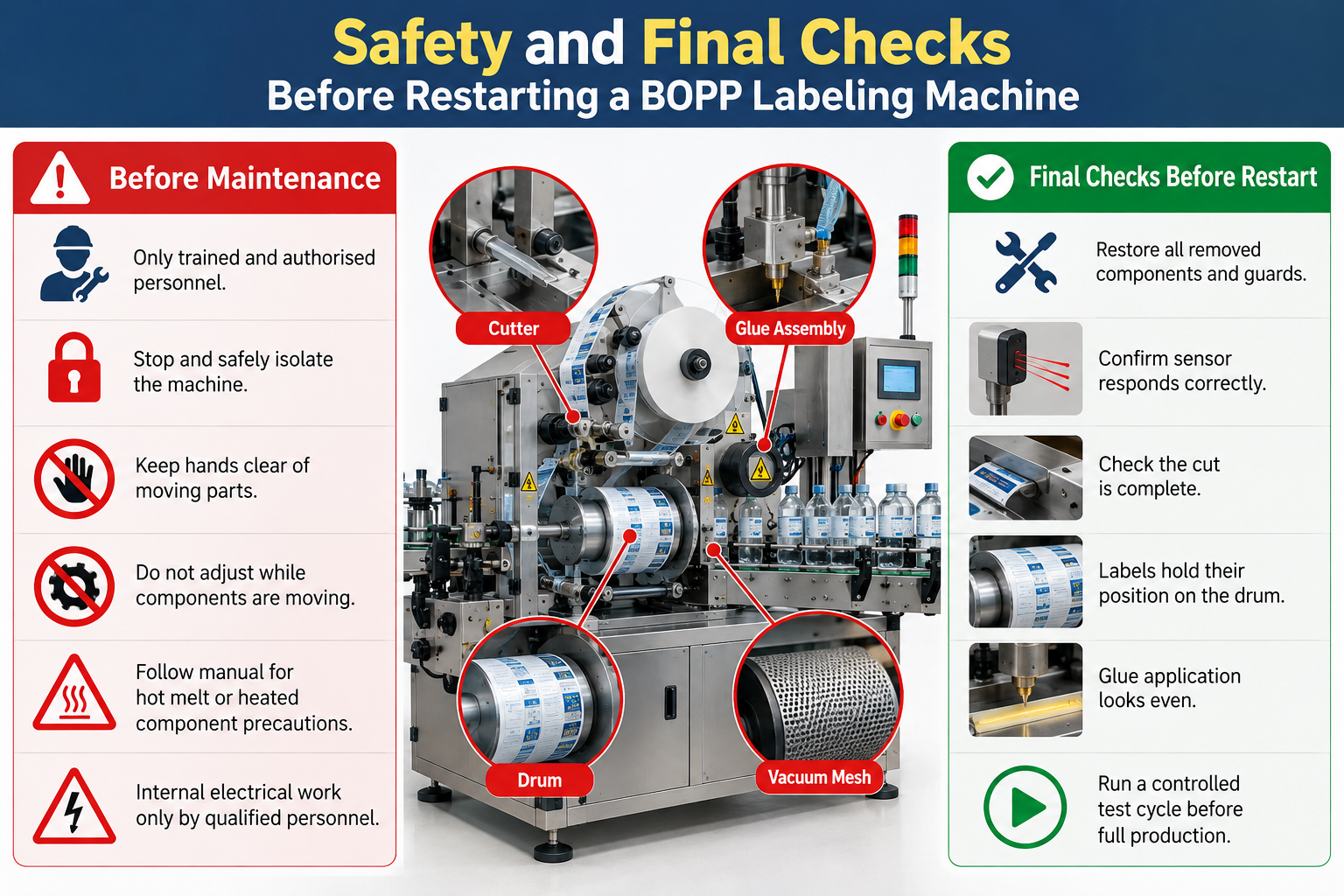
Maintenance should only be carried out by trained and authorised personnel. Stop and safely isolate the machine before accessing the cutter, drum, glue assembly, or vacuum mesh, keep hands clear of moving parts, and never attempt adjustment while components are still moving. Follow the machine manual for hot melt or heated component precautions, and reserve internal electrical work for qualified personnel.
Before resuming production, restore all removed components and guards, confirm the sensor responds correctly, the cut is complete, labels hold their position on the drum, and glue application looks even. Run a controlled test cycle before returning to full production.
 Email Us Today!
When to Contact DTPPL for BOPP Labeling Machine Technical Assistance
If cutting problems, uncertain alignment, vacuum loss, or poor glue application continue after these checks, bring in qualified support. As an established BOPP Labeling Machine Manufacturer, Dharmanandan Techno Project Pvt. Ltd. (DTPPL) also works as a bopp labeling machine supplier, supporting mineral water plants with technical assistance.
About Dharmanandan Techno Project Pvt. Ltd. (DTPPL)
Dharmanandan Techno Project Pvt. Ltd. (DTPPL) is a Surat, Gujarat based manufacturer of mineral water plants and related beverage packaging machinery, including Fully Automatic BOPP Labeling Machines for bottled water lines. The company’s range also covers RO and mineral water plants, bottle blow moulding machines, and filling and capping systems built to work together on one line. This background in building and supporting labeling systems is the basis for the maintenance points above.
Conclusion
Most labeling interruptions on a mineral water bottling line come down to a small setting drifting out of place rather than a major fault. Working through sensor response, cutter position, vacuum suction, and glue flow as part of a regular routine, rather than only after a problem appears, keeps rejects low and production running smoothly between scheduled servicing visits.
Frequently Asked Questions
Why does a BOPP labeling machine cut labels at the wrong position?
Usually because the eye mark sensor detects a different area instead of the eye mark, often since the mark is not distinguishable enough from the label colour, or because the roll is too tight or too loose.
How is the I-Mark sensor set on a BOPP labeling machine?
The sensor light is positioned over the eye mark, the ON button is held for two to three seconds, then the sensor is moved to a background area and the OFF button is pressed. The indicator should then blink each time the eye mark passes.
What should be checked when a BOPP labeling machine does not cut labels completely?
Check the main cutter positioning bolt first, and the separate alignment bolts if cutting is incomplete specifically at the top or bottom. If the issue continues, have qualified support from Dharmanandan Techno Project Pvt. Ltd. (DTPPL) review the alignment.
Why do labels slip on the vacuum drum of a BOPP labeling machine?
This is usually linked to inadequate vacuum, often from glue building up on the rubber section and entering the vacuum path. Daily cleaning of the rubber section and periodic mesh cleaning help prevent this.
How can insufficient or excessive glue application be checked in a BOPP labeling machine?
Insufficient transfer is often linked to the glue assembly position, while excessive application can relate to either the assembly position or the pump speed. Checking both separately helps identify the correct fix.
How can I request a bopp labeling machine price quotation from DTPPL?
Plant owners and buyers can contact Dharmanandan Techno Project Pvt. Ltd. (DTPPL) through the BOPP Labeling Machine Product page to request a bopp labeling machine price quotation suited to their plant’s capacity and requirements.
Our associates











































Director – Global Marketing and Sales
Mr. Bhavesh from Dharmanandan Techno Projects Pvt. Ltd. has played a pivotal role in elevating the DTPPL brand to the global stage, leveraging his exceptional expertise in marketing and communications. He is committed to helping clients achieve significant growth while strengthening their own brands. Dharmanandan Techno Projects Pvt. Ltd. is a leading manufacturer and supplier of water purification systems and turnkey solutions for mineral water plants. With years of experience in designing and delivering high-quality water treatment solutions, the company provides end-to-end services, including system design, installation, maintenance, and ongoing support. Specializing in scalable and customizable water plants, DTPPL has successfully served industries worldwide, ensuring clean and safe drinking water across diverse applications.