



Listening Article
Table of Contents
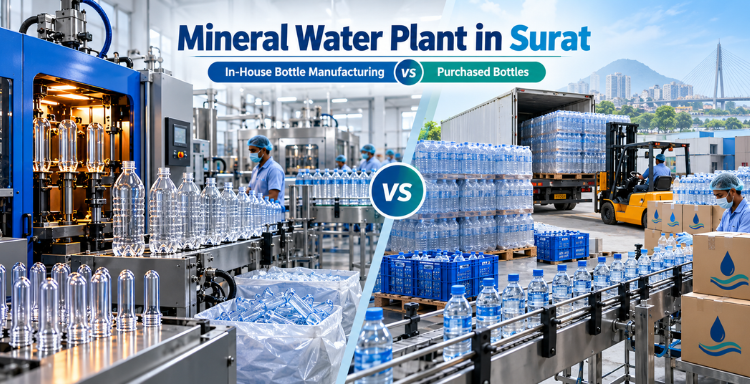
Mineral Water Plant in Surat: In-House Bottle Manufacturing vs Purchased Bottles
October 22, 2026
AI Summary
A Mineral Water Plant in Surat should evaluate bottle sourcing as part of its overall production and packaging strategy rather than as a standalone purchasing decision. This article compares PET bottle manufacturing for water plant operations with purchasing ready-made bottles, explaining how each approach influences investment, storage, production scheduling, utility requirements, supply chain planning and future expansion. It also discusses the role of blow moulding equipment, packaging line integration and operational flexibility, helping businesses assess which model best aligns with their production volume, infrastructure and long-term growth objectives.
Mineral Water Plant in Surat: Why Bottle Sourcing Matters
For a mineral water plant in Surat, bottle sourcing is a strategic production decision rather than only a packaging purchase. It affects investment requirements, space utilisation, storage needs and how smoothly the packaging line runs, alongside the more obvious choices around filling machines and RO systems.
Any water plant in Surat, whether an established bottler scaling up, a distributor moving into manufacturing, or a project planner evaluating a first setup, needs to assess bottle sourcing alongside production capacity, market demand and future growth plans, not as an afterthought.
Two approaches exist. The first is producing bottles internally using PET preforms converted into bottles through blow moulding equipment integrated with the plant. The second is procuring finished PET bottles from external vendors and feeding them directly into the filling line. Neither is inherently superior. The right fit depends on production volume, available space, utility infrastructure, labour planning and supply chain confidence. For businesses evaluating PET bottle manufacturing for water plants, the decision depends on production volume, available utilities, labour requirements, and future expansion plans.
 Call Us Now!
Understanding Bottle Supply Options for a Mineral Water Plant
Both approaches deliver the same outcome, a bottle ready for filling, but reach it differently. In house production starts with lightweight PET preforms heated and stretched into shape using blow moulding systems located within the plant. Purchased bottles arrive already formed and only need unpacking, inspection and movement to the filling station.
This is the core operational difference to understand before evaluating either model further. In house production adds a manufacturing step to the workflow. Purchasing ready bottles removes that step but shifts responsibility for consistent supply and quality onto external vendors. Bottle sourcing is therefore best evaluated during overall plant planning, not as a separate procurement decision made later.
| Factor | In House Bottle Manufacturing | Purchased Bottles |
| Initial investment | Higher | Lower |
| Storage requirement | Preforms and equipment space | Finished bottle storage |
| Supply control | Higher | Supplier dependent |
| Operational complexity | Higher | Lower |
| Best suited for | Stable, high volume plants | New or flexible operations |
PET Preforms and Ready Made Bottles for Water Plants
Preforms are compact and stackable, needing comparatively less space than finished bottles of the same count. They give the plant direct control over when and how many bottles are produced, scheduled to match filling requirements rather than external delivery timing.
Ready made bottles are immediately usable but occupy considerably more space per unit and are more prone to handling damage. Coordinating order quantities, lead times and delivery schedules with suppliers becomes an ongoing task. Neither format is automatically cheaper or more efficient. The right choice depends on site layout and how tightly production needs to be controlled.
In House Bottle Production and Blow Moulding Machine Requirements
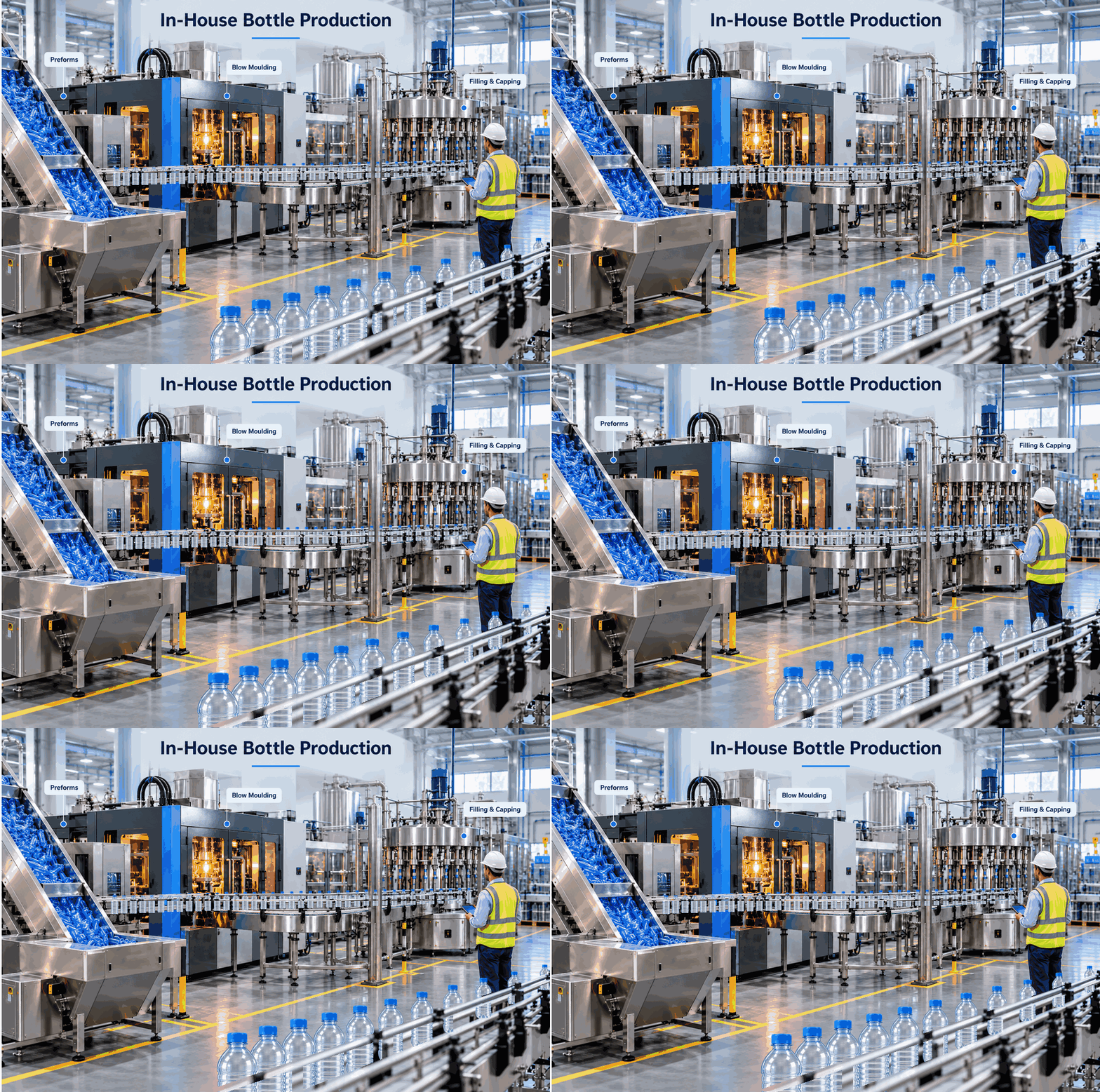
Internal bottle manufacturing requires blow moulding equipment sized to the plant’s bottling capacity and integrated into the packaging line, converting preforms into bottles just ahead of filling. The equipment sits alongside the filling and capping stages, so its output rate, footprint and placement within the plant need to be planned as part of the overall line layout rather than added on afterwards. This also means the plant takes on responsibility for a piece of production machinery that did not previously exist in its operations, with its own commissioning, calibration and ongoing operating requirements.
Businesses evaluating a blow moulding machine in Surat should consider equipment footprint, compressed air requirements, maintenance needs and integration with the filling line, rather than assuming cost savings without verified figures. This is dedicated machinery that adds to the plant’s utility load and requires trained operation, so it should be assessed on its own operational merits.
Purchasing Ready Made Bottles for a Water Bottling Plant
Businesses with lower or variable bottle consumption often find purchasing bottles simplifies operations, since there is no preform handling or blow moulding machinery to maintain on site.
The trade off is dependency on external suppliers for consistent, timely delivery, requiring active supplier management and backup arrangements. Transportation of bulkier, more fragile bottles also requires careful handling compared with preforms. This approach suits businesses prioritising operational simplicity or with fluctuating bottle needs.
 Email Us Today!
Bottle Size Variation and Manufacturing Flexibility
Bottle sourcing decisions also depend on how many bottle sizes or formats a plant produces, whether that is 200 ml, 500 ml, 1 litre, 2 litre bottles or jars. Businesses producing multiple sizes need to consider mould availability, changeover time between formats and how much production flexibility their sourcing model allows.
In house bottle manufacturing provides greater control over bottle formats, since new sizes can be added by investing in the corresponding mould, but each additional size adds to the mould investment and changeover planning required. Purchased bottles reduce this internal complexity, since the plant is not managing multiple moulds, but availability of specific sizes and designs then depends on what suppliers stock or are willing to produce, particularly for less common formats.
Investment Considerations: Bottle Manufacturing vs Purchased Bottles
When planning a new or expanded mineral water plant in Surat, businesses usually compare the investment pattern of both approaches.
In house production generally involves:
- Capital investment in blow moulding machinery
- Installation and commissioning cost for the new equipment
- Additional infrastructure, such as utility connections and floor space preparation, to house the machinery
Purchased bottles generally involve:
- No capital investment in bottle manufacturing machinery
- Lower upfront infrastructure requirement, since no blow moulding line needs to be installed
- Investment directed toward storage and receiving infrastructure for incoming bottles instead
These are directional patterns rather than fixed figures. Actual investment costs depend on equipment specification, capacity requirements and installation scope, and should be confirmed through a proper project evaluation rather than general assumptions.
Operating Cost Comparison: Manufacturing Bottles vs Buying Bottles
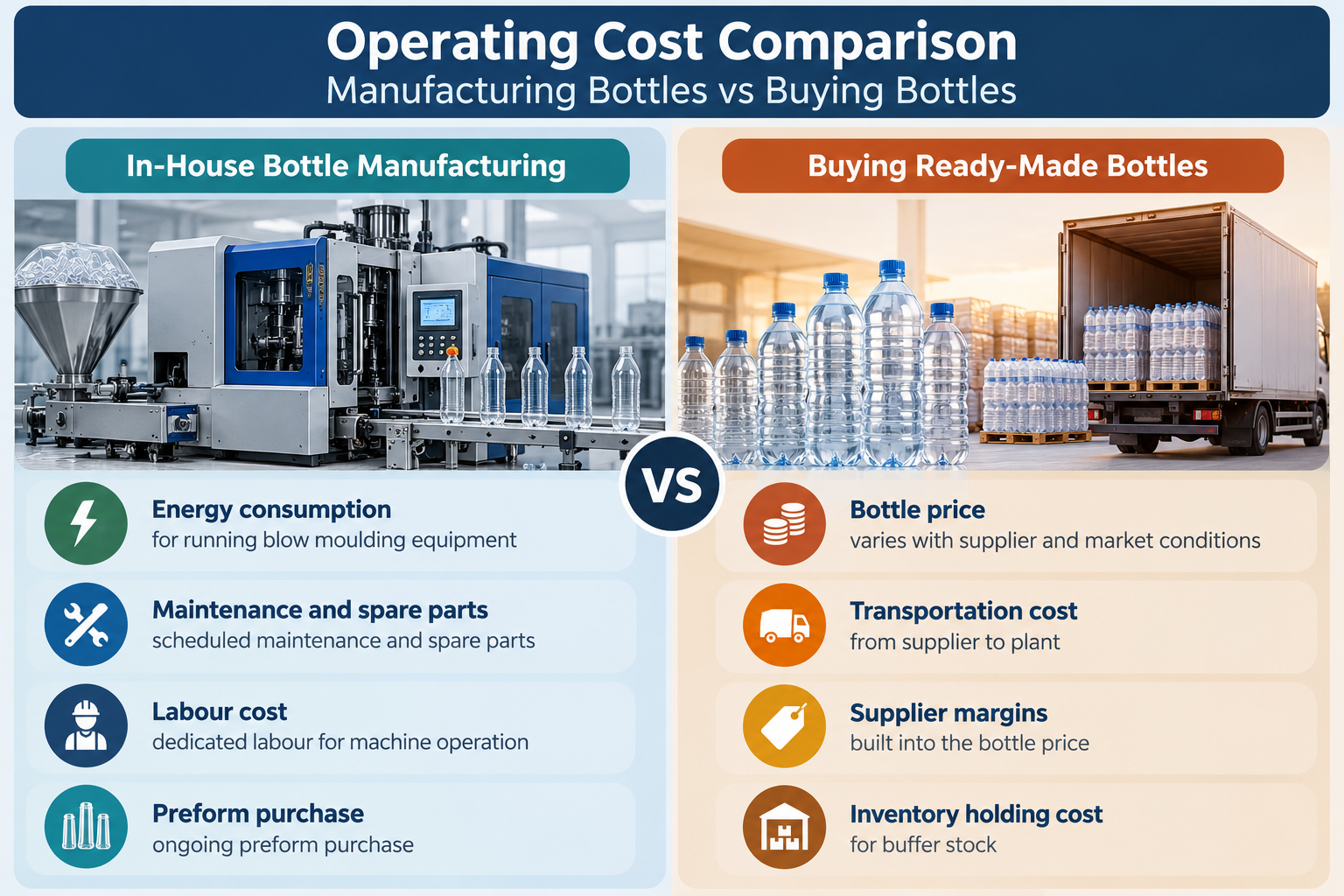
Beyond the initial investment, businesses also compare the ongoing cost pattern of each approach.
In house bottle manufacturing typically involves:
- Energy consumption for running blow moulding equipment
- Scheduled maintenance and spare parts
- Dedicated labour for machine operation
- Ongoing preform purchase
Purchasing ready made bottles typically involves:
- Bottle price, which can vary with supplier and market conditions
- Transportation cost from supplier to plant
- Supplier margins built into the bottle price
- Inventory holding cost for buffer stock
Neither pattern is automatically cheaper overall. In house manufacturing can reduce per bottle cost at high, consistent volumes once equipment is well utilised, while purchased bottles avoid machinery related running costs but carry ongoing procurement expense. The actual comparison depends on production volume, equipment utilisation and supplier pricing, and should be worked out for the specific plant rather than assumed in general terms.
Client Review
“DTPPL provides useful insights into mineral water plant planning, particularly when comparing in-house PET bottle manufacturing with purchasing ready-made bottles. Their guidance helps businesses understand equipment requirements, operating costs, storage needs, and production efficiency before making an investment decision.”
– Rudra Shah
Production Volume and In House Bottle Production Decisions
Deciding whether production volume supports in house manufacturing starts with a few calculation factors. Daily bottle requirements, the number of shifts the plant runs, expected equipment utilisation and projected growth over the next few years all feed into this assessment. A plant running close to full capacity across multiple shifts, with utilisation figures that justify the machinery investment, is in a different position from one running a single shift with spare capacity. Businesses should work through these numbers, rather than relying on general volume assumptions, before committing to bottle manufacturing equipment.
Production Scheduling and Packaging Line Control
Internal bottle production allows scheduling to be adjusted within the same facility in response to changes elsewhere in the plant, since bottle making and filling sit under one roof. Purchased bottles mean the packaging schedule is partly shaped by supplier delivery timing, managed through advance ordering and buffer stock rather than internal adjustment. This scheduling difference is separate from the equipment and investment questions covered earlier, and is worth weighing on its own when comparing day to day plant operations.
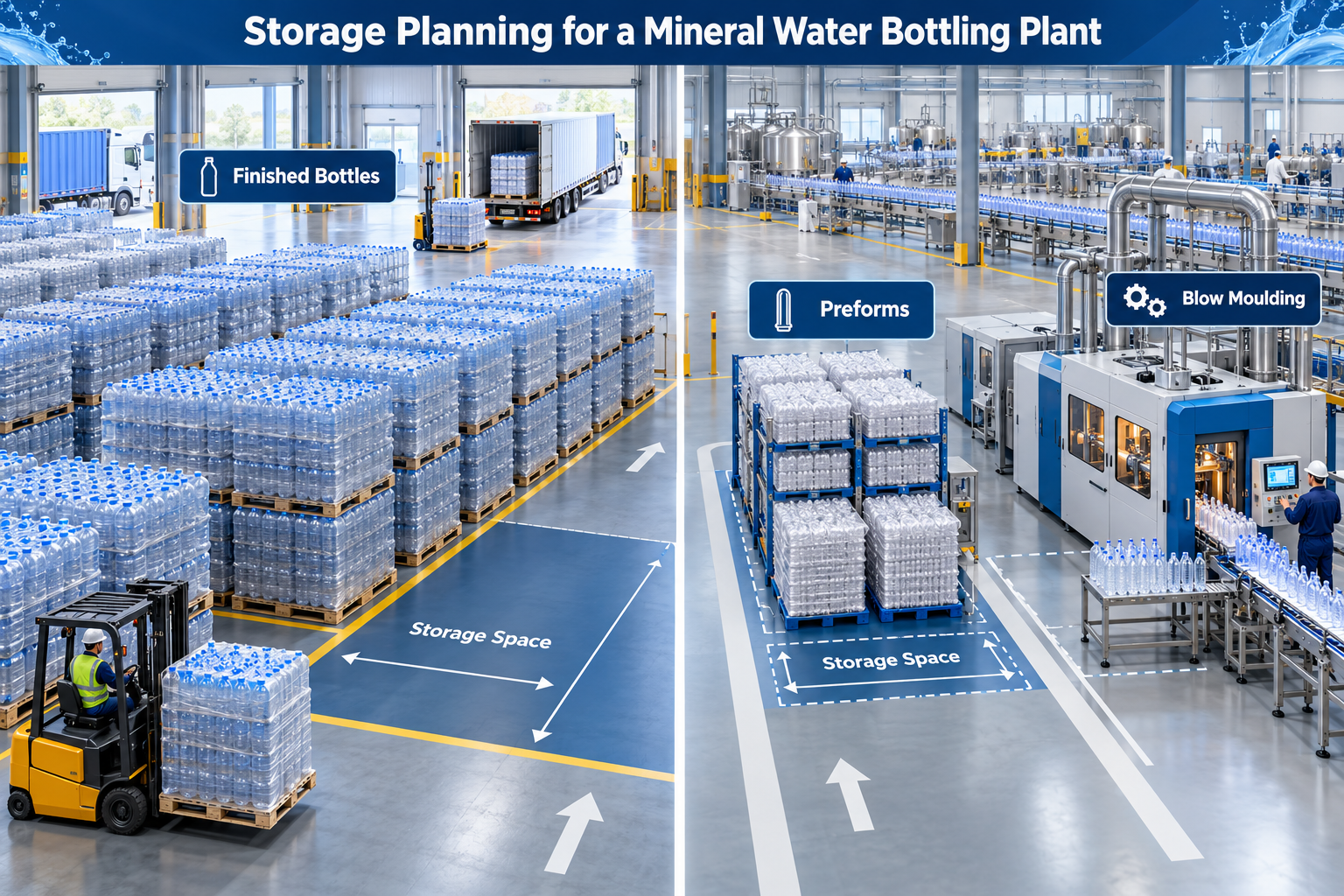
Storage Planning for a Mineral Water Bottling Plant
Storage is one of the more practical differences between the two models and deserves its own evaluation. Finished bottles require significantly more warehouse volume per unit than preforms, which stack compactly. This directly affects how much warehouse area a plant needs to set aside relative to its bottle volume. Plants purchasing bottles need adequate incoming stock space within the layout, while plants producing bottles in house need preform storage, equipment space and short term storage for freshly blown bottles instead. These requirements should be factored into plant layout at the design stage, since retrofitting storage later is more disruptive than planning for it upfront.
Transport and Supply Chain Planning for Bottle Sourcing
Transport planning is a separate concern from storage and centres on how reliably bottles or preforms reach the plant. Supplier distance affects delivery frequency and lead times, and purchased bottles, being bulkier and more damage prone than preforms, carry a higher risk of transit damage that needs to be factored into supplier agreements. In house production reduces finished bottle transport but still depends on regular preform deliveries, so supply reliability from the preform supplier becomes the equivalent consideration. Either way, businesses should evaluate delivery frequency, distance and damage risk as part of their overall supply chain planning, since disruptions at any stage affect the whole packaging schedule.
Bottle Quality and Mineral Water Packaging Line Consistency
Bottle consistency in wall thickness, neck finish and dimensions needs to align with filling and capping equipment to avoid line disruptions. With purchased bottles, quality depends on the supplier’s own control processes, making supplier selection and periodic checks important. With in house production, quality control sits within the plant’s own process, offering closer monitoring but placing responsibility on internal operations and maintenance. Either model needs quality checks built into the workflow.
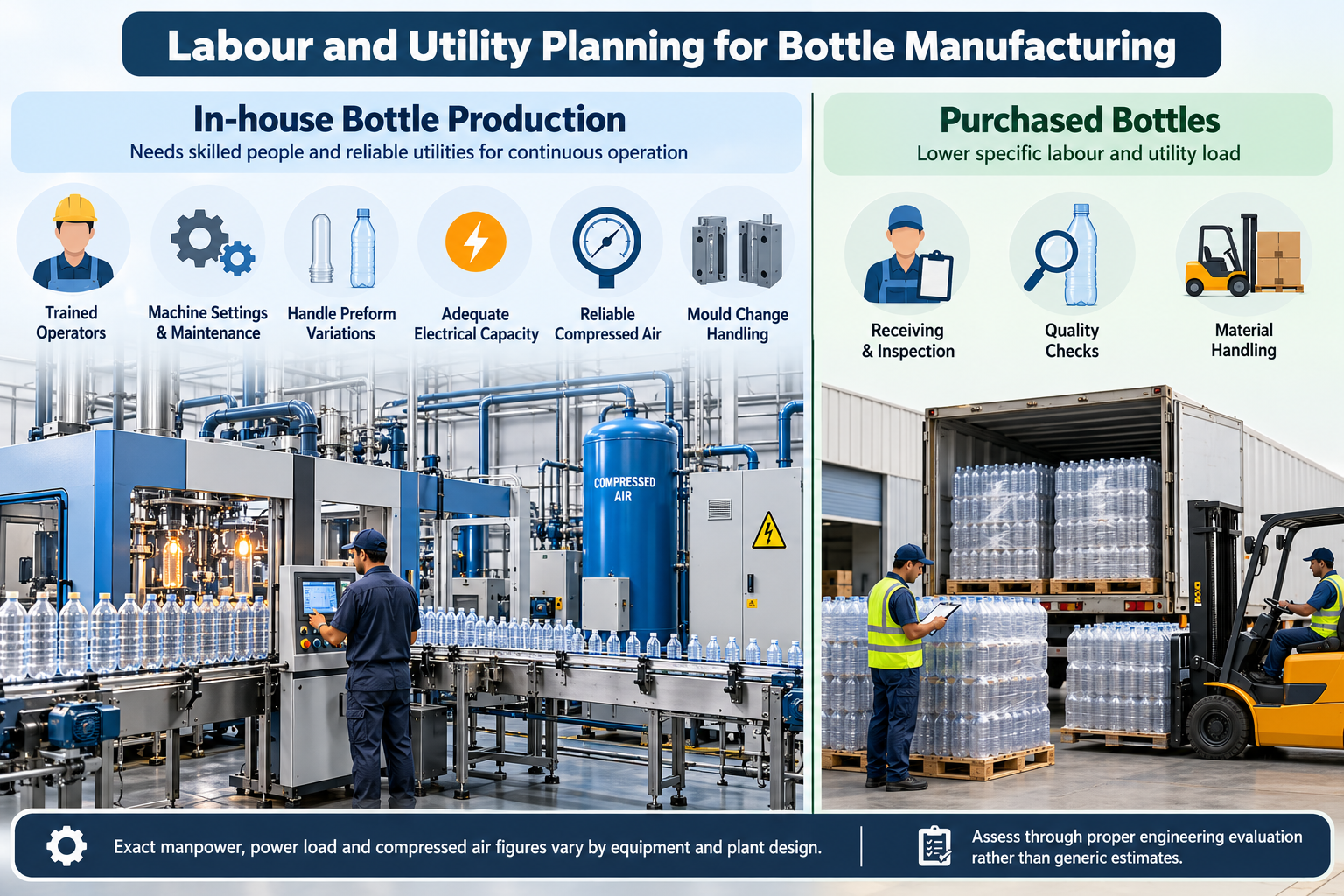
Labour and Utility Planning for Bottle Manufacturing
Blow moulding operations require reliable compressed air generation, adequate electrical capacity, mould change handling and trained operators to maintain consistent bottle quality. In house bottle production therefore needs personnel who understand machine settings, routine maintenance schedules and how to respond to variations in preform quality, along with utility infrastructure sized for continuous operation.
Purchased bottles reduce this specific labour and utility load, though staff are still needed for receiving, inspecting and moving incoming stock. Exact manpower, power load and compressed air figures vary by equipment and plant design and should be assessed through proper engineering evaluation rather than generic estimates.
Bottle Sourcing and Mineral Water Packaging Line Integration
Whichever model is chosen, it needs to align with the complete mineral water packaging line, from bottle arrival or production through filling, capping, labelling and packing. Bottle sourcing decisions should also be considered alongside water bottling plant machinery in Surat because bottle dimensions, conveyor design and filling speed must work together. A mismatch between bottle supply timing and filling line speed, whether from delayed deliveries or an undersized in house setup, creates bottlenecks. Planning bottle sourcing as part of the broader workflow helps avoid these mismatches as output scales.
Impact of Bottle Sourcing on Plant Expansion Plans
Bottle sourcing decisions made today also shape how easily a plant can expand later. A business planning to add another filling line, introduce new bottle sizes, or expand into new distribution areas needs bottle supply that can scale with those plans, whether that means a supplier who can handle higher volumes or blow moulding equipment with enough spare capacity to support growth. Businesses aiming to reduce dependency on external suppliers over time often treat in house bottle production as part of that longer term direction, even if they start with purchased bottles in the early stages. Factoring expansion plans into the bottle sourcing decision now can avoid a costly reconfiguration of the packaging line later.
Which Approach Fits Your Business
The table below summarises how business situations commonly align with each sourcing model. It is a starting reference point, not a fixed rule, since space, budget and supplier access vary by plant.
| Business Situation | Better Fit |
| New small plant | Purchased bottles |
| Stable high volume production | In house bottle production |
| Limited floor space | Purchased bottles |
| Expansion focused business | Blow moulding setup |
| Multiple bottle sizes or formats | Evaluate integrated production |
When In House Bottle Production Becomes Practical
In house production tends to become practical at a particular business stage rather than at a specific volume alone. An established brand with predictable, repeat demand is better placed to commit to dedicated equipment than a business still testing market response. Companies supplying multiple markets or regions often value the supply control that internal production offers, since it reduces reliance on any single external vendor. This decision should rest on demonstrated business maturity, meaning confirmed, repeat demand rather than projected or hoped for growth.
When Purchased Bottles Suit a Water Bottling Plant
Purchased bottles suit businesses that prefer to keep operations simple, without taking on the added machinery, moulds and maintenance that in house production involves. This model gives newer or smaller operations a way to enter the market without committing capital to blow moulding equipment before demand is proven, letting internal resources stay focused on filling, quality control and market development instead of bottle production. The option to move toward in house production later remains open once volume and consistency justify it.
How Dharmanandan Techno Project Pvt. Ltd. Supports Plant Planning
Dharmanandan Techno Project Pvt. Ltd. supports businesses planning a mineral water plant in Surat through turnkey plant design, machinery selection and packaging line integration, working as a manufacturer and turnkey beverage plant provider. This includes helping businesses evaluate complete turnkey mineral water plant solutions, covering PET bottle blowing integration, filling line selection, water treatment systems and plant layout planning based on production requirements.
Support also extends to packaging line considerations, technical discussions, documentation requirements and installation and commissioning planning. Rather than positioning one bottle sourcing approach as default, this support is intended to help businesses weigh their own production volume, space, utility and supply chain factors before finalising plant configuration.
Choosing the Right Bottle Sourcing Model for a Mineral Water Plant
The decision comes down to weighing the factors covered above together, rather than any single one in isolation, using the comparison table and decision framework as a starting reference for where a mineral water plant in Surat currently stands.
Long term scalability matters as much as the immediate choice. A plant that expects to add filling lines, introduce new bottle formats or expand distribution should treat bottle sourcing as part of its packaging line design from the outset, since retrofitting bottle manufacturing or renegotiating supplier capacity later is more disruptive than planning for it now. Dharmanandan Techno Project Pvt. Ltd. supports businesses in working through these considerations as part of broader plant configuration and packaging planning. For businesses evaluating their mineral water plant requirements, packaging solutions, bottling line planning or project considerations, a detailed discussion of current needs and future plans is a practical starting point.
Frequently Asked Questions on Bottle Sourcing for Water Plants
Is in house bottle manufacturing better for every mineral water plant?
No. It suits businesses that have already established predictable bottle demand and can justify dedicated equipment. Plants with lower or variable demand may find purchased bottles more practical.
What factors should businesses evaluate before installing bottle blowing equipment?
Current and projected bottle consumption, available floor space, utility infrastructure, staffing capacity, and how the equipment will integrate with the existing filling line.
When is purchasing ready made bottles a practical option?
When space is limited, production needs vary, or a business wants to reduce internal operational complexity while keeping flexibility in its packaging line.
How does bottle production affect mineral water packaging line planning?
Bottle sourcing timing directly affects filling line scheduling. Whether bottles are produced internally or delivered externally, the packaging line needs to be planned so bottle supply keeps pace with filling and packing operations.
Should expanding water plants consider PET preform processing?
Expanding plants with growing, predictable demand may find PET preform processing worth evaluating, particularly if supply control and scheduling flexibility become more important as volume grows.
Is a blow moulding machine required for every mineral water plant?
No. Plants can operate using purchased bottles. Blow moulding becomes practical when volume, supply control and long term production plans justify internal manufacturing.
What is the advantage of PET bottle manufacturing for a water plant?
It provides better control over bottle availability, production scheduling and packaging integration, especially for plants operating at consistent volumes.
Does in house bottle manufacturing reduce the cost of bottled water production?
Not always. In house production can improve control and reduce dependence on suppliers at higher volumes, but it also adds machinery investment, utilities, maintenance and labour costs. The financial advantage depends on production volume and equipment utilisation.
Can a mineral water plant start with purchased bottles and add bottle manufacturing later?
Yes. Many businesses start with purchased bottles to validate demand and later install blow moulding equipment once production volume becomes stable enough to justify internal bottle manufacturing.
How much production capacity justifies in house bottle manufacturing?
There is no fixed capacity threshold, since the decision depends on bottle consumption, equipment utilisation, labour availability and supplier costs. However, plants with consistent, high volume production generally have stronger reasons to evaluate internal bottle manufacturing.
Our associates







































Director – Global Marketing and Sales
Mr. Bhavesh from Dharmanandan Techno Projects Pvt. Ltd. has played a pivotal role in elevating the DTPPL brand to the global stage, leveraging his exceptional expertise in marketing and communications. He is committed to helping clients achieve significant growth while strengthening their own brands. Dharmanandan Techno Projects Pvt. Ltd. is a leading manufacturer and supplier of water purification systems and turnkey solutions for mineral water plants. With years of experience in designing and delivering high-quality water treatment solutions, the company provides end-to-end services, including system design, installation, maintenance, and ongoing support. Specializing in scalable and customizable water plants, DTPPL has successfully served industries worldwide, ensuring clean and safe drinking water across diverse applications.