




Listening Article
Table of Contents
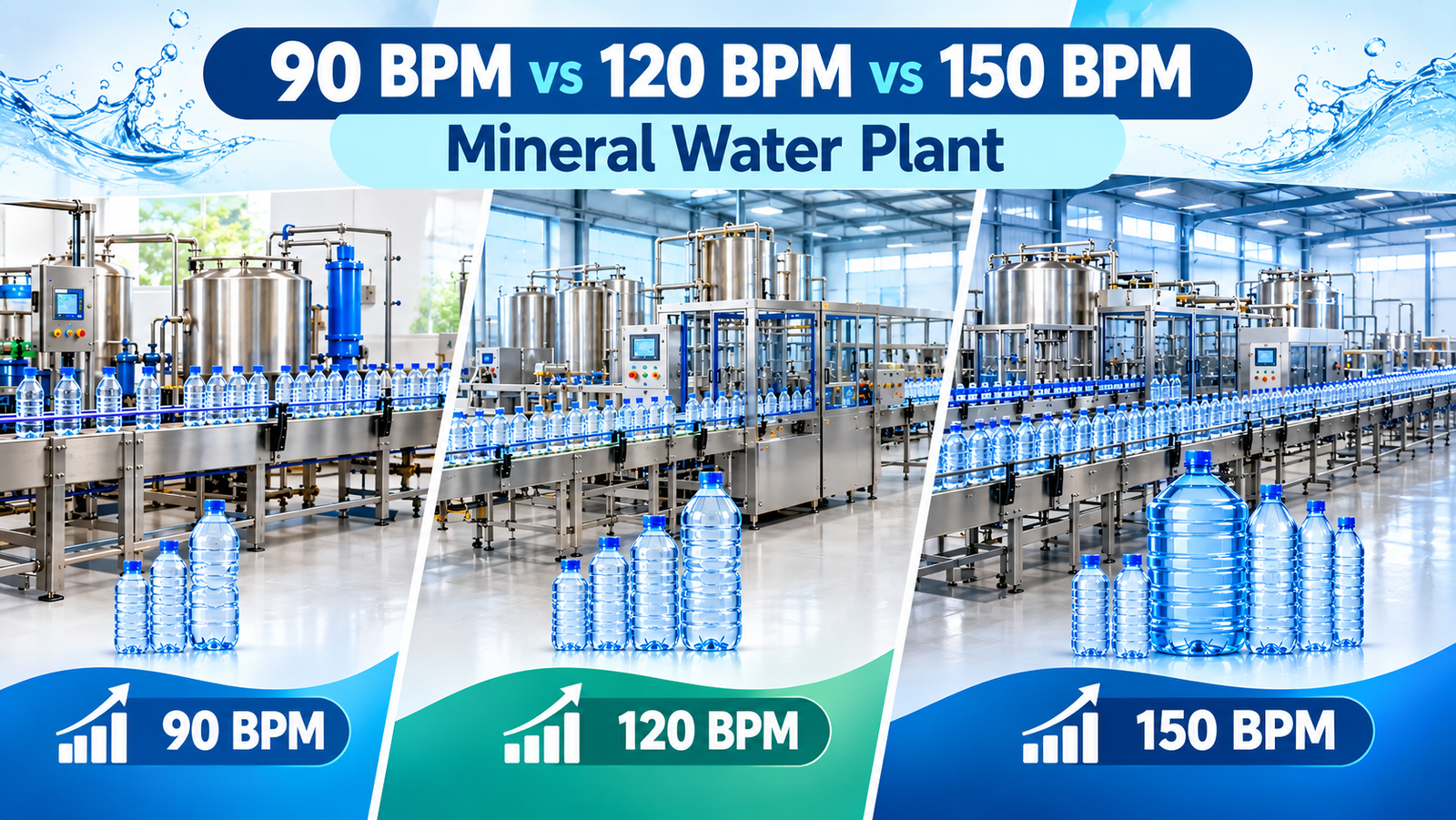
90 BPM vs 120 BPM vs 150 BPM Mineral Water Plant: Which Capacity Fits Your Market?
October 19, 2026
AI Summary
90 BPM, 120 BPM, and 150 BPM mineral water plants serve different stages of operational maturity, based on verified orders, dealer network strength and production readiness rather than machine speed alone. The comparison below covers differentiated buyer profiles for each capacity, market reach, supply coverage challenges, mineral water equipment needs, mineral water plant cost, and the financial impact of picking the wrong size. Dharmanandan Techno Project Pvt. Ltd. supports buyers in matching their commercial readiness to the right plant capacity before committing to a project.
Understanding Mineral Water Plant Capacity Selection
Choosing a plant capacity is one of the biggest decisions a packaged drinking water business will make. Buy too small, and the business keeps turning away orders. Buy too large, and the business carries idle equipment, extra staff, and financing costs that current sales cannot yet justify. The decision also goes beyond production speed, because capacity affects the choice of bottling line configuration, supporting mineral water equipment, automation level and the overall investment required for the project.
The decision becomes sharper once a business is already running a plant and is looking at its next move. Among the capacities most commonly compared at this stage are 90 BPM, 120 BPM and 150 BPM, three tiers that sit close together on paper but represent different stages of operational maturity. A 120 BPM Mineral Water Plant is not simply a faster version of a 90 BPM plant. It usually reflects a shift from serving a district well to building a brand trusted across a wider region, with a different packaging machine specification, mineral water machine cost and management structure behind it.
What follows compares these three capacities on business terms rather than machine speed, covering the 90 BPM vs 120 BPM water plant decision, the 120 BPM vs 150 BPM mineral water plant decision, and the broader bottling plant capacity comparison buyers work through before committing capital. The aim is practical mineral water plant capacity selection guidance, not a case for buying bigger. A sound decision rests on a few honest questions: what does confirmed order volume look like today, how consistent has purchase history been across the year, what does operational maturity look like two to three years out, how strong is the current dealer network, and what does the investment plan comfortably allow without straining cash flow. Capacity should follow the business plan, not lead it.
 Call Now !
Buyer Profile for a 90 BPM Mineral Water Plant
A 90 BPM plant is rarely a first purchase. It is more often chosen by a business with a smaller line already running near its limit during peak season, but not yet ready for the scale of organisation a larger plant demands. This capacity tends to suit operators whose existing plant struggles to keep pace with seasonal demand, businesses expanding supply across several districts at once, and buyers who already have institutional or contract orders lined up rather than orders they merely hope to win later.
What differentiates a 90 BPM buyer from a smaller operator is less about the machine and more about the surrounding systems. SKU count typically grows at this stage, since a business serving several districts often needs more than one bottle size to satisfy different retail counters and price points. Distributor onboarding becomes a real skill rather than an informal handshake, since the business is usually appointing its first proper set of dealers outside its home territory. Seasonal production balancing also becomes a discipline of its own, since a 90 BPM line has enough headroom to build stock ahead of summer, but only if that planning is deliberate rather than reactive. Warehouse size needs a fresh look too, since finished goods and packaging materials both grow with SKU count, and a shed sized for a smaller line quickly becomes the bottleneck instead of the bottling equipment.
At this stage, the business usually needs a properly structured team with real supervision, and running two shifts starts to make financial sense. It is a capacity built for proven demand rather than early-stage ambition, and a business without that track record may find the step up harder to justify than it first appears.
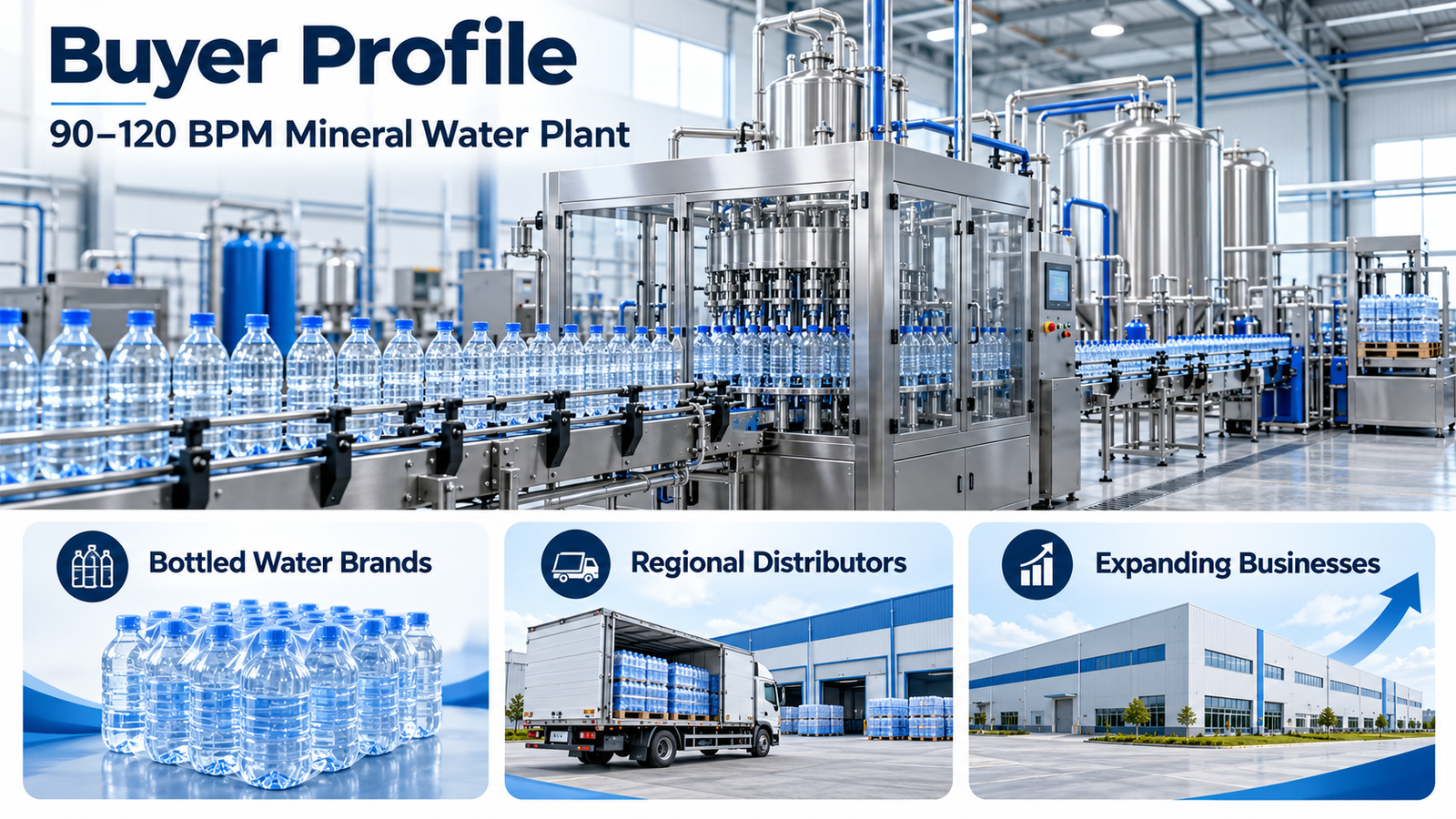
Buyer Profile for a 120 BPM Mineral Water Plant
At 120 BPM, the business generally stops behaving like a growing local operation and starts behaving like a regional brand. Two types of buyers commonly reach this point: the operator who has built genuine strength across several districts and is ready to compete at a state level, and the well capitalised entrant, often a business family diversifying into water, intending to start at brand scale rather than build up to it gradually.
The operational shift here is different from the one at 90 BPM, and it centres on planning discipline rather than territory. Production scheduling moves from an owner’s memory into an actual system, since a 120 BPM line producing multiple SKUs across multiple shifts cannot run efficiently on verbal instructions alone. Quality control documentation becomes a daily habit rather than an occasional test, partly because organised retail and modern trade buyers expect to see records, not just finished bottles. Shift planning turns into a genuine management function, covering staffing, handovers and accountability across day and night operations. Maintenance scheduling also has to move from reactive repair to a preventive calendar, since unplanned downtime on a line this size affects far more orders than it would on a smaller plant.
Reaching this stage brings noticeable changes to how the business operates more broadly. Departments start to separate properly, with production, quality, maintenance, stores and dispatch each needing their own structure. A dedicated sales function becomes necessary, warehousing has to be planned as part of the overall strategy, and the owner’s own role shifts toward brand, channel and direction rather than daily production. This is also the point where organised retail and modern trade chains become realistic partners, since they generally expect suppliers who can guarantee consistent replenishment, a conversation that rarely progresses far at smaller scale.
Read Our Article
Buyer Profile for a 150 BPM Mineral Water Plant
A 150 BPM plant typically suits businesses chasing larger, contract-based volumes such as institutional supply, corporate accounts or government tenders. These orders come with strict terms and penalties attached, so the business taking them on needs both production flexibility and compliance depth to deliver reliably. Buyers who consider this capacity often include established regional brands actively pursuing tender or institutional business, family businesses professionalising an existing operation, and entrepreneurs from related industries entering the water business with contract relationships already in place.
The demands at this tier go well beyond what a 120 BPM operation typically needs. An ERP system, or at minimum a structured production and inventory tracking process, generally becomes necessary once multiple SKUs, multiple shifts, and large institutional orders are all running through the same facility. Tender documentation turns into a specialised, ongoing task, since government and corporate buyers usually require detailed technical submissions, compliance certificates and renewal paperwork repeatedly. Preventive maintenance moves from a scheduling habit to a formal programme with logged records, because institutional clients often audit supplier reliability before renewing contracts. Audit readiness becomes a constant state rather than a periodic exercise, covering everything from batch traceability to staff hygiene protocols. Backup utilities, including standby power and redundant water treatment capacity, also become a serious consideration, since a large tender contract rarely tolerates a missed delivery caused by a power cut or a single point of equipment failure.
At this scale, a single large contract no longer has to come at the cost of regular retail supply, provided production scheduling and cash flow are managed with discipline. The decision here should be based on business opportunities the buyer can already point to, not on projected growth that has not yet materialised.
90 BPM vs 120 BPM vs 150 BPM Market Reach Comparison
These three capacities generally support different stages of geographic reach. The table below is planning guidance, not a fixed rule for every market.
| Capacity | Typical Market Reach | Operational Maturity |
| 90 BPM | Multiple districts, with a mix of retail and early institutional orders | Growth transition from a smaller plant |
| 120 BPM | State level presence, including organised retail and modern trade | Regional brand building |
| 150 BPM | Institutional, tender and corporate supply alongside retail | Contract driven, professionalised operation |
Actual reach still depends on dealer network strength, local competition and supply consistency, not on capacity figures alone. The profiles above explain who each capacity suits; the table below summarises how the buyer, the main challenge and the management need shift from one tier to the next.
| Factor | 90 BPM | 120 BPM | 150 BPM |
| Primary Buyer | Growing regional operator | Established regional brand | Large institutional supplier |
| Main Challenge | Dealer expansion | Process management | Contract fulfilment |
| Management Need | Supervisors | Department structure | Professional operations |
| Best Growth Driver | Retail and districts | Regional distribution | Institutional contracts |
OUR OTHER PRODUCT
Supply Coverage Challenges as Mineral Water Plant Capacity Grows
Production capacity and supply coverage need to grow together. A plant that can produce far more than the current dealer network can move simply creates idle stock rather than stock reaching customers, and this is often where a business finds the real ceiling on its growth is not the bottling line at all.
A few challenges tend to repeat as capacity rises. Servicing consistency gets harder to maintain once a business is covering more districts or a full state, since customers expect the same fill rate whether they are the first stop on a route or the last. Logistics network planning becomes more technical, involving route optimisation and vehicle scheduling rather than ad hoc deliveries. Channel conflict is also worth watching, since a business selling directly to some customers while appointing dealers for others needs clear territory rules to avoid undercutting its own network. Institutional and modern retail buyers add a further layer, since they generally will not sign a supplier who cannot guarantee replenishment on a fixed schedule, and that guarantee depends on how well production and supply coverage are synchronised, not on production capacity in isolation.
Mineral Water Equipment, Workforce and Automation Planning
As capacity increases, staffing, management and the equipment on the line tend to change meaningfully. Smaller operations are often run closely by the owner with simpler machinery, while larger operations need dedicated supervision, defined roles and a greater degree of automation on the mineral water packaging machine and treatment systems. Areas worth planning for include how production supervision is structured as output grows, whether preventive maintenance needs a dedicated function, and how automation affects consistency and cost per bottle. Exact manpower numbers and automation specifications vary by site and should be confirmed through proper engineering assessment rather than general assumptions.
Client Review
“We were looking for a mineral water plant with the right balance of production capacity and automation. DTPPL clearly explained the available options and helped us select the right equipment for our project.”
– Leela Rawat
Mineral Water Plant Cost and Mineral Water Machine Cost by Capacity
Mineral water plant cost generally increases with higher production capacity, although automation level, equipment configuration, utilities and project requirements also influence the final investment, so buyers comparing 90 BPM, 120 BPM and 150 BPM options should budget accordingly rather than anchoring to a single figure. On DTPPL’s published pricing, a fully automatic mineral water plant, covering the packaging machine along with water treatment systems and finishing equipment, is generally priced from around Rs 18 lakh to Rs 45 lakh depending on automation level and output, and total turnkey project cost, once land, construction, utilities and licensing are added, typically ranges from Rs 41 lakh to Rs 1 crore. Larger installations up to 50,000 LPH can carry mineral water plant cost well beyond this range. The exact mineral water machine cost for a specific 90 BPM, 120 BPM or 150 BPM configuration depends on automation level, bottle size and site conditions, and should be confirmed directly with the manufacturer rather than assumed from a general range.
Financial Impact of Choosing the Wrong Mineral Water Plant Capacity
Capacity choices ultimately show up as one thing: the financial health of the business, and it helps to look at production utilisation, working capital, inventory and cash flow together rather than as separate topics.
Production utilisation is the first signal. A plant comfortably running below its limit for most of the year may not yet justify added capacity, while one regularly stretched during peak months and losing orders is a stronger case for moving up a tier. Working capital needs to expand alongside whatever capacity is chosen, and the items involved are specific rather than abstract. PET preform inventory, cap inventory, labels and shrink film all need to be stocked in larger volumes as line speed increases, since running short on any one of them stops the whole line regardless of how well everything else is planned. Finished goods stock also grows, particularly for a business carrying multiple SKUs or building up supply ahead of a seasonal peak.
Dealer credit periods matter just as much, since a business extending 30 or 45 days of credit to its network needs a larger cash buffer to keep operating smoothly while waiting to get paid. Diesel, logistics and electricity costs rise with both production volume and delivery distance, and these recurring costs are easy to underestimate when a buyer is focused mainly on the upfront machine price.
Choosing capacity beyond what confirmed orders and dealer network strength can support tends to create more pressure than opportunity. The consequences are consistent across cases: equipment running well below its potential output, higher fixed operating costs without matching revenue, working capital tied up in a larger operation than current sales justify, and coverage limitations that keep the extra output from reaching the market at all. Balanced capacity planning, matched closely to established sales volume rather than hoped-for growth, supports steadier and more sustainable expansion than capacity chosen on assumption alone.
When to Move From 90 BPM to 120 BPM or 150 BPM
Moving from one capacity to the next should be based on evidence, not optimism. A few signals tend to indicate that expansion is genuinely due: production is consistently running near its limit and not just during short peaks, recurring customer orders are growing steadily rather than occasionally, dealer network coverage has already expanded to match higher output, and the business has a long-term plan that the next capacity actually supports. When these signals are present together, an upgrade decision is on solid ground. When they are not, waiting is usually the safer choice, since capacity added ahead of confirmed demand tends to sit idle rather than accelerate growth.
How Dharmanandan Techno Project Pvt. Ltd. Helps Buyers Select the Right Plant Capacity
Dharmanandan Techno Project Pvt. Ltd. is a manufacturer and provider of turnkey beverage plant solutions, supporting buyers in understanding their technical requirements and in identifying a plant configuration and treatment setup suited to their actual operational maturity. The company assists buyers with capacity evaluation, feasibility studies, plant layout planning, equipment selection, automation decisions, and installation and commissioning support. Buyers evaluating a 90 BPM, 120 BPM or 150 BPM Mineral Water Plant can work with the DTPPL team to select a configuration aligned with their market requirements, production goals and expansion plans.
 Email Us Today!
Quick Decision Guide: Which Capacity Should You Choose?
| Business Situation | Recommended Capacity |
| Expanding from district level supply | 90 BPM |
| Building a regional brand | 120 BPM |
| Targeting institutional contracts | 150 BPM |
Conclusion: Choosing the Right Mineral Water Plant Capacity
A 90 BPM plant supports expanding district operations, a 120 BPM Mineral Water Plant suits businesses building reliable regional supply, while a 150 BPM installation is justified when institutional contracts and large volume commitments already exist. The right capacity is the one that current orders, infrastructure and financial resources can sustain profitably over the coming years.
Businesses planning a 90 BPM, 120 BPM or 150 BPM Mineral Water Plant should evaluate their current sales network, production requirements and future expansion plans before finalising equipment selection. Consulting with an experienced turnkey manufacturer can help determine the capacity that delivers sustainable growth without unnecessary investment pressure.
Frequently Asked Questions
Can a 90 BPM, 120 BPM or 150 BPM plant run more than one bottle size?
Yes, though production scheduling needs to stay disciplined as SKU count rises. Multiple pack sizes become easier to manage once the operation has dedicated planning and quality functions in place, which generally happens from 120 BPM upward.
Do licensing requirements change with plant capacity?
Core approvals such as BIS certification and FSSAI licensing are important considerations for packaged drinking water businesses, regardless of plant capacity. However, additional documentation requirements may depend on the project scope, location and customer segment.
Can a second shift substitute for upgrading to a higher BPM plant?
It can extend a plant’s output without new capital, but only if the dealer network can absorb the extra volume. A second shift buys time, it does not replace the automation and compliance depth needed for large tender or institutional supply.
Is a semi-automatic setup a realistic starting point before 90 BPM?
Yes, some businesses use a semi-automatic line to prove demand and build distribution before committing to a fully automatic plant. The move works best when it is planned for in advance rather than treated as a stopgap.
Does higher BPM always mean higher profitability?
No. Profitability depends on whether utilisation, distribution and working capital keep pace with the added output, not on production speed alone.
What factors should be considered before selecting a mineral water plant capacity?
Businesses should evaluate current sales volume, future market expansion, dealer network capability, available working capital, automation requirements and expected production utilisation before finalising plant capacity. The right capacity should support growth without creating unnecessary idle production.
Our associates









































Director – Global Marketing and Sales
Mr. Bhavesh from Dharmanandan Techno Projects Pvt. Ltd. has played a pivotal role in elevating the DTPPL brand to the global stage, leveraging his exceptional expertise in marketing and communications. He is committed to helping clients achieve significant growth while strengthening their own brands. Dharmanandan Techno Projects Pvt. Ltd. is a leading manufacturer and supplier of water purification systems and turnkey solutions for mineral water plants. With years of experience in designing and delivering high-quality water treatment solutions, the company provides end-to-end services, including system design, installation, maintenance, and ongoing support. Specializing in scalable and customizable water plants, DTPPL has successfully served industries worldwide, ensuring clean and safe drinking water across diverse applications.