




Listening Article
Table of Contents
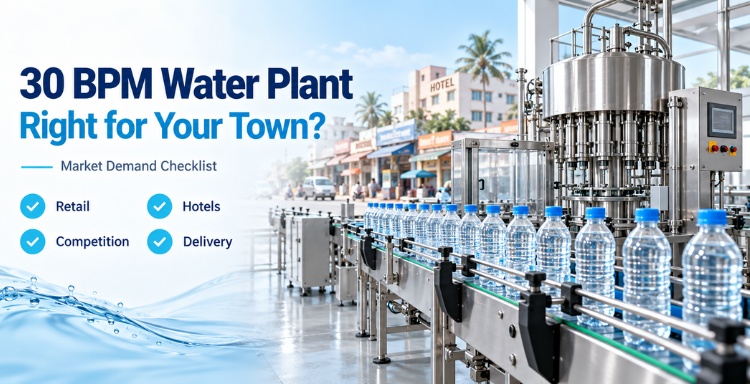
Is a 30 BPM Mineral Water Plant Right for Your Town? A Market Demand Checklist
October 5, 2026
A 30 BPM mineral water plant for small business is usually the first serious step into packaged drinking water, and it works best once local demand is confirmed rather than assumed. BPM stands for bottles per minute, describing the rated filling speed of the machine, not a guaranteed sales figure. This article walks through a practical water plant demand analysis to run in your own town before finalising a water bottling plant for startup, covering retail reach, hospitality and institutional buyers, competitors and delivery planning.
AI Summary
A 30 BPM line is usually enough if your town shows steady retail counter turnover, at least one dependable hospitality or institutional account, and a delivery radius your team can service consistently. Hold off on a higher capacity plant until repeat orders, not one time distributor stock, show that sales volume has outgrown what this configuration and your current distribution set-up can comfortably handle. A local packaged water business that grows this way, built one town at a time, scales on solid ground rather than guesswork.
Population and Demand Assessment for a Small Town Mineral Water Plant
Every small town mineral water plant project should begin with a realistic read of the local population and its water buying habits, since this is fundamentally a demographics question. A large population does not automatically translate into local consumption, so this step needs more than a headcount.
Points worth studying include:
- Local population and household density in the area you intend to serve
- Whether municipal or borewell water is generally trusted, or households already buy packaged water
- How much packaged water is currently available through existing suppliers
- Markets, industrial areas, transport hubs or other zones with steady footfall
- General purchasing behaviour, such as preference for bottles, jars or pouches
A mineral water business in small town settings often depends more on local trust in water quality than on population size alone, so two towns of similar size can show very different consumption patterns depending on water quality, income levels and existing habits.
 Call Now
Retail Counter Survey for a Local Packaged Water Business
Once you have a broad sense of the town, visit the retail counters that would actually stock and sell your product. The focus here is shelf turnover rather than general impressions, since how quickly stock moves off a shelf tells you far more than footfall alone.
Useful stops for this survey include:
- Grocery stores and kirana shops
- Supermarkets or larger general stores
- Small retailers near transport stands, markets and residential clusters
- High footfall locations such as near schools, colleges or bus stands
Conversations with shopkeepers can reveal how fast existing packaged water brands move off the shelf, how often they need restocking, what price points customers accept, and whether retailers feel underserved by current suppliers. This shelf-level feedback is more useful at this stage than a general market estimate.

Hospitality Demand for a Water Bottling Plant for Startup
Hotels, restaurants, banquet halls, and caterers form a separate customer segment defined by bulk consumption cycles rather than single unit sales. Their ordering rhythm looks very different from a retail counter, so it needs its own read.
Consider how regular daily or weekly bulk consumption compares with event-driven spikes for functions and weddings, whether the town sees seasonal upswings from tourism, festivals or local fairs, how predictable order volumes are across the year, and what delivery timing these customers expect. A single hotel or caterer with a steady bulk order can support a meaningful share of early production, which is why this segment deserves its own evaluation rather than being folded into general retail research.
Institutional Demand in a Mineral Water Business in a Small Town
Institutions such as offices, schools, hospitals and local organisations buy differently again, and the deciding factor here is usually the contract rather than shelf appeal or bulk timing. Requirements are typically driven by staff strength or visitor footfall, but the purchase itself often runs through a tender, annual agreement or a designated procurement contact rather than a walk-in decision.
Understanding whether an institution already has a fixed supplier, works through an open tender, or negotiates a fresh agreement each year helps you judge how realistic it is to win that account, and how differently it should be priced compared with retail or hospitality customers.
Client Review
“Before investing, our biggest concern was whether our town had enough consistent volume to sustain daily operations. This checklist gave us clear benchmarks to evaluate local banquet halls, hotels, and retail shops. It prevented us from either undersizing or over-investing, making a 30 BPM semi-automatic plant the exact right fit for our launch phase.”
– Rahul Vaidya
Competitor Mapping and Water Plant Demand Analysis
Before investing in a mineral water plant, it helps to understand who is already serving your target area and how, without comparing brands. Look beyond how many suppliers are active, and study finer details such as:
- Delivery frequency and reliability
- Bottle sizes and formats commonly available
- Incentives or credit terms offered to retailers
- Refill or empty jar collection systems in use
- Exclusive supply arrangements with certain shops or institutions
Mapping these details often reveals whether there is room for a new entrant, whether the opportunity lies in a specific format or service gap, or whether certain pockets of the town are simply not served well.
OUR OTHER PRODUCT
Distribution Radius Planning for a 30 BPM Mineral Water Plant
Distribution planning should be worked out before you finalise your plant configuration, because production capacity and delivery capability are closely linked. A plant that fills bottles faster than you can realistically transport and sell them creates unnecessary storage pressure.
Key points to plan for include:
- The area you can realistically service with regular delivery
- Transportation arrangements, such as vehicle availability and route planning
- Your capacity to service customers consistently during peak periods
- How often deliveries need to reach retailers, hotels and institutional customers

Seasonal Demand Planning for a Packaged Drinking Water Business
Packaged drinking water businesses typically see consumption shift with the seasons, and summer months often bring a noticeable rise compared to cooler periods. Entrepreneurs should factor this into production and staffing plans rather than assuming a flat demand curve through the year, thinking about additional working shifts, extra staff availability and enough packaging material in stock for peak periods, while also planning for the quieter months when order volumes settle back down.
Customer Retention and Reorder Patterns Before Scaling a Water Bottling Plant
A single large order or an encouraging first month of sales is not the same as a sustainable business. Before considering any expansion in production capacity, look at customer retention: how regularly the same retailer, hotel or institution places a repeat order, and whether average monthly consumption from each account stays steady rather than spiking once and disappearing.
It is also worth remembering that a distributor accepting stock into their channel is not the same as that stock moving off the shelf to actual customers. Order consistency at the retailer or end customer level is the stronger signal to track before planning any increase in capacity.
Owner Led Selling for a Local Packaged Water Business
In the early stage of a mineral water business, direct involvement from the owner often plays an important role in building the local customer base, and the emphasis here is relationship building rather than transaction volume. Personally visiting retailers, hotels and institutional buyers helps surface honest feedback on pricing, packaging and delivery, and lets you develop the first few reliable sales channels before scaling up a distribution network. Once a stable base of repeat customers is established, it becomes easier to bring in dedicated sales staff or distributors for wider coverage.
 Drop Us an Email!
When a 40 BPM Plant Suits Your Business Better
A 30 BPM mineral water plant is generally positioned for businesses with moderate production needs, and this configuration can work well as a cost-effective starting point or as a planned upgrade from a smaller machine. However, some businesses may find that their market conditions point toward a 40 BPM configuration instead.
This may be worth considering when your target market covers a wider area than a single town or taluka, when retail, hospitality and institutional buying activity together consistently exceed what a 30 BPM line can comfortably support, or when your distribution plan already covers a broader delivery radius with the vehicles and staff to support it. The right choice ultimately depends on your actual, established business requirements rather than a general preference for higher output. A district-level operation with strong repeat business may genuinely need the higher throughput, while a single town operation may find this capacity more than adequate for several years.
District Expansion Planning for a Small Town Mineral Water Plant
The table below offers a simple way to think through expansion stages as market opportunity is confirmed at each level. It is illustrative only and should be adjusted to your own findings.
| Stage | Coverage Area | Focus |
| Stage 1 | Single town or taluka | Confirm buying behaviour through direct owner led selling |
| Stage 2 | Neighbouring localities | Expand delivery radius once reorder patterns are established |
| Stage 3 | Adjoining talukas or district | Consider distributor tie ups and reassess capacity |
| Stage 4 | Wider district coverage | Reassess configuration based on sustained order consistency |
How Dharmanandan Techno Project Pvt. Ltd. Supports Mineral Water Plant Setup
Dharmanandan Techno Project Pvt. Ltd. (DTPPL), based in Surat, Gujarat, is a manufacturer and turnkey project provider for mineral water treatment and packaging plants. Entrepreneurs can discuss plant configuration options, project planning, documentation and licensing guidance, and installation and setup expectations with DTPPL before finalising their plant.
OUR OTHER PRODUCT
Conclusion
Choosing the right plant configuration is less about picking the highest available BPM and more about matching equipment to purchase patterns that have actually been demonstrated through population data, retail and institutional research, competitor mapping and distribution planning. Careful market validation before investment almost always produces better long-term business results than selecting equipment based only on production capacity.
An experienced turnkey provider such as Dharmanandan Techno Project Pvt. Ltd. can be a useful partner in working through plant configuration and project planning once that research is complete.
FAQs on 30 BPM Mineral Water Plant for Small Business
What does BPM mean for a mineral water plant?
BPM stands for bottles per minute, the rated filling speed of the machine. It is not a guaranteed sales figure, since actual output depends on operating hours, bottle size, changeovers and market demand.
Is a 30 BPM plant only suitable for very small towns?
Not necessarily. It is generally positioned for moderate production needs and can suit a single town or taluka market, but suitability depends on your specific market assessment rather than town size alone.
How do I know if my town has enough demand for a water bottling plant for startup?
A structured assessment covering population patterns, retail feedback, hospitality and institutional requirements, and existing competitor coverage gives a more reliable picture than assumptions based on population alone.
What is the difference between primary orders and actual demand?
Primary orders are the stock a distributor takes into their channel, while actual demand shows up as repeat purchases at the retailer or end customer level over time.
When should I consider upgrading from a 30 BPM to a 40 BPM plant?
Once your retail, hospitality and institutional segments show confirmed buying activity that consistently exceeds what a 30 BPM line can support, and your distribution setup can handle the wider coverage that comes with higher output.
Our associates
















































Director – Global Marketing and Sales
Mr. Bhavesh from Dharmanandan Techno Projects Pvt. Ltd. has played a pivotal role in elevating the DTPPL brand to the global stage, leveraging his exceptional expertise in marketing and communications. He is committed to helping clients achieve significant growth while strengthening their own brands. Dharmanandan Techno Projects Pvt. Ltd. is a leading manufacturer and supplier of water purification systems and turnkey solutions for mineral water plants. With years of experience in designing and delivering high-quality water treatment solutions, the company provides end-to-end services, including system design, installation, maintenance, and ongoing support. Specializing in scalable and customizable water plants, DTPPL has successfully served industries worldwide, ensuring clean and safe drinking water across diverse applications.