




Listening Article
Table of Contents
Juice & Mineral Water Plants in Shimla, Solan & Himachal Pradesh
August 28, 2026
AI Summary
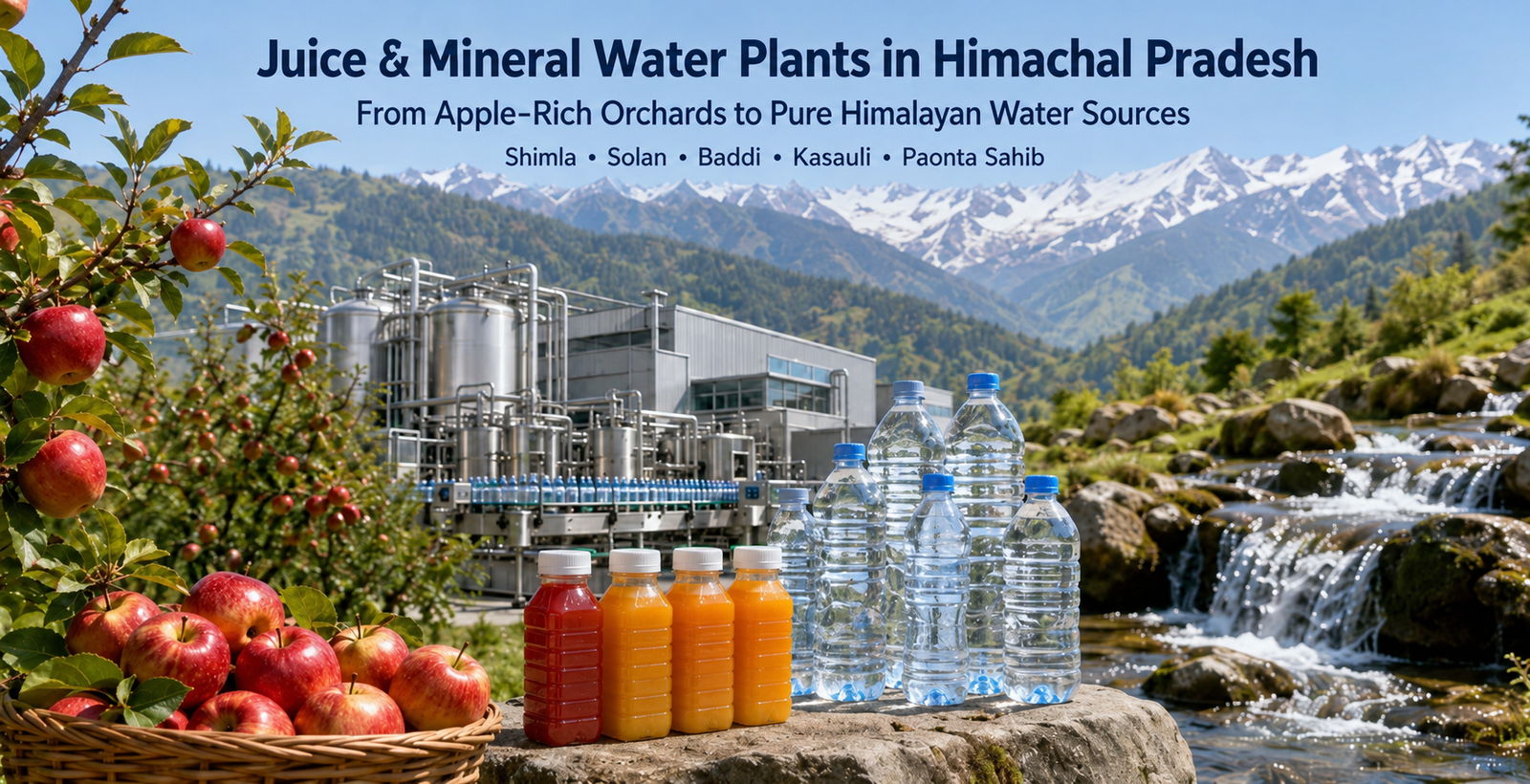
Himachal Pradesh occupies a genuinely unique position in India’s beverage manufacturing map, it is both the country’s leading apple growing state, with an apple economy valued between roughly Rs 4,000 and Rs 5,500 crore annually supporting well over 1.5 lakh farming families, and the literal source region for several of India’s best known natural mineral water brands, which are bottled at the source from aquifers beneath the Shivalik foothills around Baddi, Kasauli, Solan and Paonta Sahib. Few Indian states combine a premium horticultural raw material base with an already proven natural mineral water sourcing industry in the same handful of districts. Add Himachal’s steady tourist inflow to Shimla, Manali, Dharamshala and the wider hill circuit, and the state offers a rare, layered opportunity for both juice manufacturing plant and natural mineral water plant investment. This article examines Himachal Pradesh’s apple economy, its natural mineral water sourcing industry, and how Dharmanandan Techno Projects Pvt. Ltd. (DTPPL) can support new plant investment across the state.
From Apple Orchards to Bottled Springs: Why Himachal Pradesh Is India’s Natural Home for Juice and Mineral Water Plants
Himachal Pradesh is known to most of India for two very different things, its apples and its status as a favoured hill tourism destination, but a third identity matters just as much for beverage manufacturers: it is where several of the country’s most recognised natural mineral water brands are actually sourced and bottled. Understanding how these three threads, horticulture, natural water sourcing and tourism, come together across districts such as Shimla, Kullu, Solan and Sirmaur is the key to seeing where new juice and mineral water plant investment fits best in the state.
Read Our Article
Himachal Pradesh’s Apple Economy: The Raw Material Case for Juice Plants
Apple is by far the most important fruit crop in Himachal Pradesh, accounting for roughly 80 to 85% of the state’s total fruit production and generating an apple economy estimated at between Rs 4,000 and Rs 5,500 crore annually, supporting more than 1.5 lakh families directly across the apple belt that stretches through Shimla, Kullu, Kinnaur, Mandi, Chamba and parts of Sirmaur. Beyond apple, the state also grows meaningful volumes of plum, pear, peach and apricot, giving a potential juice manufacturing plant a genuinely diverse stone and pome fruit input base rather than dependence on a single crop. Every harvested crate of fruit already supports an established ecosystem of packaging, cold storage and transport infrastructure that a new juice plant can plug directly into.
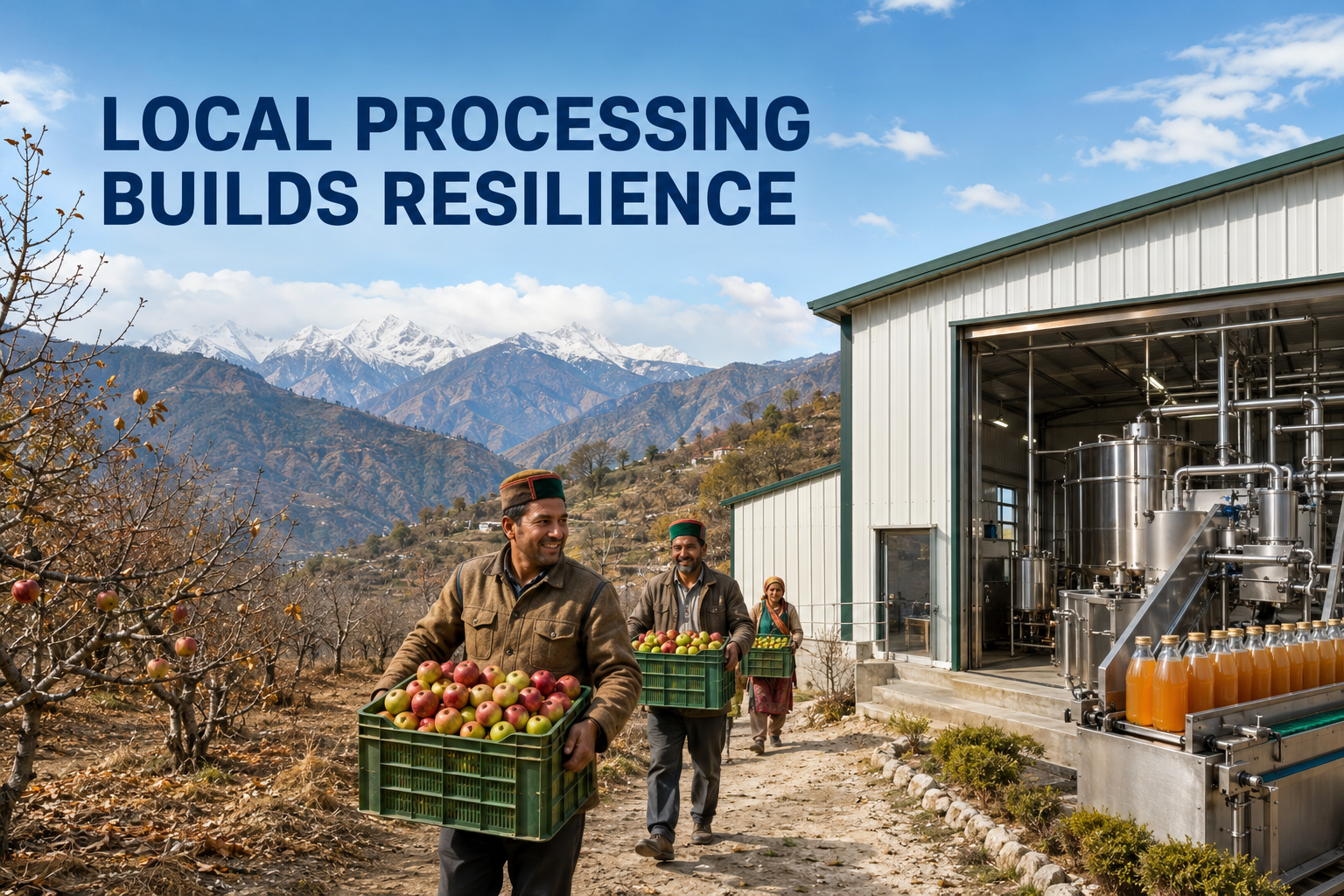
Climate Risk Makes Local Processing More Valuable, Not Less
Himachal’s apple economy has shown real vulnerability to warm, dry winters that reduce the chilling hours orchards need, with production swinging from a record 777,126 tonnes in one recent year down toward the low 500,000s in others. This volatility strengthens, rather than weakens, the case for local juice and processing capacity, since a nearby juice plant gives growers a reliable buyer for fruit that does not meet fresh market grading in a difficult year, adding resilience to an otherwise weather exposed farm economy.
OUR OTHER PRODUCT
Baddi, Kasauli and Solan: The Literal Source of India’s Natural Mineral Water
Unlike ordinary packaged drinking water, natural mineral water must legally be bottled at its source, and Himachal Pradesh is where several of India’s most established natural mineral water brands actually draw their supply. Industry facilities operate bottling plants directly over source aquifers in Kasauli and Solan district, at Paonta Sahib in the foothills of the Shivalik range, and around Baddi, where multiple natural mineral water and alkaline water brands are bottled directly at their catchment area. This is not a hypothetical opportunity, it is a proven, decades old model operating successfully in these very districts today, and it gives Himachal Pradesh a genuine structural advantage that most other Indian states simply cannot replicate for a natural mineral water plant specifically, as opposed to a standard treated packaged drinking water plant.
 Email Us Now!
Tourism Adds a Third, Complementary Demand Layer
Himachal Pradesh’s hill stations, led by Shimla, Manali, Dharamshala, Kasauli and Dalhousie, draw a large and steady tourist inflow that sustains hotel, restaurant and highway retail demand for packaged drinking water throughout the year, with particular peaks during the summer and winter tourist seasons. Local industry commentary has noted that bottled water demand in Himachal Pradesh is increasingly driven by outside visitors rather than the resident population alone, tourists, hotels, highway eateries and even school contracts, and that new bottling units are appearing not just in established centres but in emerging zones such as Dharamshala and Baddi, often operating from leased industrial sheds rather than large dedicated facilities.
Comparing Himachal Pradesh’s Key Opportunity Zones for Mineral Water & Juice Manufacturing Plants
| Location | Core Strength | Demand Pattern | Strongest Opportunity |
| Shimla, Kullu, Kinnaur, Mandi | Apple, plum, pear and peach growing belt | Seasonal harvest, established grower networks | Juice manufacturing plant using local stone and pome fruit |
| Baddi, Kasauli, Solan, Paonta Sahib | Existing natural mineral water source and bottling hub | Proven, decades old bottling at source model | Natural mineral water plant and expansion capacity |
| Shimla, Manali, Dharamshala | Major hill tourism destinations | Year round with summer and winter peaks | Packaged drinking water plant for hotel and retail supply |
| Nalagarh and industrial belt | Growing small scale manufacturing zone | Mixed industrial and consumer demand | Flexible packaged water and juice bottling capacity |
Read Our Article
How to Get A Bank Loan For A Mineral Water & Beverage Business?
Government Standards and Support Relevant to Himachal Pradesh
- Natural mineral water production requires BIS certification under IS 13428, a stricter standard than the IS 14543 applied to standard packaged drinking water, given the requirement to bottle at source without altering the water’s natural mineral composition.
- FSSAI licensing applies to all packaged water and juice manufacturing in Himachal Pradesh.
- The Himachal Pradesh State Pollution Control Board issues consent to establish and operate for new bottling and processing facilities.
- State horticulture schemes, including the Prakritik Kheti Khushhal Kisan natural farming initiative, support fruit growers across the apple belt and can strengthen a juice plant’s local sourcing relationships.
Client Review
“DTPPL supplied us with a reliable juice and mineral water processing plant. The machinery operates smoothly, maintains consistent product quality, and is easy for our team to manage. Their technical support throughout installation and commissioning was also very helpful.”
– Devansh Chauhan
How Dharmanandan Techno Projects Pvt. Ltd. (DTPPL) Can Help in Himachal Pradesh?
DTPPL supports entrepreneurs across Himachal Pradesh with turnkey design, supply and installation of juice manufacturing plants suited to apple, plum, pear and peach processing, alongside natural mineral water plants and standard packaged drinking water plants for the state’s hotel, retail and highway trade. Because Himachal Pradesh offers three genuinely distinct opportunities in one state, horticulture led juice processing, source bottled natural mineral water, and tourism driven packaged water demand, DTPPL helps entrepreneurs choose the right plant type and location, supporting the project from water and fruit source assessment through machinery selection and commissioning.
OUR OTHER PRODUCT
 Call Now
How to Set Up a Juice or Mineral Water Plant in Himachal Pradesh: Step by Step
- Decide whether your primary opportunity is juice processing tied to local fruit, natural mineral water bottled at a qualifying source, or standard packaged water plant for tourism trade.
- For a natural mineral water plant, confirm the source qualifies under IS 13428 and that bottling can occur directly at the catchment area.
- For a juice plant, build grower relationships across the apple, plum, pear or peach belt appropriate to your district.
- Register the business and obtain FSSAI licensing and the applicable BIS certification.
- Secure Himachal Pradesh State Pollution Control Board consent to establish and operate.
- Build distribution relationships with hotels, highway retailers and, for a juice plant, food processing or export buyers appropriate to your target market.
Frequently Asked Questions
Why is Himachal Pradesh well suited to a juice manufacturing plant?
Himachal Pradesh is India’s leading apple growing state, with an apple economy worth roughly Rs 4,000 to Rs 5,500 crore annually and over 1.5 lakh farming families, alongside meaningful plum, pear, peach and apricot production, giving a juice plant a diverse, established local fruit supply.
Why are so many natural mineral water brands sourced from Himachal Pradesh?
Natural mineral water must legally be bottled at its source, and Himachal Pradesh’s Shivalik foothill aquifers around Baddi, Kasauli, Solan and Paonta Sahib have proven, decades old catchment areas that already supply several of India’s established natural mineral water brands.
Does Himachal Pradesh's apple production fluctuate a lot?
Yes. Production has swung from a record high of over 777,000 tonnes in one recent year to closer to 500,000 tonnes in others, largely due to warm, dry winters reducing the chilling hours orchards need, which is one reason local juice processing capacity adds valuable resilience for growers.
What certification does a natural mineral water plant need that a standard water plant does not?
A natural mineral water plant must meet BIS certification under IS 13428, which requires bottling at the source without altering the water’s natural mineral composition, a stricter standard than the IS 14543 certification used for standard packaged drinking water.
How can DTPPL help set up a plant in Himachal Pradesh?
DTPPL provides turnkey design, supply and installation for juice manufacturing plants, natural mineral water plants and standard packaged water plants across Himachal Pradesh, helping entrepreneurs choose the right model for their specific district and target market.
Mineral Water Plant
Capacity: 500 LPH to 50,000 LPH
(USD 27,500 to USD 16,49,000)
Conclusion
Himachal Pradesh offers a combination that is genuinely difficult to find anywhere else in India: a leading apple and stone fruit growing economy that can feed a juice manufacturing plant, a proven, decades old natural mineral water sourcing industry centred on Baddi, Kasauli, Solan and Paonta Sahib, and a steady tourist inflow that sustains packaged drinking water demand across its hill station circuit. Entrepreneurs evaluating this state have the rare choice of building around any one of these three strengths, or combining them, and working with an experienced partner such as DTPPL to design the right plant gives them a genuine head start in a market that few other states can match.
Our associates









































Director – Global Marketing and Sales
Mr. Bhavesh from Dharmanandan Techno Projects Pvt. Ltd. has played a pivotal role in elevating the DTPPL brand to the global stage, leveraging his exceptional expertise in marketing and communications. He is committed to helping clients achieve significant growth while strengthening their own brands. Dharmanandan Techno Projects Pvt. Ltd. is a leading manufacturer and supplier of water purification systems and turnkey solutions for mineral water plants. With years of experience in designing and delivering high-quality water treatment solutions, the company provides end-to-end services, including system design, installation, maintenance, and ongoing support. Specializing in scalable and customizable water plants, DTPPL has successfully served industries worldwide, ensuring clean and safe drinking water across diverse applications.