



Listening Article
Table of Contents
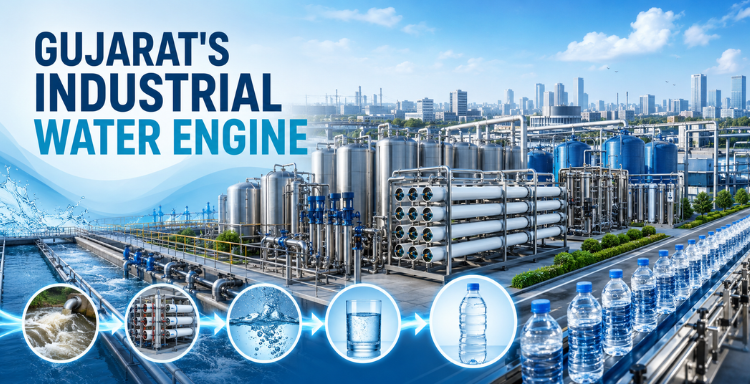
Why Ahmedabad, Surat, Vadodara, Dholera and Rajkot Need Advanced Water Treatment and Packaged Drinking Water Plants? – Gujarat’s Industrial Water Engine
August 7, 2026
AI Summary
Gujarat’s five leading industrial and urban centres, Ahmedabad, Surat, Vadodara, Dholera and Rajkot, are each creating a distinct and rapidly growing demand for water treatment infrastructure, and the driver in most of these cities is industrial rather than purely residential. Ahmedabad’s pharmaceutical, textile and chemical clusters operate under tightening Gujarat Pollution Control Board discharge norms that increasingly push units toward reverse osmosis based recycling and zero liquid discharge. Surat’s textile dyeing belt and its diamond polishing economy, which together employ several million workers, combine extremely high process water demand with an equally large requirement for basic packaged drinking water for a dense industrial workforce. Vadodara’s petrochemical and fertiliser complex, anchored by companies such as Gujarat Alkalies and Chemicals Limited, Gujarat State Fertilizers and Chemicals and the Indian Oil Corporation refinery, depends on demineralised and softened process water at industrial scale. Dholera, India’s largest greenfield industrial smart city and the site of the country’s first commercial semiconductor fabrication project, requires ultrapure water of a purity level far beyond standard packaged drinking water, delivered through a dedicated 50 million litres per day treatment system built specifically for this purpose. Rajkot and the wider Saurashtra region face a structurally different problem, chronic groundwater scarcity and coastal salinity ingress that has pushed the state to build the Narmada based Saurashtra Avtaran Irrigation network, creating strong demand for reverse osmosis and water softening capacity to make available water usable for its dense engineering, bearing and diesel engine manufacturing clusters. This article examines each city’s water demand profile in depth and outlines how a turnkey engineering partner such as Dharmanandan Techno Projects Pvt. Ltd. (DTPPL) can support new investment in industrial RO plants, water softening plants, packaged drinking water plants and related infrastructure across Gujarat.
Introduction
Gujarat is India’s most industrialised state by several measures, home to a dense network of Gujarat Industrial Development Corporation (GIDC) estates, one of the country’s four notified Petroleum, Chemicals and Petrochemicals Investment Regions at Dahej, and the anchor node of the Delhi Mumbai Industrial Corridor at Dholera. This industrial density creates a very different kind of mineral water demand story compared to a purely consumer or tourism driven market. Alongside the packaged drinking water that any large population needs, Gujarat’s factories, dye houses, chemical plants and the state’s newly arriving semiconductor industry require process water, demineralised water, softened boiler feed water and, in the most demanding cases, ultrapure water treated to specifications that go well beyond ordinary drinking water standards.
At the same time, Gujarat’s water resources are not evenly distributed. Coastal and Saurashtra districts around Rajkot face genuine scarcity and salinity, addressed through large state administered infrastructure projects such as the Narmada based state wide water grid and the Saurashtra Avtaran Irrigation project, while industrial clusters in Ahmedabad, Surat and Vadodara face regulatory pressure to treat and recycle wastewater rather than draw fresh groundwater at all. This article looks at five cities, Ahmedabad, Surat, Vadodara, Dholera and Rajkot, each representing a distinct piece of this picture, and explains where the resulting opportunity lies for entrepreneurs and industrial buyers evaluating new water treatment and packaged drinking water capacity.
Understanding Gujarat’s Industrial Water Corridor
Three overlapping frameworks shape water demand across Gujarat’s industrial cities:
- Gujarat Industrial Development Corporation (GIDC) estates, which host thousands of small and medium manufacturing units across Ahmedabad, Surat, Vadodara and Rajkot, each requiring both process water and drinking water for their workforce.
- The Petroleum, Chemicals and Petrochemicals Investment Region (PCPIR) at Dahej near Vadodara, one of only four such regions notified in India, hosting large scale chemical, fertiliser and petrochemical manufacturing that depends on demineralised and water softening at industrial volumes.
- The Delhi Mumbai Industrial Corridor’s Dholera node, India’s largest greenfield industrial smart city, now anchoring the country’s first commercial scale semiconductor fabrication project and requiring ultrapure water infrastructure built from the ground up.
Layered on top of this industrial footprint is Gujarat’s uneven natural water endowment. North Gujarat, Saurashtra and Kachchh face structural groundwater scarcity and coastal salinity ingress advancing at roughly two kilometres a year along the state’s coastal aquifers, according to state water resource assessments, a challenge the government has addressed through large scale Narmada canal based supply infrastructure. Understanding these three frameworks together explains why water treatment demand across Ahmedabad, Surat, Vadodara, Dholera and Rajkot looks so different from city to city, even though all five sit within the same state.
Ahmedabad: Pharmaceutical and Textile Manufacturing Push Industries Toward Zero Liquid Discharge
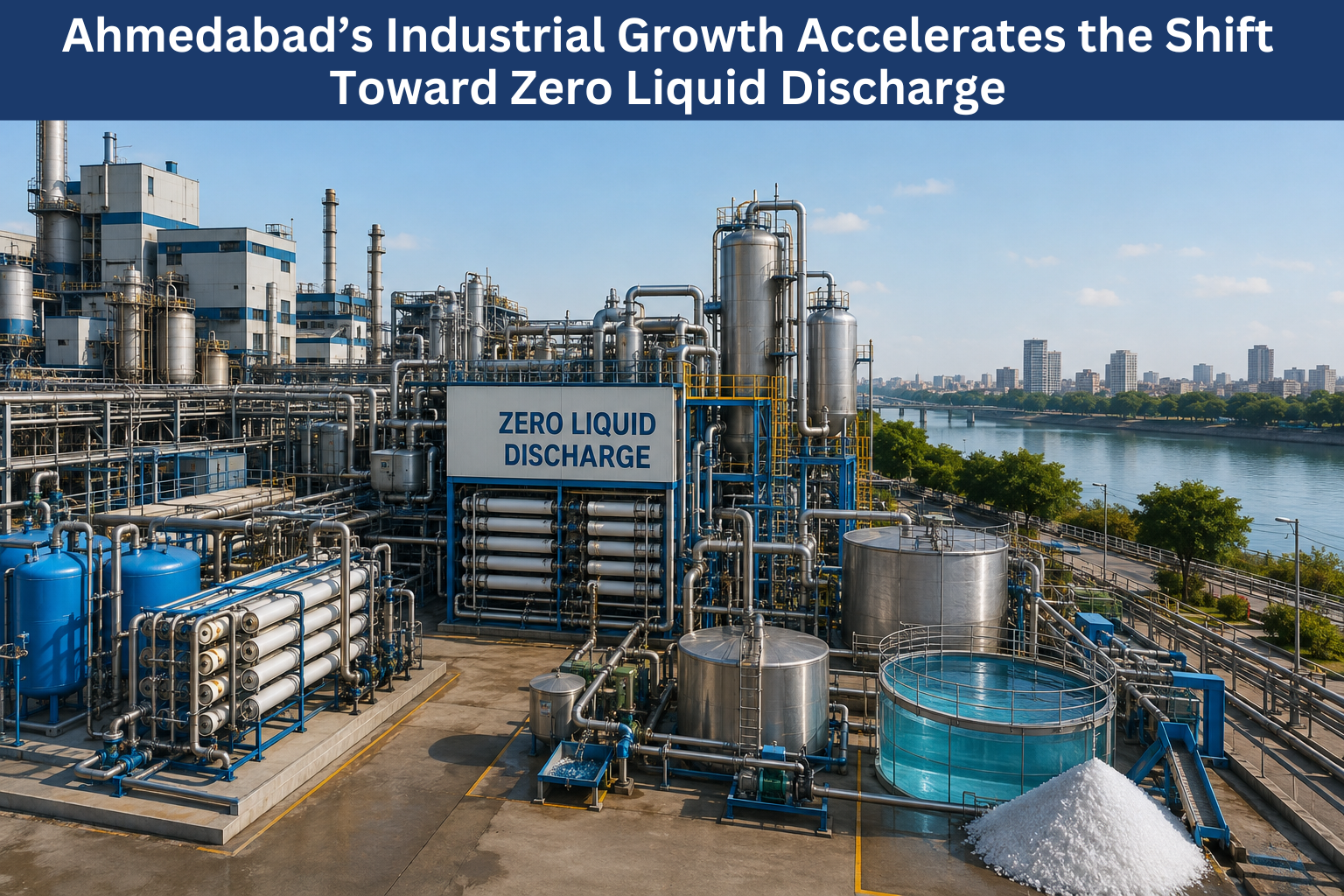
Ahmedabad anchors Gujarat’s pharmaceutical, textile processing and chemical manufacturing base, and its industrial effluent has historically flowed toward the Sabarmati river through a network of Common Effluent Water Treatment Plants managed by industry associations. Repeated Gujarat High Court directions aimed at cleaning up the Sabarmati have pushed both individual units and CETP operators toward Zero Liquid Discharge, a treatment approach in which effluent is processed through reverse osmosis followed by evaporation so that essentially no liquid waste leaves the plant boundary.
What This Means for Water Treatment Demand in Ahmedabad
- Textile processing and dyeing units within Ahmedabad’s GIDC estates increasingly need in house effluent treatment plants feeding into reverse osmosis systems before discharge to a CETP, both to meet inlet standards and to recover reusable water.
- Pharmaceutical manufacturers, a sector with a significant presence around Ahmedabad, typically require purified water and water for injection systems that go well beyond standard drinking water treatment, creating demand for pharmaceutical grade RO and deionisation systems.
- Ahmedabad’s rapidly growing population and its status as Gujarat’s largest city also sustain steady demand for conventional packaged drinking water and commercial RO plants serving offices, hospitals and residential societies.
- The GIFT City financial and IT services hub near Gandhinagar, adjoining the wider Ahmedabad metropolitan region, is adding a fresh layer of institutional and commercial drinking water demand as its office towers and residential towers fill up.
Client Review
“Dharmanandan company has large manufacturing unit having skilled technician, Great supportive staff and best quality of machines. Really I can say, this is no 1 company in this field having overall solution.”
– Alpesh Tank
Surat: A Dual Demand City Built on Textile Dyeing and Diamond Polishing
Surat presents perhaps the most distinctive water demand profile of any city in Gujarat, shaped by two industries that could not be more different in their water needs. The city’s textile belt, concentrated in Pandesara, Sachin and Udhna GIDC estates, is estimated to include more than 60,000 weaving, dyeing, processing and finishing units, while its diamond cutting and polishing economy, centred on the Varachha neighbourhood and the newly opened Surat Diamond Bourse, employs an estimated workforce running into the hundreds of thousands to several million people depending on how the wider trade is counted.
Textile Dyeing: A Zero Liquid Discharge Hotspot
Surat is repeatedly named alongside Tirupur and Panipat as one of India’s largest Zero Liquid Discharge textile clusters, since dyeing effluent carries high total dissolved solids, colour and chemical oxygen demand that Gujarat Pollution Control Board norms increasingly require to be fully treated and recycled through reverse osmosis, multi effect evaporation and, in some cases, crystallisation, rather than discharged even after conventional treatment. This creates sustained demand for industrial RO systems, water softening ahead of RO, and the broader ecosystem of effluent recovery equipment across Surat’s dyeing units.
Diamond Polishing: A Workforce Sized Packaged Drinking Water Market
Surat’s diamond polishing workforce, concentrated in dense micro units across Varachha and surrounding neighbourhoods, represents one of the largest single industrial workforces anywhere in Gujarat. This population, working long shifts in small, tightly packed units, sustains enormous day to day demand for 20 litre jar water and retail bottled water, a demand pattern driven by workforce density rather than tourism or brand competition, and one that remains comparatively underserved by large scale organised bottling relative to its sheer size.
The Opportunity in Surat
- Industrial RO and Zero Liquid Discharge systems for textile dyeing and processing units across Pandesara, Sachin and Udhna.
- Water softening plants supporting boiler feed water across the city’s dense concentration of dyeing and printing units.
- Packaged drinking water and jar water supply contracts targeted specifically at the diamond polishing workforce belt, an underserved segment relative to its population density.
Vadodara: Petrochemical and Fertiliser Manufacturing Demand Process Grade Water at Scale
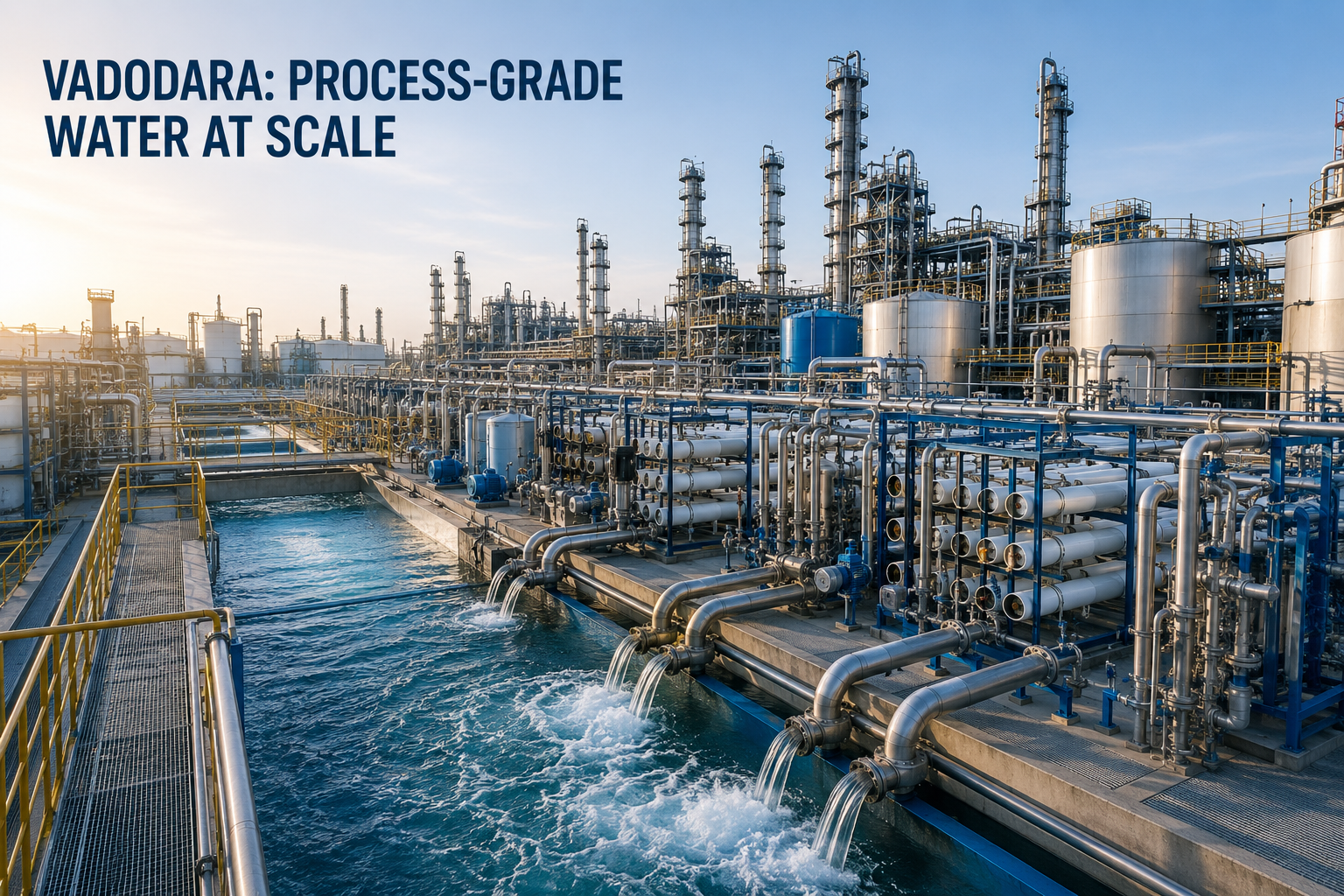
Vadodara is home to some of Gujarat’s largest chemical and fertiliser manufacturers, including Gujarat Alkalies and Chemicals Limited, Gujarat State Fertilizers and Chemicals Limited, and the Indian Oil Corporation’s Vadodara refinery, alongside the wider Nadesari and Petrochemicals GIDC estates. These facilities sit close to the Dahej Petroleum, Chemicals and Petrochemicals Investment Region, one of only four PCPIRs notified nationally, which has already attracted actual investment exceeding roughly Rs 1,12,000 crore and generated close to 1.84 lakh jobs according to government PCPIR assessments.
What Vadodara’s Industry Needs From Water Treatment
- Demineralised water for boiler feed and high pressure steam systems across the city’s chemical and fertiliser plants, a category distinct from and more demanding than standard softened water.
- Softened water ahead of reverse osmosis and demineralisation stages, since Vadodara’s groundwater and Narmada sourced supply both carry hardness levels that require pre treatment before use in sensitive process equipment.
- Effluent recycling infrastructure, since Vadodara’s petrochemical estate operates a dedicated effluent channel, promoted jointly by GIDC and major chemical producers, carrying treated effluent to a coastal outfall, a system that increasingly favours recovery and reuse over simple discharge as environmental norms tighten.
- Conventional packaged drinking water and commercial RO capacity for Vadodara’s growing residential and educational institution base, since the city is also a significant university and residential centre in its own right.
Dholera: India’s First Semiconductor City Needs Ultrapure Water Infrastructure
Dholera Special Investment Region, spread across roughly 920 square kilometres about 100 kilometres southwest of Ahmedabad, is being built as India’s largest greenfield industrial smart city and the anchor node of the Delhi Mumbai Industrial Corridor. It is now the site of India’s first commercial semiconductor fabrication project, a facility being developed with an investment of approximately Rs 91,000 crore in partnership with Taiwan’s Powerchip Semiconductor Manufacturing Corporation, targeting a capacity of around 50,000 wafers a month.
 Call Now
Why Semiconductor Manufacturing Changes the Water Equation
Semiconductor fabrication is among the most water intensive manufacturing processes in the world on a per unit basis, and it requires water treated to an ultrapure standard, water stripped of essentially all dissolved ions, particles and organic content, a specification far beyond even pharmaceutical or food grade purified water. Dholera’s planning authority has already built a dedicated 50 million litres per day water treatment plant along with mass balancing reservoirs and elevated service reservoirs specifically to guarantee this level of supply reliability and quality for incoming semiconductor and electronics manufacturers.
The Wider Opportunity Beyond the Fab Itself
- Ultrapure water treatment systems and supporting reverse osmosis, deionisation and polishing stages for semiconductor and electronics component manufacturers locating around the anchor fab.
- Industrial recycling and water reuse systems, since fabs of this scale typically recover and reuse a significant share of their process water rather than relying solely on fresh supply.
- A fresh, largely untapped packaged drinking water market, since Dholera’s population of construction workers, plant staff and eventually permanent residents is growing from close to zero, meaning there is no entrenched incumbent bottler the way there is in an established city, a genuine first mover opportunity for a new packaged water plant serving the region as it grows.
- Commercial RO and water softening capacity for the residential, hospitality and institutional infrastructure being built out alongside the industrial zone, including the planned Dholera International Airport and its surrounding township.
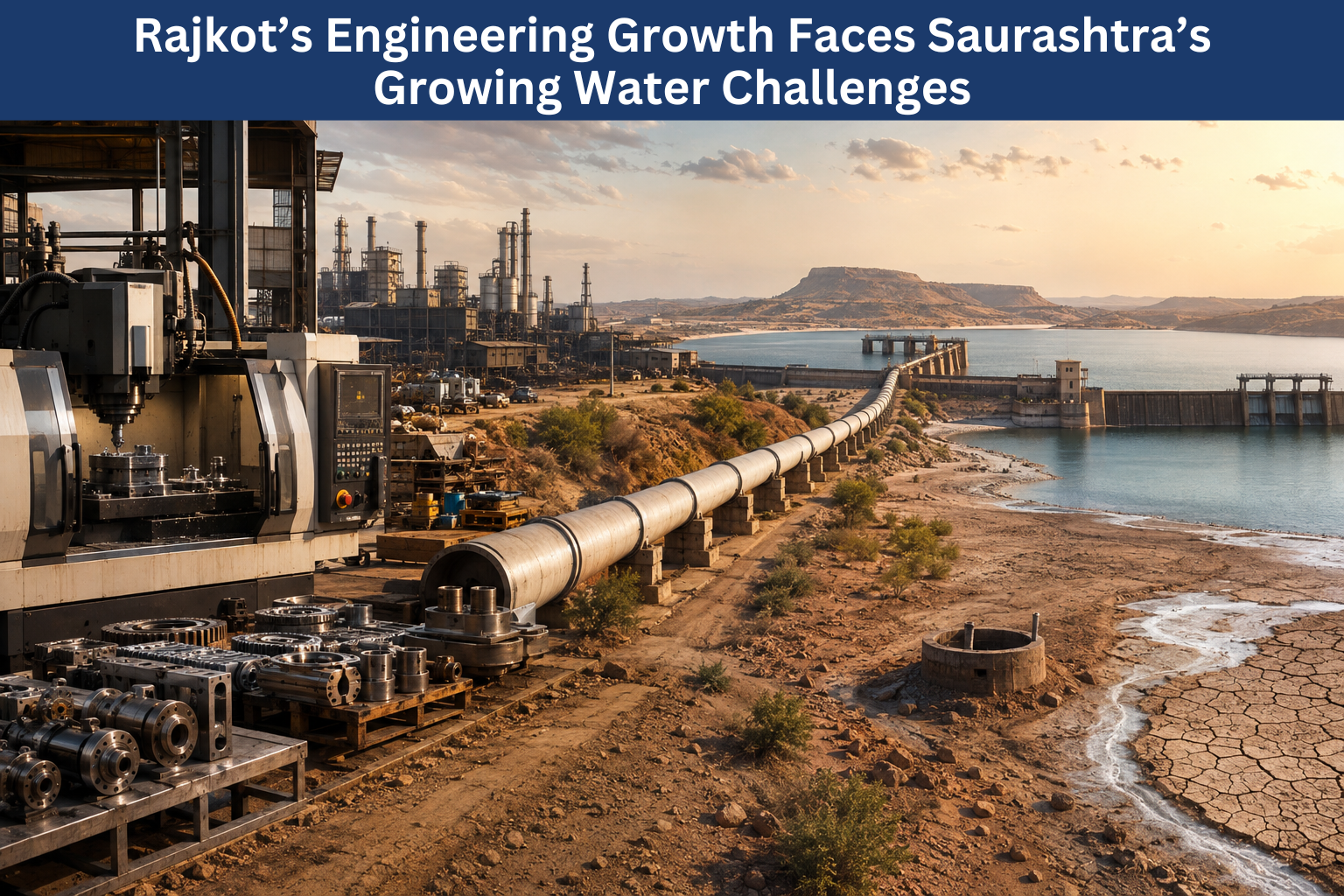
Rajkot: Engineering Manufacturing Meets Saurashtra’s Structural Water Scarcity
Rajkot sits at the centre of Gujarat’s Saurashtra region, an area that state water resource studies describe as facing chronic groundwater scarcity, worsened by a coastal salinity ingress rate estimated at roughly two kilometres a year along the region’s aquifers. To address this, the state built the Saurashtra Narmada Avtaran Irrigation (SAUNI) project, a network that diverts surplus Narmada floodwater through pipelines to refill around 115 dams and reservoirs across Saurashtra, including several serving the Rajkot, Jamnagar and Morbi districts.
Rajkot’s Engineering Manufacturing Base
Alongside this water challenge, Rajkot hosts a dense and well established engineering manufacturing base. Industry association data compiled for cluster development studies describes a bearing manufacturing cluster of around 150 units generating roughly Rs 1,500 crore in turnover, a diesel engine and pump manufacturing cluster of around 375 units in the Bhaktinagar industrial area generating roughly Rs 200 crore in turnover and employing about 7,500 workers, and a machine tool and metal cutting cluster of around 325 units generating roughly Rs 800 crore in turnover and employing about 10,000 workers, much of it concentrated across the Lodhika, Aji and Metoda GIDC estates.
OUR OTHER PRODUCT
Why This Combination Matters for Water Treatment
- Brackish and hard groundwater across large parts of Saurashtra makes reverse osmosis and water softening close to a baseline requirement, rather than an optional upgrade, for both drinking water and light process use in Rajkot’s manufacturing units.
- Rajkot’s engineering and bearing units require clean water for precision cleaning, cooling and finishing processes, a smaller but steady industrial RO and softening demand distinct from the city’s residential and drinking water needs.
- Rajkot’s dense industrial workforce across GIDC Lodhika, Aji and Metoda estates sustains conventional packaged drinking water and jar water demand at a scale comparable to a much larger city, given the sheer number of manufacturing units concentrated in these estates.
- Because Rajkot and the wider Saurashtra region depend heavily on the Narmada based SAUNI network and bulk pipeline supply for their base water availability, local reverse osmosis and softening capacity remains essential for converting that bulk supply into water suitable for both drinking and precision manufacturing use.
Five Cities, Five Water Demand Profiles: A Comparison
| City | Core Industry Driving Demand | Primary Water Challenge | Strongest Opportunity |
| Ahmedabad | Pharmaceuticals, textiles, chemicals | Zero Liquid Discharge compliance pressure on the Sabarmati basin | Industrial RO and ZLD systems, pharmaceutical grade purified water |
| Surat | Textile dyeing and diamond polishing | High TDS dyeing effluent and a dense underserved workforce | ZLD for textile units, packaged jar water for the diamond belt |
| Vadodara | Petrochemicals and fertilisers | Demineralised and softened process water at industrial scale | DM plants, softening plants, effluent recycling systems |
| Dholera | Semiconductor fabrication and electronics | Ultrapure water for chip manufacturing in a greenfield city | Ultrapure water systems and first mover packaged water supply |
| Rajkot | Bearings, diesel engines, machine tools | Saurashtra groundwater scarcity and coastal salinity | RO and softening plants for both drinking and light process use |
Regulatory Framework Behind Gujarat’s Industrial Water Demand
Several overlapping regulatory drivers shape how quickly Zero Liquid Discharge, industrial RO and water recycling capacity is being adopted across these five cities:
| Requirement or Body | Relevance to Water Treatment Demand |
| Gujarat Pollution Control Board (GPCB) | Sets effluent discharge limits and increasingly incorporates Zero Liquid Discharge conditions into Consent to Operate renewals for high polluting, high TDS industries such as textile dyeing |
| Central Pollution Control Board (CPCB) directions | National level directions mandating ZLD for textile, distillery, pulp and paper and tannery sectors in critically polluted or water stressed areas, applied through state boards |
| Central Ground Water Authority (CGWA) | Governs groundwater extraction permissions in over exploited or water stressed districts, frequently making ZLD a condition of continued groundwater access |
| National Green Tribunal (NGT) orders | Have driven closures and mandated zero discharge compliance for high polluting industrial clusters across India, reinforcing state level enforcement |
| FSSAI licensing and BIS certification (IS 14543, IS 13428) | Apply to all packaged drinking water manufacturing across Gujarat’s cities, independent of any industrial ZLD requirement |
The Equipment Ecosystem Behind Gujarat’s Industrial and Drinking Water Plants
Because Gujarat’s demand spans everything from ultrapure semiconductor water to everyday jar water for a factory workforce, the equipment required varies significantly by city and application:
| Equipment or System | Where It Applies |
| Industrial RO plant and industrial RO system | Textile dyeing effluent recovery in Surat, chemical process water in Ahmedabad and Vadodara, brackish water treatment in Rajkot |
| Water softening plant | Boiler feed pre treatment in Vadodara’s chemical plants, hard groundwater treatment across Rajkot and Saurashtra |
| Demineralisation (DM) plant | High pressure boiler feed water for Vadodara’s petrochemical and fertiliser units |
| Zero Liquid Discharge (ZLD) systems, including multi effect evaporators | Textile dyeing units in Surat and pharmaceutical or chemical units in Ahmedabad operating under ZLD consent conditions |
| Ultrapure water systems | Semiconductor and electronics manufacturing in Dholera |
| Packaged drinking water plant and bottle filling machine | Workforce and residential drinking water supply across all five cities, with particular scale opportunity in Surat’s diamond belt and Rajkot’s GIDC estates |
| Commercial and institutional RO plant | Offices, hospitals, educational institutions and residential societies in Ahmedabad, Vadodara and the emerging Dholera township |
| PET bottle manufacturing and blow moulding machine | Supporting packaged water production close to Ahmedabad and Surat’s large consumption bases |
How Dharmanandan Techno Projects Pvt. Ltd. (DTPPL) Can Help You Set Up a Water Treatment Plant in Gujarat
Because Gujarat’s five leading industrial cities each demand a genuinely different water treatment configuration, from ultrapure water in Dholera to Zero Liquid Discharge systems in Surat to softening and demineralisation in Vadodara and Rajkot, choosing the right equipment and capacity matters far more here than in a purely residential market. Dharmanandan Techno Projects Pvt. Ltd. (DTPPL) offers turnkey design, supply and installation support across this full spectrum, including:
- Industrial and commercial RO plants sized for textile, chemical, pharmaceutical and engineering applications
- Water softening plants and demineralisation systems for boiler feed and process water requirements
- Packaged mineral water plants for workforce, residential and institutional supply, including bottle filling, capping, labeling and shrink wrapping lines
- PET bottle manufacturing lines, including automatic and semi automatic blow moulding machines, to support packaged water production close to demand centres
- Guidance on right sizing a plant to the specific regulatory and process requirements of a given city, whether that means designing toward eventual Zero Liquid Discharge compliance in Surat or a straightforward RO and softening setup for Rajkot’s brackish groundwater
DTPPL supports entrepreneurs and industrial buyers through the full project lifecycle, from initial water testing and project cost estimation through machinery selection, installation and commissioning, allowing investors across Ahmedabad, Surat, Vadodara, Dholera and Rajkot to work with a single experienced technical partner rather than coordinating separate vendors for RO systems, softening equipment and packaging machinery.
 Email Us
How to Set Up an Industrial or Packaged Water Treatment Plant in Gujarat: A Step by Step Overview
- Identify your target application: process water for a specific industry, Zero Liquid Discharge compliance, or packaged drinking water for a workforce or residential market.
- Test the source water: groundwater, Narmada canal supply or municipal water quality varies significantly across Ahmedabad, Surat, Vadodara, Dholera and Rajkot, so testing determines the treatment configuration required.
- Finalise plant capacity and treatment stages: decide whether the project needs simple RO, RO with softening and demineralisation, or a full Zero Liquid Discharge or ultrapure water configuration.
- Register the business and, for drinking water production, obtain FSSAI licensing and BIS certification under IS 14543 or IS 13428 as applicable.
- Secure Gujarat Pollution Control Board consent to establish and consent to operate, including any Zero Liquid Discharge conditions attached to the consent for high TDS or high polluting processes.
- Confirm groundwater extraction permissions with the Central Ground Water Authority where applicable, particularly in Ahmedabad, Surat and Rajkot’s water stressed zones.
- Install treatment and, where relevant, packaging infrastructure: RO, softening, demineralisation, ZLD or ultrapure systems, along with bottle filling, labeling and shrink wrapping lines for drinking water production.
- Conduct trial production and quality testing against the relevant standard, whether BIS drinking water norms or the specific process water purity required by the end industry.
- Build supply and offtake partnerships: industrial process water contracts with manufacturing units, or drinking water supply agreements with GIDC estates, residential societies and institutions.
- Plan for future scaling: Gujarat’s industrial corridors, particularly Dholera, are still in early stages of buildout, so designing a plant with room to expand capacity is often more valuable than sizing tightly to current demand.
Frequently Asked Questions
Why do Ahmedabad, Surat, Vadodara, Dholera and Rajkot need more water treatment plants?
Each city faces a different water challenge. Ahmedabad and Surat face tightening Zero Liquid Discharge requirements for high polluting industries, Vadodara needs demineralised and softened water at industrial scale for its petrochemical base, Dholera needs ultrapure water for its new semiconductor fabrication project, and Rajkot faces structural groundwater scarcity and salinity across the Saurashtra region.
What is Zero Liquid Discharge and why does it matter in Surat and Ahmedabad?
Zero Liquid Discharge is a treatment approach in which industrial effluent is processed through reverse osmosis and evaporation so that no liquid waste leaves the plant boundary. It matters in Surat and Ahmedabad because textile dyeing and chemical effluent carries high total dissolved solids and pollution load, and Gujarat Pollution Control Board norms increasingly require ZLD as a condition of operating consent for these industries.
How much water does a semiconductor fabrication plant like the one in Dholera actually need?
Semiconductor fabrication is among the most water intensive manufacturing processes per unit of output in the world, and it requires ultrapure water treated to remove essentially all dissolved ions and particles. Dholera’s planning authority has built a dedicated 50 million litres per day water treatment plant specifically to meet this requirement for the anchor fab and its surrounding electronics ecosystem.
Why does Rajkot face water scarcity despite being an industrial city?
Rajkot sits within Gujarat’s Saurashtra region, which state water resource studies describe as facing chronic groundwater depletion and coastal salinity ingress advancing at roughly two kilometres a year along the region’s aquifers. The state addresses this through the Narmada based Saurashtra Avtaran Irrigation project, but local reverse osmosis and softening capacity remains essential to convert that bulk supply into usable water for both drinking and manufacturing.
What government approvals are required to set up an industrial water treatment plant in Gujarat?
Requirements typically include Gujarat Pollution Control Board consent to establish and operate, Central Ground Water Authority clearance for groundwater extraction where applicable, and, for drinking water production, FSSAI licensing and BIS certification under IS 14543 or IS 13428.
Is there still opportunity for a new packaged drinking water plant in an established industrial city like Surat?
Yes, particularly in workforce dense areas such as Surat’s diamond polishing belt around Varachha, which sustains an enormous day to day drinking water requirement from its resident workforce but remains comparatively underserved by large scale organised bottling relative to its population density.
How can DTPPL help a business set up a water treatment plant in Gujarat?
Dharmanandan Techno Projects Pvt. Ltd. (DTPPL) provides turnkey design, supply and installation support for industrial RO plants, water softening and demineralisation systems, Zero Liquid Discharge configurations and packaged drinking water plants, allowing entrepreneurs and industrial buyers across Ahmedabad, Surat, Vadodara, Dholera and Rajkot to work with a single technical partner through the full project lifecycle.
Mineral Water Plant
Capacity: 500 LPH to 50,000 LPH
(USD 27,500 to USD 16,49,000)
Conclusion
Gujarat’s water treatment opportunity looks nothing like a single, uniform market. Ahmedabad and Surat are being pushed toward Zero Liquid Discharge by regulatory pressure on their river systems and effluent clusters, Vadodara’s petrochemical base runs on demineralised and softened process water at industrial scale, Dholera is building an entirely new category of ultrapure water infrastructure to support India’s first semiconductor fabrication project, and Rajkot’s engineering economy sits inside one of India’s most structurally water scarce regions, dependent on Narmada based supply and local reverse osmosis capacity to make that water usable. For entrepreneurs and industrial buyers, this diversity is the opportunity: each city rewards a different plant configuration, and getting that match right, whether it is a ZLD system for a Surat dye house, a demineralisation plant for a Vadodara chemical unit, an ultrapure system for a Dholera electronics manufacturer, or a straightforward RO and softening plant for a Rajkot bearing factory, is best done with an experienced turnkey partner such as DTPPL, who can help design, supply and commission the right system for the right city.
Our associates



































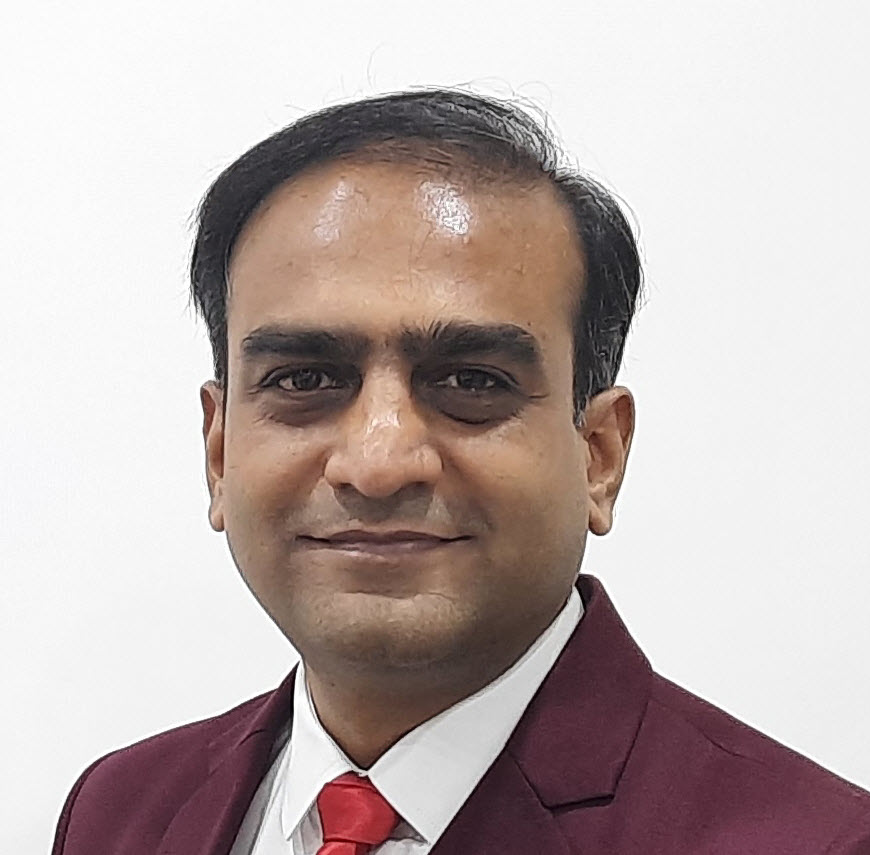
Director – Global Marketing and Sales
Mr. Bhavesh from Dharmanandan Techno Projects Pvt. Ltd. has played a pivotal role in elevating the DTPPL brand to the global stage, leveraging his exceptional expertise in marketing and communications. He is committed to helping clients achieve significant growth while strengthening their own brands. Dharmanandan Techno Projects Pvt. Ltd. is a leading manufacturer and supplier of water purification systems and turnkey solutions for mineral water plants. With years of experience in designing and delivering high-quality water treatment solutions, the company provides end-to-end services, including system design, installation, maintenance, and ongoing support. Specializing in scalable and customizable water plants, DTPPL has successfully served industries worldwide, ensuring clean and safe drinking water across diverse applications.