




Listening Article
Table of Contents
How Clear Premium Water Became a ₹450 Crore Brand with DTPPL’s Mineral Water Bottling Plant: A Case Study
June 9, 2026AI Summary
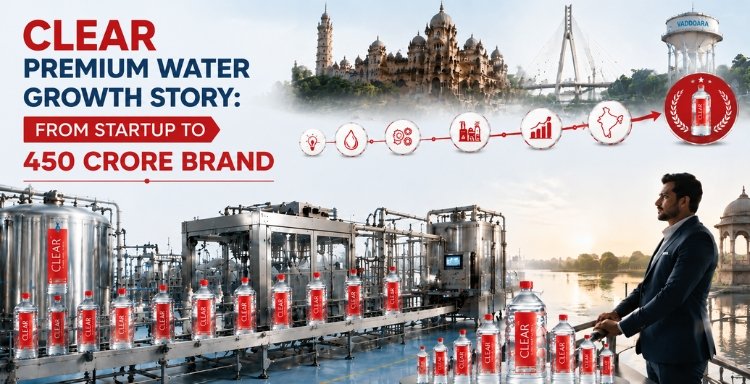
This case study examines how Clear Premium Water evolved from a near-zero-revenue startup in 2010 into a 450 crore valued, nationally recognized beverage brand by 2024 — and what that journey reveals for entrepreneurs seeking to build or scale a mineral water, juice, or soft drink business across India, Africa, South America, and Southeast Asia.
Dharmanandan Techno Projects Pvt. Ltd. (DTPPL), an ISO 9001:2015 certified global leader in beverage manufacturing technology since 2011, has played a pivotal role in enabling entrepreneurs to replicate this kind of transformational growth. From world-class mineral water plants to high-speed fully automated bottling lines, DTPPL equips ambitious business owners with the industrial infrastructure necessary to compete at a national — and international — level.
Clear Premium Water’s story is more than an inspiring narrative. It is a practical blueprint. At its core, it demonstrates that the right product category, a disciplined go-to-market strategy, uncompromising manufacturing quality, robust distribution architecture, and brand resilience in crisis are the five pillars that separate sustainable beverage businesses from those that quietly disappear.
| 800 Bottles — Year 1 (2010) | 60 L Bottles/Day Capacity (2024) | ₹354 Cr Annual Revenue | ₹450 Cr Current Valuation | ₹1000 Cr Target by 2026–27 |
Part 1 – From Failure to Foundation: Nayan Shah’s Defining Pivot
Behind every high-growth company is usually a founder who first learned what does not work. For Clear’s founder Nayan Shah, that lesson came through ‘Current’, his first entrepreneurial venture — an Indian energy drink positioned in the mold of international brands like Red Bull.Nayan came from a well-established wire and cable manufacturing family in Ahmedabad and had completed his MBA in Australia. By most definitions, his life was set. But rather than inherit an existing legacy, he chose to build his own. In 2005, he launched Current with an initial capital of approximately 2 crore rupees. By 2007, annual revenue had reached approximately 3.2 crore — encouraging, but fragile.The product had a fundamental structural problem that no amount of effort could fix: Indian consumers in 2005 were not habituated to energy drinks. The product was a high-margin, low-frequency purchase. By 2009, annual revenue had collapsed to roughly 60 lakh. The venture was effectively over.Challenges at This Stage
- Premature market — Indian consumers were not yet conditioned to regular energy drink consumption
- High cost per unit relative to chai and coffee, which dominated the affordable beverage market
- Low purchase frequency meant the business had no compounding revenue base
- Capital erosion without a viable path to sustainable scale
- Social and family pressure to abandon entrepreneurship and return to a proven family business
 Drop Us an Email!
The Insight That Changed Everything: FOC Framework
Rather than fold completely, Nayan Shah drew a critical strategic insight from the failure. He developed what can be called the Frequency of Consumption (FOC) Framework — a simple but powerful lens for evaluating FMCG product categories.
Framework 1: FOC — Frequency of Consumption
- High FOC = High Stability: Products consumed daily generate compounding, predictable revenue
- Low FOC = High Risk: Even high-margin products struggle if purchases are occasional
- Water vs. Energy Drink: Water is a daily biological necessity; energy drinks are periodic indulgences
- Long-term scale comes from frequency — not from margin alone
- Application: Before launching any product, ask — how often will a consumer buy this? Weekly? Daily? Monthly?
This single realization redirected his entire entrepreneurial trajectory. Water, packaged and premium, offered everything that energy drinks lacked: daily consumption, growing urbanization tailwinds, a massive addressable market, and a product category where quality differentiation was genuinely possible.
Clear Premium Water was born not from excitement but from data-driven conviction.
Client Review
“I had a great experience purchasing my soda bottling plant from Dharmanandan Techno Projects Pvt. Ltd. The team guided me through setup and operations, the machinery quality is excellent, and their support has been prompt. I’m fully satisfied and would recommend them to anyone starting a carbonated beverage business.”
– Rutul More
Part 2 – Blue Ocean Strategy: Going Where Giants Were Not
By the time Clear entered the packaged water market, the retail segment was completely dominated. Bisleri, Aquafina, and Kinley had shelf space locked up in virtually every kirana store, supermarket, and pan shop across urban India. Competing on price or promotions in that environment would have been financial suicide for a startup with limited capital.Nayan Shah recognized this clearly, and rather than charge at the wall, he went around it.Challenges at This Stage
- Dominant incumbents occupied retail shelves with superior negotiating power and brand recognition
- No capital or distribution muscle to fight for shelf space in mass retail
- Zero brand equity at launch — the company was completely unknown
- Conventional packaged water was perceived as a commodity with minimal room for premiumization
- In the first full year (2010), total sales amounted to just 800 bottles
Implementation: HoReCa First Strategy
The strategic insight was to identify the segment that the mass water brands were effectively ignoring: Hotels, Restaurants, Catering, and Airlines — collectively known as HoReCa. These establishments did not simply need water. They needed water that enhanced the dining or travel experience. They needed a product that looked and felt appropriate on a fine-dining table or a business class tray.
Existing round bottles from major brands were utilitarian. They looked out of place on a premium restaurant table, rolled off trays, and offered no co-branding opportunity. This was the gap Clear was designed to fill.
Clear launched with a deliberately premium aesthetic: a distinctive square bottle with a vertical label. Hotels could co-brand the label with their own logo. The product was not being sold as utility hydration — it was being sold as a table accessory, an extension of the dining experience itself.
The founder’s conviction during this period is worth noting. Despite selling only 800 bottles in the entire first year, there was no deviation from the strategy. That discipline — continuing to invest in positioning and quality when numbers are near zero — separates founders who build durable brands from those who chase short-term revenue at the cost of long-term identity.
Mineral Water Plant
Capacity: 500 LPH to 50,000 LPH
(USD 27,500 to USD 16,49,000)
Outcome
- Clear secured its first high-value HoReCa clients, including premium hotels, airlines, and caterers
- The square bottle became a visual signature — immediately recognizable and impossible to confuse with mass-market competitors
- Co-branding capability created institutional stickiness — once a hotel printed its logo on a Clear bottle, switching became an active decision rather than a passive one
- Brand narrative shifted from ‘packaged water’ to ‘premium hydration partner’ for hospitality businesses
Framework 2:3C Blue Ocean Strategy
- Category: Define a specific sub-category — ‘mass premium’ packaged water, priced above commodity but accessible
- Client: Target HoReCa first — build credibility and premium association before entering mass retail
- Container: The square bottle was a strategic weapon — stable on trays, visually distinct on shelves, ideal for co-branding
Part 3 – Engineering World-Class Manufacturing
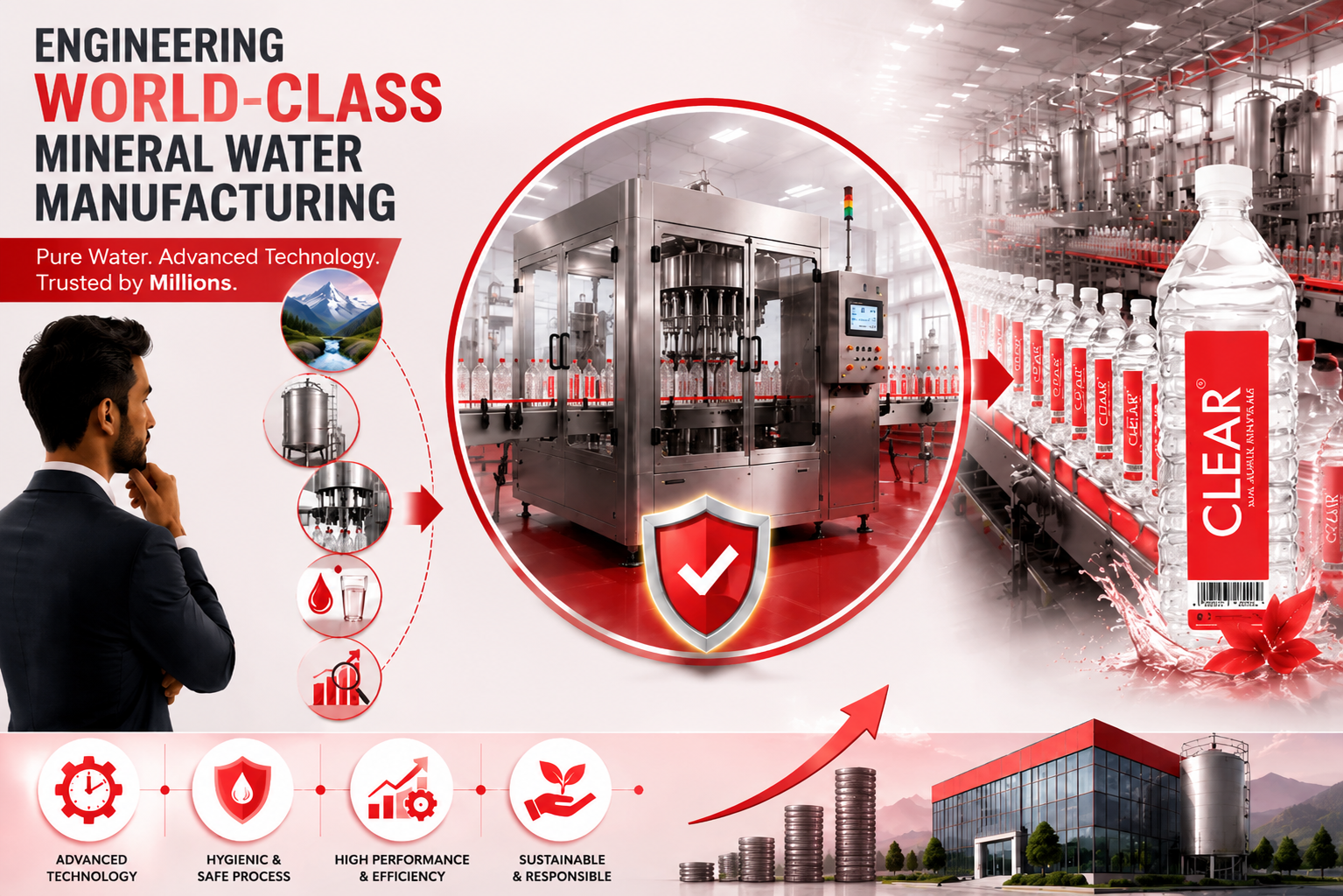
The most common and most destructive mistake made by first-time beverage business startup entrepreneurs is to minimize upfront machinery investment with the intention of upgrading later. Clear’s journey proves definitively that this logic does not hold in a quality-sensitive sector.
As Clear’s model gained traction in the HoReCa segment, the decision was made to invest in genuinely world-class manufacturing infrastructure — not in phases, and not at the lowest available cost. In 2015, a fully automated plant was established in Ahmedabad, followed by a second facility in Surat. These were not incremental upgrades. They were designed from the outset to meet the most stringent international quality standards.
Challenges at This Stage
- Significant upfront capital requirement for high-specification automated equipment
- Pressure to reduce costs by choosing lower-specification machinery, particularly during the early growth phase
- Need to meet the rigorous quality audits of airlines and 5-star hotels — one leakage incident could mean a lost contract
- Achieving consistency across high-volume production runs without human error
- Navigating multiple certification bodies including ISO 22000, ISO 9001, HACCP, BIS, and FSSAI
Implementation: DTPPL’s Role in Manufacturing Excellence
This is precisely the domain where Dharmanandan Techno Projects Pvt. Ltd. brings transformative value to beverage entrepreneurs. DTPPL’s fully automatic lines integrate blow moulding machine, filling, capping, and labeling into a single seamless system — minimizing human contact, eliminating inconsistencies, and delivering production speeds of up to 20,000 bottles per hour per line.
Clear’s plants were built on this philosophy: every bottle produced should be indistinguishable in quality from every other bottle. The 11-stage purification process and 121 individual quality checks per bottle were not marketing claims. They were operational realities that enabled Clear to pass the audits of India’s most demanding commercial clients.
- Inconsistent bottle thickness and shape
- Frequent leakages and cap failures
- 60% operational efficiency
- High downtime, high wastage, high labor cost
- Distributor complaints and contract losses
- Unable to pass airline or 5-star hotel audits
- Consistent quality across every unit produced
- Zero leakage, zero deformation tolerance
- Over 90% operational efficiency
- Minimal labor dependency, maximum hygiene
- Distributor and client retention at premium tier
- Full compliance with ISO, BIS, FSSAI, HACCP
Outcome
- Each manufacturing plant represented a capital investment of approximately 8 to 10 crore rupees, with payback achieved within 25 to 30 months
- Long-term ROI over a 10-year horizon is estimated at approximately 650%
- Certifications obtained: ISO 22000, ISO 9001, HACCP, BIS, FSSAI — enabling access to the highest-tier commercial clients in India
- Consistent brand experience across 60 lakh bottles produced daily
Framework 3: MACHINE Mindset for Manufacturing Excellence
- M — Mindset: Treat machinery as a profit center, not a cost line.
- A — Automation: Less manual intervention means more consistency, hygiene, and output.
- C — Compliance: ISO, BIS, FSSAI are not formalities — they are trust credentials for premium clients.
- H — High-speed: Production capacity must be able to absorb peak seasonal demand without disruption.
- I — Innovation: Lightweight bottle design, eco-friendly packaging, unique mold shapes.
- N — Nurture: Invest in your people, processes, and R&D to cultivate growth, quality, and long-term innovation.
- E — End-to-end control: Preforms, caps, purification, lab testing — all under one quality standard.
 WhatsApp
Part 4 — Building a Distribution Powerhouse
A world-class manufacturing plant without a world-class distribution architecture is simply a well-run storage facility. Clear’s leadership understood this early, and distribution was treated not as an operational afterthought but as a core strategic pillar.
The progression from 800 bottles in 2010 to a capacity of 60 lakh bottles per day in 2024 was not achieved through manufacturing alone. It was driven by a methodical, multi-layered distribution network built over more than a decade.
Challenges at This Stage
- Limited geographic reach with only two owned plants, restricting freshness and increasing logistics cost at distance
- Capital constraints preventing simultaneous expansion into multiple states
- Need to penetrate both mass retail and premium HoReCa channels — two entirely different sales motions
- Competing with national brands that already had established distributor relationships
- Managing quality consistency across a geographically distributed network
Implementation: Franchise and Co-Packer Model
Clear’s most elegant solution to the distribution challenge was the franchise and co-packer model. Rather than funding every new plant from its own balance sheet, the company allowed local entrepreneurs to establish manufacturing facilities under the Clear brand umbrella. DTPPL has been instrumental in enabling this kind of scalable infrastructure deployment for beverage businesses across India.
Under this model, the local operator funds and runs the plant. Clear provides the brand standards, preform specifications, SOPs, quality control protocols, and mandatory compliance requirements including regular audits, lab testing, and BIS certification. The result is asset-light geographic expansion with rigorous quality control — a genuinely scalable architecture.
| 2Owned Hi-Tech Plants | 45+Franchise & Co-Packer Plants | 1,100+Distributors Nationwide | 1.25L+Retail Outlets | 1,600+ HoReCa Clients |
In parallel, Clear embraced digital commerce early. Platforms including Swiggy Instamart, Blinkit, Zepto, BigBasket, and Amazon now collectively account for approximately 15% of total revenue — a channel that did not exist as meaningful revenue just five years prior.
Outcome
- Pan-India presence from a two-plant origin, achieved through capital-efficient franchising
- Reduced transport costs and improved bottle freshness through proximity of co-packer plants to end markets
- Diversified channel revenue: retail, HoReCa, institutional, modern trade, and quick-commerce
- Quick-commerce contributing approximately 15% of total revenue and growing
Framework 4: 3D Distribution Power
- D1 — Depth: Deep distributor network, 1.25 lakh retail outlets, 1,600+ HoReCa clients — penetration creates pricing power
- D2 — De-risking: No single channel dependency — retail, HoReCa, modern trade, institutions, and digital are all active
- D3 — Digital: Quick-commerce platforms represent the fastest-growing revenue channel for packaged beverages
Part 5 — Surviving the COVID Crisis: Pivot or Perish
By the start of 2020, Clear had built what appeared to be a robust, high-performing business. HoReCa accounted for approximately 90% of total revenue. The model was working, profitability was improving, and expansion was on track.
Then COVID-19 arrived. Airlines grounded. Hotels shuttered. Restaurants closed. Overnight, 90% of Clear’s revenue base effectively ceased to exist. The company was not merely under pressure — it was facing potential closure.
OUR OTHER PRODUCT
Challenges at This Stage
- Near-total revenue collapse as the primary sales channel shut down within days
- No meaningful retail presence to fall back on — this channel had been deliberately deprioritized
- Fixed manufacturing and staffing costs continuing with minimal income
- Uncertainty about when — or whether — the HoReCa segment would recover
- Need to rebuild distribution relationships in an entirely different channel while managing a crisis
Implementation: The War-Room Pivot
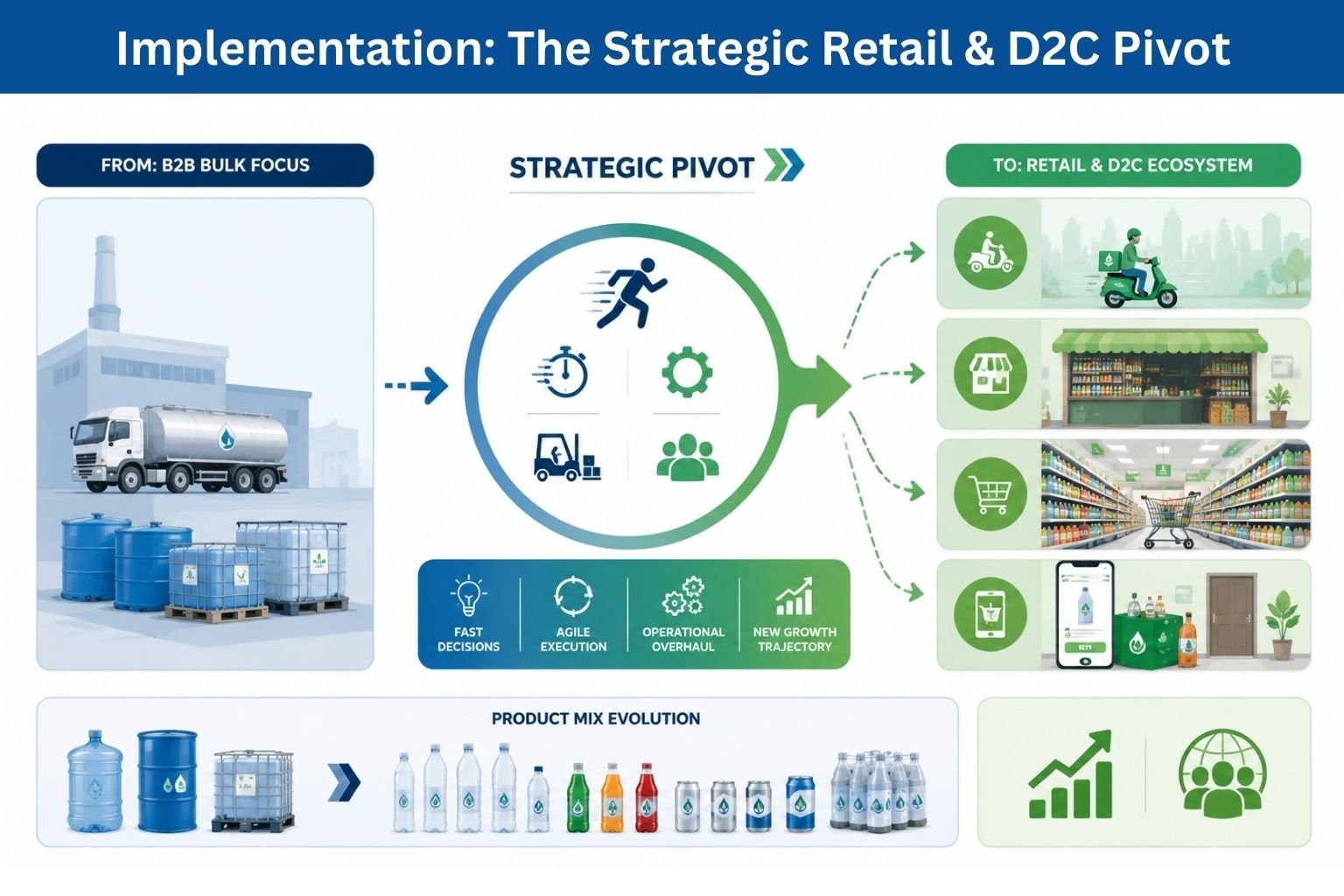
The response from Nayan Shah and the Clear leadership team was rapid and decisive. Rather than waiting for HoReCa to recover, they executed a full channel pivot. The company pivoted aggressively toward retail, onboarding thousands of new kirana stores, supermarkets, and chemist outlets. Distribution infrastructure was rebuilt from a B2B bulk model to a high-frequency, smaller-unit consumer model.
Simultaneously, the product mix was adjusted. Family packs, 5-liter plus 1-liter combo offers, and home-use formats were introduced to match the consumption patterns of households rather than institutions. D2C and quick-commerce channels were fast-tracked to capture urban delivery demand.
Outcome
- Revenue recovered and the business returned to growth within the same financial year
- Channel mix transformed from 90% HoReCa / 10% retail to approximately 50% / 50%
- The company emerged structurally stronger — no longer dependent on any single segment
- New retail relationships established during COVID became a permanent revenue pillar as HoReCa also returned
Part 6 — Building a Killer Brand: From Hotel Water to National Icon
Quality, manufacturing, and distribution create a business. Brand creates a lasting institution. Clear’s transition from a B2B premium water supplier to a nationally recognized consumer brand represents the third major phase of its evolution — and perhaps the most instructive for entrepreneurs who underestimate the power of brand architecture.
Challenges at This Stage
- Brand awareness was strong in the HoReCa segment but negligible among general consumers
- Retail expansion required consumer-level recognition that did not yet exist
- Premium positioning risked alienating price-sensitive mass retail customers
- Counterfeit products had begun appearing in the market under deceptively similar names and packaging
- Growing consumer consciousness around sustainability required a credible environmental story
Implementation: Celebrity, Sustainability, and Anti-Counterfeit
Phase 1 — Celebrity Brand Ambassador
In 2023–24, Clear onboarded Bollywood actor Hrithik Roshan as brand ambassador. The campaign — ‘Hum Sabki Clear Choice’ — was designed to position the brand as the intelligent hydration choice for every Indian, not merely a hotel water brand. Hrithik’s association with fitness, discipline, and premium lifestyle aligned precisely with Clear’s positioning and created mass-market aspiration around the product.
Marketing spend allocation was deliberate: approximately 20% was directed toward television and print, while 80% went toward below-the-line (BTL) activities — in-store branding, outlet visibility, and point-of-sale material. This reflects the fundamental truth of FMCG distribution: the point of purchase is where the decision is made.
Phase 2 — Sustainability: The Clearth Initiative
Modern consumers, particularly in urban and institutional markets, increasingly factor environmental responsibility into purchasing decisions. Clear recognized this and built a credible sustainability narrative through its Clearth eco-line, launched in 2017.
- The square bottle design reduced plastic consumption by up to 30% compared to standard round bottles
- By 2024, Clear had established a 100% rPET (recycled PET bottle manufacturing) partnership with premium hotel clients including Radisson Blu
- This gave corporate clients a dual value proposition: premium brand quality and verifiable environmental responsibility
Phase 3 — Anti-Counterfeit Strategy
Success attracted imitation. Brands named ‘Clear Fresh’ and other similar designations appeared in the market, explicitly designed to benefit from Clear’s growing recognition. This was both a financial and a public health concern.
Clear responded on multiple fronts simultaneously. Legal action, factory raids, and court orders targeted counterfeit producers directly. Bottle design was upgraded with unique square molds and embossed branding that smaller operators could not economically replicate. Consumer education programs were deployed to help buyers verify authenticity.
Outcome
- Brand recognition extended from institutional to consumer markets across India
- Hrithik Roshan association elevated brand perception and significantly accelerated retail penetration
- Clearth positioning differentiated Clear from competitors in premium institutional segments
- Anti-counterfeit measures reduced market confusion and protected both revenue and brand integrity
- Clear is now on track to achieve its stated target of 1,000 crore in revenue by 2026–27
How DTPPL Helps Entrepreneurs Build Their Own Clear
The Clear Premium Water journey illustrates what is possible when entrepreneurial vision is matched with the right manufacturing partner. Dharmanandan Techno Projects Pvt. Ltd. exists precisely to be that partner for the next generation of beverage entrepreneurs across India and emerging markets globally.
DTPPL’s manufacturing solutions address every critical challenge that Clear’s early journey surfaced — and that every new mineral water or beverage entrepreneur will face.
| Entrepreneur Challenge | DTPPL Solution | Business Outcome |
| Machine quality uncertainty | World-class fully automatic water bottle filling line with 90%+ efficiency | Consistent product quality that passes 5-star hotel and airline audits |
| Certification complexity | ISO 22000, ISO 9001, BIS, FSSAI, HACCP-ready plant design and documentation support | Premium client access and institutional tender eligibility |
| High-volume production gaps | Single-line capacity up to 20,000 bottles per hour | Ability to absorb seasonal demand spikes without supply failure |
| 11-stage purification requirements | Integrated multi-stage purification systems built into plant design | Product quality that meets both regulatory and consumer standards |
| Franchise expansion challenges | Standardized plant specifications enabling replicable co-packer and franchise models | Rapid geographic expansion without proportional capital increase |
| Packaging differentiation | Custom bottle mold design including unique shapes for brand identity | Visual product differentiation that commands premium pricing |
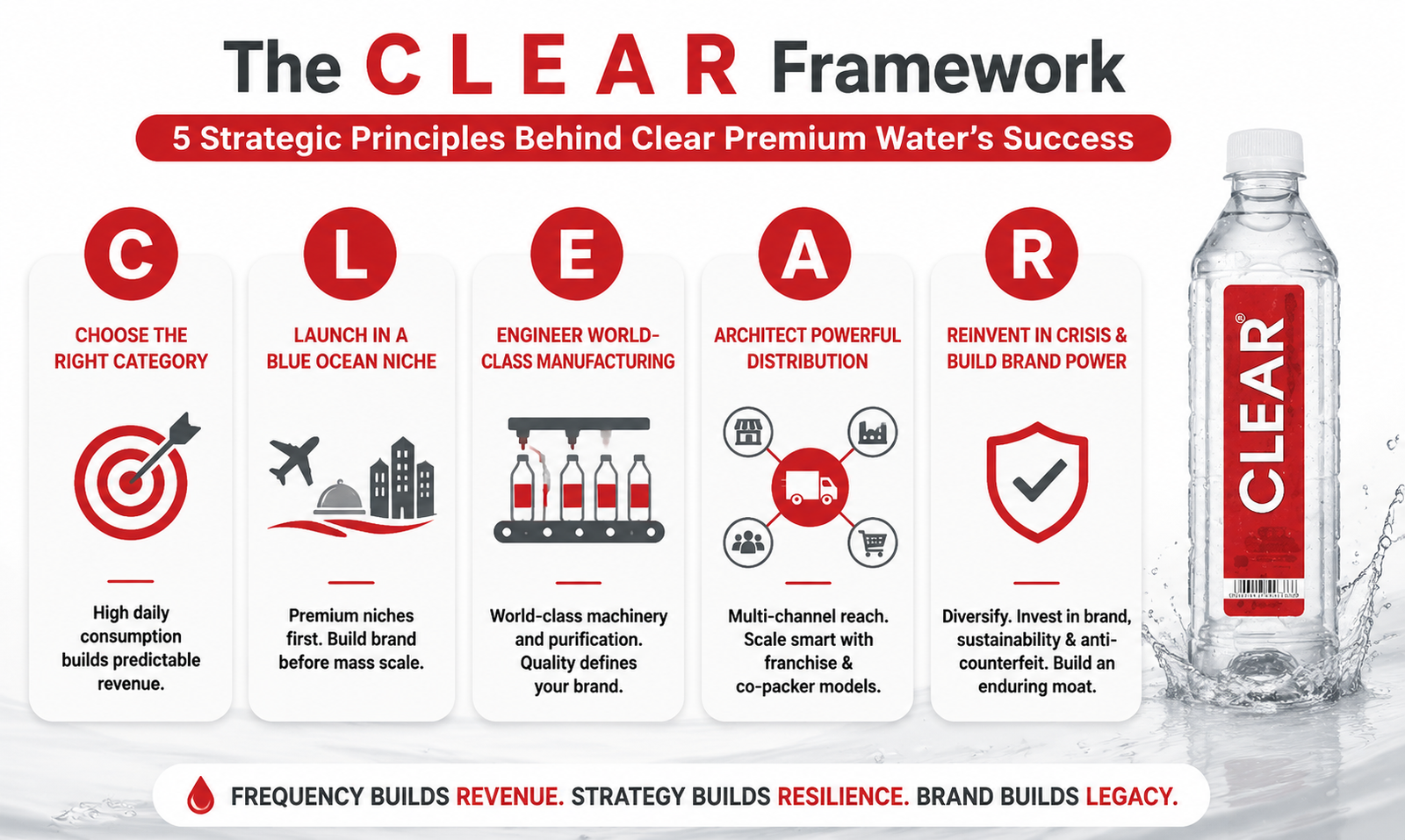
The C.L.E.A.R. Success Framework — Your Beverage Business Blueprint
Across all six phases of Clear Premium Water’s evolution, five strategic principles emerge consistently. These principles are universally applicable to anyone building a mineral water, juice, soft drink plant, alkaline water, or any packaged beverage business.
| C | Choose the Right Category — Select a product with high daily consumption frequency. Water and essential beverages create compounding, predictable revenue. Margin alone does not build a sustainable business; frequency does. |
| L | Launch in a Blue Ocean Niche — Do not enter the most crowded segment first. HoReCa, airports, corporate offices, and institutions offer premium pricing and brand-building opportunities that retail cannot match at the launch stage. |
| E | Engineer World-Class Manufacturing — The quality of your machinery is the quality of your brand. Fully automatic lines, 11-stage purification, comprehensive certification, and high-speed production capacity are not luxuries. They are competitive necessities. |
| A | Architect Powerful Distribution — Build distribution as a strategic asset from day one. Franchise and co-packer models enable geographic expansion without proportional capital expenditure. Multi-channel presence is non-negotiable for long-term resilience. |
| R | Reinvent in Crisis and Build Brand Power — Single-channel dependency will eventually create existential risk. When disruption arrives — and it will — a diversified distribution base is what determines survival. Brand investment, sustainability credentials, and anti-counterfeit infrastructure compound over time into an enduring competitive moat. |
OUR OTHER PRODUCT
Conclusion: DTPPL’s Impact on Clear Premium Water’s Growth
Clear Premium Water’s journey from producing just 800 bottles in 2010 to a capacity of 60 lakh bottles per day by 2024 — generating ₹354 crore in annual revenue and achieving a valuation of ₹450 crore — was powered by Dharmanandan Techno Projects Pvt. Ltd. (DTPPL). Renowned for manufacturing mineral water plant, juice production plants, and soft drink plants, DTPPL provided the advanced manufacturing infrastructure that enabled Clear to scale efficiently while maintaining premium quality.
DTPPL’s world-class, fully automated bottling lines, including blow-fill-cap-label systems, multi-stage purification, and high-speed capping, ensured consistent quality, regulatory compliance, and operational efficiency. These solutions allowed Clear Premium Water to meet the stringent standards of HoReCa clients, airlines, and institutional buyers while expanding its distribution network nationwide.
By leveraging DTPPL’s turnkey beverage manufacturing solutions, Clear Premium Water could focus on brand building, strategic market entry, and multi-channel expansion with confidence. The case demonstrates that with DTPPL’s expertise in mineral water, juice, and soft drink plants, entrepreneurs can replicate this success — scaling production, ensuring quality, and establishing a resilient, nationally recognized beverage brand.
Frequently Asked Questions
For entrepreneurs planning to enter or scale in the mineral water or packaged beverage industry, the following questions address the most common practical concerns.
What is the minimum investment required to set up a mineral water plant, and when can I expect returns?
A mid-sized automatic mineral water plant typically requires an investment of ₹8–10 crore. Returns are generally achieved within 25–30 months, with strong long-term profitability. Smaller investments are possible through franchise or co-packer models.
Do I need prior experience in the beverage industry to start a mineral water business?
No. Prior experience is not required. With proper training, quality control systems, and operational support, new entrepreneurs can successfully run a mineral water business.
Why should I target HoReCa clients first instead of going directly into retail?
HoReCa (Hotels, Restaurants, Catering, Airlines, and Corporates) is easier for new brands to enter than retail. It helps build credibility, premium positioning, and a strong customer base before expanding into retail markets.
What certifications are mandatory to sell packaged drinking water commercially in India?
The essential certifications are:
- BIS Certification (IS 14543 or IS 13428)
- FSSAI License
For premium and institutional clients, ISO 22000, ISO 9001, and HACCP certifications are highly recommended.
Can the Clear Premium Water model be replicated in markets outside India — such as Africa, Southeast Asia, or South America?
Yes. The model can be successfully replicated in emerging markets across Africa, Southeast Asia, and South America, where demand for safe, premium packaged drinking water is growing rapidly.
Our associates





































Director – Global Marketing and Sales
Mr. Bhavesh from Dharmanandan Techno Projects Pvt. Ltd. has played a pivotal role in elevating the DTPPL brand to the global stage, leveraging his exceptional expertise in marketing and communications. He is committed to helping clients achieve significant growth while strengthening their own brands. Dharmanandan Techno Projects Pvt. Ltd. is a leading manufacturer and supplier of water purification systems and turnkey solutions for mineral water plants. With years of experience in designing and delivering high-quality water treatment solutions, the company provides end-to-end services, including system design, installation, maintenance, and ongoing support. Specializing in scalable and customizable water plants, DTPPL has successfully served industries worldwide, ensuring clean and safe drinking water across diverse applications.